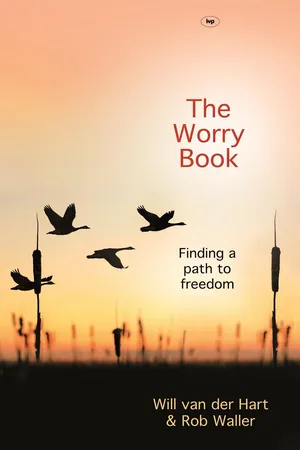
'A very thoughtful, balanced and practical approach.' - J.John, EvangelistWorry has reached epidemic proportions. Many are suffering in silence, unsure if psychological solutions are appropriate for them, or if biblical teaching can lead them to freedom.The Worry Book offers a fresh solution: seeing the process of worry as the problem, rather than getting stuck into individual concerns. We can often use worry to create a sense of certainty and control, but the illusion is temporary, and we generate even more problems in the process. Here we learn about the factors behind worry, and how to disable the cycle of worry and tolerate uncertainty - principles we can apply to every situation.This is a journeyman's guide through the comedy and heartache of discovering worry's function, and so removing its power. Good theology and psychology combine here to offer new perspectives and real hope. You will find real lives and real people, and solutions which are both practical and doable.
- English
- ePUB (mobile friendly)
- Available on iOS & Android
eBook - ePub
About this book
Information

1. Why we worry
I am an old man and have known a great many troubles,
but most of them never happened.Mark Twain
When I (Rob) get up in the morning, I tend to do things that I think will be useful. I have breakfast to give me energy. I brush my teeth to keep them healthy. I put on clothes because others will appreciate this! My point is that we tend to do things that we believe will have value. So, in the light of this, why do we spend so much time worrying?
If you ask most worriers, they will tell you that churning away at things doesn’t help, but I think that they think it does – at least at a deeper level. There must be something about worry which we think assists us, which means we do actually value it (like our old pair of comfortable jeans) and believe it is useful to us. And so we are reluctant to discard it.
In this chapter, we present worry as a process (or thinking style) with clear patterns and goals. Worry doesn’t just happen – we learn to do it over time, and it tends to operate the same way in different people. It is this that gives us hope, because if we can understand the processes and patterns, then that is the first step to overcoming worry.
Where worry starts
Worriers can typically trace their worrying back to childhood, and even to their parents or other family members who worried before them, so there is a genetic contribution to worry that is important to understand.
Psychologists talk about hard-wired aspects of our personality, such as whether we are more introvert or more extrovert. These aspects are neutral and not illnesses or problems. It is fine to be either an introvert or an extrovert – or even a mixture of both. All parts of the spectrum come with strengths and weaknesses that are well within the normal range, and are fully compatible with living a fulfilled life.
One aspect of personality that psychological testing has repeatedly shown to be part of the normal spectrum is ‘neuroticism’: a tendency to think on things and to be cautious. This has obvious advantages in life: for example, you are less likely to be the first one into a fight! But there is also a downside, in that you may be more reticent about going for a new opportunity. On balance, however, it is seen as a valuable aspect of human personality. Evolutionary biologists would say that neuroticism is genetically ‘successful’, that it has been helpful enough to have been selected over many generations. People who score highly on neuroticism scales are compassionate, careful and make good friends. For interest, the other stable aspects of personality are: extraversion, openness to experience, agreeableness and conscientiousness.
Neuroticism is the part of personality that is least talked about. One common personality questionnaire, the Myers Briggs Inventory,1 doesn’t even mention it. Instead, it focuses on the other four dimensions above. So why doesn’t it measure neuroticism? One explanation is that Myers Briggs was in part developed for business use, and businesses generally don’t see the advantages in neuroticism, but love extrovert, open, agreeable and conscientious workers! The result is that, in our culture, people who tend towards neuroticism are already made to feel they are abnormal – even when they are very strong in some respects and well within the normal human range.
Jonathan was someone who thought deeply about things. He liked to see things well and truly proven before doing them. He would often be the last person to adopt a certain fashion or fad, preferring to stick with ‘classic’ styles and tried-and-tested ideas. Other people who were always off on to the next thing frustrated him, as he thought there were more important things than the latest iPhone. However, the time he saved in not chasing culture was spent with people – often people who couldn’t afford the fashions anyway. They felt comfortable with him. He sensed he was talking deeply with them. His deep thinking meant that he remembered their birthdays and what they had said the last time they had met. They felt understood, but he worried that he worried.
It’s true that people who come with this genetic background are more likely to develop problematic worry. But this is only part of the story. Many people with this personality aspect do not worry, and the personality itself is not an illness – it is normal. So it is possible to get back from problematic worrying to ‘just’ being healthily slightly neurotic! However, given the link between neuroticism and unhelpful worry, if you do have a tendency to think deeply and cautiously, you may start to respond too deeply and too cautiously over time, whereas a less neurotic personality might brush things off more easily or not even give them a thought. A good example of this is if you experience a near miss, such as nearly going into debt, or nearly losing a parent to cancer, and you begin to think too deeply. This can lead to you making extra plans and taking extra precautions in the future to try to make sure this never happens again. Oh, and then do a lot of worrying about whether these plans and precautions are enough, or not...or maybe they are...but then again...
Families can also contribute to this excessive thinking. They may live by sayings and mantras such as, ‘It’s better to be safe than sorry’ or ‘Well, you never know.’ There is truth in these, to be sure, but there is also the potential to take them to extremes. There are also families where no-one seems to worry, so a child feels he or she has to, or where a future divorce is so likely that there is no stable ground to rest upon.
The reason for worry
Worry is a normal human emotion, and there are times when it is perfectly right to worry – in fact it would be odd not to.
Jackie is a mother whose son has joined the army and been posted to a war zone. She knows she can’t not care – this is impossible, not to mention immoral, for a mother. But neither does she feel she can allow herself to consider the possible ultimate consequences. If she were, for example, to contemplate her son being blown up, it would probably destroy her, and, at the very least, she would probably have a panic attack. So she ends up having a good old worry instead. If she is honest, her worry has become a comfort blanket. Other similar mums can share this with her. It is her ‘friend’ at the moment.
Jackie is not the only example we could give. Will and his wife Louie nearly lost their second child Joseph Douglas during the writing of this book. For seven consecutive weeks, their child was treated in hospital with a serious breathing problem and a complex MRSA infection. Will describes himself at this period as having been ‘the most genuinely and justifiably worried’ he has ever been in his life. Interestingly, he says this ‘felt’ very different from the sort of worry he normally experienced (and you will hear more about these two types of worry later in the book). Will described the sort of ‘justifiable’ worry he experienced as similar to the anguish of the Prodigal Son’s father who watched every night for his son’s safe return (Luke 15:20).
Worry also has a protective function, ensuring that we prepare for possible threats when in dangerous places, or make suitable arrangements for retirement or times of ill health. Worry might not be the right word to use here, but there is definitely a process of thinking going on that is driven by a fear of something bad happening. And frankly, if we didn’t worry, we’d be dead.
However, this level of normal worry (acute concern might be a better way of putting it) can easily turn into something else. This begins to have a more unhelpful function, and we get stuck in cycles of worry. Someone once said that worry is like a rocking chair – it doesn’t get you anywhere, but at least it gives you something to do. And this is the main function that worry has. It gives you something to do, instead of something else to do that seems impossible or unpalatable.
But what is a normal amount of worry, and when does worry become unhelpful or unproductive? This is very hard to say, and more could be considered allowable in some situations – such as in the case of the mother above. But worry is more common than you think. We set ourselves an impossible and unnecessarily high standard if we think we will get to a level of never worrying. Research studies have found that 40% of university students worry at least once a day, but people with GAD worry about 60% of the day, so there does seem to be a spectrum ranging from what is ‘normal’ to what will result in illness.
The pain of worry
The Dutch writer Corrie Ten Boom is reported to have said, ‘Worry does not rid tomorrow of its sorrows, but it does rob today of its joy.’ People tend to struggle on through with worry, never really relaxing and never really panicking, and this prevents them from enjoying the day-to-day joys of life. They live in the future and never delight in the moment, which is a gift of God, a ‘present’ to us in both senses of the word. They also tend to keep their worries to themselves, believing that other people would not want to help them or be bothered.
Because they enjoy and share things less, there is a tendency over time to do both these things less and to slip into isolation and inactivity. Add to the mix that worriers also give themselves a hard time for worrying, and this makes depression much more likely. Many cases of depression start as an anxiety problem of some kind, and then the mood lowers as negative thoughts and behaviours begin to bite.
Worry also tends to get worse and ‘generalize’ to other areas. Because many worries are about questions to which there is no easy or possible answer (more of this later), they tend to lead to more and more questions in an attempt to get to the bottom of the problem – except that no bottom exists. This is when worry really starts to turn into GAD and take up increasing amounts of time and energy.
The process of worry
All worriers know that, as soon as one worry is sorted out, then another will come along and take its place. It’s a bit like cutting the head off a weed – the roots mean that another quickly grows to take its place. So we need to move beyond seeing each worry as an individual problem, and focus instead on the general style of thinking that comes with worry.
To get the worry weed out by the root, we need to understand what is common to all worries. Think of it as being a bit like driving in a traffic jam2 where, if you focus on the car that happens to be in front, you will make no progress, but if you focus on the general flow of traffic, you stand more of a chance. Take this illustration further and now imagine it is your job to make all the traffic in a city flow as smoothly as possible: you really do need to get the big picture. To manage a city’s traffic, we have to focus on the core issues that affect traffic: different types of vehicle, drivers’ strongly held beliefs, rush hours, planned and unplanned roadworks and so on. There are many parallels we can take from this analogy to help us with worry:
- There are different worry themes which, like different vehicles, behave in different ways. Understanding what your worry themes are, and why you have them (and not others), can be the first step in understanding and then not worrying.
- Worry uses tricks, like a stressed driver using a rat-run to avoid a traffic jam. But rat-runs in rush hours rarely work, as everyone else uses them too. If we can learn the unhelpful adaptations we have made in response to worry, the tricks we think work, and then change them, this can help us drive through life more smoothly and probably more quickly as well.
- Worriers have beliefs, such as, ‘Worrying helped me once and can help me again’ or ‘If I worry about my family, it shows I care.’ These beliefs are based on truth to some degree, but are likely to have moved beyond being useful to now supporting and maintaining our worry. Gently breaking these rules can free things up a lot, as we realize our ‘beliefs’ are not always true.
There is a future
Matthew worries about lots of things, but his main worry is about whether or not he will perform well at work. He wants to get things ‘just right’, so that he will be good at his job and please his parents who worked so hard to put him through school. He feels he owes them something, so he spends some time at the start of each day thinking things through. However, what started as a few minutes of problem-spotting has turned into about an hour of making lists, and lists about lists. Whenever he spots a problem and starts to think about it, he spots even more related things that might go wrong.Over time, and by using techniques like those in this book, he is able to sit back and see that, although he worries about many individual things, in general he worries about making mistakes and so letting his parents down. He also realizes that things go better when he looks at the flow of his thoughts. He makes decisions about things that need a decision, agrees to limit his lists about things that have no answer and challenges his over-positive beliefs about the benefits of worrying. Slowly, he develops a tolerance of the uncertainty this brings, as he learns that this is a normal condition and he is not making that big mistake he feared.He also learns that, as he spends less time worrying, he can spend more time enjoying his faith, and so he grows closer to God. He finds that he can please his parents and God without needing to be trapped by having to please them, as they all love him anyway. He still worries – sometimes more than usual – but it doesn’t take up an hour at the start of his day, and he can go with the flow a bit more as the intensity is less. Not worrying didn’t mean things getting out of control; it meant them coming back under appropriate control.
If you have worried for many years, it can seem as though things will never change. However, we have a number of reasons to be hopeful. This book is based on the techniques of cognitive-behavioural therapy, the approach for severe worry recommended by the NHS. Also, we have changed (more about that later), and if we can change, then anyone can! Even more importantly, we have an amazing God who loves us and loves to help us. And finally, we believe in the healing power of prayer and the community of the local church, and would encourage you all to get as much of both of these as possible.
The old adage of learning the difference between what we need, what we want and what we worry about what we need is relevant here. God knows what we need! Telling the difference is something we will teach you later in this book. For now, we just encourage you to be hopeful, to read on and enjoy.
It’s also been our experience that addressing our worry doesn’t just make us people who worry less – it can actually make us more mature people, better appraisers of situations and more compassionate friends. Perhaps even in our worry and our dealing with it, God is working for good.
To wrap up...
We have looked at the origins of worry in our personalities and childhoods, and how worry has important and useful functions, but when severe, it can cause us great pain. We have looked beyond the individual concerns to see the thinking process behind worry as the problem, and reminded ourselves that this really can change.
Exercises
To make a change, you first need to know your starting point. These questions will help you clarify why you are reading this book and what you hope to achieve. We will come back to your three answers to the last question at the end of the book. Find a notebook and write down your answers to these questions so you have a record of them.
I am reading this book because:
The two main questions I have about worry are:
I understand worry:
AGREE – PARTLY AGREE – NOT SURE – PARTLY DISAGREE – DISAGREE
I can see a way of getting better:
AGREE – PARTLY AGREE – NOT SURE – PARTLY DISAGREE – DISAGREE
I feel trapped by my worry:
AGREE – PARTLY AGREE – NOT SURE – PARTLY DISAGRE...
Table of contents
- The Worry Book
- Contents
- Acknowledgments
- Foreword
- Preface
- Introduction
- 1. Why we worry
- 2. Understanding my worry
- 3. What happens when we worry
- 4. Worry fuel: What keeps my worries alive
- 5. My faith and my worry
- 6. Tolerating uncertainty
- 7. Taking action
- 8. Worry and hope
- Appendix 1: Going deeper
- Appendix 2: Prayers and contemplations for times of anxiety
- Appendix 3: Other resources
- Glossary
- Notes
Trusted by 375,005 students
Access to over 1.5 million titles for a fair monthly price.
Study more efficiently using our study tools.
Frequently asked questions
Yes, you can cancel anytime from the Subscription tab in your account settings on the Perlego website. Your subscription will stay active until the end of your current billing period. Learn how to cancel your subscription
No, books cannot be downloaded as external files, such as PDFs, for use outside of Perlego. However, you can download books within the Perlego app for offline reading on mobile or tablet. Learn how to download books offline
Perlego offers two plans: Essential and Complete
- Essential is ideal for learners and professionals who enjoy exploring a wide range of subjects. Access the Essential Library with 800,000+ trusted titles and best-sellers across business, personal growth, and the humanities. Includes unlimited reading time and Standard Read Aloud voice.
- Complete: Perfect for advanced learners and researchers needing full, unrestricted access. Unlock 1.5M+ books across hundreds of subjects, including academic and specialized titles. The Complete Plan also includes advanced features like Premium Read Aloud and Research Assistant.
We are an online textbook subscription service, where you can get access to an entire online library for less than the price of a single book per month. With over 1.5 million books across 990+ topics, we’ve got you covered! Learn about our mission
Look out for the read-aloud symbol on your next book to see if you can listen to it. The read-aloud tool reads text aloud for you, highlighting the text as it is being read. You can pause it, speed it up and slow it down. Learn more about Read Aloud
Yes! You can use the Perlego app on both iOS and Android devices to read anytime, anywhere — even offline. Perfect for commutes or when you’re on the go.
Please note we cannot support devices running on iOS 13 and Android 7 or earlier. Learn more about using the app
Please note we cannot support devices running on iOS 13 and Android 7 or earlier. Learn more about using the app
Yes, you can access The Worry Book by Will van der Hart in PDF and/or ePUB format, as well as other popular books in Psychology & Mental Health in Psychology. We have over 1.5 million books available in our catalogue for you to explore.