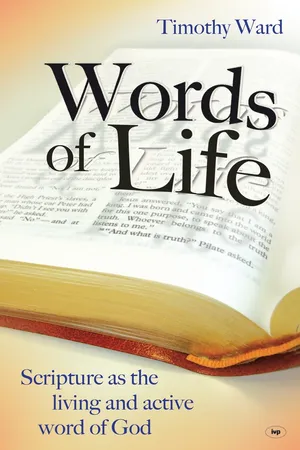
Throughout Christian history, the overwhelmingly predominant view of the Bible has been that it is itself the living and active word of God.
Timothy Ward explains and defends what we are really saying when we trust and proclaim, as we must, that the Bible is God's word. In particular, he describes the nature of the relationship between the living God and Scripture. He examines why, in order to worship God faithfully, we need to pay close attention to the Bible; why, in order to be faithful disciples of Jesus - the Word-made-flesh - we need to base our lives on the words of the Bible; and why, in order to keep in step with the Holy Spirit, we need to trust and obey what the Bible says.
Ward offers an understanding of the nature of Scripture under three main headings. A biblical outline shows that the words of the Bible form a significant part of God's action in the world. A theological outline focuses on the relationship of Scripture with each of the persons of the Trinity. A doctrinal outline examines the 'attributes' of Scripture. A final chapter explores some significant areas in which the doctrine of Scripture should be applied.
Grounded in the relevant scholarship, this excellent, lucid exposition of the nature and function of Scripture stands firmly in line with the best of the theological traditions and is expressed in a form appropriate for the twenty-first century.
- English
- ePUB (mobile friendly)
- Available on iOS & Android
eBook - ePub
About this book
Information
Topic
Theology & ReligionSubtopic
Christianity1. INTRODUCTION: GOD AND THE BIBLE
In my own Anglican denomination it has long been customary, at the end of the public reading of Scripture, for the reader to say, ‘This is the Word of the Lord.’ Throughout Christian history, the overwhelmingly predominant view of the Bible has been that it is itself the living and active Word of God. To say that the Bible is the Word of God is to say, putting it another way, that ‘what the Bible says, God says’. In this book I shall refer to this view of the Bible in different ways: as the evangelical view of Scripture, or as the view held by the Protestant Reformers of the sixteenth century, or sometimes as the orthodox view. When I talk in these ways, however, those different labels ought not to obscure the fact that the conviction most commonly held about the Bible by Christians has been, and is, that it is the Word of God.
However, this is not always an easy view of the Bible to defend in the face of critics, or to understand properly for oneself. I once saw a pencil-drawn cartoon that depicted a man, alone in a bare room, sitting on an uncomfortable-looking chair. Open on his lap was a ridiculously oversized book, and the book’s title was visible, written on the spine: ‘Brief Notes on Leviticus’. He was studying the book intently, and was frankly looking pretty serious and dour. The caption underneath read, ‘Chris the Calvinist just lived for pleasure’.
I know this is only a cartoon (and am ignoring the cheap shot it makes about Calvinists, among whom I would want to identify myself!). Yet it does put its finger on a worry about the Bible that lies not far below the surface for many Christians. Indeed for some people this is a worry that long ago broke through the surface, and that they have had to face explicitly. It is at heart the worry that, if we insist the Bible is itself God’s Word, we might pay so much attention to Scripture that we fail to pay all the attention we should to Christ. And that would be a very serious mistake to make, tantamount to the sin of idolatry (or, as it is sometimes called in this case, ‘bibliolatry’: worship of the book). We often like to think our concerns and questions are brand new ones, but of course that is rarely the case. This worry about the Bible and Christ has been thought through for centuries, as we shall come to see.
The same basic question can be asked in many different ways: Does the fullness of life which Christ came to bring really have to involve paying such close attention to the Bible? Does our new life in the Spirit really need to be centred around what seem to be comprehension exercises on biblical texts? Has a high view of Scripture led some of us to turn our weekly gatherings for worship into little more than preaching rallies, where we sit passively, when in fact our meetings should be joyful, collaborative and encouraging? Surely Christ came to call us to be disciples, not bookworms? Indeed did Jesus not reserve some of his harshest criticisms for groups such as the Pharisees and teachers of the law, taking them to task for being obsessed with rightly interpreting tiny details of Scripture, while missing the great spiritual realities to which Scripture was pointing them? Is the evangelical view of Scripture in the end therefore fundamentally Pharisaic, and not really fully Christian?
The biblical scholar John Barton, who wishes to build on these worries in order to encourage people away from the evangelical view of Scripture, has put it this way:
it is not primarily the Bible that is the Word of God, but Jesus Christ. I do not think one could find a single Christian who would dissent from this proposition, for to do so would plainly be to commit what is sometimes called bibliolatry: the elevation of the Bible above Christ himself....Christians are not those who believe in the Bible, but those who believe in Christ.1
It is easy to find Christians who say they have abandoned the evangelical doctrine of Scripture because they have found this kind of argument persuasive. (In some places, such people have terms like ‘open evangelical’ and ‘post-conservative’ to describe themselves.) Indeed it can seem impossible, at first, to disagree with this quotation from Barton. Christians certainly are in relationship with a saviour, not with a paper-and-ink book. Our devotion should be towards a living Lord, not to words printed on a page. Of course many Christians, looking again at Barton’s words, would soon realize that in the last sentence he is forcing a false dichotomy on us. We do not have to choose between ‘believing in the Bible’ and ‘believing in Christ’. As Christians we are called on to do both. In fact one crucial means by which we demonstrate our faith in Christ is by also believing what the Bible says. Perhaps the most straightforward argument for this begins by observing the fact that Jesus himself treated the Jewish Scriptures, our Old Testament, as themselves words from God, and so if we are going to be devoted to him then we must make sure our view of the Scriptures is the same as his.2
This gets us to the heart of what I am attempting to do in this book: I want to articulate, explain and defend what we are really saying when we proclaim, as we must, that the Bible is God’s Word. In particular, this is how I want to go about this: I am attempting to describe the nature of the relationship between God and Scripture. Why is it the case that, in order to worship God faithfully, we need to pay close attention to the Bible? Why is it the case that, in order to be a faithful disciple of the Word-made-flesh, I need to base my life on the words of Scripture? Why is it the case that, in order to walk in step with the Spirit, I need to trust and obey what Scripture says? And how can we do all of this without beginning to worship a book instead of the Lord? What I am offering here, then, is an outline of what is usually called the doctrine of Scripture.
The outline has three main components, each building on what comes previously. The first is a biblical outline. We shall look within the Bible itself, in order to discern the Bible’s own description of the relationship between, on the one hand, God and Christ, and, on the other hand, the words by which they speak and act. To give a very brief summary in advance: we shall find that the words of the Bible are a significant aspect of God’s action in the world. The relationship between God and the Bible is at heart to do with the actions God uses the Bible to perform. (The word of God is, after all, living and active, according to Heb. 4:12.)
It is important that we start in this way with a biblical outline, for too often writing on the doctrine of Scripture, whether supportive or critical of the evangelical view of Scripture, has started elsewhere than with the biblical shape of God’s acts of speech. This shape is that of the history of God’s revelatory and redemptive activity in the world. It is focused initially on his covenant people in Israel, and then comes to a climax in the birth, death, resurrection and ascension of his Son, the Word made flesh, before spreading out to the whole world through the outpouring of the Holy Spirit and the proclamation of the gospel. Claims that ‘the Bible is the Word of God’ must be explicitly related to God’s speech and actions in this history.
Writing on Scripture that does not take account of this usually runs into trouble of one kind or another. Examples of this can be found in consciously evangelical writing that wants primarily to defend one or another historic formulation of the doctrine of Scripture, without seriously reflecting on the areas where that formulation might need reconsidering in the light of Scripture. However, a hallmark of Protestant theology ought always to be its adherence to the Reformation maxim ecclesia semper reformanda (the church is always in need of reforming). Other writers have approached Scripture from a theological or doctrinal starting point. Such works can give real insights, but lack the explicit biblical moorings each aspect of the doctrine of Scripture requires in order to demonstrate that it is not just coherent within systematic theology, but also that it is in genuine conformity with the content of the very book it intends to describe, and with the actions of the God revealed in that book.3 Still other writers have begun their work on Scripture with categories drawn from outside Scripture and theology, usually with the apologetic aim of updating the doctrine of Scripture in order to make it more comprehensible (and, in some cases, apparently more credible) to a new generation in a new culture.4 The explicitly biblical foundation I shall lay aims to avoid some of these problems.
Following this biblical outline, I shall begin to draw the threads together into a theological outline of Scripture in its relationship with God, focusing on Scripture’s role in relationship with each of the persons of the Trinity. In the construction of any aspect of Christian doctrine it is appropriate to move in this way from an analysis of the biblical material to a theological exposition of that material. However, it is especially important to make these theological steps explicit here, because of the history of the evangelical doctrine of Scripture in recent centuries, and because of criticisms regularly made of it.
Much evangelical writing on Scripture from the last four centuries has been taken to task for allegedly not being as truly theological as it should have been. That is, it is said that the doctrine of Scripture has not been integrally related to the primary Christian doctrines: the doctrines of God, Christ, the Spirit, creation and salvation. Indeed it is certainly the case that in the period following the Protestant Reformation in the sixteenth century a significant shift took place in the form in which evangelical theology was constructed. The sixteenth-century Reformers mostly did not devote an entire separate section to Scripture itself in their theological writings. Thus John Calvin’s Institutes of the Christian Religion (1559) does not contain a section explicitly on Scripture. Instead he deals with Scripture within a more general opening section entitled ‘The Knowledge of God the Creator’. By contrast, theologians of the following seventeenth century more usually opened their systematic theologies with an introductory discussion of the nature of theology itself (usually termed the ‘prolegomena’), followed immediately by a section devoted entirely to the doctrine of Scripture. Only after this came discussions of God, creation, Christ and salvation. Modern works of evangelical systematic theology often follow this same pattern.
It is often said that this represents a major theological shift, and a mistaken one, in orthodox Protestant theology after the Reformation. The claim being made is that from the seventeenth century a doctrine of Scripture was developed as central to theology expressed in mostly philosophical and speculative terms, in isolation from the Bible’s teaching about God and Christ. Thus the theology of the generations who came after the Reformers often stands accused of talking about the Bible without always being conscious, or at least making explicit, that we ought not to theologize and theorize about Scripture without beginning squarely with the Bible’s teaching about God’s character and actions. However, this interpretation of theology in the seventeenth and eighteenth centuries has been subjected to searching and persuasive criticism. What was happening was that theologians were changing the format in which they wrote their theology, but without substantially moving away from the basic theological views of the Bible that Luther, Calvin and others had articulated.5
Nevertheless it is probably the case that, since the eighteenth century, this revised format in which evangelical systematic theology has been presented has had some unforeseen negative impact on popular evangelical thought. Many presentations of evangelical theology often begin by discussing Scripture, and discuss Scripture under doctrinal headings such as Scripture’s sufficiency, clarity and authority. It is certainly not the case that these headings are misleading; later in this book I shall defend them and explain them. The problem is, rather, that when the doctrine of Scripture is presented primarily in this form it can at least appear as if Scripture is unrelated to the great central doctrines of the Christian faith. At the very least, much contemporary evangelical teaching and writing on Scripture has not gone out of its way to demonstrate in its very content and form that such accusations are mistaken. The result can be that believers are left at least slightly unclear on just why the Bible ought to be so central to faith, and especially on how it can be kept central without itself attracting attention away from Christ, thereby becoming an idolatrous focus of worship.
Indeed if we talk about the Bible without explicitly structuring what we say about it around the great doctrines of God, Christ and the Spirit, then two unfortunate things happen. First, the doctrine of Scripture can begin to look like a preface or appendix to the central doctrines of the Christian faith, as these have been expressed in the church’s great creeds. As such it can seem easily dispensable. (Most books, after all, lose very little of substance if stripped of their preface and appendices.) The doctrine of Scripture is certainly not dispensable, but evangelicals can sometimes, quite contrary to their intentions, make it appear so. This is an especially attractive option to anyone who has personal and painful experience of controversy between evangelicals over the nature of Scripture, and who has consequently come to think that focusing in doctrinal detail on Scripture usually results in a destructive fall away from Christ. It is also attractive to those Christians who wish to remain largely orthodox in their understanding of God, but who disagree with the orthodox doctrine of Scripture.
A second unfortunate consequence of a doctrine of Scripture developed apparently in isolation from other central Christian teachings, and from the shape of the narrative structure of Scripture as a whole, is that it can turn out to be a doctrine that seems impoverished and thin, lacking deep roots in the rich glories of the character and actions of God himself. This can be the case even if the doctrine, considered detail by detail, is unimpeachably orthodox and biblical. Such a doctrine can feel, even to some of those who at heart want to uphold it, more like an interesting and necessary tangent in theology than part of the heartbeat of theology itself. It comes to look like a kind of theological throat-clearing, prior to the main business of actually talking about God, as if in articulating the doctrine of Scripture we were really saying little more than this: ‘Let’s establish the basis on which we talk about God...and that’s where the Bible comes in. Now that this is clear, we can get on with the business of actually talking about God.’
There may be times in Christian history when it is right to begin one’s theology with the doctrine of Scripture, because the prevailing culture makes it important apologetically to address questions of how God can be known right at the outset. However, the doctrine of Scripture itself is often distorted through this approach, and therefore the kind of doctrine of Scripture this book will outline is one that aims to demonstrate that its every aspect is shaped from the bottom up by the character and actions of God, and is integrally related to God’s being and action, yet without the inert book coming to eclipse the living Saviour.
After these biblical and theological outlines comes, thirdly, a doctrinal outline of Scripture. It is in this chapter that I discuss Scripture under the headings with which evangelicals are usually most familiar, namely Scripture’s necessity, sufficiency, clarity and authority. These doctrinal headings certainly do flow naturally and necessarily out of the biblical and theological outlines of Scripture, and I shall be concerned to demonstrate carefully that that is the case. They are often termed the ‘attributes’ of Scripture, and the doctrinal outline will try to show that they are not a list of abstract qualities assigned to Scripture for questionable philosophical reasons. Instead they emerge as appropriate and necessary descriptions of Scripture, in the light of its dynamic and integral function within God’s actions in the history of redemption. I shall offer a definition of each attribute, shaped by the preceding biblical and theological material.
The final major chapter seeks to open up some significant areas where the doctrine of Scripture, as I have outlined it, should be applied. We shall look first at that great slogan from the Reformation, sola scriptura (Scripture alone), and then more specifically at some basic questions about the place of Scripture within the Christian community. Then come two final sections: one on the nature of preaching, in the light of the nature and function of Scripture I am describing, and one on the appropriate role and aims of the private reading of Scripture by Christians. In these sections I want to demonstrate how a proper doctrine of Scripture can and should make the way a Christian approaches Scripture day by day more faithful, dynamic and life-giving.
To help the reader keep pace with the doctrine of Scripture which will build up as the book progresses, regular summary paragraphs have been included, often at the end of each major section.
It will be helpful to note here at the outset the theological writings on which I have drawn most heavily. As the book progresses, readers will find the names of certain theologians appearing more often than others in the text and footnotes. These are the four primary ones:
- John Calvin, the great systematizer of Reformation theology in the sixteenth century.
- Francis Turretin of Geneva, an influential and leading figure of Reformed theology from the middle of the seventeenth century.
- B. B. Warfield, the American theologian of the late nineteenth and early twentieth centuries, whose writings on Scripture have set the agenda for many debates on Scripture in the last century, especially in the United States.
- Herman Bavinck, Warfield’s brilliant contemporary in Holland.
It is not that all four agree with each other on every detail; nor are they to be slavishly followed at every point, since like us they were fallible people. Nor am I suggesting that nothing worthwhile has been written on Scripture since the 1950s; the writings of J. I. Packer, for example, have helped many people understand and remain committed to the evangelical doctrine of Scripture in recent decades. Nevertheless in the works of these four older theologians we are given some of the great high points in Christian history of the explanation and defence of the evangelical doctrine of Scripture. We are therefore impoverished in coming to grips with Scripture in our own day, and dealing with contemporary challenges to Scripture, if we are not rooted in the thought of people such as these.
Overall, then, this book intends to describe the nature and function of Scripture in explicitly biblical and theological terms, as well as doctrinal ones. I aim to offer an outline of the doctrine of Scripture that stands firmly in line with the best of the theological traditions that have come down to us, and that is also expressed in a form appropriate for the twenty-first century. If it turns out that this will help some readers to understand God’s actions in and through Scripture in a little more depth, and so worship the God of Scripture with greater assurance and joy, then my aims will have been fulfilled.
2. GOD AND SCRIPTURE: A BIBLICAL OUTLINE
The fundamental question to which we seek an answer in this chapter is: What, according to the Bible, is in fact going on when God speaks? We need to be clear on this, if what we eventually say about our understanding of the Bible as the ‘Word of God’ is going to be true and coherent. The focus will be on how God relates himself to words, both spoken and written. Therefore this chapter will sketch an outline of how central language is to who God and Christ are, and to what they do. If this way of putting it sounds a little abstract to some readers, the picture being pieced together here should become increasingly clear as the chapter progresses.
God’s action and his words
The Old Testament
It is often observed that God’s words and actions are intimately related in the Bible. To say of God that he spoke, and to say of God that he did something, is often one and the same thing. The examples that follow here have been drawn deliberately from different parts of the Bible. One of the most obvious examples is found in the biblical creation accounts. According to the Bible, God creates by speaking: ‘God said, “Let there be light,” and there was light’ (Gen. 1:3). It seems that here God expressing the wish that light exist, and the coming into existence of light, are two ways of describing the same event. In Genesis 1:6 he says, ‘let there be a vault between the waters’, and verse 7 adds, ‘so God made the vault’...
Table of contents
- Words of Life
- CONTENTS
- ACKNOWLEDGMENTS
- 1. INTRODUCTION: GOD AND THE BIBLE
- 2. GOD AND SCRIPTURE: A BIBLICAL OUTLINE
- 3. THE TRINITY AND SCRIPTURE: A THEOLOGICAL OUTLINE
- 4. THE ATTRIBUTES OF SCRIPTURE: A DOCTRINAL OUTLINE
- 5. THE BIBLE AND CHRISTIAN LIFE: THE DOCTRINE OF SCRIPTURE APPLIED
- 6. SUMMARY
- Footnotes
Trusted by 375,005 students
Access to over 1.5 million titles for a fair monthly price.
Study more efficiently using our study tools.
Frequently asked questions
Yes, you can cancel anytime from the Subscription tab in your account settings on the Perlego website. Your subscription will stay active until the end of your current billing period. Learn how to cancel your subscription
No, books cannot be downloaded as external files, such as PDFs, for use outside of Perlego. However, you can download books within the Perlego app for offline reading on mobile or tablet. Learn how to download books offline
Perlego offers two plans: Essential and Complete
- Essential is ideal for learners and professionals who enjoy exploring a wide range of subjects. Access the Essential Library with 800,000+ trusted titles and best-sellers across business, personal growth, and the humanities. Includes unlimited reading time and Standard Read Aloud voice.
- Complete: Perfect for advanced learners and researchers needing full, unrestricted access. Unlock 1.5M+ books across hundreds of subjects, including academic and specialized titles. The Complete Plan also includes advanced features like Premium Read Aloud and Research Assistant.
We are an online textbook subscription service, where you can get access to an entire online library for less than the price of a single book per month. With over 1.5 million books across 990+ topics, we’ve got you covered! Learn about our mission
Look out for the read-aloud symbol on your next book to see if you can listen to it. The read-aloud tool reads text aloud for you, highlighting the text as it is being read. You can pause it, speed it up and slow it down. Learn more about Read Aloud
Yes! You can use the Perlego app on both iOS and Android devices to read anytime, anywhere — even offline. Perfect for commutes or when you’re on the go.
Please note we cannot support devices running on iOS 13 and Android 7 or earlier. Learn more about using the app
Please note we cannot support devices running on iOS 13 and Android 7 or earlier. Learn more about using the app
Yes, you can access Words of Life by Timothy Ward in PDF and/or ePUB format, as well as other popular books in Theology & Religion & Christianity. We have over 1.5 million books available in our catalogue for you to explore.