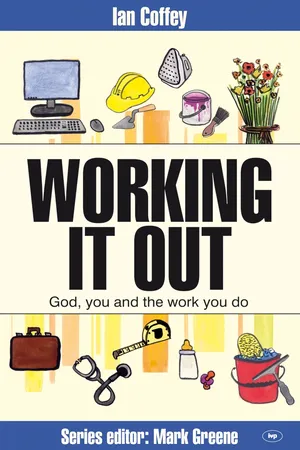
Can welding a gatepost bring glory to God? Does ironing your children's uniforms help you grow as a disciple? Will your new crime prevention strategy do anything to further the kingdom?
To all three Ian Coffey says a resounding 'yes'. With lively Bible teaching and drawing on a wealth of real-life stories, he shows how work was part of God's good plan for men and women - given to us so we can make a creative contribution in his world.
Whatever your work, God is interested in it, God can transform it, and God wants to use it - for his glory.
- English
- ePUB (mobile friendly)
- Available on iOS & Android
eBook - ePub
About this book
Information
Topic
Teologia e religioneSubtopic
Cristianesimo1. Curse or blessing?
In the Walt Disney classic film Snow White and the Seven Dwarfs, there is an instantly recognized and catchy little tune, ‘Hi ho, hi ho, it’s off to work we go’. The movie was made at the end of the Great Depression of the 1930s and is an interesting reflection of that period. It was a time when millions did not have paid work and lacked a sense of personal value. No matter how mundane your job, the fact of having one and being able to put bread on the table might well have made you want to whistle while you worked!
But things are different today. You may have seen the bumper sticker that parodies the seven dwarfs’ song: ‘I owe, I owe, it’s off to work we go’. For many, work is simply a means of paying the mortgage and the bills. There is no sense of fulfilment or purpose beyond the daily grind. Some find work simply a chore and, given the freedom to choose, would look for a more fulfilling job.
Which is closest to your view of the world of work: the original song, or the bumper sticker? Is it a privilege or a chore, a curse or a blessing?
Tony is a car mechanic and his wife, Jo, is a practice nurse in a GP’s surgery. They met as teenagers at their local church youth club, which Tony now helps to run. Some months ago at their home group, the subject of work came up in discussion. Rob, who leads the group, suggested some ways in which we can worship God through our work. Tony responded with a mixture of surprise and amusement. The last place you could worship God, in Tony’s opinion, was his garage!
Tony did acknowledge that God wants us to help people in the course of our daily lives, because that is all about loving our neighbour. But he felt work was nothing more than a way of getting through life and having enough cash to support the family. In Tony’s view, God didn’t create us to work. It was a direct result of human rebellion.
Is it correct that work is a consequence of what is known as ‘the fall’? If you ask those who are familiar with the Bible, ‘What does God think about work?’ they might point to the opening chapters of Genesis and God’s words of judgment against Adam:
Cursed is the ground because of you;
through painful toil you will eat of it
all the days of your life.It will produce thorns and thistles for you,
and you will eat the plants of the field.By the sweat of your brow
you will eat your fooduntil you return to the ground,
since from it you were taken;for dust you are
and to dust you will return.1
Sin had consequences and Adam and Eve lost much as a result. The banishment from the Garden of Eden (symbolizing the loss of immortality) is described in these words:
So the LORD God banished him from the Garden of Eden to work the ground from which he had been taken.2
Humankind fell into sin and missed God’s best. Fellowship with God was broken, relationships were impaired – paradise was lost. Pain in childbirth and hard physical work were added to the mix of the sorry mess of human rebellion.
Such a reading of Scripture suggests that work is indeed a curse and a direct result of living in a fallen world. But that is a faulty interpretation, which doesn’t take account of the whole of Genesis 1 – 3, nor indeed the rest of the Bible. It offers a wrong foundation on which to build an understanding of life.
If we read the whole of the Genesis story, we discover that work is a blessing from the hand of God. Even in a fallen world, work can become a window of grace.
To begin to understand this we need to look briefly at God’s character, God’s command and God’s call.
God’s character
Ask a group of friends, ‘What do you find really fulfilling?’ and you will probably get a rich mixture of replies. I have a friend who tells me that a day organizing her garden gives her an enormous buzz; another says it’s cooking a delicious meal for a houseful; one (who really needs to get out more) is never happier than when surrounded by spreadsheets and columns of figures. I have a son who thinks being covered in mud and bruises at the end of a bone-crunching game of rugby on a wet winter’s day is sheer heaven, and another who reckons that teaching a bunch of children to read is more fun than flying. But, for all our differences, most of us recognize that warm glow of fulfilment that exclaims, ‘I really like that!’
That feeling is an echo of the truth that human beings are made in God’s image. As the universe was shaped and fashioned, God delighted in his handiwork. The Big Bang had an author and its aftermath a sculptor as divine fingers shaped a universe of limitless wonders. Genesis records:
God saw all that he had made, and it was very good.3
We are offered the image of an artist working intensely on a canvas then standing back to take in the masterpiece with a feeling of immense satisfaction and achievement. God is by nature creative – he is a workman.
A family likeness
It is sometimes easy to spot people from the same family, not simply because they look alike, but because they carry something else that links them – a mannerism, a gesture, or a facial expression. The Genesis account teaches that we are made in the image of God, after his likeness:
Then God said, ‘Let us make human beings in our image, in our likeness, and let them rule over the fish of the sea and the birds of the air, over the livestock, over all the earth, and over all the creatures that move along the ground.’So God created human beings
in his own image,in the image of God
he created them;male and female
he created them.4
As well as sharing something of God’s likeness, we are called to rule and reign – and work – within the creation that he has made.
This is both a high and a holy calling that should humble and amaze us. As King David wrote in one of his prayer songs:
What are mere mortals that you are mindful of them,
human beings that you care for them?You made them a little lower than the heavenly beings
and crowned them with glory and honour.You made them rulers over the works of your hands;
you put everything under their feet.5
In all the ongoing debates about our world and its resources, the threats to the environment, the depletion of the ozone layer, the protection of species of animals, birds and fish, the exploration of space and oceans, and genetic research, the Bible sends a vital signal.
It is God’s world before it is our world. We are entrusted with the responsibility of being stewards of those things he has committed to our care. A steward is a guardian – someone looking after something that belongs to another. When we view the universe through that filter, everything takes on a different colour.
We hear much of human rights and that is an important matter, especially in those parts of the global community where people still live in fear under the rule of tyrants. But on the other side of the same coin lie what we could describe as human responsibilities. First and foremost they are to God, and secondly to our neighbour, as summed up in the two great commandments according to Jesus.6
We have a privileged position at the apex of God’s creation and it carries responsibilities. Emphasizing privilege at the expense of responsibility produces a lopsided view of life.
We can trace the God image in a number of ways and one of them is the capacity to create, work and find fulfilment in such things. Ulrich Zwingli (1484–1531) was a leader in the great Reformation of the church that swept across Europe in the sixteenth century and stood alongside men such as Martin Luther and John Calvin. Zwingli wrote:
There is nothing in the universe so like God as the worker.
He was acknowledging that when we see a man or a woman going about their work, we catch a glimpse of the character and the nature of the God who made them.
Or take an example from the award-winning film Chariots of Fire. It tells the story of Eric Liddell, a man who had a call from God to be a missionary and who also had an amazing athletic ability. His sister was really worried that he was missing God’s best, and so she challenged him that his love of athletics was eclipsing his devotion to Christ. Eric responded with a burning passion: ‘I believe God made me for a purpose – for China. But he also made me fast and when I run, I feel his pleasure.’
Are there particular tasks or activities in your life that make you feel good? Is it adding up a row of figures and making them balance? Is it making a cake? Is it caring for an elderly relative, or teaching a child to tie her shoelaces? Is it winning a contract? Is it seeing a class change over the course of two or three terms? Is it mowing a lawn, or making a chair, or repairing a car, or helping someone die with dignity? Thank God for helping you to spot the family likeness.
Take the story of Leonardo da Vinci, who had almost completed a painting on which he had been working for months. He was surrounded by a group of students watching the master craftsman at his work. As he reached the final touches, he handed a brush to one of his students and said, ‘Finish it.’
The astonished young man protested, ‘I haven’t got the talent – I am not worthy.’
Da Vinci replied, ‘Will not what I have done inspire you to do your best?’
As we consider the universe with wonder and worship and marvel at our Creator God, so we are inspired to display the family likeness through our work.
Key pointGod in his nature is a worker. We are made in his image – and our capacity to work and discover fulfilment displays the family likeness.
God’s command
The Genesis story reveals two basic instructions that God gave to men and women, which we can summarize in this way:
- Be fruitful.7
- Be useful.8
The first is the command to fill the earth, to procreate and exercise authority over all created things. The second is to work the land and take care of it. Adam was not given a deckchair and a parasol, but a shovel and a rake – and this was before the fatal act of rebellion against God’s rule and its awful consequences. So work was commanded before the fall took place; it was a command from God and as such should be seen as an expression of the privileged position of stewardship Adam was called to undertake.
As God gives Adam his new responsibility, he recognizes that he lacks a partner and so the Genesis story reveals the creation of Eve, ‘a helper suitable for him’.9 A richer way of translating that is ‘a helper matching him and supplying what he lacks’. Men and women share God’s gifts and responsibilities as partners and co-stewards.
The decisions made – first by Eve and then by Adam – to turn their backs on God led to banishment from the beautiful garden made for them to work in and enjoy. Pride (which lies at the root of all sin) led to separation from God, loss of privilege, loss of innocence, loss of immortality and the introduction of sickness and disease. Eve was told that childbirth would become more painful and Adam that work would become more wearisome. Everything was affected by the choice to rebel – even the world of work was damaged.
But we should not buy into the mistaken idea that work did not exist before the great separation. Before the fall God gave work as a creation gift. It is a living definition of what it means to be human.
Key pointWork is a creation gift from God. When we work we express our privileged role as stewards of God’s creation.
God’s call
I am so glad that the Bible doesn’t stop at Genesis, but goes through the other sixty-five books to spell out a wonderful story of grace, forgiveness and a God who didn’t abandon his fallen and flawed creation.
How lost people can be found sums up the theme of the Bible, and the central character in the story is the Lord Jesus Christ, God’s Son.
Jesus is described as the second Adam – who came to put right the mess made by the first one.10 The pages of the Old Testament point to his coming and the pages of the New Testament explain how it happened and all that has become possible as a result.
The great themes of salvation (being made whole), redemption (being bought out of slavery), justification (being declared not guilty), atonement (sin being covered and wiped away), sanctification (how by God’s power we can live holy lives) and glorification (the wonderful hope that we will be with Christ for ever, made complete in him) are all traced to what Jesus has accomplished by his death on the cross and resurrection. Such themes have inspired paintings and music, architecture and literature for centuries. In Christ alone we can find forgiveness and peace with God. The gospel (or good news) offers hope to people who are lost.
How, then, does the gospel of Christ touch my world of work? It has a lot to do with being called to follow Christ.
In the first place, we need to recover the forgotten years. Jesus was crucified at thirty-three years of age after a public ministry that lasted for three years. For thirty years he lived in relative obscurity in an unglamorous and small community in the region of Galilee. He worked in a carpenter’s shop following the family trade. It would appear that Joseph – Mary’s husband – died when Jesus was young and he took responsibility as eldest son for the others in his family.
Jesus knew how to work with wood and make a door frame. His customers were farmers and tradesmen and some probably didn’t pay their bills. He knew how to work until the sweat poured down, he hit his thumb with a hammer, he knew what aching tiredness felt like and he understood the glow of satisfaction at a job well done.
Jesus lived an ordinary life.
Joy has cared for her son, David, for the last twenty-seven years. David has cerebral palsy and, in recent years, other health difficu...
Table of contents
- WORKING IT OUT
- Contents
- Acknowledgments
- Series preface
- Big ears
- Introduction: My journey to work
- 1. Curse or blessing?
- 2. What does God do on Mondays?
- 3. I hate my job!
- 4. ‘On yer bike!’
- 5. Like a candle in the wind
- 6. When I’m sixty-four
- 7. With a little help from my friends
- 8. Milking cows for Jesus?
- 9. Where do I fit in?
- Postscript: Notes from a pastor’s casebook
- Notes
- Resources
Trusted by 375,005 students
Access to over 1.5 million titles for a fair monthly price.
Study more efficiently using our study tools.
Frequently asked questions
Yes, you can cancel anytime from the Subscription tab in your account settings on the Perlego website. Your subscription will stay active until the end of your current billing period. Learn how to cancel your subscription
No, books cannot be downloaded as external files, such as PDFs, for use outside of Perlego. However, you can download books within the Perlego app for offline reading on mobile or tablet. Learn how to download books offline
Perlego offers two plans: Essential and Complete
- Essential is ideal for learners and professionals who enjoy exploring a wide range of subjects. Access the Essential Library with 800,000+ trusted titles and best-sellers across business, personal growth, and the humanities. Includes unlimited reading time and Standard Read Aloud voice.
- Complete: Perfect for advanced learners and researchers needing full, unrestricted access. Unlock 1.5M+ books across hundreds of subjects, including academic and specialized titles. The Complete Plan also includes advanced features like Premium Read Aloud and Research Assistant.
We are an online textbook subscription service, where you can get access to an entire online library for less than the price of a single book per month. With over 1.5 million books across 990+ topics, we’ve got you covered! Learn about our mission
Look out for the read-aloud symbol on your next book to see if you can listen to it. The read-aloud tool reads text aloud for you, highlighting the text as it is being read. You can pause it, speed it up and slow it down. Learn more about Read Aloud
Yes! You can use the Perlego app on both iOS and Android devices to read anytime, anywhere — even offline. Perfect for commutes or when you’re on the go.
Please note we cannot support devices running on iOS 13 and Android 7 or earlier. Learn more about using the app
Please note we cannot support devices running on iOS 13 and Android 7 or earlier. Learn more about using the app
Yes, you can access Working it out by Ian Coffey in PDF and/or ePUB format, as well as other popular books in Teologia e religione & Cristianesimo. We have over 1.5 million books available in our catalogue for you to explore.