- 500 pages
- English
- ePUB (mobile friendly)
- Available on iOS & Android
eBook - ePub
Asbestos The Hazardous Fiber
About this book
With the passage of the Asbestos Hazard Emergency Response Act, AHERA, Public Law 99-519, it was clear that great quantities of asbestos would be disturbed and would require proper management and disposal. If these were poorly done, many people would be placed at risk unnecessarily.Into such an environment, a book dealing with the many diverse facets of asbestos abatement, written by people with substantial experience, seemed reasonable and appropriate, but even more so, necessary.
Information
1 History and State of the Problem
Indeed, asbestos is a hazardous fiber. It is clear that it is a human carcinogen and not one of those chemicals for which the carcinogenicity is inferred from animal studies. Our knowledge of the ill effects of asbestos comes, unfortunately, directly from exposed workers. That’s a key. Adverse effects have been primarily associated with workers heavily exposed to asbestos fibers in occupational settings.
Asbestos is a generic term referring to the unusual crystallization of a group of minerals, inorganic chemicals, with long, extremely strong fibers. Specifically, they are all hydrated silicates which, when crushed or processed, separate into flexible fibers. It is this unique fibrous nature and great tensile strength that makes asbestos so desirable and hazardous.
Asbestos is not normally used in its raw, fibrous state. It is added to such diverse materials as cement, vinyl, plaster, asphalt, and cotton. It can be spun into yarn, woven into fabric, and braided into rope. Its heat- and corrosion-resistant qualities have been so beneficial and so desirable that betweeen the years 1900 and 1980, some 36 million metric tons were used worldwide in over 3000 products. Therein hangs the tale.
The fire-resistant quality of asbestos was known early and to this day has never been surpassed. The ancient “Egyptians, Greeks, Romans and even earlier civilizations”, we are told by Tibor Zoltai in his compelling historical account,1 “had knowledge of asbestos and used it for special purposes”. Embalmed bodies of the Pharaohs were wrapped in asbestos clothes to offset the ravages of time. According to Plutarch, Strabo, and Theophrastus, writing between the 4th century B.C. and the 1st century A.D., the Greeks used asbestos for wicks in their temple lamps and candles and were amazed that the flames did not consume the wicks. Consequently, they called the substance “Sasbestos”, meaning “inextinguishable” or “unquenchable”. And in the 9th century A.D., Charles the Great, Charlemagne, was known to clean his asbestos tablecloth by throwing it into a fire.2
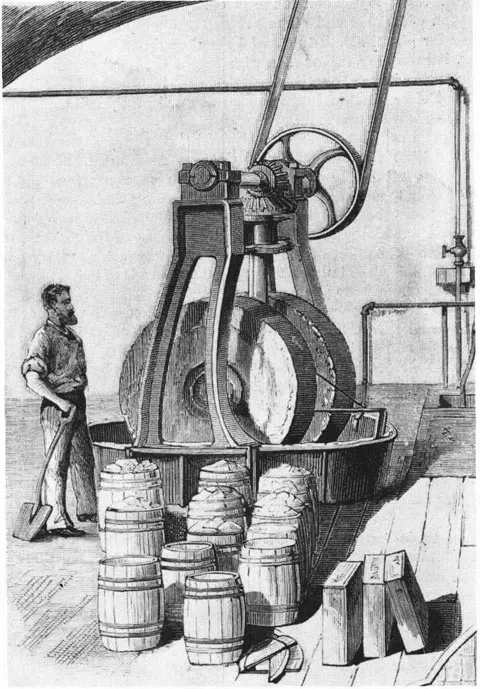
FIGURE 1. A commonly used practice for grinding asbestos ore for use in industrial insulation. (From The Bettmann Archive, Inc., New York. With permission.)
With the unleashing of technology during the industrial revolution and the need to insulate hot engines, boilers, and piping, a large number of new applications were found for asbestos. Figure 1, circa 1880, shows a commonly used process for grinding asbestos ore for use in industrial insulation. Another view of the grinding process is shown in Figure 2. Preparation and mixing of asbestos for use in nonconducting coverings is shown in Figure 3, while Figures 4 and 5 depict the way boilers and pipes were insulated. Not a thought appears to be given to the possibility that asbestos might be hazardous. Yet, Castleman tells us that “the Romans may well have found that slaves weaving asbestos were becoming disabled to the point that they first could not exert themselves in their work, and then died as their breathing difficulties became severe”.3 This description is highly suggestive of asbestosis. He goes on to note that “a Viennese physician wrote in 1897 that emaciation and pulmonary problems in asbestos workers and their families left no doubt that (asbestos) dust inhalation was the cause…”. In England, it was the Lady Inspectors of Factories who were the first to report the hazards of asbestos. In 1898, they wrote that asbestos manufacturing processes were given special attention “on account of their easily demonstrated danger to the health of the workers, and because of ascertained cases of injury to bronchial tubes and lungs medically attributable to the employment of the sufferers”.
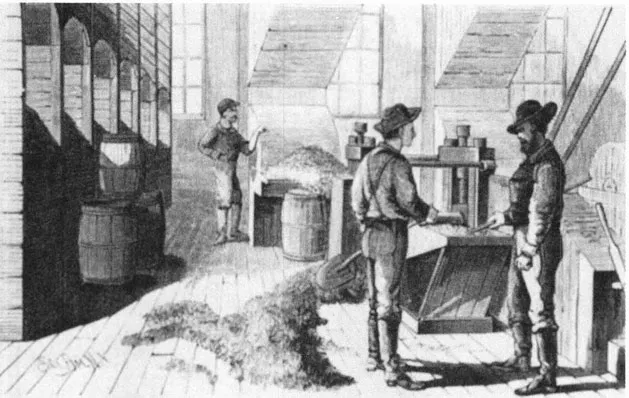
FIGURE 2. The grinding process seen in a close-up view. (From the Bettmann Archive, Inc., New York. With Permission.)
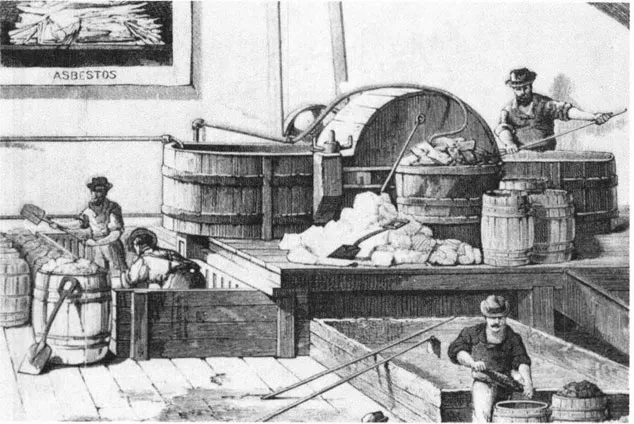
FIGURE 3. Preparation and mixing of asbestos for use in nonconducting coverings. (From The Bettmann Archive, Inc., New York. With permission.)
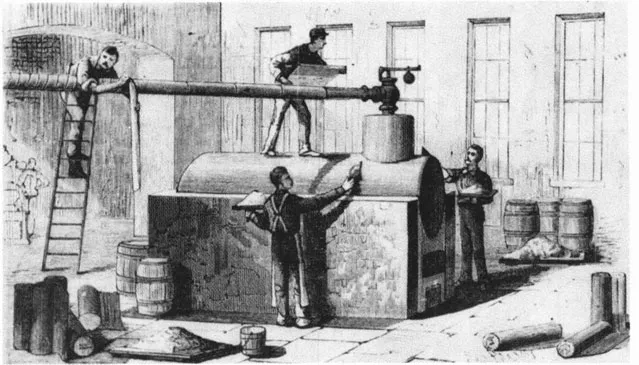
FIGURE 4. Procedure for insulating boiler and piping. (From The Bettmann Archive, Inc., New York. With permission.)
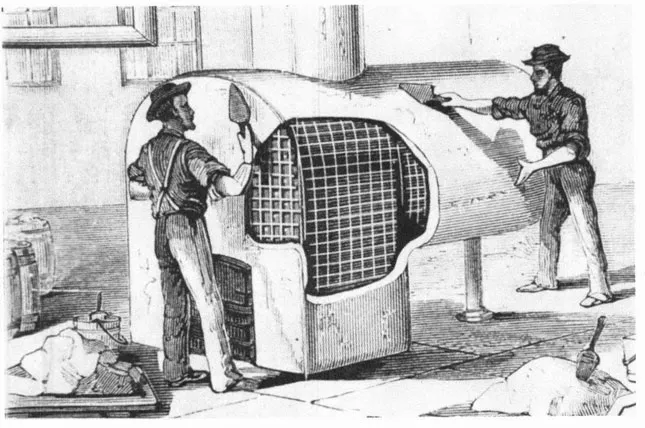
FIGURE 5. Common procedure for applying insulation to a boiler. (From the Bettmann Archive, Inc., New York. With permission.)
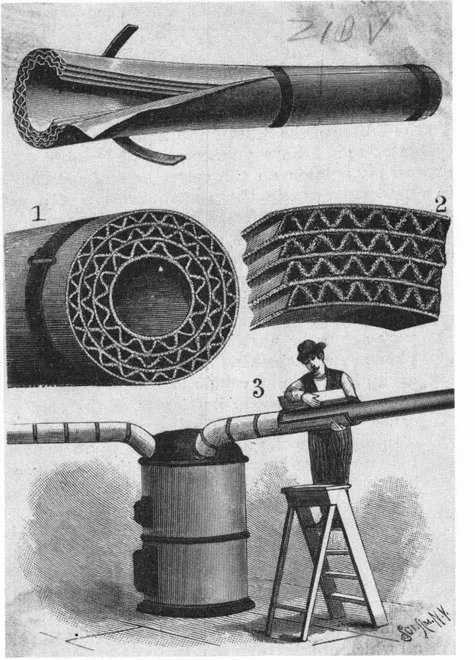
FIGURE 6. Air cell insulation. This became the material of choice for pipe insulation. (From the Bettmann Archive, Inc., New York. With Permission.)
One of the most desirable products, and extensively used because of the ease of its application, was the newly developed air-cell covering shown in Figure 6. The partitions forming the cells were, of course, asbestos impregnated. The fire-resistant properties of asbestos did not escape attention either. It was the odd theater, movie, and auditorium that did not have fire-resistant screens and curtains woven with asbestos fibers. A typical demonstration of its “miraculous” fire-resistant properties is shown in Figure 7. Of course, the fire-fighting possibilities of asbestos-containing protective clothing were not lost on the more imaginative. A typical fireproof helmet and jacket used by the Parisian Fire Brigade as early as 1853 is shown in Figure 8. It required a further flight of creativity and another 50 years to totally encapsulate fire fighters — protecting hands, legs, and feet.
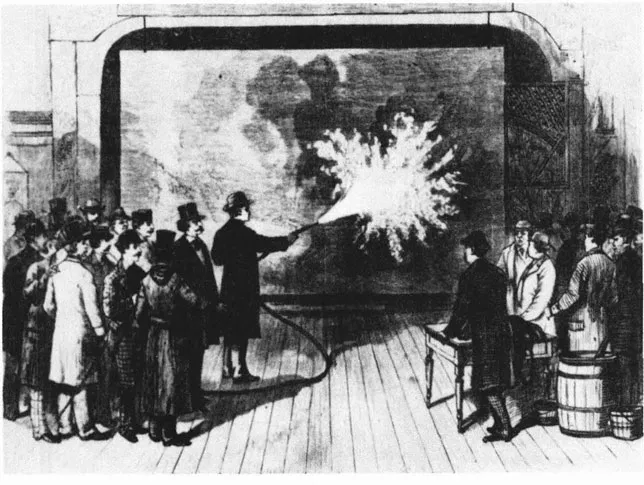
FIGURE 7. A demonstration of the fire-resistant quality of asbestos-containing cloth. (From the Bettmann Archive. Inc., New York. With permission.)
It was not until the early 1930s, however, that widespread use of asbestos in homes, schools, and office buildings began. Figure 9 shows the upward trend in asbestos use from the 1930s to the 1980s. During this period asbestos was perceived as the “miracle” fiber — even though reports in medical journals in England and the U.S., as sporadic as they were, warned of associations between respiratory fibrosis and lung cancer with the inhalation of asbestos dust by textile workers and miners.
It was during World War II, however, with its need for a vast fleet of military and cargo vessels, that hundreds of thousands of workers were employed in shipyards across the country. Many of them became insulators and pipe fitters and worked within the cramped, confining holds of ships applying fire-resistant asbestos-containing materials, often without benefit of respirators and adequate ventilation. And, smoking as they worked in the heavily polluted asbestos-containing atmospheres, excessive numbers of them became the cases of asbestosis, lung cancer, and mesothelioma, which appeared 20 and 30 years later. That is another key. Current decision-making about risks to health in schools and other public buildings appears not to be based on the heavy exposures received by these workers...
Table of contents
- Cover
- Title Page
- Copyright Page
- Dedication
- Table of Contents
- PART I
- PART II
- PART III
- APPENDICES
- INDEX
Trusted by 375,005 students
Access to over 1.5 million titles for a fair monthly price.
Study more efficiently using our study tools.
Frequently asked questions
Yes, you can cancel anytime from the Subscription tab in your account settings on the Perlego website. Your subscription will stay active until the end of your current billing period. Learn how to cancel your subscription
No, books cannot be downloaded as external files, such as PDFs, for use outside of Perlego. However, you can download books within the Perlego app for offline reading on mobile or tablet. Learn how to download books offline
Perlego offers two plans: Essential and Complete
- Essential is ideal for learners and professionals who enjoy exploring a wide range of subjects. Access the Essential Library with 800,000+ trusted titles and best-sellers across business, personal growth, and the humanities. Includes unlimited reading time and Standard Read Aloud voice.
- Complete: Perfect for advanced learners and researchers needing full, unrestricted access. Unlock 1.5M+ books across hundreds of subjects, including academic and specialized titles. The Complete Plan also includes advanced features like Premium Read Aloud and Research Assistant.
We are an online textbook subscription service, where you can get access to an entire online library for less than the price of a single book per month. With over 1.5 million books across 990+ topics, we’ve got you covered! Learn about our mission
Look out for the read-aloud symbol on your next book to see if you can listen to it. The read-aloud tool reads text aloud for you, highlighting the text as it is being read. You can pause it, speed it up and slow it down. Learn more about Read Aloud
Yes! You can use the Perlego app on both iOS and Android devices to read anytime, anywhere — even offline. Perfect for commutes or when you’re on the go.
Please note we cannot support devices running on iOS 13 and Android 7 or earlier. Learn more about using the app
Please note we cannot support devices running on iOS 13 and Android 7 or earlier. Learn more about using the app
Yes, you can access Asbestos The Hazardous Fiber by Melvin A. Benarde in PDF and/or ePUB format, as well as other popular books in Technology & Engineering & Materials Science. We have over 1.5 million books available in our catalogue for you to explore.