- 248 pages
- English
- ePUB (mobile friendly)
- Available on iOS & Android
eBook - ePub
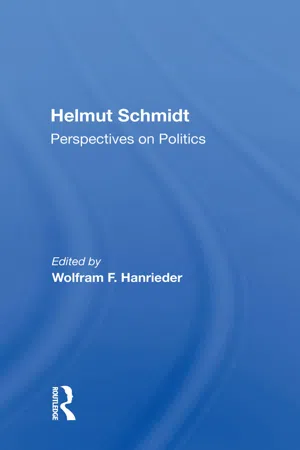
Helmut Schmidt: Perspectives On Politics
About this book
Helmut Schmidt, chancellor of the Federal Republic of Germany, is one of the most remarkable and prominent political figures on the contemporary-world stage. His many years of public service in a wide range of government and party positions have coincided with the growth of the Federal Republic; one might say that he and West Germany have grown to maturity together. The various responsibilities that he has undertaken—as a member of the Bundestag, as senator of the city-state of Hamburg, as floor leader of his party in the Bundestag, as minister of defense, as minister of economics and finance, and as chancellor—have kept Schmidt in close contact with the major concerns of the Federal Republic. There is hardly an important issue in West German foreign or domestic policy in which Helmut Schmidt has not participated. Chancellor Schmidt's masterful use of language, developed in the critical forum of parliamentary debate and sharpened over the decades as an instrument of explanation and persuasion, has made his public voice one of the most articulate of our time. The speeches, interviews, and essays collected in this book—the first such collection presented to an English-speaking readership— reflect the broad spectrum of Chancellor Schmidt's experience as well as his political temperament. Many of the chapters focus on practical matters of public policy, but in the more philosophical essays, the reader will find Helmut Schmidt speaking in a reflective, contemplative voice, providing insight into the underlying moral sensibility and personal view of public life that tie his world of thought to his world of action.
Information
1
Germany in the Era of Negotiations
(October 1970)
The rationale of West German foreign policy is very simple: the postwar era has ended. Its hallmarks were high hopes for Western political structures on the one hand, and high tension between East and West on the other. Now a new epoch is in the offing. In the West it is going to be characterized by less ambitious objectives and more pragmatic approaches. The achievements of the fifties and sixties will not be dismantled, but the aims for the immediate future will be lowered. Dreams of "Atlantic Union Now" or "Instant Europe" must give way to expectations more closely geared to realities: wider and deeper cooperation, without necessarily institutional perfection. Between East and West the new era could be one of diminished tension and growing detente, of more cooperation and less confrontation. Not unlike President Nixon, the Bonn government is also trying to "build agreement upon agreement" without in any way deluding itself that this could be a process easily or speedily accomplished.
There is no conflict between these policies. They are not mutually exclusive; indeed, they complement one another. The Federal Republic of Germany is firmly rooted in the West—both in the Atlantic Alliance and in such European institutions as the Western European Union and the Common Market. These Western ties are beyond question.
II
It is an undeniable fact that the North Atlantic Treaty Organization (NATO) has fully served its purpose during its twenty years of existence. In Europe, it has created a military balance vis-à-vis the Eastern bloc, and thus maintained the peace through grave international crises: first Korea, then Berlin and Cuba, finally Prague. And there has been more reasonable reform in recent years than many critics are willing to admit.
In the seventies as well, NATO will retain its lasting value as a safeguard against any revival of communist aggressiveness. After all, the lesson of Czechoslovakia in 1968 has been that the era of East-West crises is not yet a thing of the past. By means of the Brezhnev doctrine, Moscow has brutally collectivized the sovereignty of the East European nations. At the same time, the Soviet military are coolly debating the question whether war has really ceased to be an instrument of politics in the nuclear age.
Without the North Atlantic Alliance, there can be no security for Europe. Without it, the main threat to the West cannot be eliminated: namely a political stranglehold which could suffocate individual areas such as West Berlin, or bring pressure to bear on the Federal Republic or the NATO countries located on Europe's northern and southern flanks.
By the same token, without a firm foundation in NATO, there can be no sensible policy of détente in Europe. The maintenance of an effective defense depends on the continuity of a balance of power as does the improvement of East-West relations.
From all this, three conclusions can be drawn: for Germany, tor western Europe, and for the relationship between Europe and its two North American allies, especially the United States.
For Germany, an exclusively national policy of deterrence would lack both credibility and effectiveness. As Chancellor Willy Brandt said in his policy statement on October 28, 1969, "For our security we need friends and allies, just as they need us and our contribution for theirs." Let me repeat here what I said recently before the North Atlantic Council: "The new German government will continue the previous policy, both within the Alliance and toward the Alliance. We will not diminish the German defense effort, either in quantity or in quality, but will improve our contribution by a program for modernizing and reforming our armed forces. . . . Our defense contribution of 460,000 men under arms will remain unaltered."
For Europe, the necessity remains to keep up an effective defense. The buildup of the Soviet fleet, and of a Soviet naval presence in the Mediterranean, is growing at an undiminished rate. The military potential of the Warsaw Pact is continuously being reinforced and modernized in the western part of the USSR and in communist Eastern Europe in such manner and strength that we have no alternative but to maintain NATO forces now in Western Europe, in sufficient strength and of adequate quality. In this context, one has to at least raise the question whether Europe could not do more than it has done in the past to combine its various national efforts in the fields of defense, of arms procurement, and of technology, and to make them more effective by streamlining them without an increase in expenditure.
For the United States, given the strategic implications of the military potential of the Soviet Union and its continued effort in this respect, it remains an unquestionable fact of life in our time that there is no substitute for the role and function of the United States in the balance of strategic power.
Against this background, we actively support European efforts which would facilitate the continued and unquestioned presence of sufficient U.S. troops in Europe. The Euro-Group in Brussels and some other cooperative ventures are first steps on the road to what may, in time, become the consolidated defense establishment of a politically united Western Europe.
But we are still far from that goal. And we know too well that the alliance with the United States continues to be indispensable for maintaining that balance in the defense and deterrence capabilities which lead the other side to a rational handling of its foreign policy. The alliance with the United States is kept alive by the military presence of the United States in Europe and must remain so for some time. Also during this decade the fundamental asymmetry between East and West in Europe has to be brought into balance by a U.S. military presence in Europe itself.
It is only this presence, by the way, which underpins the strategy of "flexible response." It has taken the members of the Atlantic Alliance many years to reach agreement on this strategy. It is reasonable and credible. There is no alternative to it. A return to massive nuclear retaliation would be incredible, as would be a fallback on purely "tactical" nuclear defense—the former being unimaginably cruel to the Americans, the latter to the Europeans. The strategy of flexible response is the only one which combines credibly effective deterrence with nonsuicidal defense, sharing the risks of warfare in a fair way between North Americans and West Europeans.
This fact is not accepted with happiness—either on this or on the other side of the Atlantic. However, it must be taken into account with all the implications it carries in many fields. It is with intense concern that we follow the course of events in the United States and Canada, and the development of thoughts suggesting a lessening of foreign policy commitments of the United States, in particular concerning Europe. Past experience gives rise to the hope that notwithstanding the pressing domestic issues a wide consensus will emerge to reaffirm the responsibilities of the United States as a vital and fundamental backbone for the strategic balance.
Certainly, substantial changes in the international environment would justify a reassessment of the number of American troops necessary in Europe. It is not Holy Writ that U.S. forces will have to remain in Europe at present strength forever and ever (already the American garrison in Germany has been reduced by 20 percent over the past four years). We are hopeful that future conditions will allow for modifications of their role. Major changes, however, have not yet occurred. They may be looming on the horizon, but they may never become palpable political reality if the West throws away its cards before going to the conference table or before getting agreements on mutual force reductions.
There are many convincing arguments against precipitate or premature American troop withdrawals from Europe. In the first place there is the conventional military argument. U.S. ground troops man one-fourth of the European dividing line; the U.S. Air Force furnishes between 70 and 80 percent of all flying units in the 4th ATAF [Allied tactical air force] covering southern Germany, and about the same percentage of HAWK and NIKE [missile] batteries in that area. Were any of them thinned out or pulled out, grievous gaps would be created and the concept of forward defense turned into a shambles. Moreover, substantial U.S. withdrawals would sorely undermine public confidence not only in the reliability of the American commitment but also in the basic feasibility of European defense. An opinion poll recently conducted in West Germany bears this out. Sixty-six percent of those polled—and 79 percent of all Bundeswehr soldiers—felt that without American troops Germany would be overrun in the event of a communist aggression. Thus, an American pullout might indeed cause a psychological landslide and impel a despondent Western Europe toward its first major reorientation since the end of World War II.
Finally, nobody can deny that Western Europe, even if it were willing and able to put a European soldier in place of every GI withdrawn, could never make up for the deterrent effect inherent in American troops and their immediate link with the strategic deterrence. In the balance of power that obtains between the two superpowers one cannot replace the soldiers of the American superpower by French, British, or German soldiers. This is true for the Seventh Army; it also goes for the Sixth Fleet. Unilateral American withdrawals would accentuate rather than attenuate the structural imbalance of the present situation.
For obvious reasons, West Germany could not man the breach. By the same token, increased German payments for continued undiminished American presence offer no way out, because they would have to come from the German defense budget. The best way to help the Americans stay in Europe lies therefore in a joint European effort to facilitate the presence of U.S. troops here, and I hope that sufficient agreement can be effected among our European partners in this new venture.
III
The political unification of Western Europe continues to be a principal goal of our foreign policy. But the desire for institutional perfection is now tempered by a decade of sobering experience. Too many high-flying plans and projects have foundered on the mountains of national self-interest. The European Defense Community, a European Political Community, European Union along the Fouchet pattern—all of these projects were eminently sensible and desirable, yet they failed. The European nation-states were not ready for them. Each failure, however, caused a grievous loss of dynamics and confidence and threw Europe back by several years. The lesson is obvious: West European unification is jeopardized if its architects aim for the unattainable. Pragmatism and gradualism offer better chances.
West Germany still wants to sec Western Europe unified, It was, after all, Chancellor Brandt who engineered a decisive breakthrough when, at the Hague Conference in December 1969, he convinced France's President Pompidou of the necessity to get Europe moving again. Meanwhile, talks about the entry of new members—first and foremost the United Kingdom—into the Common Market club have begun. They will no doubt be protracted, but they are off to a felicitous start. The Europe of the Six is evolving into a Europe of the Ten. And the Community is now moving toward increased integration as well.
Though some would argue that more members and more integration are incompatible aims, we have learned the hard way that integration takes time. If we cannot have all, at least we should work for all that is possible—for strengthened consultation procedures in the first place, for less-than-perfect forms of union in the second. The Common Market nations must consider themselves lucky if they can complete their economic and currency union by the end of the seventies. So why not include in that process those willing and able to join? Why not take them along on the road to political union that lies beyond the horizons of 1980?
Others contend that you cannot simultaneously pursue integration in Western Europe and rapprochement with Eastern Europe. But these are not the fifties any longer. Then it was possible to plan for a Carolingian Western Europe for which Eastern Europe was nothing but a heathen adversary. But now, the Carolingians have passed away; the East has been put on the map. Whatever structure the West Europeans are going to create, it will certainly not be one without windows, doors, and passageways to the East Europeans. President Pompidou put it very bluntly in his Strasbourg speech last June: Western Europe would not come into existence unless it developed its relations with the countries of Eastern Europe; France, at any rate, would not go along if it were otherwise. Seen in this light, an active Eastern policy would appear to be a prerequisite of a West European renewal.
IV
Three preliminary remarks must be made about our Ostpolitik, the Eastern policy of the new West German government.
(1) It is not the result of a radical break with the past but rather the logical outcome of an evolution that started in the mid-sixties under Foreign Minister Gerhard Schröder; it found a first expression in the Peace Note of March 1966 and was assiduously developed by the Grand Coalition.
(2) It is firmly embedded in the fabric of a strong Western alliance. It is in no way an attempt to break away from that alliance, but rather an attempt to engage the political strength of the alliance in order to overcome the sterile confrontation of the past decade. The Paris Treaties of 1954 and our commitments to NATO are beyond question—and so is our constitution. West Germany will not become a "wanderer between the two worlds," as Chancellor Brandt has repeatedly stated. It is no "floating kidney."
(3) Bonn's Eastern probe fits into the wider pattern of Western policy vis-à-vis the communist powers. Its basic aim is to find out what room and readiness there are in the East for compromise and conciliation. Like other Western probes—the Strategic Arms Limitation Talks (SALT), for instance—ours is also governed by the basic consideration that if it fails we must not find ourselves in a worse position than before. We shall not embark on any adventure from which our friends will have to bail us out.
The impelling motive of our Eastern operation was the recognition that security through deterrence is only one essential element of stabilizing the framework of international relations and that security through lessening tension is a supplementary one, no less essential. The ultimate goal of this undertaking is the healing of the rift that has divided Europe for more than twenty years. Since the partition of our continent and our country cannot be overcome, at least we must want to overcome the separation of the peoples; since borders cannot be shifted about any longer, we must bend all our efforts to render their presence more tolerable. This, basically, is what Ostpolitik is all about.
Our method is that of patient, persevering, matter-of-tact diplomatic dialogue, carried on in a spirit neither euphoric nor frustrated. That dialogue is being launched simultaneously with the Soviet Union, with Eastern Europe, and with East Germany.
We see the situation realistically, as it is. Nothing important can be accomplished in Eastern Europe that Moscow does not agree to; it would be foolish to try to drive wedges among the members of the Warsaw Pact. Nevertheless, Warsaw, East Berlin, Prague, and the others are not mere satellites without a will of their own and without any influence. We recognize that they are not. Therefore, we started an exchange of opinions with Poland and the German Democratic Republic (GDR), at the same time that we opened talks with the Soviet Union. We hope that later there will be conversations with other member states of the Warsaw Pact as well. In each case, we consider the proposal to conclude an agreement on the renunciation of force a useful organizational framework for addressing the different bilateral problems.
With Moscow we have had and still have intensive and serious talks and negotiations. At the time of this writing, the outcome so far has been a preliminary agreement on the substance of a renunciation-of-force agreement. In addition, several points of understanding relating to matters of mutual interest were put on record. The Soviets refrained from insisting on their previous maximalist positions. "Recognition" of all existing frontiers was no longer demanded, "respect" accepted instead; they were declared "inviolable" but not necessarily "unalterable." Moscow accepted the German view that treaties previously concluded with third parties should not be affected; this is especially important with regard to the Paris Treaties, our membership in NATO, and our European Community ties. Moreover, the Soviets showed themselves willing to accept a letter from the Federal Government to the effect that self determination for the entire German people remains the goal of our policy. While Berlin is not an object of talks or arrangements between Bonn and Moscow, the Soviets took note of our view that a general détente must include and is intimately linked with a satisfactory settlement of the situation in and around Berlin. The ultimate result remains still to be seen. At present one can at least say that the Soviets are negotiating as seriously as in SALT.
The dialogue with Warsaw has also taken an encouraging turn since the Brandt administration took office. The Federal Republic does not feel able to recognize formally and finally the Oder-Neisse Line as Poland's western border; this is a decision which even the architects of present-day Poland reserved to a peace treaty with Germany. But we are willing to do everything possible short of an eventual peace treaty. We have made the Poles a twofold offer: first, to concede in no uncertain terms that, in its view, the Oder-Neisse is the western frontier of Poland; and second, to commit itself to the inviolability of this frontier. There is real hope that an agreement can be reached along these lines.
The third area in which we aim at normalization is the relationship between the two German states. Here it is our primary goal to end a development that, in the past twenty years, has ever more deepened the rift between the two Germanys. This will not be made possible as long as they adhere unequivocally to maximalist claims and arguments. The people in both parts of Germany want practical solutions that would permit the nation to live together more easily than it can at present.
The communist leadership of the GDR obviously finds it difficult to budge from its formalistic position. It demands the final and definitive recognition of East Germany in terms of international law as a prerequisite to any negotiations over normalization. And it leaves nobody in doubt that the relations between East Berlin and Bonn should be no different in character from those between, say, Belgium and Poland.
Bonn, in turn, has made it clear that it is ready to adopt a sensible, forthcoming attitude. We think it is useless to continue pretending there is no GDR; not that we approve of the regime or of the social system it has imposed on the East Germans, but neither do we call its existence in question any longer. We are eager to talk with East Germany, as the Erfurt and Kassel meetings between Chancellor Brandt and Chairman Stoph have proved. We shall cooperate with them wherever they are ready for it. There is one thing, however, which we refuse to do: recognize the other part of Germany as a foreign country. The Germans are one nation and will remain so. If the GDR should one day be ready to normalize its relations with the Federal Republic on the basis of this principle, then we on our part wi...
Table of contents
- Cover
- Half Title
- Title
- Copyright
- Contents
- Introduction
- 1. Germany in the Era of Negotiations
- 2. The 1977 Alastair Buchan Memorial Lecture
- 3. A Policy of Reliable Partnership
- 4. Speech Before the Tenth Special General Assembly of the United Nations
- 5. Speech in Moscow
- 6. The Struggle for the World Product: Politics Between Power and Morals
- 7. Europe and Africa—Partners with Equal Rights: Speech Before the Nigerian Institute for International Affairs
- 8. Speech Before the Society for the Family of Man
- 9. Speech at the Commencement Ceremony at Harvard University
- 10. Continuity and Concentration: Policy Statement Delivered to the Bundestag
- 11. The State of the Nation: Statement Delivered to the Bundestag
- 12. Statement Delivered to the Bundestag
- 13. The Challenging Decade Ahead: Speech at the SPD Party Convention
- 14. Political Action Aimed at Fostering Understanding: Speech to the Congress on "Kant in Our Time"
- 15. A Plea for Honesty and Tolerance: Speech at the Cologne Synagogue
- 16. Excerpts from an Interview on ABC News "Issues and Answers," Conducted by Peter Jennings
- 17. An Interview with The Economist
- Helmut Schmidt: A Biographical Political Profile
- Bibliography
- List of Abbreviations
- Index
- About the Book and Editor
Trusted by 375,005 students
Access to over 1.5 million titles for a fair monthly price.
Study more efficiently using our study tools.
Frequently asked questions
Yes, you can cancel anytime from the Subscription tab in your account settings on the Perlego website. Your subscription will stay active until the end of your current billing period. Learn how to cancel your subscription
No, books cannot be downloaded as external files, such as PDFs, for use outside of Perlego. However, you can download books within the Perlego app for offline reading on mobile or tablet. Learn how to download books offline
Perlego offers two plans: Essential and Complete
- Essential is ideal for learners and professionals who enjoy exploring a wide range of subjects. Access the Essential Library with 800,000+ trusted titles and best-sellers across business, personal growth, and the humanities. Includes unlimited reading time and Standard Read Aloud voice.
- Complete: Perfect for advanced learners and researchers needing full, unrestricted access. Unlock 1.5M+ books across hundreds of subjects, including academic and specialized titles. The Complete Plan also includes advanced features like Premium Read Aloud and Research Assistant.
We are an online textbook subscription service, where you can get access to an entire online library for less than the price of a single book per month. With over 1.5 million books across 990+ topics, we’ve got you covered! Learn about our mission
Look out for the read-aloud symbol on your next book to see if you can listen to it. The read-aloud tool reads text aloud for you, highlighting the text as it is being read. You can pause it, speed it up and slow it down. Learn more about Read Aloud
Yes! You can use the Perlego app on both iOS and Android devices to read anytime, anywhere — even offline. Perfect for commutes or when you’re on the go.
Please note we cannot support devices running on iOS 13 and Android 7 or earlier. Learn more about using the app
Please note we cannot support devices running on iOS 13 and Android 7 or earlier. Learn more about using the app
Yes, you can access Helmut Schmidt: Perspectives On Politics by Wolfram F. Hanrieder in PDF and/or ePUB format, as well as other popular books in Politics & International Relations & Politics. We have over 1.5 million books available in our catalogue for you to explore.