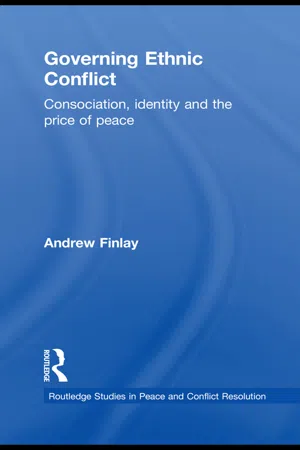
Governing Ethnic Conflict
eBook - ePub

Governing Ethnic Conflict

Consociation, Identity and the Price of Peace

  1. 152 pages
  2. English
  3. ePUB (mobile friendly)
  4. Available on iOS & Android
eBook - ePub

Governing Ethnic Conflict

Consociation, Identity and the Price of Peace

About this book

This book offers an intellectual history of an emerging technology of peace and explains how the liberal state has come to endorse illiberal subjects and practices.

The idea that conflicts are problems that have causes and therefore solutions rather than winners and losers has gained momentum since the end of the Cold War, and it has become more common for third party mediators acting in the name of liberal internationalism to promote the resolution of intra-state conflicts. These third-party peace makers appear to share lessons and expertise so that it is possible to speak of an emergent common technology of peace based around a controversial form of power-sharing known as consociation.

In this common technology of peace, the cause of conflict is understood to be competing ethno-national identities and the solution is to recognize these identities, and make them useful to government through power-sharing. Drawing on an analysis of the peace process in Ireland and the Dayton Accords in Bosnia Herzegovina, the book argues that the problem with consociational arrangements is not simply that they institutionalise ethnic division and privilege particular identities or groups, but, more importantly, that they close down the space for other ways of being. By specifying identity categories, consociational regimes create a residual, sink category, designated 'other'. These 'others' not only offer a challenge to prevailing ideas about identity but also stand in reproach to conventional wisdom regarding the management of conflict.

This book will be of much interest to students of conflict resolution, ethnic conflict, identity, and war and conflict studies in general.

Andrew Finlay is Lecturer in Sociology at Trinity College Dublin.

Frequently asked questions

Yes, you can cancel anytime from the Subscription tab in your account settings on the Perlego website. Your subscription will stay active until the end of your current billing period. Learn how to cancel your subscription.
No, books cannot be downloaded as external files, such as PDFs, for use outside of Perlego. However, you can download books within the Perlego app for offline reading on mobile or tablet. Learn more here.
Perlego offers two plans: Essential and Complete
  • Essential is ideal for learners and professionals who enjoy exploring a wide range of subjects. Access the Essential Library with 800,000+ trusted titles and best-sellers across business, personal growth, and the humanities. Includes unlimited reading time and Standard Read Aloud voice.
  • Complete: Perfect for advanced learners and researchers needing full, unrestricted access. Unlock 1.4M+ books across hundreds of subjects, including academic and specialized titles. The Complete Plan also includes advanced features like Premium Read Aloud and Research Assistant.
Both plans are available with monthly, semester, or annual billing cycles.
We are an online textbook subscription service, where you can get access to an entire online library for less than the price of a single book per month. With over 1 million books across 1000+ topics, we’ve got you covered! Learn more here.
Look out for the read-aloud symbol on your next book to see if you can listen to it. The read-aloud tool reads text aloud for you, highlighting the text as it is being read. You can pause it, speed it up and slow it down. Learn more here.
Yes! You can use the Perlego app on both iOS or Android devices to read anytime, anywhere — even offline. Perfect for commutes or when you’re on the go.
Please note we cannot support devices running on iOS 13 and Android 7 or earlier. Learn more about using the app.
Yes, you can access Governing Ethnic Conflict by Andrew Finlay in PDF and/or ePUB format, as well as other popular books in Politics & International Relations & Military & Maritime History. We have over one million books available in our catalogue for you to explore.

Table of contents

  1. Routledge studies in peace and conflict resolution
  2. Contents
  3. Abbreviations
  4. Preface and acknowledgements
  5. 1 Introduction
  6. 2 Anthropology, cultural pluralism and consociational theory
  7. 3 Essentialism and the reconciliation of the liberal state to ethnicity
  8. 4 Is ethnopolitics a form of biopolitics?
  9. 5 Consociationalism as a form of liberal governmentality
  10. 6 Paradigm shifts and the production of ‘national being’
  11. 7 No exit
  12. 8 ‘A long way to get very little’
  13. 9 Conclusion
  14. Bibliography
  15. Index