This title was first published in 2001. Challenging conventional approaches to the delivery of sustainable "social protection" to the elderly in developing countries (DCs) and assessing their implications, this work discusses the appropriateness of the public management of funded systems in DCs with relatively large formal sectors. The combination of social assistance approaches to social protection for the elderly facilitates the formation of an original unbiased "pensions in development" approach. Arguing for expeditious implementation of non-contributory tax (or aid) financed universal old-age "pensions" provision in all DCs and advocating industry flexibility and inclusivity, the book provides a treatment of a growing issue in worldwide development.
- 386 pages
- English
- ePUB (mobile friendly)
- Available on iOS & Android
eBook - ePub
Pensions in Development
About this book
Information
Part I
Global Perspectives and Issues
1 Introduction
An optimally designed old age pension system should fulfil the dual purpose of protecting the old from income insecurity and being an engine of economic growth.
Georges Heinrich, 1997
Pensions policy is a central element within most national social security and social protection policy strategies. Despite the rather earlier institution of national work injury programmes in many states - a fact which rendered these schemes, as recently as 1990, the most common benefit type within social security systems - there are now a larger number of schemes providing old age benefits than there are providing any other benefit contingency. According to US Social Security Administration’s (USSSA) biennially published survey of Social Security Programs Throughout the World (1999), one hundred and sixty seven countries, theoretically, currently provide some form of social security benefit to meet the contingencies associated with old age. At the end of 1999, and largely predictably in relation to their characteristic problems of poverty, violence, state repression and instability, only the Asian country of Myanmar (Burma) and the African countries of Angola, Comoros, Eritrea, Ethiopia, Guinea Bissau, Lesotho, Malawi, Sierra Leone, Somalia and, even more unsurprisingly, Western Sahara,1 are either listed as not yet providing an old age benefit within their respective national social security provisions or not listed at all in the USSSA’s compendium. Notwithstanding these least developed country (LDC) exceptions,2 the global expansion of national systems for the provision of old age protection is rightly considered by the ILO as ‘one of the great social developments’ (Gillion, 1999, p.1) of the 20th century. Nevertheless, this social policy success story should not distract attention from remaining problematic issues of great current and potential significance, not least the problems raised by demographic ageing. World Bank cost projections based upon likely future global demographic ageing levels suggest that ‘public spending on old age security will escalate sharply in all regions over the next fifty years’ (World Bank, 1994, p.6). These mounting costs are portrayed as likely to be most acutely felt in OECD economies in particular, followed by the transition economies of central and eastern Europe, with average pension costs in relation to GDP within these two groups of economies reaching double digit figures in the first and the second decade of the new millennium respectively. Similarly, in China the demographic situation looks set to deteriorate markedly after 2020. In contrast, in sub-Saharan Africa (SSA) pension spending, as projected by the World Bank, is expected to remain fairly stable, continuing to average less than one percent of GDP for the next twenty years (1994, p.7, Fig. 2). This projection, in turn, reflects SSA’s status as ‘both the “youngest” continent and the one where the population is ageing most slowly’ (Fultz, 1997, p.3).
As these predicted regional variations in the future cost of pension provision suggest, the demographic context within which the global pension system reform debate occurs will become differentially problematic, with obvious implications for both analysis and practice. Currently, the fashionable focus on the problems posed by demographic ageing to established pension systems has often tended to obscure many wider, and much more immediately problematic, issues of serious concern to a very large percentage of the world’s older persons, defined for the purposes of this volume, following the UN, as those aged 60 years and above. Nevertheless, three discernible strands can be identified within contemporary pension reform debates. First, responding to demographic projections, one strand of debate relates to a growing concern regarding the projected longer term affordability of old age benefit provision within predominantly the high, and some middle income, economies. This book is largely unconcerned with the specifics of this debate since ageing of populations does not yet constitute a key issue for most low income countries (LICs). In particular, ‘Africa will remain young well into the 21st century. The predicament of social security financing that ageing populations pose is thus not on the immediate horizon’ (Fultz, 1997, p.4). Nevertheless, as Maps 1.1 and 1.2 underline, Africa is only relatively unaffected by demographic ageing. ‘The older population of Africa, currently estimated to be slightly over 38 million, is projected to reach 212 million by 2050. Thus Africa’s older population will increase six-fold in five decades’ (HelpAge International, 2000, p.3).
Map 1.1 Global Population 60+ 1999
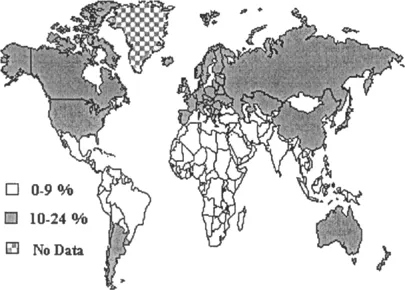
Source: UNDP Population Division
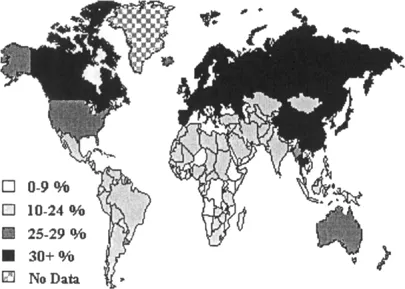
Map 1.2 Global Population 60+ 2050
Source: UNDP Population Division
A second policy debate relates to the general, albeit not universal, inadequacy of old age benefits across the transition economies of central and eastern Europe (CEE) and the newly independent states of the former Soviet Union (NIS/FSU). Although our central concerns lie elsewhere, this volume deals with those transition economy pension policy developments and issues of wider relevance to the low and middle income developing countries on which we primarily focus in this book. Our reasons for this choice of focus are straightforward. Today, 61 percent of the world’s over-60s live in developing countries (DCs). By 2025, 70 percent will do so. Moreover, as Colin Gillion, former Director of the ILO’s Social Security Department has stated, soberingly, ‘the vast majority of the world’s population is still without some form of income security in old age’ (1999, p.1). Current figures suggest that only around 40 percent of the world’s working population, and just over 30 percent of the world’s elderly, ‘are covered by formal arrangements for old age’ (World Bank, 1994, p.6). In response, a third pensions policy debate, to which this volume seeks to contribute, relates primarily to pensions problems predominantly associated with the DCs of the Third World: specifically, their characteristic problems of poor formal system coverage and benefit inadequacy.3 However, in dealing with these DC-specific issues below in Chapters 6 and 7 we have been conscious of Amanda Heslop’s stricture that ‘[t]oo often development of formal pension and social security programmes is taken as the single reform agenda for older people’ (1999, p.27). With almost 70 percent of the world’s elderly, on the Bank’s estimate, relying on ‘informal’ means of support, we have sought to respond positively to this reality and to tailor our proposals for LICs, presented in Chapter 7, appropriately.
The ‘Global’ Pension Reform Debate: Content versus Context
Currently, there is a rather obvious mismatch between the contents of much of the ongoing pensions reform debates and the contexts within which ‘radical’ pension reform is mainly occurring on the ground as policy. In practice, it is somewhat ironic that the so-called ‘radical’ pension reform proposals championed by the World Bank, involving an agenda centred on private rather than public provision, has, to date, been largely ignored by the high income countries to whose problems the Bank’s proposals are largely addressed. Responding to the views of both the International Monetary Fund (IMF) and the European Commission (EC) regarding significant negative costs associated with the wholesale abandonment of mature unfunded public pension systems and conversion to a system based mainly on funded private provision, many high income countries (HICs) have preferred to implement cost-cutting, or parametric, reforms as their mechanism for controlling the cost of public pension provision (Espina, 1996, p.204; EC, 1998a, section 2.3.1). As a result, in practice, as considered in Chapters 3 and 4 of this volume, it is middle income countries (MICs) that have implemented pension system reforms modelled upon, or at least significantly influenced by, the World Bank’s ‘radical’ agenda of pension privatisation. Nevertheless, as we argue below in Chapter 6, the ‘radical’ reform agenda is now targeting even sub-Saharan Africa, previously considered to be too poor and to possess insufficiently developed financial sectors to be included in the debate on pension privatisation. It is the widening scope of this agenda that has given rise to, what may now more appropriately be referred to as, a ‘global’ pension system reform debate.
For better or for worse, and again reflecting the mismatch between the content and the context of debate described above, contemporary discussions of appropriate pension system reform agendas for developing countries and transition economies are focusing on an increasingly narrow range of options, notably preferencing fully funded over unfunded, pay-as-you-go (PAYG) schemes, and, among the former, aggressively asserting the advantages of private provision over public management. Accordingly, the not inconsiderable welfare merits of unfunded, PAYG, state pension schemes operated on social insurance principles are largely ignored (as are the enormous, unavoidable, short-term administrative and medium-term transition costs involved in either reforming and restructuring, or abolishing, established, mature, systems) in much of the burgeoning literature on appropriate pension reform strategies for low and middle income economies. Central to the case against existing unfunded PAYG systems, which, prior to recent, increasingly global, waves of pension reform, monopolised retirement provision in Latin America, Eastern Europe and the former Soviet Union (FSU), and, so far, continue to predominate in East Asia, the Middle East and francophone Africa, is their irrelevance to financial system development. As Dimitri Vittas and Roland Michelitsch of the World Bank bluntly put it, these ‘pay-as-you-go social pension systems … make little or no contribution to the accumulation of financial assets’ (1996, p.264) in total contrast to their funded counterparts’ observed capacities to drive financial sector development and their increasingly accepted capacities as important elements in wider economic growth sequences.
The correct choice of pensions funding, management and delivery systems is increasingly perceived as central to the functioning and healthy development of national economies in free market systems. Not only is ‘the organization of a country’s pension system … a major determinant of the structure of the financial system’ (Vittas, 1992, p.2; see also Vittas and Michelitsch, 1996, p.262), but financial system deepening is seen as crucial to the achievement of sustainable economic development. As the 1997 World Development Report summarises: ‘Our understanding of financial sector development has changed dramatically over the past decade. We now know that the depth of a country’s financial sector is a powerful predictor and driver of development’ (1997, p.65). Among the key assumptions made by the advocates of the current pension reform orthodoxy are that the widening and deepening of national financial markets associated with the process of pension fund privatisation should create more opportunities not only for the government to restructure fiscal debt and other liabilities but should also serve to facilitate national economic development more widely. In the light of the comparative evidence available not only from Malaysia and Singapore, our two main counter-examples, but also from Chile, the Bank’s model reformer, we demonstrate below in Chapter 8 that current pension reform prescriptions, based on the model proposed by the World Bank, are not fully appropriate for developing countries even in these limited respects.
In principle, stimulating the development of private pensions sectors and other forms of contractual savings, most rapidly and most comprehensively achieved through making pensions saving mandatory, can aid the development of capital markets. In practice, the capital market benefits of such pension system reform may have been oversold. In some cases the exercise may well prove self-defeating. Wide-ranging financial system underdevelopment combined with a relatively small volume of assets held by each of a number of contractual savings institutions all competing with each other for customers, are likely, in the short to medium term, to undermine the achievement of such goals. Initial set up costs combined with administration expenses and commercial costs suggest, moreover, that it may take several decades for even the best run private funds to build assets to a level significant enough to make an identifiable impact upon financial sectors and systems, let alone on the wider economy. More widely, in this book we seek to question whether pension reform models which demand a significant role for private defined contribution pension funds provide DCs with the most appropriate means for serving the twin purposes of Georges Heinrich’s optimum pension system — providing social welfare for the old in the form of adequate incomes and forming an engine of economic development.
The History of Pension System Diffusion
The history of the development and diffusion of pension systems, originally within Europe and then outwards from Europe to Latin America and beyond, has been frequently and exhaustively chronicled and will not be reiterated here in any great empirical detail. Our interest in these historical developments is essentially analytical and conceptual, seeking to identify the balance between international and domestic forces in earlier examples of pension system adoption and reform in order to place the more recent and on-going developments, with which this volume is mainly concerned, in perspective: our focus in Chapter 2. All that needs to be underlined at this point, therefore, is that the historical evolution of social security policy in general, and of pension policy in particular, demonstrates that international, and inter-state, influences on the policy and institutional choices of individual states, far from constituting novel departures, have a very long pedigree. As chronicled below, events occurring earlier in the 20th century anticipated recent developments in a number of very significant respects.
As a large number of analysts, across a range of disciplines, have separately concluded, the history of national developments in welfare and social security policy has long been intimately bound up with the trajectory of the complex of international economic developments and interactions that are encapsulated in the term ‘globalisation’. At the highest level of generality, for example, the close correlation between a country’s economic openness to international trade and the early adoption of comprehensive social security systems is striking, indicating the logic of utilising the promise of social protection as a form of domestic policy insurance against the vagaries of international competition. Social security, therefore, becomes a policy carrot offered by states to its workers in order to buy-off their likely opposition to free trade (Rodrik, 1997). In turn, the fundamental similarities in policy format and content between national social security programmes, as well as the close coincidences in the timing of first adoption among groups of similarly situated states, have generated assumptions of more immediate and direct inter-state influences at work. Consequently, emphasis on the significance of the inter-state diffusion of policy innovations has been a hallmark of research on the spread of social security programmes around the world for some decades. Rather than recording a simple series of independent national inventions in response to similar problems, such as the threats of international openness, an established literature records the specificities of the impact of cross-national pressures and influences in the construction of national social security policies. For example, in a seminal paper published a quarter of a century ago, Collier and Messick demonstrated how, from 1920, standardised social security policy packages, centred on the adoption of social insurance programmes, spread swiftly from the early adopters in Europe to the Americas and beyond, diffusing rapidly down a hierarchy of modernisation to cover the developing countries of South and central America by the early 1940s (Collier and Messick, 1975).
In practice, therefore, it has long been acknowledged that ‘national’ policy, not least social policy, is not formulated in isolation. The relevant processes were well summarised by Rose Spalding two decades ago in framing an insightful case study of the complex interactions occurring between domestic and non-domestic forces shaping the adoption and evolution of welfare policy in Mexico. Specifically, ‘nations do not exist in a vacuum, devising social policies in a wholly independent fashion, oblivious to programs and decisions being formed elsewhere. Instead, internal policy developments are influenced by similar developments occurring in other areas. Thus, the worldwide spread of social security programs is not simply the result of nations independently responding in a similar fashion to similar problems, but at least in part, [is] the product of the diffusion of models and concepts from innovative centers to other nations throughout the world’ (Spalding, 1980, p.421). Moreover, as Spalding underlines, the processes of social security diffusion identified in this well-established analytical literature were not exclusively or simply state-to-state or directly region-to-region but also, from the establishment of the League of Nations institutions, most relevantly the ILO in 1919, progressively involved Deacon’s ‘international organisations’ (Deacon, 1997) as crucial players in these diffusion processes and patterns. Importantly, Spalding was able, in 1980, to refer to ‘numerous works that emphasize the role of international organizations and transgovernmental networks in the transferral of information and development of international standards’ (1980, p.421), thereby significantly facilitating and reinforcing the international diffusion of social security instruments and programmes from the 1920s.
Considered separately the two processes of diffusion identified above explain much about the specifics of the impact of inter-state influences and international factors in determining substantial policy and programme convergence in the social security sphere among those states, both developed and developing, that were independent prior to the Second World War. Consid...
Table of contents
- Cover
- Half Title
- Dedication
- Title Page
- Copyright Page
- Table of Contents
- List of Figures
- List of Tables
- List of Maps
- About the Authors
- Preface
- Acknowledgements
- List of Acronyms
- Part I: Global Perspectives and Issues
- Part II: Regional Responses: Distilling Lessons from Pension Reform
- Part III: Pensions in Development: Towards Expanded Options
- Appendix
- Bibliography
- Index
Trusted by 375,005 students
Access to over 1.5 million titles for a fair monthly price.
Study more efficiently using our study tools.
Frequently asked questions
Yes, you can cancel anytime from the Subscription tab in your account settings on the Perlego website. Your subscription will stay active until the end of your current billing period. Learn how to cancel your subscription
No, books cannot be downloaded as external files, such as PDFs, for use outside of Perlego. However, you can download books within the Perlego app for offline reading on mobile or tablet. Learn how to download books offline
Perlego offers two plans: Essential and Complete
- Essential is ideal for learners and professionals who enjoy exploring a wide range of subjects. Access the Essential Library with 800,000+ trusted titles and best-sellers across business, personal growth, and the humanities. Includes unlimited reading time and Standard Read Aloud voice.
- Complete: Perfect for advanced learners and researchers needing full, unrestricted access. Unlock 1.5M+ books across hundreds of subjects, including academic and specialized titles. The Complete Plan also includes advanced features like Premium Read Aloud and Research Assistant.
We are an online textbook subscription service, where you can get access to an entire online library for less than the price of a single book per month. With over 1.5 million books across 990+ topics, we’ve got you covered! Learn about our mission
Look out for the read-aloud symbol on your next book to see if you can listen to it. The read-aloud tool reads text aloud for you, highlighting the text as it is being read. You can pause it, speed it up and slow it down. Learn more about Read Aloud
Yes! You can use the Perlego app on both iOS and Android devices to read anytime, anywhere — even offline. Perfect for commutes or when you’re on the go.
Please note we cannot support devices running on iOS 13 and Android 7 or earlier. Learn more about using the app
Please note we cannot support devices running on iOS 13 and Android 7 or earlier. Learn more about using the app
Yes, you can access Pensions in Development by Roger Charlton,Roddy McKinnon in PDF and/or ePUB format, as well as other popular books in Literature & Literary Criticism. We have over 1.5 million books available in our catalogue for you to explore.