- 256 pages
- English
- ePUB (mobile friendly)
- Available on iOS & Android
eBook - ePub
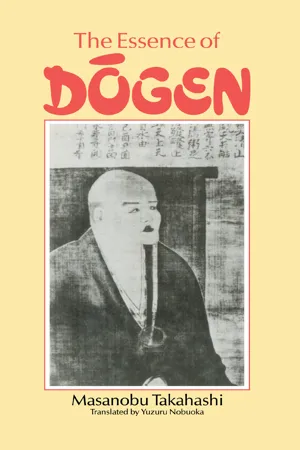
Essence Of Dogen
About this book
First published in 1983. Dogen was one of the great Zen masters of the Middle Ages in Japan, and in this book Masanobu Takahashi, a leading authority on Dogen, explains his thought in the clearest terms. Professor Takahashi has drawn on many years of study and on deep understanding of the whole structure of Dogen's thought to give a lucid account of Dogen's complete philosophy. This first systematic introduction to Dogen's thought to be published in English, translated by Yuzuru Bobuoka.
Information
Chapter 1
Dōgen’s life and his essential precepts
1 Dōgen’s life
Dōgen was born on 26 January in AD 1200 and died on 29 September in 1253. An outline of his 54 years of life is as follows.1 He was born into an aristocratic family and was related to the Emperor. His father was the Lord Keeper of the Privy Seal and his mother, the daughter of a certain Regent. But Dōgen lost both parents early; the former when he was 3 years old; the latter when he was 8. After the loss of his parents he was brought up by a maternal uncle. His lot was not good as such but he was given an excellent education worthy of nobility. As he showed brilliant talent at an early age, he was considered to be a boy wonder. Observing his ability, his foster father intended preparing him for a successful career in officialdom, but Dōgen wished to enter the Buddhist priesthood. At 14 years of age, he freely renounced the world. For about four years he devoted himself to the study of traditional Buddhism; at the age of 18, dissatisfied with this, he entered a monastery of the Rinzai Zen sect, which had just been introduced from China. There he remained for about six years and at the age of 24, went to the China of the Sung Dynasty (960-1279) to deepen his study. In China he made a profound, many faceted probing into Zen. The practical result was that he was both impressed and affected by the Sōtō-Zen sect. He finally established his religious thought, based upon the tenets and practices of Sōtō-Zen. Returning to Japan at the age of 28, he began to preach and subsequently became the founder of the Sōtō sect in Japan.
At first Dōgen resided at a Zen temple in Kyoto called Kennin-ji. After three years he moved to the suburbs, founding the temple of Kōshō-ji (he was now 34 years old). For ten years he engaged in teaching and working for the spread of his faith, but at 44 years of age, driven by the stress of circumstances, he moved to Echizen, a remote area about 200 kilometres north of Kyoto. He founded a temple there, named it Eihei-ji, and continued missionary work until he was 54 years old. In the autumn of his fifty-fourth year, becoming ill, he went to Kyoto for medical treatment, but soon, all remedies having proved ineffectual, this great Zen thinker died.
2 Shikan-taza (single-minded zazen)
Dōgen lived in the early half of the Kamakura era (1192-1333) of Japanese history. It was a time when radical societal changes were underway, due to the change from an aristocratic to a military government. Shaking itself free of the troublesome formalism which imitated the political and social pattern of the Tang Dynasty of China, Japan began to display characteristics proper to itself, while setting a new value on certain fundamental elements in life. This tendency gave rise to many new sects of Buddhism. Traditional Buddhism, as a religion for noblemen, had degenerated into a kind of esoteric practice or collection of magical rites. In contrast to this, the Buddhism of this new age celebrated a return to the truth of Buddhism. Transforming itself into a fundamentalist religion for the common people, it directed itself towards becoming easily attainable and simply understood.
Broadly speaking, there were three main sects central to this new Buddhism: the Nembutsu sect, the Zen sect, and the Nichiren sect. The first, the Nembutsu sect teaches that we can be born into the Land of Happiness by faithfully chanting a nembutsu (prayer) to Buddha. Three minor sects are offshoots of this branch of Buddhism: Jōdo-shū, Shin-shū, and Ji-shū. The second, the Zen sect, lays special stress on zazen, a paradoxical act of sitting without thinking and yet, not without thinking; a paradox which involves moving beyond thought. Although zazen is assiduously practised, the essential spirit of Zen is its belief in Jihi, the mercy of Buddha. The doctrine of Jihi, it should be noted, is the point at which all three sects converge. The third, the Nichiren sect, emphasizes that man can be saved simply by reciting the titles of the important Sutras in which they have faith.
Dōgen’s Sōtō sect is one of the sects which belongs to the Zen sect and its characteristic is that it accentuates zazen more than anything else. Shikan-taza (a single-minded sitting in zazen) which Dōgen advocates is the best expression of this teaching. It means ‘to sit intently with a single-mindedness’. That is to say, we can find the true way to enlightenment if we just sit. We find in this teaching an attitude quite contrary to the trivialities and difficulties of the old, conventional Buddhism. Buddhism formerly demanded troublesome practices and the ability of the believer to understand complex esoteric theories, far beyond the grasp of uneducated believers.’Zazen only’, however, caused a revolutionary change in this situation; the Way became attainable to all, the Way was simplified and became ‘familiar’. The original preaching of Buddha was identical to Kamakura Buddhism in its accessibility to all, and for this reason it was reactionary.
Among the plethora of teachings, Dōgen’s shows the strongest tendency to return to the true, original spirit of Buddha. The precepts of Buddha contain some theory; they are not always illogical though certainly an appeal is made to a certain supraintellectual sense rather than the rigid strictures of logic. A person may arrive at or grasp the truth not as a result of logical reasoning but through an enlightenment which does not negate the role of intellect. This is what satori in Buddhism means, and the faculty for attaining this is called wisdom. Dōgen does not always ignore the need for disciplining such wisdom, but his opinion is that if the mind returns to its pure, original beginning, it will be able to exercise this wisdom properly. Assisting the mind to return to its original state is of the essence of zazen.
To explore this central point in Dōgen’s teaching, two of his works are helpful. One is Fukan-zazengi (General Promotion of the Ways of Zazen) and the other is Shōbōgenzō (The Treasury which Contains the True and Essential Teaching of Buddhism). The former, only one volume in length, was completed during the year he returned from China. We may call it a kind of manifesto which declares the establishment of the Sōtō sect, based on the practice of zazen. In order to spread his teachings and explain them more easily, he wrote another volume, entitled Bendō-wa (An Introduction to the Way of Zazen). Both books explain the physical reality of zazen as a practice where one sits cross-legged, the spinal column straight, a practice by which the mind is set free, and returned to the state of activity of a pure, liberated’ spirit. The stability of a pure placid mind acquired through zazen is of the essence of the ‘Buddha World’. Therefore, if the student wants to keep having within himself the true nature of Buddha, the practice of zazen must be continued without interruption. That is to say, practice becomes one with satori; this is called shushō-ittō (the practice is itself enlightenment) or honshō-myōshū (true enlightenment is itself excellent practice). What Dōgen preaches by advocating shikan-taza is that everyday life should be lived in the spirit of zazen. This aspect of his teaching underscores the certainty of adherence to the practice of zazen only.
Is it possible, it may be argued, to be satisfied with doing only zazen? Are there no other important doctrines or tenets to be known? Actually, there are. Human existence raises some questions, the nature of religious belief raises others. How is Dōgen’s preaching connected with Buddha’s essential precepts, or how is his teaching concerned with life after death, that death which we poor mortals cannot escape? Concerning the practical phases of life, what does Dōgen think about the problem of good and evil? Does Dōgen refer to such problems and give an answer to them? Of course he does. He talks and preaches about them in various ways. Many of his literary works are the records of such explanations and preaching. Above all, the Shōbōgenzō is his greatest, the most important work of all. To grasp the whole structure of Dōgen’s thought, we must study it with special reference to the Shōbōgenzō as well as to his other minor works.
There is one important point, however, which should not be forgotten or disregarded when considering the shikan-taza which Dōgen advocates. The ultimate meaning of shikan-taza is to practise zazen alone. Compared to the whole structure of Dōgen’s thought about which he discourses at length, shikan-taza occupies the smallest part; ‘one should do zazen only’ means in other words, ‘one should do this at least.’ What is required here appears to be very little, but shikan-taza ranks at the top of any scale in order of importance. The summation of what Dōgen preaches is, in a sense, that we should practise nothing but zazen. We could even say that this teaching encapsulates the whole body of his precepts.
Essentially what shikan-taza aims at is a way of making Buddhism attainable, simple, and familiar in contradistinction to the erroneous approach which conventional Buddhism had tended to take and preach. What Dōgen asks is that a follower recognizes that some kind of purity and inclusiveness is found in shikan-taza.2 First, such purity asks that one should not practise zazen from any profit-motivated type of ambition, such as that of becoming a Buddha. The truth of shikan-taza is ‘zazen for zazen’s sake’. But, even if this is so, the final and ideal aim of zazen is to become Buddha. ‘Zazen for zazen’s sake’ can be taken to mean that enlightenment — the true nature of Buddha — is always concerned with practice; the essential quality of Buddha actualizes itself in the practice of zazen. Therefore we are urged to devote ourselves to zazen practice, during which all worldly thoughts are dispelled from the mind. Shikan-taza implies and demands such purity of intention. Second, inclusiveness means that all the commandments of Buddha are included in zazen itself. Thus zazen is practised for its own sake, because all the rules and commandments of Buddha can be observed by adhering to it alone.
Is it possible, however, for society to hold itself together, if we practise nothing but zazen in daily life, while basing such a choice on the belief that ‘all the commandments of Buddha can be observed by doing zazen alone’? Is doing zazen only, in conflict with societal involvement? Dōgen is ready to answer these questions. He teaches renouncing the world, by joining the priesthood, so that one can devote oneself to zazen. But if everybody wanted to do that, could society survive? His teaching provides an answer to this problem. He suggests two interrelated concepts, gūgō and Bosatsu-dō (the Ways of Bodhisattva). Gūgō designates the karma common to all men, a concept derived from the theory of transmigration and regeneration. Gūgō postulates the truth that society can hold itself together through the co-operative labour of all people, such as labour being allocated according to the karma of each man. This idea has become one of the basic principles of Buddhism.
Originally gūgö was applied only to the natural world, but it may also be applied to human society according to Dōgen’s free interpretation. On the other hand, Bosatsu-dō is ‘the way’ of constructing an ideal world for all humankind, a world of the Buddha encompassing even eternity. With these two concepts as a background, Dōgen encourages us to become priests, so that we can devote ourselves to zazen practice. One character of Dōgen’s precepts is found in this explanation; society is never denied nor are the laity ever haughtily brushed aside. Whether priests or laymen, zazen is a universal mode of meditation.
This precept of Dōgen’s is even more significant because he teaches from the standpoint of a formally religious man. For him, religion must prepare the way for the salvation of all human beings. If only the elect can be saved, religion is suspect. In this point the significance of Kama-kura Buddhism’s development towards becoming attainable, simple, and familiar, becomes clear. Dōgen’s contribution was to teach that the practice of zazen opened the way to universal salvation. Indeed, if the average person had to memorize the many detailed rules or understand the profound theory of Buddhism in order to attain salvation, only a minority could entertain any hope of success. Or, if Dōgen required an understanding of the complex theory of Buddhism so that the same average individual could read the Shōbōgenzō, the attainment of the Way would be beyond him.
His recommendation to ‘just sit in zazen ‘, a method which disregarded difficult and troublesome requirements reflects the true attitude of a religious man. All men may be saved through zazen practice alone. All that is required of those who seek intently to achieve the attainment of salvation is to enter the priesthood or practise zazen. The practising of zazen as a Bosatsu-dō is a timeless practice by which the believer might not attain salvation immediately, but ultimately salvation will be attained. The compassionate quality of this Buddhist tenet also allows for the concrete historical reality that owing to various situations and circumstances a person may be prevented from beginning zazen. But he or she will have a chance to do so sometime according to the theory of the transmigration of souls. In conclusion, it is possible to see that shikan-taza is an irreducible, minimum demand put forth by Dōgen — as evidenced by the terse comment that ‘on...
Table of contents
- Front Cover
- Half Title
- Title Page
- Copyright
- Contents
- Preface
- Acknowledgments
- 1 Dōgen’s life and his essential precepts
- 2 Genjō‘kōan (the actuality of instruction
- 3 Practice
- 4 On Buddha
- 5 Gūjin (thoroughness) and Buddha
- 6 Racial ground
- Supplement
- Notes
- Index of persons
- Index of works
- General index
Trusted by 375,005 students
Access to over 1.5 million titles for a fair monthly price.
Study more efficiently using our study tools.
Frequently asked questions
Yes, you can cancel anytime from the Subscription tab in your account settings on the Perlego website. Your subscription will stay active until the end of your current billing period. Learn how to cancel your subscription
No, books cannot be downloaded as external files, such as PDFs, for use outside of Perlego. However, you can download books within the Perlego app for offline reading on mobile or tablet. Learn how to download books offline
We are an online textbook subscription service, where you can get access to an entire online library for less than the price of a single book per month. With over 1.5 million books across 990+ topics, we’ve got you covered! Learn about our mission
Look out for the read-aloud symbol on your next book to see if you can listen to it. The read-aloud tool reads text aloud for you, highlighting the text as it is being read. You can pause it, speed it up and slow it down. Learn more about Read Aloud
Yes! You can use the Perlego app on both iOS and Android devices to read anytime, anywhere — even offline. Perfect for commutes or when you’re on the go.
Please note we cannot support devices running on iOS 13 and Android 7 or earlier. Learn more about using the app
Please note we cannot support devices running on iOS 13 and Android 7 or earlier. Learn more about using the app
Yes, you can access Essence Of Dogen by Masanobu Takahashi,Takahashi in PDF and/or ePUB format, as well as other popular books in Social Sciences & Anthropology. We have over 1.5 million books available in our catalogue for you to explore.