eBook - ePub
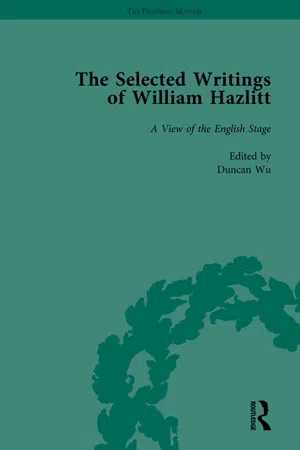
The Selected Writings of William Hazlitt Vol 3
- 290 pages
- English
- ePUB (mobile friendly)
- Available on iOS & Android
eBook - ePub
The Selected Writings of William Hazlitt Vol 3
About this book
William Hazlitt is viewed by many as one of the most distinguished of the non-fiction prose writers to emerge from the Romantic period. This nine-volume edition collects all his major works in complete form.
Information
A
VIEW
OF
THE ENGLISH STAGE;
OR,
A SERIES OF DRAMATIC CRITICISMS.
BY
WILLIAM HAZLITT.
“FOR I AM NOTHING IF NOT CRITICAL.”
London:
PRINTED FOR ROBERT STODART, 81, STRAND ;
ANDERSON AND CHASE, 40, WEST SMITHFIELD ;
AND BELL AND BRADFUTE, EDINBURGH.
1818.
A VIEW OF THE ENGLISH STAGE
Preface
The Stage is one great source of public amusement, not to say instruction. A good play, well acted, passes away a whole evening delightfully at a certain period of life, agreeably at all times; we read the account of it next morning with pleasure, and it generally furnishes one leading topic of conversation for the afternoon. The disputes on the merits or defects of the last new piece, or of a favourite performer, are as common, as frequently renewed, and carried on with as much eagerness and skill, as those on almost any other subject. Rochefoucault, I believe, it was, who said that the reason why lovers were so fond of one another’s company was, that / they were always talking about themselves.1 The same reason almost might be given for the interest we feel in talking about plays and players; they are ‘the brief chronicles of the time,’2 the epitome of human life and manners. While we are talking about them, we are thinking about ourselves. They ‘hold the mirror up to Nature;’3 and our thoughts are turned to the Stage as naturally and as fondly as a fine lady turns to contemplate her face in the glass. It is a glass too, in which the wise may see themselves, but in which the vain and superficial see their own virtues, and laugh at the follies of others. The curiosity which every one has to know how his voice and manner can be mimicked, must have been remarked or felt by most of us. It is no wonder then, that we should feel the same sort of curiosity and interest, in seeing those whose business it is to ‘imitate humanity’ in general, and who do it sometimes ‘abominably,’4 at other times admirably. Of these, some record is due to the / world; but the player’s art is one that perishes with him, and leaves no traces of itself, but in the faint descriptions of the pen or pencil. Yet how eagerly do we stop to look at the prints from Zoffany’s pictures of Garrick and Weston!5 How much we are vexed, that so much of Colley Cibber’s Life6 is taken up with the accounts of his own managership, and so little with those inimitable portraits which he has occasionally given of the actors of his time! How fortunate we think ourselves, when we can meet with any person who remembers the principal performers of the last age, and who can give us some distant idea of Garrick’s nature, or of an Abington’s grace! We are always indignant at Smollett, for having introduced a perverse caricature of the English Roscius,7 which staggers our faith in his faultless excellence while reading it. On the contrary, we are pleased to collect anecdotes of this celebrated actor, which shew his power over the human heart, and enable / us to measure his genius with that of others by its effects. I have heard, for instance, that once, when Garrick was acting Lear, the spectators in the front row of the pit, not being able to see him well in the kneeling scene, where he utters the curse, rose up, when those behind them, not willing to interrupt the scene by remonstrating, immediately rose up too, and in this manner, the whole pit rose up, without uttering a syllable, and so that you might hear a pin drop. At another time, the crown of straw which he wore in the same character fell off, or was discomposed, which would have produced a burst of laughter at any common actor to whom such an accident had happened; but such was the deep interest in the character, and such the power of rivetting the attention possessed by this actor, that not the slightest notice was taken of the circumstance, but the whole audience remained bathed in silent tears. The knowledge of circumstances like these, serves to keep alive the memory of / past excellence, and to stimulate future efforts. It was thought that a work containing a detailed account of the Stage in our own times – a period not unfruitful in theatrical genius – might not be wholly without its use.
The volume here offered to the public, is a collection of theatrical Criticisms which have appeared with little interruption, during the last four years, in different newspapers – the Morning Chronicle, the Champion, the Examiner, and lastly, the Times. How I came to be regularly transferred from one of these papers to the other, sometimes formally and sometimes without ceremony, till I was forced to quit the last-mentioned by want of health and leisure, would make rather an amusing story, but that I do not chuse to tell ‘the secrets of the prison-house.’8 I would, however, advise any one who has an ambition to write, and to write his best, in the periodical press, to get if possible ‘a situation’ in the Times newspaper, the / Editor of which is a man of business, and not of letters.9 He may write there as long and as good articles as he can, without being turned out for it,10 – unless he should be too prolix on the subject of the Bourbons,11 and in that case he may set up an opposition paper on his own account – as ‘one who loved not wisely but too well.’12
The first, and (as I think) the best articles in this series, appeared originally in the Morning Chronicle. They are those relating to Mr Kean. I went to see him the first night of his appearing in Shylock.13 I remember it well. The boxes were empty, and the pit not half full: ‘some quantity of barren spectators and idle renters were thinly scattered to make up a show.’14 The whole presented a dreary, hopeless aspect. I was in considerable apprehension for the result. From the first scene in which Mr Kean came on, my doubts were at an end. I had been told to give as favourable an account / as I could: I gave a true one. I am not one of those who, when they see the sun breaking from behind a cloud, stop to ask others whether it is the moon. Mr Kean’s appearance was the first gleam of genius breaking athwart the gloom of the Stage, and the public have since gladly basked in its ray, in spite of actors, managers, and critics. I cannot say that my opinion has much changed since that time. Why should it? I had the same eyes to see with that I have now, the same ears to hear with and the same understanding to judge with. Why then should I not form the same judgment? My opinions have been sometimes called singular: they are merely sincere. I say what I think: I think what I feel. I cannot help receiving certain impressions from things; and I have sufficient courage to declare (somewhat abruptly) what they are. This is the only singularity I am conscious of. I do not shut my eyes to extraordinary merit because I hate it, and refuse to open them till the clamours of / others make me, and then affect to wonder extravagantly at what I have before affected hypocritically to despise. I do not make it a common practice, to think nothing of an actor or an author, because all the world have not pronounced in his favour, and after they have, to persist in condemning him, as a proof not of imbecility and ill-nature, but of independence of taste and spirit. Nor do I endeavour to communicate the infection of my own dulness, cowardice, and spleen to others, by chilling the coldness of their constitutions by the poisonous slime of vanity or interest, and setting up my own conscious inability or unwillingness to form an opinion on any one subject, as the height of candour and judgment. – I did not endeavour to persuade Mr Perry15 that Mr Kean was an actor that would not last, merely because he had not lasted; nor that Miss Stephens knew nothing of singing, because she had a sweet voice. On the contrary, I did all I could to counteract the effect of these safe, not very sound, / insinuations, and ‘screw the courage’16 of one principal organ of public opinion ‘to the sticking-place.’ I do not repent of having done so.
With respect to the spirit of partisanship in which the controversy respecting Mr Kean’s merits as an actor was carried on, there were two or three things remarkable. One set of persons, out of the excess of their unbounded admiration, furnished him with all sorts of excellences which he did not possess or pretend to, and covered his defects from the wardrobe of their own fancies. With this class of persons,
Pritchard’s genteel, and Garrick’s six feet high!17
I never enlisted in this corps of Swiss bodyguards;18 I was even suspected of disloyalty and leze-majesté, because I did not cry out – Quand memel – to all Mr Kean’s stretches of the prerogatives of genius, and was placed out of the pale of theatrical orthodoxy, for not subscribing implicitly to all the / articles of belief imposed upon my senses and understanding. If you had not been to see the little man twenty times in Richard, and did not deny his being hoarse in the last act, or admire him for being so, you were looked on as a lukewarm devotee, or half an infidel. On the other hand, his detractors constantly argued not from what he was, but from what he was not. ‘He was not tall. He had not a fine voice. He did not play at Covent-Garden. He was not John Kemble.’ This was all you could get from them, and this they thought quite sufficient to prove that he was not any thing, because he was not something quite different from himself. They did not consider that an actor might have the eye of an eagle with the voice of a raven, a ‘pigmy body,’ and ‘a fiery soul that o’er-informed its tenement;’19 that he might want grace and dignity, and yet have enough nature and passion in his breast to set up a whole corps of regular stagers. They did not enquire whether this was the case with respect to Mr / Kean, but took it for granted that it was not, for no other reason, than because the question had not been settled by the critics twenty or thirty years ago, and admitted by the town ever since, that is, before Mr Kean as bom. A royal infant may be described as ‘un haut et puissant prince, agé d’un jour*20,’ but a great and powerful actor cannot be known till he arrives at years of discretion, and he must be first a candidate for theatrical reputation before he can be a veteran. This is a truism, but it is one that our prejudices constantly make us not only forget, but frequently combat with all the spirit of martyrdom. I have (as it will be seen in the following pages) all along spoken freely of Mr Kean’s faults, or what I considered such, physical as well as intellectual; but the balance inclines decidedly to the favourable side, though not more I think than his merits exceed his defects. It was also the more necessary / to dwell on the claims of an actor to public support, in proportion as they were original, and to the illiberal opposition they unhappily had to encounter. I endeavoured to prove (and with some success), that he was not ‘the very worst actor in the world.’21 His Othello is what appears to me his master-piece. To those who have seen him in this part, and think little of it, I have nothing farther to say. It seems to me, as far as the mind alone is concerned, and leaving the body out of the question, fully equal to any thing of Mrs Siddons’s. But I hate such comparisons; and only make them on strong provocation.
* See the Fudge Family, edited by Thomas Brown, jun.
Though I do not repent of what I have said in praise of certain actors, yet I wish I could retract what I have been obliged to say in reprobation of others. Public reputation is a lottery, in which there are blanks as well as prizes. The Stage is an arduous profession, requiring so many essential excellences / and accidental advantages, that though it is an honour and a happiness to succeed in it, it is only a misfortune, and not a disgrace, to fail in it. Those who put themselves upon their trial, must, however, submit to the verdict; and the critic in general does litde more than prevent a lingering death, by anticipating, or putting in immediate force, the sentence of the public. The victims of criticism, like the victims of the law, bear no good will to their executioners; and I confess I have often been heartily tired of so thankless an office. What I have said of any actor, has never arisen from private pique of any sort. Indeed the only person on the stage with whom I have ever had any personal intercourse, is Mr Liston,22 and of him I have not spoken ‘with the malice of a friend.’23 To Mr Conway and Mr Bartley my apologies are particularly due: I have accused the one of being tall,24 and the other of being fat.25 I have also said that Mr Young plays not only like a / scholar, but like ‘a master of scholars;’26 that Miss O’Neill shines more in tragedy than comedy; and that Mr Mathews is an excellent mimic. I am sorry for these disclosures, which were extorted from me, but I cannot retract them. There is one observation which has been made, and which is true, that public censure hurts actors in a pecuniary point of view; but it has been forgotten, that public praise assists them in the same manner. Again, I never understood that the applauded actor thought himself personally obliged to the newspaper critic; the latter was merely supposed to do his duty. Why then should the critic be held responsible to the actor whom he damns by virtue of his office? Besides, as the mimic caricatures absurdity off the Stage, why should not the critic sometimes caricature it on the Stage? The children of Momus should not hold themselves sacred from ridicule. Though the colours may be a little heightened, the...
Table of contents
- Cover
- Half Title
- Series Page
- Title Page
- Copyright Page
- Contents
- List of abbreviations
- Introductory note
- Directory of principal singers, actors and actresses
- A View of the English Stage
- Notes
- Books referred to in the notes to volume 3
Trusted by 375,005 students
Access to over 1.5 million titles for a fair monthly price.
Study more efficiently using our study tools.
Frequently asked questions
Yes, you can cancel anytime from the Subscription tab in your account settings on the Perlego website. Your subscription will stay active until the end of your current billing period. Learn how to cancel your subscription
No, books cannot be downloaded as external files, such as PDFs, for use outside of Perlego. However, you can download books within the Perlego app for offline reading on mobile or tablet. Learn how to download books offline
Perlego offers two plans: Essential and Complete
- Essential is ideal for learners and professionals who enjoy exploring a wide range of subjects. Access the Essential Library with 800,000+ trusted titles and best-sellers across business, personal growth, and the humanities. Includes unlimited reading time and Standard Read Aloud voice.
- Complete: Perfect for advanced learners and researchers needing full, unrestricted access. Unlock 1.5M+ books across hundreds of subjects, including academic and specialized titles. The Complete Plan also includes advanced features like Premium Read Aloud and Research Assistant.
We are an online textbook subscription service, where you can get access to an entire online library for less than the price of a single book per month. With over 1.5 million books across 990+ topics, we’ve got you covered! Learn about our mission
Look out for the read-aloud symbol on your next book to see if you can listen to it. The read-aloud tool reads text aloud for you, highlighting the text as it is being read. You can pause it, speed it up and slow it down. Learn more about Read Aloud
Yes! You can use the Perlego app on both iOS and Android devices to read anytime, anywhere — even offline. Perfect for commutes or when you’re on the go.
Please note we cannot support devices running on iOS 13 and Android 7 or earlier. Learn more about using the app
Please note we cannot support devices running on iOS 13 and Android 7 or earlier. Learn more about using the app
Yes, you can access The Selected Writings of William Hazlitt Vol 3 by Duncan Wu,Tom Paulin,David Bromwich,Stanley Jones,Roy Park in PDF and/or ePUB format, as well as other popular books in Literature & Literary Criticism. We have over 1.5 million books available in our catalogue for you to explore.