- 884 pages
- English
- ePUB (mobile friendly)
- Available on iOS & Android
eBook - ePub
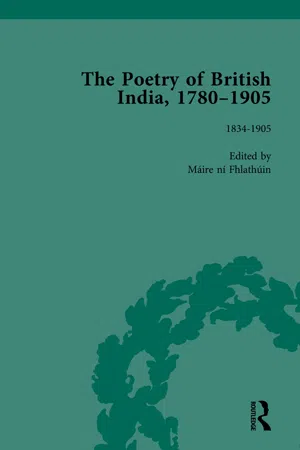
The Poetry of British India, 1780–1905 Vol 2
About this book
This two-volume reset edition draws together a selection of Anglo-Indian poetry from the Romantic era and the nineteenth century.
Information
EDITORIAL NOTES
Abbreviations
| DIB | C. E. Buckland, Dictionary of Indian Biography, first published 1906 (New York: Greenwood Press, 1969). |
| Hobson-Jobson | H. Yule, Hobson-Jobson: A Glossary of Colloquial Anglo-Indian Words and Phrases, and of Kindred Terms, Etymological, Historical, Geographical and Discursive, ed. W. Crooke (London: J. Murray, 1903), at http://dsal.uchicago.edu/dictionaries/hobsonjobson. |
| ODNB | Oxford Dictionary of National Biography (Oxford University Press, 2004; online edn, October 2008), at http://oxforddnb.com. |
| OED | Oxford English Dictionary (Oxford University Press, 2010), at http://www.oed.com. |
William Francis Thompson
1 Hard taskmasters … the same: Exodus 5:6–9.
2 peasant maid: Joan of Arc, religious inspiration and military leader of the French armies of Charles VII, who defeated English forces in several battles during 1429, including the crucial relief of the besieged city of Orleans.
3 Arabian: Spain was invaded by Arabs and Berbers from Morocco in 711–18 ad, the beginning of approximately 800 years when Muslims ruled over a large part of the country. In 1492, the last remaining Muslim stronghold of Granada was re-taken by the combined forces of Ferdinand of Aragon and Isabella of Castile, creating a united Christian Spain.
4 Gallic lord: Charles of Anjou, a son of the king of France, imposed an oppressive regime on the people of Sicily during his reign as Charles I of Sicily and Naples. He was overthrown by the ‘Sicilian Vespers’ rising of 1282.
5 The Jogi’s Address to the Ganges: The version of this poem included in The City of the East (1837) is substantially revised. A jogi, or yogi, is a Hindu ascetic.
6 sister current: the river Yamuna meets the Ganges at Allahabad.
7 Cashee’s: Kashi, another name for the city more commonly known in the nineteenth century as Benares, and today as Varanasi.
8 Hurdwar: Hurdwar, or Haridwar, is the location where the river Ganges leaves the Himalayas and flows across the northern plains of India.
9 Mlechhas: foreigners, outcastes, those who reject Hindu beliefs.
10 Serendeep: another name for Ceylon, or Sri Lanka.
11 Cheytrie’s … god: Cheytrie, or Kshatriya, member of a warrior caste; Brahmun, or Brahmin, member of a scholarly / priestly caste.
12 Typheus: In Greek mythology, the monstrous being Typheus, or Typhon, is attacked by Zeus and imprisoned beneath a volcano, Mount Etna.
The Author of ‘Griffe Epistles’
1 lacs or crores: A lakh is one hundred thousand; a crore, ten million.
2 Ganges … Bramaputra: Both rivers have their origin in the Himalaya mountains, and flow into the Bay of Bengal.
3 Opium: The East India Company’s monopoly on opium production in Bengal, and its export of opium to China in defiance of Chinese law, provided a lucrative source of revenue for both the Company and private traders during the late eighteenth and early nineteenth centuries.
4 Baboo’s: Originally a Hindu term of respect for a higher-status individual, the word baboo, or babu, was associated in British India with the educated Bengalis employed by the British as administrative or clerical workers, and thence came to signify any Indian clerk or white-collar worker.
5 Banian: a trader.
6 sircars: clerks, writers or accountants.
7 britzka: ‘open carriage with a folding hood and space for reclining’ (OED).
8 Consumah: khansamah, or house-steward, who runs the kitchen.
9 Kitmutgar: khidmutgar, a servant who waits at table.
10 Baburchee … Durzee: bobachee, a cook; mussalchee, a servant; syce, a horse-keeper or groom; durzee, a tailor.
11 maytor: mehtar, a sweeper, the servant lowest in status.
12 Ayah: a nurse or lady’s maid.
13 pice: coin of very small value.
James Ross Hutchinson
1 The Sunyassee: A revised version of this poem appeared in 1840, and a further revised version was published as ‘The Pilgrim of India’ in The Pilgrim of India, an Eastern Tale: and Other Poems (London: Pickering, 1847). The erratic punctuation of ‘The Sunyassee’ was regularized to some extent in this new edition.
2 Rajpoot: in this context, a warrior, member of a Hindu military caste.
3 Wellesley or Lake: Arthur Wellesley (1769–1852), later Duke of Wellington, and Gerard Lake (1744–1808) were both victorious in battles against Maratha armies in 1803, during the second Anglo–Maratha war. See also the author’s note on p. 34.
4 female: When Jeswunt Rao Holkar died, Tulsi Bai, who had left her husband to live with him some years previously, assumed control of the state in the name of his minor son Malhar Rao II, whom she had adopted. The state was in disorder, however, and the military turned on Tulsi Bai, killing her in 1817. See J. Malcolm, A Memoir of Central India, vol. 1 (London: Kingsbury, Parbury & Allen, 1824), pp. 260–317.
5 He lingered … state: Holkar was insane from 1808 until his death in 1811.
6 Pindarree’s Song: This is a revised version of the poem appearing as ‘The Pindarree’ in the Bengal Annual (1834), pp. 198–9.
7 To bounne: to prepare or make ready for action (Scots).
8 The Nurbaddah … Baroach: The authorial notes to ‘The Sunyassee’ were printed as end-notes, and in some cases these are very long, and appear to bear little relation to the poem. Passages of text have been omitted from this and other footnotes below, as indicated.
Samuel Sloper
1 Rajmahal: The city of Rajmahal was the capital of Bengal during the rule of Shah Shuja (1616–60). Shuja’s palace was destroyed by fire in 1640.
2 Deccan’s ghauts: mountain passes, or ghats, of the Deccan plateau in southern India.
3 Nilgherrie’s … stream: the Nilgiri Hills, on the edge of the Deccan plateau; and the river Narmada, in central India.
4 gibbet tree: The bodies of executed criminals were displayed hanging in chains along the roads – a practice which continued in British India after it had been abandoned in Britain in the early 1830s (V. A. C. Gatrell, The Hanging Tree: Execution and the English People 1770–1868 (Oxford: Oxford University Press, 1994), pp. 268–9).
James Abbott
1 T’hakoor’s: ‘Thakur’, a Rajput feudal title.
2 Toorkish: ‘In Central India this name is used to indicate any dominant Muhammedan race’ (Abbott, The Legend of Maandoo, p. 63).
3 Narbudda’s shore: Mandu, the capital of Malwa during the fifteenth and sixteenth centuries, overlooks the va...
Table of contents
- Cover
- Half Title
- Title Page
- Copyright Page
- CONTENTS
- Introduction
- Chronology
- Note on the Text
- William Francis Thompson
- The Author of ‘Griffe Epistles’
- James Ross Hutchinson
- Samuel Sloper
- James Abbott
- James Henry Burke
- William Bingham
- Henry George Keene
- John Dunbar
- Thomas Seymour Burt
- Mary Carshore
- Mary Johnson Jourdan
- Ella Haggard
- Mary Eliza Leslie
- ‘D. M.’
- James Innes Minchin
- Lionel James Trotter
- Charles Arthur Kelly
- William Henry Abbott, Jr
- William Waterfield
- Robert Caldwell
- George Augustine Stack
- Walter Yeldham
- Edwin Arnold
- Alfred Comyn Lyall
- William Trego Webb
- Thomas Frank Bignold
- George Herbert Trevor
- ‘Ram Bux’
- Alec McMillan
- John Renton Denning
- ‘S.’
- Adela Florence (‘Violet’) Nicolson
- Alice Macdonald Kipling and Alice (‘Trix’) Macdonald Fleming
- Editorial Notes
- Silent Corrections
- Index of First Lines
Trusted by 375,005 students
Access to over 1.5 million titles for a fair monthly price.
Study more efficiently using our study tools.
Frequently asked questions
Yes, you can cancel anytime from the Subscription tab in your account settings on the Perlego website. Your subscription will stay active until the end of your current billing period. Learn how to cancel your subscription
No, books cannot be downloaded as external files, such as PDFs, for use outside of Perlego. However, you can download books within the Perlego app for offline reading on mobile or tablet. Learn how to download books offline
Perlego offers two plans: Essential and Complete
- Essential is ideal for learners and professionals who enjoy exploring a wide range of subjects. Access the Essential Library with 800,000+ trusted titles and best-sellers across business, personal growth, and the humanities. Includes unlimited reading time and Standard Read Aloud voice.
- Complete: Perfect for advanced learners and researchers needing full, unrestricted access. Unlock 1.5M+ books across hundreds of subjects, including academic and specialized titles. The Complete Plan also includes advanced features like Premium Read Aloud and Research Assistant.
We are an online textbook subscription service, where you can get access to an entire online library for less than the price of a single book per month. With over 1.5 million books across 990+ topics, we’ve got you covered! Learn about our mission
Look out for the read-aloud symbol on your next book to see if you can listen to it. The read-aloud tool reads text aloud for you, highlighting the text as it is being read. You can pause it, speed it up and slow it down. Learn more about Read Aloud
Yes! You can use the Perlego app on both iOS and Android devices to read anytime, anywhere — even offline. Perfect for commutes or when you’re on the go.
Please note we cannot support devices running on iOS 13 and Android 7 or earlier. Learn more about using the app
Please note we cannot support devices running on iOS 13 and Android 7 or earlier. Learn more about using the app
Yes, you can access The Poetry of British India, 1780–1905 Vol 2 by Maire ni Fhlathuin in PDF and/or ePUB format, as well as other popular books in Literature & Asian Literary Criticism. We have over 1.5 million books available in our catalogue for you to explore.