This title was first published in 2000: These essays ecplore the spiritual culture shared by texts and writers in Western Europe from the 13th to 17th centuries; the visionaries, mystics and nuns who were poets or scholars and the creative writers who drew on spiritual themes. The topics range chronologically from the late 13th to late 17th centuries and geographically from Germany, England, Italy, France, Spain and New Spain (Mexico), though the volume's centre is the spiritual culture of 16th-century Spain. Common concerns of each essay are the exploration of spiritual culture; how some texts and writers shape expectations attending the life of the spirit; and how they are in turn shaped by them. The sub-themes many of the essays share are the gendering of spiritual culture and the relationship between traditional literary genres like poetry and drama and spiritual discourse. Each text or spiritual figure covered here has a distinctive spiritual voice - a mystical gesture - that contributes an individual mysticism to the common spiritual culture they all share. Each scholar in her or his own way defines this mystical gesture. The essays analyze Mechthild von Magdburg, "Piers Plowman", "The Second Shepherds' Play", Catherine of Siena, Bernardo de Laredo, Teresa of Avila, Alonso de la Fuente, Luisa de Carvajal y Mendoza, Cecilian de nacimiento, Margaret Mary Alaconque and Sor Juana.
eBook - ePub
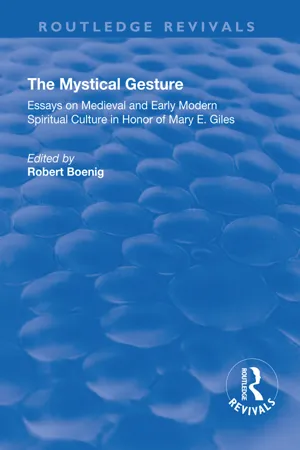
The Mystical Gesture
Essays on Medieval and Early Modern Spiritual Culture in Honor of Mary E.Giles
- 236 pages
- English
- ePUB (mobile friendly)
- Available on iOS & Android
eBook - ePub
The Mystical Gesture
Essays on Medieval and Early Modern Spiritual Culture in Honor of Mary E.Giles
About this book
Information
1 Mechthild von Magdeburg, the Devil, and Antichrist
Among the kinds of scenes Mechthild describes in her Flowing Light of the Godhead, two of the most striking are her depictions of the devil (or devils) and of the time of Antichrist. What follows is an attempt to characterize Mechthild’s own literary talent and creativity in presenting this material and to say what can be said about the relationships of what she wrote to the medieval culture around her, as manifested in such areas as religious thought, drama, and art. What justifies joining the topics of the devil and Antichrist is that, in the case of both, Mechthild sets herself the task of impressing upon the minds of her readers an evil that transcends the merely human. As to form, they share most particularly Mechthild’s use of material found also in medieval drama, art, and folklore. In maintaining that Mechthild, also in the case of Antichrist, describes an evil that is greater than human, I do not wish to imply that she breaks with the tradition, say, of an Adso.1 Indeed, she refers to Antichrist at one point as a human being.2 I simply mean that she portrays him, his reign, and its evil as so inhuman and so utterly opposed to God’s salvific will for humanity, that she would have approved of Jerome’s assertion that the devil is the parent of Antichrist,3 at least figuratively, and also with Adso’s description of the prenatal association of the devil with Antichrist. Any attempts to show connections between Mechthild and medieval culture are, given the state of our knowledge, fraught with problems, and seldom can one rise above showing them to be probable or even plausible. More will be said about this below in regard to specific relationships. At the outset, however, it will be well to state general difficulties affecting our investigation. First, in the case of the Antichrist material, it is generally recognized that the various strains had become so intermingled by her time that it is impossible to determine what her specific sources might have been.
In any case, her sources are most likely material she became familiar with through sermons and religious instruction and not actual theological writings. Second, as Petrus Tax has pointed out in his valuable study on Mechthild’s visions of heaven and hell, when one looks for sources for her visual images in medieval iconography, most representations that one finds corresponding to something in one of her visions can be documented as occurring only after 1300, so that one can only speak of a possible parallelism and not of a source for Mechthild’s depicitons.4 As we shall see below, one is faced with similar difficulties when one explores Mechthild’s possible use of medieval drama.
Finally, when attempting to establish relationships between Mechthild and her sources, one has to take into account her practice of infusing tradition with original elements—a practice evident, for example, in her appropriation of vernacular lyric poetry. Mechthild frequently draws on her obvious familiarity with various genres of courtly lyric poetry of the generations preceding her. Yet, though the influence is unmistakable, Mechthild’s poetry cannot simply be reduced to courtly lyric, either as to verse form or as to content. The assonance rhyme she often employs is—to the best of our knowledge—her own creation; and, in exploiting the poetry of human love to describe a love that is both human and divine, she must reformulate according to the different nature of this love.5 Thus her own creativity often causes an additional blurring of her relationship to sources and traditions.
The Devil
Fortunately, in treating the two most detailed occurrences of devils in Mechthild’s book, the principle source is hardly in question. In describing these personal confrontations with the evil ones, she draws on the portrayal of the temptation of Christ in the wilderness as described in the synoptic gospels (Mt 4:1–11; Mk 1:12–13; and Lk 4:1–13). Twice she avails herself of this format (II 24, 47–62; 60–61; and IV 2, 40–70; 111-12), though she modifies it and adds touches from other sources. In both instances, she, or “the soul,” replaces Christ as the one being tempted.
In his first appearance in the Flowing Light of the Godhead, the devil avails himself of two disguises. First, he comes as an angel of light who brings her a radiant book as a kiss of peace.6 Mechthild’s wit and verbal acuity rise to the occasion. She bests him by remarking: “He who has no peace himself, cannot bestow peace on me.”7 Thus confounded the devil returns as a sickly wretch with his guts falling out who begs her to heal him, implying that her holiness gives her such power. There follows a stichomythic exchange of several lines centering on the word sick in which Mechthild demonstrates her unshakable humility in language that would do anyone proud. She concludes by telling him that he is eternally sick and, like the lepers in the gospel, should show himself to a priest, or—she throws in for good measure—to a bishop, an archbishop, or the pope. “Never!” he retorts. Then, turning into black smoke and with an obscene gesture, he departs.
In Mechthild’s next detailed mention of devils (IV 2, 40–98; 111–13), she is confronted by two of them who provide a counterweight to the two guardian angels whom, she confides, she has been given. The encounters with these two devils are described consecutively, each being a separate tale. Only the encounter with the first devil follows the temptation format of the gospels. This infernal creature, too, appears in beautiful angelic garb and exploits his appearance by tempting her with one of the three temptations of the gospels, namely, that she should adore him.8 She echoes the words of Jesus in her initial response—that one should worship God alone; but rather than immediately adding a “Begone, Satan,” as happens in Matthew, she lets her hellish visitor engage her in further verbal dueling: You shall be a virgin sitting on the highest throne and I shall adore you, he cajoles; and he shows her his five wounds to prove his divine identity. She responds to all his flatteries with a self-possessed cleverness which culminates in her retort that, if he is God, then who is that in the priest’s hands at the altar. Like some Hollywood vampire with a cross thrust in his face, the devil seeks to retreat. Mechthild, however, goes on the offensive. Confident that she has seen through his attempt to bring her down, she commands him to listen and subjects him to a thorough tongue-lashing. Like the demons dwelling in the Gerasene man (Mt 8:28–34; Mk 5:1–20; and Lk 8:26–39), this devil wishes only to escape and promises never to trouble her again.
These first two temptation scenes demonstrate well the interplay of tradition and creative drive in Mechthild. She borrows mainly from the gospels but adds touches from other sources. Through narratives relating the lives of the desert fathers, as these were used in sermons and in other forms of religious instruction, the common folk were exposed to many stories in which devils figure prominently. This material then merged with pagan ideas already present in the popular imagination. When Mechthild has the devil appear as an angel of light and disappear in a cloud of black smoke after offering a final obscene gesture, she is relying on popular tradition.9
The dialogue, however, I take to be largely her own creation. In both scenes the dialogue has been expanded beyond that in the gospels and, in the second scene, some of Mechthild’s retorts have been fashioned in the assonance rhyme peculiar to her. In other words, we have here a literary artist at work who sees the dramatic possibilities in the material and cannot help but respond to them. Not without a twinge of conscience, however. In the second scene, to head off the oft-repeated spiritual admonition that one should not dispute with the devil but should simply flee him, she justifies her verbal jousting by interjecting the remark that “his idle talk annoyed her greatly; nevertheless, she listened to it freely so that she could become more shrewd.”10 Despite her assertion to the contrary, she obviously enjoys these verbal contests from which she comes away the winner. And it is the devil who must eat humble pie.
Three other personal encounters with the devil which Mechthild describes are not presented in the evangelical temptation format. Rather, they are based on more popular sources, such as holy legend, the lives of the saints, and folk literature. Her description of her encounter with a second devil, immediately following upon the second temptation scene just treated, is the most detailed of the three. All of them manifest didactic tendencies more directly than the temptation scenes.
This second devil assigned to her, Mechthild asserts, is a “trouble maker and master of concealed lewdness,”11 whom God does not allow to attack her directly but rather through evil people who try to spoil good things for her and rob her of her honor, and even through good people whose idle unchaste talk distresses her. One night—the time when he is most likely to appear—he visits Mechthild still at her prayers. He is gigantic, with a short tail and crooked nose, his head large like a tub. Fiery sparks and black flames dart from his mouth as his raucous voice cunningly speaks and laughs. However, his cunning seems to desert him as he openly reveals what weaknesses he looks for in people in religious life and how he then proceeds. Mechthild then asks why, if he is evil, he is relating all this spiritually helpful information to her. He replies that he can only do what God commands, so firmly is he in God’s hands (IV 2, 71–98).
Mechthild again does battle with a devil later in Book IV over the soul of a beguine. He is huge, fiery, bloody, and black; with claws, horns, and glassy eyes. He trundles over her like a sack of water. Mechthild blesses herself and falls asleep, but an angel from the fourth choir then explains what this visitation is all about.12 It all has to do with the fact that Mechthild has been opposing him in the case of a lady torn between living her life at court or as a beguine. The devil—one of the worst, we are told—returns to shoot excruciating fiery rays at Mechthild.13 Because, however, she submits to anything and everything God may allow the devil to do to her, he sees his power diminishing. With quasi-divine authority Mechthild commands him: “by the living God” and “by the last judgment” to identify himself and his business with the lady.14 He finally capitulates. His name, he says, is Raging Anger, and he destroys spiritual hearts by fostering arrogance, cunning, and lust in his victims. Again, in this spiritual anecdote narrated by Mechthild in the first person, the devil provides the reader with spiritual insight.
In a third dialogue with another devil (VI 7, 1–33; 213–14), following much the same pattern as the one just mentioned, the object of contention is a stubborn, self-willed beguine under Mechthild’s supervision. The lesson learned is that the devil can only assail those who freely allow him to do so. God, however, is not so gentle with this recalcitrant beguine and tells Mechthild he cannot help the person with kindness and will soon strike her lame, dumb, and blind. At the same time he warns that what one does to this woman one does to him. When these afflictions indeed befall the woman fourteen days later, Mechthild exclaims, “Alleluia,” presumably at seeing God’s power revealed and not just in relief at being free of the woman.
A third format or structure Mechthild uses in dealing with the diabolical—in addition to temptation scenes and encounters based on legend, folk tales, and the like—is one in which theatrical qualities are predominant. While all her encounters with the devil have inherent dramatic qualities in that dialogue, and particularly a drama-style dialogue, is an underlying feature, Mechthild’s vision described in V 23 (1–190; 174–81), which one could call her Annunciation and Christmas pageant, contains visual elements reminiscent of medieval stage productions.15 In this long vision Mechthild witnesses—much like a member of the audience at a mystery play—gospel events from the angel Gabriel’s visit to the Virgin to Jesus’ re...
Table of contents
- Cover
- Half Title
- Title Page
- Copyright Page
- Table of Contents
- Mary E. Giles: Publications
- Introduction
- Tribute to Mary E. Giles
- 1 Mechthild von Magdeburg, the Devil, and Antichrist
- 2 The Spirituality of Piers Plowman
- 3 Doubled Truth: Skeptical Fideism, Pseudo-Dionysius, and The Second Shepherds’ Play
- 4 Ecstasy, Prophecy, and Reform: Catherine of Siena as a Model for Holy Women of Sixteenth-Century Spain
- 5 Bernadino de Laredo’s Treatise on the Mysteries of St. Joseph and the Evangelization of Mexico
- 6 What’s in a Name: On Teresa of Ávila’s Book
- 7 Teresa and Her Sisters
- 8 Demonizing Ecstasy: Alonso de la Fuente and the Alumbrados of Extremadura
- 9 The Beautiful Dove, the Body Divine: Luisa de Carvajal y Mendoza’s Mystical Poetics
- 10 Cecilia de Nacimiento: Mystic in the Tradition of John of the Cross
- 11 Inside My Body Is the Body of God: Margaret Mary Alacoque and the Tradition of Embodied Mysticism
- 12 Making Use of the Holy Office: Exploring the Contexts and Concepts of Sor Juana’s References to the Inquisition in the Respuesta a Sor Filotea
- List of Contributors
- Index
Trusted by 375,005 students
Access to over 1.5 million titles for a fair monthly price.
Study more efficiently using our study tools.
Frequently asked questions
Yes, you can cancel anytime from the Subscription tab in your account settings on the Perlego website. Your subscription will stay active until the end of your current billing period. Learn how to cancel your subscription
No, books cannot be downloaded as external files, such as PDFs, for use outside of Perlego. However, you can download books within the Perlego app for offline reading on mobile or tablet. Learn how to download books offline
Perlego offers two plans: Essential and Complete
- Essential is ideal for learners and professionals who enjoy exploring a wide range of subjects. Access the Essential Library with 800,000+ trusted titles and best-sellers across business, personal growth, and the humanities. Includes unlimited reading time and Standard Read Aloud voice.
- Complete: Perfect for advanced learners and researchers needing full, unrestricted access. Unlock 1.5M+ books across hundreds of subjects, including academic and specialized titles. The Complete Plan also includes advanced features like Premium Read Aloud and Research Assistant.
We are an online textbook subscription service, where you can get access to an entire online library for less than the price of a single book per month. With over 1.5 million books across 990+ topics, we’ve got you covered! Learn about our mission
Look out for the read-aloud symbol on your next book to see if you can listen to it. The read-aloud tool reads text aloud for you, highlighting the text as it is being read. You can pause it, speed it up and slow it down. Learn more about Read Aloud
Yes! You can use the Perlego app on both iOS and Android devices to read anytime, anywhere — even offline. Perfect for commutes or when you’re on the go.
Please note we cannot support devices running on iOS 13 and Android 7 or earlier. Learn more about using the app
Please note we cannot support devices running on iOS 13 and Android 7 or earlier. Learn more about using the app
Yes, you can access The Mystical Gesture by Robert Boenig in PDF and/or ePUB format, as well as other popular books in Social Sciences & Sociology. We have over 1.5 million books available in our catalogue for you to explore.