Originally published in 1987, this book challenged readers to consider the political issues, agency practices, and social directions of planning adult learning programs and services at the time. It confronts the subject of planning from the perspective of federally constituted countries where policies of decentralization generally prevail. It proposes that the concept of adult education may be too narrow to accommodate the breadth of adult learning in many different sectors, not only the Education sector. In clarifying main issues surrounding planning of adult learning, the book opens up new horizons for thinking about a field which heretofore had at best appeared conceptually confusing and politically unclear.
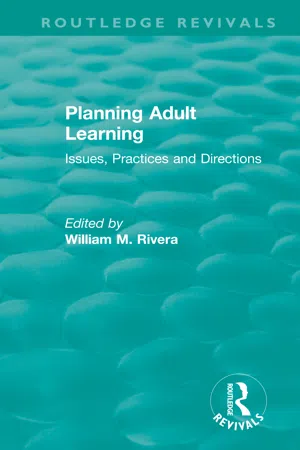
- 200 pages
- English
- ePUB (mobile friendly)
- Available on iOS & Android
eBook - ePub
About this book
Information
II
Agency Practices
of
Planning Adult Learning
Chapter 4
UNITED STATES FEDERAL GOVERNMENT PLANNING FOR ADULT BASIC AND ADULT SECONDARY EDUCATION*
Paul V. Delker
BACKGROUND
In the United States, all Federal government planning for education is conditioned by the principle that education is the responsibility of the separate States. This principle is explicit in the U.S. Constitution with no specific educational function prescribed to the Federal Government. Thus, Federal involvement in education takes place under the Constitutional responsibility to “provide for the general welfare”.
Federal support for adult basic and adult secondary education takes two forms. In the first form, federal dollars provide education for adults when it is evident that their education is related to achieving a national goal. An example of this type of support is the adult basic and secondary education services authorized under manpower and economic development programs. In the second form, Federal dollars are designed primarily to develop or increase the capacity of the fifty States to provide educational services already constitutionally designated to them. This type of support may be general, that is, directed to all citizens, or it may be categorical and aimed at specific sub-groups of the population.
The Adult Education Act of 1966 as amended and its antecedent legislation is an example of the second form of Federal Support. This Act provides funds to States on a formula basis for the purpose of providing adult basic and adult secondary education to out-of-school adults 16 years and older who are in need of such education. Federal funds may provide up to ninety percent of total costs and no fees may be charged those in basic education programs. The high percentage of Federal funds provided is designed to encourage States to make available education services to these adults. In theory, this kind of Federal incentive is not needed since States already have the responsibility of providing educational services to their citizens. However, in practice when such a responsibility is not carried out, for whatever reasons, Federal funds encourage States to provide education services and to develop or to increase their capacities to make these services available on a sustained basis. This is the case in the instance of the Adult Education Act.
In the first part of this article, the policies and planning requirements of the Adult Education Act will be described and analyzed. In the second part, the mechanisms and efforts to coordinate federal-level planning of adult basic and adult secondary education programs will be discussed.
STATE PLANNING FOR ADULT EDUCATION
The Adult Education Act
Before undertaking an analysis of the Adult Education Act, a word about terminology may avoid confusion. The Act authorizes only Adult Basic and Adult Secondary level programs and refers to these collectively as “Adult Education”. In other legislation, most notably The Higher Education Act, post-secondary level adult education is referred to as “Continuing Education”. In general parlance these terms are not so discrete; nevertheless, in this article, unless explicitly noted otherwise, the term Adult Education will connote secondary level adult education and basic education taken together.
At the time the Adult Education Act and its antecedent Title IIB of the Economic Opportunity Act of 1964 became law, there were virtually no adult basic education programs generally available to citizens of any State. This reality accounted for several policies in the original legislation, especially those of authorizing Federal funds to support ninety percent of programs on a statewide basis and the absence of any limit on the amount allowed for State administration costs. These policies were explicitly conceived as aiding States in developing an adult basic education capacity that did not exist. These two provisions, along with other features promoting the States’ capacities to provide adult education programs, are found in the legislation today.
State Planning Requirments
In order to qualify for Federal funds under the Adult Education Act, a State must submit and have approved a comprehensive State Plan for Adult Education. This Plan must cover a period of not less than three years, and all States have in fact conformed to a three year cycle since the provision was incorporated into the Act in 1978. No annual updates or amendments are required during the three-year cycle unless the State administration or program provisions vary substantially from the approved Plan. The State may vary its program at any time provided it files and receives approval for changes through a State Plan Amendment.
The State Plan requirement found in the Adult Education Act is typical of Federal formula programs in education since 1917. The State Plan requirements of specific legislation may vary widely but can generally be categorized as either “prescriptive” or “enabling”. Prescriptive State Plan requirements tend to give States little latitude in the steps taken in developing the Plan and often prescribe formulas or factors the State must use in distributing funds, the make-up, functions, and representation of planning and advisory groups, and administrative processes. Enabling State Plan requirements, on the other hand, characteristically leave most specific determinations to the State and require only a description of the general system developed to comply with basic requirements in the law. Stated simply, enabling State Plan legislation sets forth requirements which answer the question “What?”. Prescriptive Plan legislation sets forth requirements which answer both the questions of “What?” and “How?”.
The history of Federal requirements for State planning through the State Plan approval process has sponsored a continuous discussion about the effectiveness of that process. Some analysts contend that the State Plan is viewed by States principally as a document of compliance executed to qualify the State for Federal funds and as having no appreciable effect on educational planning. Others contend that the State Plan is indeed an instrument of planning and results in more effecive educational planning in the State, at least in the area addressed by the Federally supported program.
No authoritative study of this dichotomy has been conducted to attempt to determine the effects “prescriptive” or “enabling” State Plan requirements have on promoting compliance as opposed to improved educational planning. In recent years, a strong move has been made to reduce prescriptive planning requirements to a minimum by combining a variety of Federally funded programs into “block grants”, but this effort has met with limited success in education. Supported especially by Republican administrations for almost twenty years, the Congress has been reluctant to reduce categorical programs and categorical accountability in favor of greater State control and discretion.
The Adult Education Act clearly falls into the category of enabling State Plan requirements. This can be clearly illustrated by contrasting a requirement in the Vocational Education Act with the equivalent requirement in the Adult Education Act. The former requires the State to establish a State Council on Vocational Education and prescribes thirteen members, seven of whom must be from the private sector, five of these seven coming from business, industry, and agriculture, one of whom must represent small business concerns and one of whom must be a member of the State Council established under the Job Training Partnership Act. Two of the seven must represent labor organizations. The remaining six members must be representative of secondary and post-secondary vocational institutions, and the qualifications of these individuals are similarly prescribed in an attempt to broadly represent the sub-interests of those in secondary and post-secondary vocational education. The Vocational Education Act goes on to prescribe the duties and functions of the Council and sets forth a minimum meeting requirement. In all, the State Council of Vocational Education requirements take up slightly more than two pages of the Act, or 118 lines.
In contrast, the Adult Education Act currently devotes three lines to “State Advisory Councils”.
Sec. 311. Any State may use funds granted under Section 304 to support a State advisory council which assists the State educational agency to plan, implement, or evaluate programs or activities assisted under the Act (underline added).(1)
A State Advisory Council is permitted, not required, and its size, composition, representation, frequency of meeting and functions are left up to the discretion of the State.
The two contrastive approaches to Federal-State planning requirements represent two different philosophies of public administration. The prescriptive approach assumes that both processes and specific planning and administrative mechanisms can be prescribed to the betterment of all States. The enabling approach assumes this cannot be done and permits States to vary their mechanisms according to geographic, historical, demographic and cultural differences.
The Planning Process
The Adult Education Act prescribes a planning process while leaving each State free to determine the methodology for executing that process. The process is designed to complement the policy that each State should actively plan for and work toward providing adult education programs for all adults in the State.
Section 306(b)(1) of the Act requires the State to “set forth a program...to carry out the purposes ...with respect to all segments of the adult population”.(2) This provision makes explicit the responsibility of the State to provide adult basic and adult secondary education for all adults.
The process designed to support carrying out this responsibility requires that in its Plan the State identify (A) the needs of the population of the State for services authorized under the Act, (B) the other resources in the State available to meet those needs, and (C) the goals the State will seek to achieve in meeting those needs over the period covered by the plan.(3)
The type of needs assessment, the method of identifying resources and the process for articulating and setting goals are not prescribed. By design, this results in a variety of approaches and methodologies being used by the various States. As a result, in general, the level of sophistication of planning for adult education is more a reflection of each State’s overall sophistication in educational planning than it is a result of the explicit requirements of the Adult Education Act.
During the period 1970 to 1985, the Act limited the amount of money the States could spend on administering the State Plan. This served to constrain many States in collecting new data that might relate to determining needs, available resources, and in the types of activities available for participatory goal setting. In 1985, this administrative limitation was removed. However, with overall funding proposed to remain level and with continuing pressure for increasing program services, there is little likelihood that most States will elect to substantially increase their administrative costs in order to generate relevant new data and to undertake more costly planning. Because most States can readily identify adult education needs well beyond the resources available to support program services, there is little incentive for State administrators to divert needed funds to a more elaborate planning process. Most administrators are convinced more sophisticated data and planning are not needed in order to make sound management decisions about funding and distributing resources.(4)
Participatory Planning
The 1978 amendments to the Adult Education Act were designed to expand services to undereducated adults who would not readily be reached by or attracted to an adult education system controlled primarily by the public school system. While evaluation studies indicated those being reached were being quite well served in a cost effective program,(5) other data indicated large segments of the eligible population - especially those the legislative history referred to as the “least educated and most in need” - were not being reached. To counter this trend, the amendments mandated expanding the program through outreach programs to those adults not being served through the existing network. The principal, although not the sole, mechanism for stimulating expansion and outreach was an entirely new participatory planning requirement.
Since 1978 Section 306(b)(8) of the Act has required States to involve a host of non-public school agencies and organizations in developing and carrying out its program. Regulations implementing this requirement specify those to be involved:
The SEA shall describe the means by which one or more representatives of each of the following agencies and groups were involved in the development of the State plan and how they will continue to be involved in carrying out the plan: (1) The business community; (2) Industry; (3) Labor unions; (4) Public educational agencies and institutions; (5) Private educational agencies and institutions; (6) Churches; (7) Fraternal/sororal organizations; (8) Voluntary organizations; (9) Community organizations; (10) State manpower and training agencies; (11) Local manpower and training agencies; (12) Adult residents of rural areas; (13) Adult residents of urban areas with high rates of unemployment; (14) Adults with limited English language skills; (15) Institutionalized adults; (16) Other entities concerned with adult education, such as basic skills programs, volunteer literacy programs, libraries, and organizations offering education programs for older persons and military personnel and their adult dependents.(6)
Although the l...
Table of contents
- Cover
- Half Title
- Title Page
- Copyright Page
- Original Title Page
- Original Copyright Page
- Table of Contents
- Editor’s Note
- Acknowledgements
- Notes on Contributors
- Introduction
- I. CONCEPTUAL, POLITICAL AND LEGAL ISSUES IN PLANNING ADULT LEARNING
- II AGENCY PRACTICES OF PLANNING ADULT LEARNING
- III DIRECTIONS IN PLANNING ADULT LEARNING
- CONCLUSION
- INDEX
Trusted by 375,005 students
Access to over 1.5 million titles for a fair monthly price.
Study more efficiently using our study tools.
Frequently asked questions
Yes, you can cancel anytime from the Subscription tab in your account settings on the Perlego website. Your subscription will stay active until the end of your current billing period. Learn how to cancel your subscription
No, books cannot be downloaded as external files, such as PDFs, for use outside of Perlego. However, you can download books within the Perlego app for offline reading on mobile or tablet. Learn how to download books offline
Perlego offers two plans: Essential and Complete
- Essential is ideal for learners and professionals who enjoy exploring a wide range of subjects. Access the Essential Library with 800,000+ trusted titles and best-sellers across business, personal growth, and the humanities. Includes unlimited reading time and Standard Read Aloud voice.
- Complete: Perfect for advanced learners and researchers needing full, unrestricted access. Unlock 1.5M+ books across hundreds of subjects, including academic and specialized titles. The Complete Plan also includes advanced features like Premium Read Aloud and Research Assistant.
We are an online textbook subscription service, where you can get access to an entire online library for less than the price of a single book per month. With over 1.5 million books across 990+ topics, we’ve got you covered! Learn about our mission
Look out for the read-aloud symbol on your next book to see if you can listen to it. The read-aloud tool reads text aloud for you, highlighting the text as it is being read. You can pause it, speed it up and slow it down. Learn more about Read Aloud
Yes! You can use the Perlego app on both iOS and Android devices to read anytime, anywhere — even offline. Perfect for commutes or when you’re on the go.
Please note we cannot support devices running on iOS 13 and Android 7 or earlier. Learn more about using the app
Please note we cannot support devices running on iOS 13 and Android 7 or earlier. Learn more about using the app
Yes, you can access Planning Adult Learning by William M. Rivera in PDF and/or ePUB format, as well as other popular books in Education & Education General. We have over 1.5 million books available in our catalogue for you to explore.