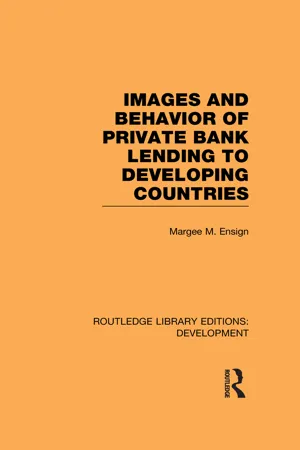
The primary questions addressed by this study, first published in 1988, focus on how private bankers made decisions on the creditworthiness of developing countries during the 1970s and what the implications of these decision rules are for the developing countries today. Based on interviews with senior bankers about their decision rules, the author has developed artificial intelligence-based simulations of their images of creditworthiness. Discussed are contemporary proposals for solving the debt crisis.
- 124 pages
- English
- ePUB (mobile friendly)
- Available on iOS & Android
eBook - ePub
Images and Behaviour of Private Bank Lending to Developing Countries
IV: Images and Behavior
This chapter examines how six international bankers assessed the creditworthiness of the developing country borrowers and what the relationship was between their images of creditworthiness and their lending behavior. For each lending period considered, the implications of this relationship for the developing country borrowers is assessed.
The image of creditworthiness for the conservative bankers during the first period of lending is presented and compared to empirical data on loans, followed by that for the aggressive bankers. Finally the merged image of creditworthiness for the second period of lending is presented and analyzed. During the initial period of lending, the conservatlve bankers lent to twelve developing countries. The total amount loaned was $1580.9 million, (See Table 4.1. All tables are located at the end of the chapter.)
These bankers, when compared to the aggressive bankers on amount loaned, were risk averters. They lent 35.1 percent less than the aggressive bankers. This is also reflected in the relationship between the amount loaned and the spread. The amount loaned and the spread should coincide if both indicators are measuring a common representation of risk. For the conservative bankers, the opposite held during this initial period of lending. The countries which received the most from these bankers, in general did not receive the best terms. There was a negative, but weak, relationship between the amount loaned and the spread (r2=-.184). The countries which borrowed the most from these bankers did not receive the best terms as represented by the spreads. This is an indication that the bankers protected themselves during this initial period of lending, even though it was a borrower's market. Since the total amount loaned is a clearer indicator of risk assessment, the total amount loaned or volume was used as the indicator of creditworthiness and compared to the country characteristics generated by the simulation of the conservative bankers' image of creditworthiness.
When the simulation of the conservative image was run reflecting the market conditions of the first period of lending, ten algorithms were triggered. Each statement that was triggered in the simulation was compared to empirical data to determine whether there was a relationship between the image and the behavior on lending. The volume of lending was used to rank the countries, and a rank order correlation coefficient was computed for the independent variables represented by the algorithms, where the two variables were at least ordinal level variables, and pearson's r (correlation coefficient) was computed when the variables reached the interval level.
Did the conservative bankers lend to countries which reflected the algorithms generated by the simulation? Can the image of creditworthiness explain the behavior of the conservative bankers towards lending to LDC governments? The foremost concern of the conservative bankers was with the stability of the LDC government. They measured this not only by considering information on elections or transfers of power but also on recent terrorist activity within the country. According to these bankers, terrorism was a strong indicator of a government's stability. The rank order correlation between volume loaned and data on terrorist activity for the countries which received loans from these banks, (rs=.384), indicates that the countries which received the most from these bankers also had the smallest amount of terrorist activity during the initial period of lending, (See Table 4.2).
For the conservative bankers, another indicator of government stability was the manner in which governmental power was transferred. A stable government, according to this Image, changed power in an orderly, non-violent fashion. In general, all of the countries, except Peru, which received loans from the conservative bankers matched this image of a stable and orderly transfer of power (See Table 4.3). Governments which received loans from these bankers were stable (as defined by the bankers) and those who received the greatest amount experienced the smallest amount of terrorist activity within the country.
An additional criterion for the conservative bankers was a governments' attitude toward foreign direct investment.
This was important, according to the bankers, because many of their clients had existing operations within many of the developing countries. The conservative bankers examined in particular the governments' attitude towards U.S. based firms. The six countries which received the largest amount in loans from these banks had the highest percentage of direct investment (of all LDC's which allowed foreign investment), and all of these countries except for Brazil and Peru, encouraged U.S. direct investment, (See Tables 4.4 to 4.6). With only two exceptions, during the period preceding the initial period of lending, all of the countries which received loans from the conservative bankers either allowed or actively encouraged foreign direct investment from the U.S. These same countries were also considered safe for the operations of the multinational banks. Only one country imposed any restrictions on the activitles of the multinational banks within their borders. Mexico barred the multinational banks from operating in the rural banking sector. In general then, there was a match between the algorithms generated by the conservative image and the indicators of political stability.
The economic analysis conducted by the conservative bankers focused on the level of development of the economy and potential growth possibilities. These bankers indicated that they would not loan to countries with G.N.P. per capita of less than $250.00 nor would they lend to countries with growth rates of less than 2.5 percent.
The first indicator on G.N.P. per capita does not entirely match the image of the conservative bankers. (See Table 4.7.) Five of the twelve countries which received loans from the conservative bankers had G.N.P.'s per capita of less than $250.00. On the other hand, these same countries had high rates of growth during this same period. All twelve countries had growth rates above 2.5 percent for the period 1960-1968 preceding the initial lending period. The rank order correlation betw~en amount loaned and G.N.P per capita is positive, but very Vieak (rs=.070) while the correlation between amount and growth rate is stronger, and also positive (rs= .273). Those countries which received the greatest amount from these bankers, in general also had the strongest economies on these measures.
An additional factor incorporated into the analysis on creditworthiness by the conservative bankers was whether the developing country had a stable and diversified source of foreign exchange. On this indicator, the bankers· image did not correspond with their lending behavior (See Table 4.8). The conservative bankers lent the most to countries which had a highly concentrated source of foreign exchange. Only two of the eight countries for which data were available in the period preceding the initial period of lending had a diversified source of foreign exchange. For Iran, the country which received the most in loans from these particular bankers, crude petroleum made up 78 percent of its foreign exchange earnings and for Brazil, which ranked third in total amount received, 44 percent of its foreign exchange earnings came from coffee, a commodity which was highly unstable during the late 1960's and early 1970's.
This mismatch between the bankers· image of what constituted creditworthiness and their behavior on loans is significant.
These two countries ran into severe difficulties with the banks later in the 1970's. However, both of these countries also scored higher on the political indicators deemed important by the conservative bankers, perhaps overriding the low ranking on this issue.
On an additional indicator, the bankers· behavior did not coincide closely with their images. The conservative bankers· image indicated that the structure of long term debt preceding the initial period of lending, should have consisted primarlly of bilateral (government to government) debt. For none of the countries which received loans from the conservative bankers, was their debt primarily bilateral in nature. For all of these countries, the structure of their debt in 1970 consisted mainly of suppliers credits, or for some of the major borrowers, it already consisted of debt to private sources. 1
Finally, the conservative bankers image indicated that a commitment to human development, particularly to education, on the part of the LDC government was a factor although a secondary one, in the assessment of creditworthiness. While it was difficult to pinpoint ...
Table of contents
- Cover
- Title
- Copyright
- Original Title
- Original Copyright
- Contents
- METHODOLOGY
- IMAGES AND BEHAVIOR
- BAKER, BRADLEY, AND BEYOND
- APPENDIX ONE: THE SIMULATIONS
- BIBLIOGRAPHY
- INDEX
Trusted by 375,005 students
Access to over 1.5 million titles for a fair monthly price.
Study more efficiently using our study tools.
Frequently asked questions
Yes, you can cancel anytime from the Subscription tab in your account settings on the Perlego website. Your subscription will stay active until the end of your current billing period. Learn how to cancel your subscription
No, books cannot be downloaded as external files, such as PDFs, for use outside of Perlego. However, you can download books within the Perlego app for offline reading on mobile or tablet. Learn how to download books offline
Perlego offers two plans: Essential and Complete
- Essential is ideal for learners and professionals who enjoy exploring a wide range of subjects. Access the Essential Library with 800,000+ trusted titles and best-sellers across business, personal growth, and the humanities. Includes unlimited reading time and Standard Read Aloud voice.
- Complete: Perfect for advanced learners and researchers needing full, unrestricted access. Unlock 1.5M+ books across hundreds of subjects, including academic and specialized titles. The Complete Plan also includes advanced features like Premium Read Aloud and Research Assistant.
We are an online textbook subscription service, where you can get access to an entire online library for less than the price of a single book per month. With over 1.5 million books across 990+ topics, we’ve got you covered! Learn about our mission
Look out for the read-aloud symbol on your next book to see if you can listen to it. The read-aloud tool reads text aloud for you, highlighting the text as it is being read. You can pause it, speed it up and slow it down. Learn more about Read Aloud
Yes! You can use the Perlego app on both iOS and Android devices to read anytime, anywhere — even offline. Perfect for commutes or when you’re on the go.
Please note we cannot support devices running on iOS 13 and Android 7 or earlier. Learn more about using the app
Please note we cannot support devices running on iOS 13 and Android 7 or earlier. Learn more about using the app
Yes, you can access Images and Behaviour of Private Bank Lending to Developing Countries by Margee M. Ensign in PDF and/or ePUB format, as well as other popular books in Economics & Business General. We have over 1.5 million books available in our catalogue for you to explore.