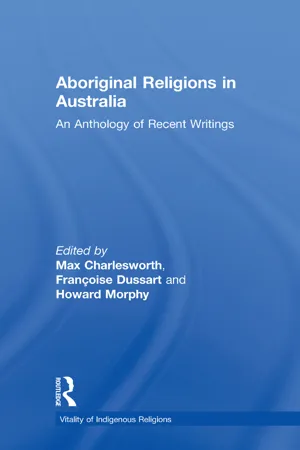
eBook - ePub
Aboriginal Religions in Australia
An Anthology of Recent Writings
- 342 pages
- English
- ePUB (mobile friendly)
- Available on iOS & Android
eBook - ePub
Aboriginal Religions in Australia
An Anthology of Recent Writings
About this book
Over the last 25 years there has been an explosion of interest in the Aboriginal religions of Australia and this anthology provides a variety of recent writings, by a wide range of scholars. Australian Aboriginal Religions are probably the oldest extant religious systems. Over some 50,000 years they have coped with change and re-invented themselves in an astonishingly creative way. The Dreaming, the mythical time when the Ancestor Spirits shaped the territories of the Aborigines and laid down a moral and ritual law for their occupants, is the fundamental religious reality. It is the basis of the Aborigines's view of their land or country, kinship relationships, ritual and art. However, the Dreaming is not a static principle since it is interpreted in different ways, as in the extraordinary movement in contemporary indigenous painting, and in attempts at an accommodation with Christianity. The contributions of anthropologists, cultural historians, philosophers of religion and others are included in this anthology which not only guides readers through the literature but also ensures this still largely inaccessible material is available to a wider range of readers and non-specialist students and academics.
Information
PART 1: REVALUATIONS
Broadly speaking, our interest in understanding other cultures and their religious systems is very much a 19th and 20th century development. This kind of understanding requires that we develop an imaginative capacity to ‘stand outside’ our own cultural and religious world and enter empathetically into the world of another culture. This means in turn that we do not see other religions as ‘primitive’ and inferior to the monotheistic religions (Judaism, Christianity, Islam) of Western Europe and the Middle East, but that we take them seriously and not as some kind of infantile mumbo-jumbo.
John Mulvaney’s sensitive account of the work of Baldwin Spencer and his remarkable associate Frank Gillen shows how the early anthropologists of the late 19th and early 20th centuries grappled with understanding the extraordinarily complex religious systems of the Aboriginal peoples of Australia. On the one hand, Spencer and Gillen were observers of genius and sympathetically described the myths, rituals, ceremonies and the Ancestral Law or ‘Dreaming’ of various Aboriginal peoples. Unfortunately, on the other hand, their ideas were distorted by an evolutionistic theory, which they shared with their contemporaries, about the development of societies and religions.
L.R. Hiatt dwells critically on the assumption made by the early anthropologists and others that the Australian indigenous peoples believed in ‘Gods’, and even in a Supreme God of a Judaeo-Christian kind. He also discusses the myth of the Rainbow Serpent which some have seen as being common to all Aboriginal belief systems.
W.E.H. Stanner (1905–1982), a professor of anthropology and sociology at the Australian National University in the sixties and seventies, is now commonly seen as the most significant figure in the development of interest in Aboriginal religions. Stanner was a humanist with a profound respect for Aboriginal thinking – a respect that was reflected in his approach to anthropology. In his close and critical analysis of Stanner’s views of Aboriginal religion, Ian Keen shows how central philosophico-religious ideas were for Stanner, but he also uncovers a number of dubious assumptions that he made, particularly about the ‘sacramental’ character of Aboriginal religions and the idea of ‘sacrifice’.
Over the last one hundred years anthropologists have played a major part in promoting a deeper understanding of the religions of Australia’s Aborigines (probably more than 50,000 years old) so different from other ‘world religions’ and other indigenous religions. But there is now an increasing interest in Aboriginal religions by cultural historians, philosophers of religions, theologians and others.
Max Charlesworth
1
Baldwin Spencer and F.J. Gillen
The Amnia: A Stone Age People was published late in 1927 under the joint authorship of Spencer and Gillen, but by now Gillen’s contribution was considerably diluted. It was dedicated ‘To Our Master, Sir James Frazer’. ‘So our names will go down linked together’, Frazer exulted: 1
your reputation rests…on the fundamental facts of human history which you have discovered…You have opened up…a deeper mine into the past of human institutions than anyone else has ever done…I have worked at the products you have brought up from the mine, as hundreds of people…will do for generations to come…
The mining simile was appropriate, for those golden words were redolent of an age before the gilt began to peel, when academic sages were immortal; Frazer, the author of Questions on the Customs, Beliefs and Languages of Savages, when asked which particular savages he had worked amongst, simply replied,2 Tut Heaven forbid!’ Frazer’s reputation today approaches its nadir as critics examine the rotten trunk from which The Golden Bough was hewn. Sir Edmund Leach3 has reflected on the transitory nature of academic fashion which now reveals it to have been merely a ‘Gilded Twig’.
Hindsight renders criticism facile and reputations are rarely maintained untarnished into later academic generations. Have Spencer (and Gillen) stood the test of time better than their ‘Master’? Spencer’s anthropology in 1926, as in 1896, was flawed in its theory, through its limited range of informants and by his linguistic deficiencies. Yet his contribution should be assessed from the perspective of anthropological history. Even half a century after his death few anthropologists have written more than he on Aboriginal society. Quantity may be a poor criterion, but he was exceptional in that all his books were based upon personal field research. From the time of his first association with Gillen, whose observation of Aboriginal life then approached a quarter of a century, he spent almost thirty-two months in contact with Aborigines, either as anthropologist, biologist or welfare officer. This constituted an exceptional record for its time.
Gillen’s Alice Springs experience was supplemented by Spencer’s total time spent in that area of over six months.
Spencer’s last visit to Alice Springs in a sense symbolized the end of the era of nineteenth-century fieldwork. Almost simultaneously a group of young anthropologists including A.P. Elkin, Donald Thomson and Lloyd Warner entered the field, either directed from the new Sydney University anthropology department or with funding from the Australian National Research Council, both bodies whose establishment Spencer had assisted. It is noteworthy that most researchers were supported financially henceforth throughout their prolonged residence, whereas much of Spencer’s work was self-funded. The new anthropologists were professionals, in the sense that their field research was a full-time occupation, oriented partly towards improving the chances of their future employment as academic anthropologists. Spencer was a busy biology teacher and his excursions were sandwiched into university vacations. Taken together with the financial aspects, these factors explain the brevity of his visits. His two year-long expeditions were made possible only because he sacrificed two sabbatical leave entitlements in that cause.
Spencer’s predecessors from Brough Smyth to Howitt had relied for most of their information upon correspondents, or they contacted Aborigines within their immediate and much detribalized areas. They never met many of their correspondents and although the quality of their information varied, they were unable to evaluate it because they seldom possessed any personal familiarity with the region concerned. Spencer either obtained his own information in the outback amongst more traditionally oriented people or he selected his own European agents as a result of these visits. They were men whose opinions he trusted and whom he enthused in the unusual task of recording the life of normally despised natives. His informants were men of character whose often unconventional initiative placed them above the ruck of hardy pioneers. Men of the calibre of Gillen, Byrne, Cowle, Cahill and Field had few equals in the correspondents of the earlier compilers. Their letters are testimony to their pains in obtaining the information which he sought, even grudgingly as in Cowle’s case. Because they respected ‘the prof’ who yarned and drank with them, he was able to question their findings and because he knew their region, he could direct their investigations. Although some informants previously owned ethnographic collections, Spencer interested them in enlarging them. He personally paid the expenses and freight charges on much of this material, including consignments from Cowle and Cahill. As director and trustee of the museum, he also arranged the purchase from public funds of such major collections as those assembled by Gillen and Field. Items from these collections now enrich displays in many countries and, belatedly, they are contributing significantly towards an understanding of the cultural diversity and creativity of mankind. Fortunately the bulk of these collections remain in Australian institutions and constitute a cultural archive of inestimable value to the national Aboriginal heritage.
Gillen was Spencer’s most striking success. A comparison of Gillen’s stilted contributions to the Horn volume (and even that was edited by Spencer) with the stream of ethnographic data which issued from his pen during the following months establishes that Spencer’s praise and critical questioning converted random comment into directed observation, even though its form was anecdotal and its expression was colloquial. The colourful correspondence from Spencer’s informants should be compared with the formal responses or completed pro forma questionnaires which Howitt received from most of his contacts, for the contrast is striking. The context of the times and circumstances under which Spencer worked should be considered, therefore, in any assessment of his place in Australian anthropology.
During his career as a part-time anthropologist, possibly only two observers could have claimed more extensive contact with traditionally oriented Aborigines. One was Daisy Bates. Her reputation is being enhanced as her voluminous notes in the Australian National Library are investigated, but her publications were few and slight. The other claimant is Spencer’s Oxford classmate W.E. Roth, whose stature is overdue for reassessment. His experience as a doctor and Protector of Aboriginals in Queensland spanned more than a decade and much of his factually oriented record of material culture and economic aspects is of outstanding merit, despite his lack of literary polish. Spencer rather disparaged Roth’s work, possibly because Roth was not interested in the social evolutionary models which so preoccupied Howitt, Frazer, Tylor and himself. ‘Curiously he makes no reference to totems…’ Spencer told Frazer rather scornfully, and ‘the rest of his work dealing with ceremonies shows that he has not been fully admitted to all their “sacred” matter though he evidently thinks he has’. (Criticism can be double-edged and Spencer’s critics might advance an identical comment.) Spencer also considered that even if Roth was an anthropologist, he was not a gentleman. Roth dwelt upon ‘ethno-pornography’, while Spencer dealt circumspectly with sexual matters even though he did not suppress them. ‘The one great drawback of Roth’s work’ he confided to Henry Balfour,4 ‘is that he has looked at their customs from what one might call a dirty point of view and the expressions he uses such as “bucks” and “gentry” make you feel wild to think that he should spoil such a valuable piece of work in this way.’
Despite the potential of Bates and Roth as sources, they were individualistic recorders rather than collaborators with local informants whom they guided. They possessed neither Spencer’s intellectual vigour, output nor clarity. His field methodology is best understood as the systematic approach of a trained biologist, who applied his powers of observation and rapid recording to the behaviour of mankind. He was influenced considerably both by Howitt’s example and early Guidance and by Frazer’s praise and suggestions and he freely acknowledged this debt. However, he maintained a healthy independence and he worried about methodological and theoretical issues more than some of his critics allowed. Due partly to Andrew Lang’s rather mischievous intervention, undue emphasis has been placed upon the conflicting interpretation of specific matters by Spencer and Pastor Strehlow.
From their cosy upholstered armchairs, the social theorists of Edwardian times used the stick of selectively chosen items from Spencer and Gillen to beat the conjectures of their opponents. The effectiveness of their blows was limited from that position, but united only by their unwillingness to attempt fieldwork themselves, they shouted abuse to gain verbal dominance. Probably Spencer and Gillen in their heyday had few readers who did not perceive their publications through the intellectual filter of their chosen exponent of social institutions, such as Tylor, Frazer, Crawley, Lang or Durkheim. It will be shown that the same sieve-like factor applied both to the presentation and the interpretation of Carl Strehlow’s data.
The theorists combed ethnographic sources in their atomistic and opinionated search for survivals or curious customs with which to adumbrate contemporary models of evolutionist and rationalist dogmas. They identified Australian culture simplistically with its celebrated Arunta tribal fragment and shredded, patched and generalized it according to individual taste. By the time that The Arunta was published, these erudite sages were as tired as most of their ideas, so fewer anthropologists may have read it because of its authors’ association with increasingly unfashionable concepts. This is regrettable because this book incorporated fresh data and hinted at new possibilities.
Spencer’s constructive attitude towards Radcliffe-Brown is interesting, because his personal opinion of his cha...
Table of contents
- Cover
- Half Title
- Title Page
- Copyright Page
- Table of Contents
- List of Illustrations, Maps and Colour Plates
- List of Contributors
- Acknowledgements
- Introduction
- Part 1: Revaluations
- Part 2: Religious Business
- Part 3: Sacred Places
- Part 4: Art and Religion
- Part 5: Different Dreamings
- Part 6: Religions and Law
- Part 7: Religious Exchanges
- Index
Trusted by 375,005 students
Access to over 1.5 million titles for a fair monthly price.
Study more efficiently using our study tools.
Frequently asked questions
Yes, you can cancel anytime from the Subscription tab in your account settings on the Perlego website. Your subscription will stay active until the end of your current billing period. Learn how to cancel your subscription
No, books cannot be downloaded as external files, such as PDFs, for use outside of Perlego. However, you can download books within the Perlego app for offline reading on mobile or tablet. Learn how to download books offline
Perlego offers two plans: Essential and Complete
- Essential is ideal for learners and professionals who enjoy exploring a wide range of subjects. Access the Essential Library with 800,000+ trusted titles and best-sellers across business, personal growth, and the humanities. Includes unlimited reading time and Standard Read Aloud voice.
- Complete: Perfect for advanced learners and researchers needing full, unrestricted access. Unlock 1.5M+ books across hundreds of subjects, including academic and specialized titles. The Complete Plan also includes advanced features like Premium Read Aloud and Research Assistant.
We are an online textbook subscription service, where you can get access to an entire online library for less than the price of a single book per month. With over 1.5 million books across 990+ topics, we’ve got you covered! Learn about our mission
Look out for the read-aloud symbol on your next book to see if you can listen to it. The read-aloud tool reads text aloud for you, highlighting the text as it is being read. You can pause it, speed it up and slow it down. Learn more about Read Aloud
Yes! You can use the Perlego app on both iOS and Android devices to read anytime, anywhere — even offline. Perfect for commutes or when you’re on the go.
Please note we cannot support devices running on iOS 13 and Android 7 or earlier. Learn more about using the app
Please note we cannot support devices running on iOS 13 and Android 7 or earlier. Learn more about using the app
Yes, you can access Aboriginal Religions in Australia by Françoise Dussart,Howard Morphy, Max Charlesworth in PDF and/or ePUB format, as well as other popular books in Theology & Religion & Christianity. We have over 1.5 million books available in our catalogue for you to explore.