- 270 pages
- English
- ePUB (mobile friendly)
- Available on iOS & Android
eBook - ePub
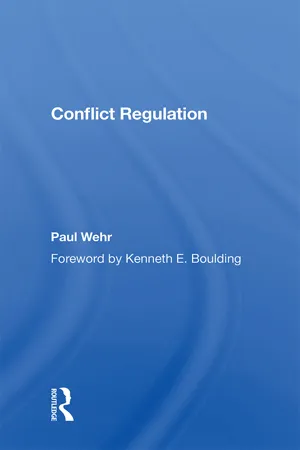
Conflict Regulation
About this book
This volume examines conflict and conflict regulation processes. The author reviews theories of conflict and techniques of conflict management and then presents case studies of self-limiting conflict in Gandhi's India, Nazioccupied Norway, and at a nuclear weapons plant in Colorado to illustrate unconventional approaches to conflict regulation. He
Information
1. Conflict Analysis
To effectively intervene in a conflict to resolve it, one must be able to analyze it properly. There are two levels of analysis that students of conflict regulation must master. At the macro level, we know much about the origins and dynamics of social and international conflict and about the relationship of conflict to violence. There is, however, no general theory of these processes nor is there agreement across or within disciplines. At this point in the development of the field, the best we can do is present a number of analytical frameworks to draw upon when analyzing a particular conflict case. Later in this chapter, an approach to microanalysis will also be presented.
Origins
Why does social and international conflict occur? Theoretical debates of the past two decades and the paradigms emerging from them suggest a number of propositions.
1. Conflict and fighting is innate in all social animals including man. This view is most clearly presented by ethologist Konrad Lorenz (1969). Its characterization of human conflict relies heavily on instinctual theories of aggression, competition for territorial space (Ardrey, 1966), and other parallels drawn between human conflict and conflictual interaction in lower animals. According to this approach, humans differ from the lower animals in their fighting habits primarily in that (1) humans have no natural weapons and have used their superior intelligence to create overly destructive ones, and (2) humans lack the inhibition against intraspecific killing that protects the survival of other species. Lorenz's proposals for regulation of conflict and fighting among humans concentrate on sublimation and displacement processes whereby destructive impulses are channeled into more or less constructive forms of fighting such as sports contests.
The response to this instinctual theory has been sharp and critical from some behavioral scientists (Montague, 1968; Gorney, 1973) and supportive from others (Storr, 1968). The major counterargument seems to be that the gap between human behavior and that of lower animals is too great to permit drawing the parallels ethologists do. As Kenneth Boulding puts it,
if displaced aggression in the goose leads to love, as Lorenz says it does, or if territoriality is a characteristic of the Uganda Kob, as Ardrey describes, does this mean either that man's ancestors possessed these qualities and attributes or that man today does? It is clear that a great leap has been made in the dark but it is by no means clear that our feet have landed on firm ground. (Montague, 1968:86)
Moreover, recent research by Leakey (1977) suggests that early man, more like lower animals in biological evolutionary terms, was a relatively pacific being. Although I tend not to accept the existence of a fighting instinct among humans, this idea does present an interesting challenge to social scientific conflict theory and should be part of a theoretical review of the field. The theory may have political importance as well. There is the possibility of a popularized form of the proposition becoming a self-fulfilling prophecy. If humans are genetically programmed to fight over territory and other values, then war is imbued with a certain inevitability, a "cosmic legitimacy" it otherwise lacks, and efforts to regulate conflict make less sense. This is not, of course, what Lorenz is saying, but when Ardrey popularized his territoriality concept at the height of the Vietnam War, the territoriality/fighting theory was cleverly woven into official justification of the war. In a Gallup poll of the late sixties, a large proportion of the respondents felt that war is an inevitable consequence of human nature and that efforts to do away with it are futile.
2. Social conflict originates in the nature of certain societies and how they are structured. This proposition is suggested by what are known as coercion theorists. Karl Marx is the most influential of the group, which views capitalist society as a highly stratified structure within which coherence is maintained through coercion of some groups or classes by others. This image of society and conflict origin implies an inevitable class-oriented conflict of interests—built-in latent conflict that must ultimately become manifest. Marcuse (1968) and C. Wright Mills (1959) provide variations on the basic theme that views conflict not as a random occurrence, but as the product of a capitalist social and economic structure.
Coercion theory implies that a conflict of interests within society is not permanent and that a consensual model of a classless society emerges from revolutionary social conflict. Various ideologues such as Lenin, Mao Tse-tung, and Fanon are contributers to this body of theory.
Other conflict theorists see social conflict emerging from control of some groups by others, but they do not relate that control necessarily to Marx's concept of social class. Dahrendorf (1959) sees an inevitable conflict of interests in society, but not between Marxist-type classes. According to Dahrendorf, authority, not property, is the prime source of social conflict. What he terms conflict groups are the agents of conflict. Social conflict centers around access to authority, and as "quasi-groups" such as laborers become aware of differential access to that authority, their latent interests become manifest, and conflict increases. Examples of conflict groups in American society would be labor unions and minority equal-rights organizations.
3. Conflict is an aberration, a dysfunctional process in social systems. This proposition is reflected in the theory of the consensus or integration school. Theorists such as Parsons (1951) and Smelser (1962) view society as a system cohering around normative consensus. Societal coherence is rooted in the legitimacy of both the social system and the roles and statuses within it as perceived by its members. The social order need not, according to this view, be imposed by groups with predominant power, because it is perceived legitimacy that sustains it. When and where conflict occurs, it is a random, almost incidental process and reflects a pathological strain in the system—a threat to systemic equilibrium. If the strain becomes too great, political revolution may occur as system legitimacy disintegrates (Johnson, 1966). These theorists see cooperation as the normal state of interpersonal and inter-group relations in any society, and it seems difficult for them to deal with the processes of conflict and change within a society—particularly the important reciprocal relationship between those processes.
Although the coercion and consensus explanations of social conflict have battled it out over the past two decades, Dahrendorf observes that
a decision which accepts one of these theories and rejects the other is neither necessary nor desirable. There are sociological problems for the explanation of which the integration theory of society provides adequate assumptions; there are other problems which can be explained only in terms of the coercion theory of society; there are finally, problems for which both theories appear adequate. For sociological analysis, society is Janus-headed, and its two faces are equivalent aspects of the same reality. (1959:159)
He goes on to suggest how the coercion and consensus views might be compatible in a general theory of conflict. His own conflict/integration model gives equal weight to the stable and the changing aspects of society—its recurring, conserving elements and its innovative, discontinuous ones.
Dahrendorf categorizes conflict as legitimate and routinized or illegitimate and uncontrolled, as interest groups develop and begin to conflict with those having exclusive access to authority. The challenging groups engage in illegitimate or encapsulated conflict, since they are not initially accorded legitimacy by dominant groups. The past century of American history reflects the repressive response of existing authority structures to the challenges of the labor movement, racial and ethnic minorities, and women (Gurr and Graham, 1970). Until recently the United Farm Worker movement was denied the right to conflict by farm management, state governments, and in many instances even the judiciary.
Once conflict groups have attained the right to conflict, and acceptable arenas and appropriate means of conflicting over access to authority have been determined, conflict becomes routinized and conflict management can occur within recognized bounds—by the rules, so to speak. Gamson (1975) has identified various means by which challenging groups in American history have achieved this right to conflict. Before a struggling group is recognized as a legitimate conflict agent, the conflict may be violent, with structural changes resisted in every possible way by groups having dominant access to authority. When legitimacy is recognized, however, the possibilities for regulation of conflict through institutionalization are greatly improved.
Dahrendorf's integrative theory of conflict encourages the formulation of composite theoretical frameworks for clarifying the origins of conflict. There are no general theories, and one should piece together a coherent framework for oneself.
4. Conflict occurs because it is functional for social systems. Conflict is not inherently pathological or necessarily dysfunctional. Coser (1956) illustrates through testable propositions how societies can be strengthened internally, relations between societies maintained and reinforced, and social pathology reduced—all through conflict. Oberschall (1973) sees the conflict associated with social movements as potentially functional for social systems. The functionality of conflict is, however, heavily dependent on the reference unit. War with another nation may bring coherence and internal strength to a society and may therefore be functional for that society. At the same time, however, it may also be dysfunctional for the regional and international systems that society is part of. It is important to distinguish between short- and long-run functionality. An external threat that pulls a society together may permit short-range survival, but over long periods may bring about deterioration through attrition. Israel could be a case in point.
Ethnologists such as Bourdieu (1962) have pointed out the functional, even indispensable role that conflict plays in certain traditional societies. Among the Berber Kabyles of North Africa, for example, balance and controlled conflict have been keystones of societal maintenance. Himes (1966) applies the functional theory of conflict to an analysis of racial conflict in the United States, where the conflict process has permitted considerable power equalization and status coordination between races, thereby strengthening the larger society.
5. Conflict between societies occurs because each, as a nation-state, pursues often incompatible national interests. These interests center around security, power, and prestige. Scholars and practitioners supporting this proposition see the nation-state as a totally different type of conflict unit—different primarily because of the concept of national sovereignty and the absence of enforceable constraints and sanctions on national behavior in the international system.
Competing national interests, miscalculation by leaders, the over-concentration of power in any one locus—these are the roots of war, according to this perspective. Hans Morgenthau (1967) is perhaps the most influential of these theorists, a group we might call the realist school. Kissinger (1964) and Knorr (1966) also take the power politics perspective in the analysis of international conflict, with the balance of power, deterrence, blocs, spheres of influence, national security, and national interest being the central concepts.
While the power politics model seems to be currently dominant in the analysis of international conflict, it is challenged by another group of theorists that sees the world as an increasingly global system in which nation-states make up only one set of actors. Their research focuses on transnational networks—legal structures, multinational corporations, voluntary associations, supranational organizations, religious bodies, and the like—that bypass or are not directly dependent on national governments and increasingly influence global processes. Kriesberg (1972), Angell (1969), Alger (1975), Judge (1972), Nye and Keohane (1971), and Falk and Mendlovitz (1966) provide a counterview to the conventional image of the international system as a jumble of power blocs, clashing national interests, and warring states. Perhaps the most accurate label for this emerging school of theory would be the transnational interaction perspective.
There are other challenges to the power politics view of the origins of international conflict as well. Linkage theory posits the existence of multiple subsystems (Singer, 1969) that facilitate the interpenetration of national systems, and it calls into serious question the classic power politics worldview. One approach sees foreign policy, including warmaking and conciliation, as at least a partial extension of domestic politics. Any thoughtful observer of the Southeast Asia policies of recent American administrations would have support for such a view.
The Marxist model too, is ultimately extended to an analysis of relationships between nation-states. Marxism is a general theory that characterizes a global conflict of interests as inherent in the capitalist international structure with its exploited and exploiting—the latter conflicting both with the exploited and among themselves for resources and markets. Modern interpretations of this view would include Baran and Sweezy (1968) and Galtung (1970).
Other approaches to analyzing origins of international conflict include the Correlates of War research (Singer, 1972), which seeks to identify what convergence of factors facilitates war, and alternative world futures (Mendlovitz, 1975), which analyzes basic global peace and world order problems and envisions alternative futures and the policies through which they would be brought about.
6. Conflict is a consequence of poor communication, misperception, miscalculation, socialization, and other unconscious processes. Behavioral conflict researchers hold that the incompatibility of interests between conflict parties is often illusory. They focus upon the actors in a conflict: decision-making styles of leaders, variables influencing decision making, perceptions of and communication between conflict parties, values and attitudes influencing conflictual behavior, personality variables that make for peace- or war-proneness. Behaviorists like North (1963) and Kelman (1965) see the origins of war as human miscalculation and misperception at least as much as the pursuit of competing national interests. The misperception and mental sets of decision makers seem to have been a major factor in the involvement of the United States in Vietnam (Halberstam, 1972).
One would include in this perspective much of the research on gaming, racial and ethnic prejudice, conflict-related decision making, cognitive conflict studies, and political socialization as it relates to handling conflict. Contributions in this area include those of Burton (1969), Rapoport (1961), FJise Boulding (1972), Klineberg (1964), Eckhardt (1972), and White (1970). Decision-making analysis (Snyder, 1962) best reveals the complexity of the processes by which foreign policy decisions are made that will lead toward and away from war. This approach counters the fiction that nations themselves are actors that conflict and co...
Table of contents
- Cover
- Half Title
- Title
- Copyright
- Dedication
- Contents
- List of Figures and Tables
- Foreword
- Preface
- Acknowledgments
- 1. Conflict Analysis
- 2. Conflict Regulation: Models and Techniques
- 3. Self-limiting Conflict: The Gandhian Style
- 4. Self-limiting Conflict: The Norwegian Resistance
- 5. Self-limiting Conflict: The Rocky Flats National Action
- 6. Regulating Environmental Conflict
- 7. Postscript
- Appendixes
- Glossary
- Notes
- Bibliography
- Index
Trusted by 375,005 students
Access to over 1.5 million titles for a fair monthly price.
Study more efficiently using our study tools.
Frequently asked questions
Yes, you can cancel anytime from the Subscription tab in your account settings on the Perlego website. Your subscription will stay active until the end of your current billing period. Learn how to cancel your subscription
No, books cannot be downloaded as external files, such as PDFs, for use outside of Perlego. However, you can download books within the Perlego app for offline reading on mobile or tablet. Learn how to download books offline
Perlego offers two plans: Essential and Complete
- Essential is ideal for learners and professionals who enjoy exploring a wide range of subjects. Access the Essential Library with 800,000+ trusted titles and best-sellers across business, personal growth, and the humanities. Includes unlimited reading time and Standard Read Aloud voice.
- Complete: Perfect for advanced learners and researchers needing full, unrestricted access. Unlock 1.5M+ books across hundreds of subjects, including academic and specialized titles. The Complete Plan also includes advanced features like Premium Read Aloud and Research Assistant.
We are an online textbook subscription service, where you can get access to an entire online library for less than the price of a single book per month. With over 1.5 million books across 990+ topics, we’ve got you covered! Learn about our mission
Look out for the read-aloud symbol on your next book to see if you can listen to it. The read-aloud tool reads text aloud for you, highlighting the text as it is being read. You can pause it, speed it up and slow it down. Learn more about Read Aloud
Yes! You can use the Perlego app on both iOS and Android devices to read anytime, anywhere — even offline. Perfect for commutes or when you’re on the go.
Please note we cannot support devices running on iOS 13 and Android 7 or earlier. Learn more about using the app
Please note we cannot support devices running on iOS 13 and Android 7 or earlier. Learn more about using the app
Yes, you can access Conflict Regulation by Paul Wehr in PDF and/or ePUB format, as well as other popular books in Politics & International Relations & Politics. We have over 1.5 million books available in our catalogue for you to explore.