eBook - ePub
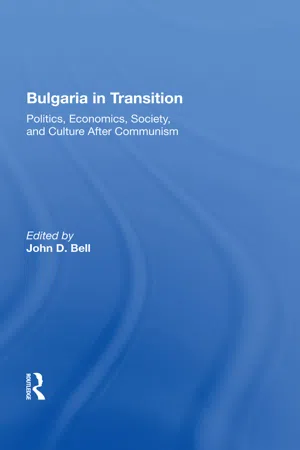
Bulgaria In Transition
Politics, Economics, Society, And Culture After Communism
- 360 pages
- English
- ePUB (mobile friendly)
- Available on iOS & Android
eBook - ePub
About this book
Since the forced resignation of Todor Zhivkov in November of 1989, Bulgaria's transition to democracy has been marked by good beginnings ending in frustration or disappointment. It has avoided the violent ethnic confrontations that have characterized much of the "post-Communist" Balkans, but has also seen the development of an influential criminal
Information
Part One
Politics and Law
1
A Democracy Born in Pain: Bulgarian Politics, 1989–1997
Several problems confront the author of contemporary history. The neutrality or detachment that one might bring to the study of the more distant past is difficult to achieve when writing about protagonists whose world one shares. Even more fundamental is the problem of rapidly changing perspective. Our understanding of the recent past is sharply colored by our sense of what is happening “today.” It is now seven years since the beginning of the changes that inaugurated the post-communist era, and the influence of “today” on this account is already apparent in my choice of the word “changes,” not “revolution,” which was formerly heard. Indeed, it has become impossible to use the categories “democratic vs. communist,” “reform,” and “change of system” in the uninhibited way that was possible only a few years ago.
The New Era
What took place on 10 November 1989 was a palace coup that removed the aging Todor Zhivkov from power. It was carried out by the highest functionaries of the regime who were prompted to action by events both inside and outside Bulgaria, and who probably acted with Soviet approval.1 In fact, Zhivkov’s regime had felt uncomfortable with Soviet glasnosť and perestroika for years already, and had even tried to innoculate the Bulgarian public against its effects by simulating liberalization.2 The most active makers of the coup - Foreign Minister Petûr Mladenov, Defense Minister Dobri Dzhurov, and Andrei Lukanov, who was in charge of foreign economic relations - aimed to keep the party from losing power by initiating changes themselves in order to take the credit and to retain as much control as possible.3 They even tried to shape the opposition to their liking by initiating talks with its prospective leaders.4
The end of 1989 saw impressive opposition rallies, headed by the leaders of newly-formed and rapidly-growing parties who became bolder and bolder, condemning not only the “old regime,” but also the Communist/Socialist5 “reformers,” and calling for the dissolution of parliament and a new constitution. Attempting to secure its own legitimacy in the context of democratization, the BSP leadership treated its opponents as “partners.” A pattern of cooperation evolved at the Round Table Talks (RTT), an arrangement imitating developments in Poland, where communist leaders sat together with selected representatives of the opposition. Apart from the particular agreements reached,6 the RTT had the even more important side effects of legitimizing both the former Communists and the new opposition, and of excluding other parties from participation in the competition for power. Moreover, the RTT put an end to street politics, by channeling opposition energies into preparation for the coming elections.7
Organized anticommunist opposition had emerged comparatively late, at the end of the 1980s, and even then only part of it was unambiguously liberal-democratic, another part being traditionally nationalist in persuasion.8 Many dissidents came from the ranks of the Communist Party, although in this respect Bulgaria was hardly an exception among former communist countries.9 It has been pointed out that Bulgaria’s small size, the concentration of potential dissidents in the capital, the cafe-society atmosphere and the highly personal character of relations between the few dissident intellectuals rendered the organization of secret clubs or an underground press both difficult and superfluous.10 Prior to 10 November 1989 there existed tiny human rights groups and a stronger ecological movement that crystallized in the opposition to the pollution of Ruse by Romanian chemical plants and, later, to projects for building hydro-electric power plants on the Mesta River in the Rila Mountains.11 The movement of the communist regime in the direction of nationalism, a common trend in Eastern Europe, diverted the traditionally nationalist antipathy to communism toward the ethnic minorities. Thus, among the intellectuals only individual voices were raised against Zhivkov’s Revival Process, launched in 1984, that forced ethnic Turks to change their names to Bulgarian ones.12
At the end of 1988 a group composed mainly of intellectuals founded the “Club for the Defense of Glasnost and Perestroika” (later renamed “Club for Glasnost and Democracy”), to discuss reform proposals.13 Several members of this club, on the initiative of Zheliu Zhelev, formed the Union of Democratic Forces (UDF) on 7 December 1989. The major anticommunist force in the years to come, it presented a loose coalition of parties in the process of formation.14 In addition to the UDF, there emerged a party of the Turkish minority, the Movement for Rights and Freedoms (MRF), under the leadership of Akhmed Dogan. There also appeared several extreme nationalist parties, such as the National Radical Party and the Fatherland Party of Labor, and several monarchist parties, all politically marginal and without significance.15
The period after 1989 was characterized by the so-called polarization of politics, i.e., sharp ideological confrontations and the inelastic concentration of the electorate around the two poles of the BSP and UDF.16 The bi-polar model developed its own dynamic, compelling each side to preserve its unity under the threat of being overcome by the other. In addition, the common interest of both in excluding other parties from power led many political analysts to conclude that the two sides were coming to resemble each other. This opinion was reinforced by the fact that the MPs of both parties grew increasingly absorbed in merely parliamentary conflicts, often purely symbolic, and found a number of common interests, especially those related to their salaries, perquisites, and work as lobbyists for shadowy economic groups. So much did the parliamentarians appear to hover above society without connections to the people below, that it seemed possible that a consociational model would develop, that is, politicians would join hands across party lines in the common interest of exploiting power for their personal gain.17 This continued until the BSP’s victory in the December 1994 elections allowed the Socialists to drive the opposition from its place at the state table.
The confrontational politics of this period produced several “tied” parliaments, and the fact that no political force before the end of 1994 possessed an absolute majority meant weak governments, some of them coalitions, others called variously “transitional,” “expert,” or “presidential.” Most of these, especially the comparatively long-lived cabinet of Liuben Berov (30 December 1992 - 8 September 1994), were under the strong influence of the BSP and shunned substantive reforms while giving free rein to shadowy economic groups. It is impossible to sort out real intentions from empty declarations, deliberate delays from genuine obstacles. What is clear is that the absence of direct political responsibility produced such absurd situations as a ruling party blaming all its failures on the opposition, MPs “rebelling” against their party leaders, and cabinet ministers (notably Nikolai Vasilev of the UDF) condemning their own government’s policies without resigning. Combined with the operations of behind-the-scenes economic groups, this proved fatal to the chance for genuine reform.
The political situation also reflected the lack of a “social consensus” or psychological readiness for drastic change among the general population. For the most part, Bulgarians continued to believe in a sort of state socialism and a caring, paternal state, even while that state was being looted before their eyes. Neither the BSP nor the UDF pushed for privatization, because the possibilities of exploiting the administration of state property on the national and local level for personal gain created temptations that most politicians were too weak to resist, especially since their views were influenced by a long tradition of étatism. One might say that these temptations led political leaders to fall short of their declared goal of implementing free market reforms. But this implies that they actually took their declared goals seriously, and this is problematic.
While the ex-communists appeared most often to throw a stick in the wheel of basic structural reform, the short-lived government of the UDF in 1992 bears its own share of responsibility. It had sufficient will to carry out the restitution of urban property to the benefit of its most ardent supporters (and some of its leaders), but did not persist with the privatization of the industrial plants and the land. One can, of course, argue that it encountered enormous technical obstacles or that it remained in office for too short a time to carry out this formidable task, but there is no escape from the conclusion that once restitution was done, its zeal for further reform slackened and that it, too, took advantage of the hidden forms of privatization and administrative leverage over the economic sphere. To be sure, it did so on a smaller scale, but to the greater resentment and disappointment from that part of the public that had expected something better.
The Political Forces
The BSP
Throughout the period under consideration, the BSP was extraordinarily adept not just at survival but at retaining power. Next to the Serbian Communists (in a very different situation), the BSP was the most successful of the former Communist Parties in preserving its influence through several changes of government. How can we account for this? We can point to the BSP’s consolidated leadership, bound by strong personal ties, economic interest, and fear of losing power; the party’s strong organization and large financial resources; its skillful strategy of presenting itself as the defender of the “socially weak,” and, especially in 1990 and 1991, playing the nationalist card. The BSP could also rely on a “hard” electorate, especially older voters and those in villages and small towns who came to identify with it during its long, uninterrupted rule. Demographic factors, such as the “aging” of the population, which included a high proportion of state pensioners, and traditional urban-rural cleavages and anti-urban sentiment, ably mobilized by BSP politicians,18 contributed to its electoral staying power. In fact, it was only in the September 1996 presidential election, following two years of disastrous policies and an unprecedented deterioration in the standard of living, none of which, given the BSP cabinet and its absolute majority in parliament, could be blamed on the opposition, that the electoral support for the BSP was shattered.
Turning to party organization, the BSP was, at least until recently, the only party with a strong and disciplined bureaucratic organization on both national and local levels. Given its starting point as a mass, state monoparty with enormous financial, material, and human resources, this is hardly surprising. The decline of its membership after 1989 did not substantially impair the functioning of its apparatus. A tradition of bureaucratic discipline and ideological cohesion -...
Table of contents
- Cover
- Half Title
- Series Page
- Title
- Copyright
- Dedication
- Contents
- Tables and Figures
- Preface
- Introduction
- PART ONE Politics and Law
- PART TWO The Economy and the Environment
- PART THREE Ethnic and Religious Issues
- PART FOUR Culture
- PART FIVE Foreign Relations
- Appendix
- About the Editor
- About the Contributors
- Index
Trusted by 375,005 students
Access to over 1.5 million titles for a fair monthly price.
Study more efficiently using our study tools.
Frequently asked questions
Yes, you can cancel anytime from the Subscription tab in your account settings on the Perlego website. Your subscription will stay active until the end of your current billing period. Learn how to cancel your subscription
No, books cannot be downloaded as external files, such as PDFs, for use outside of Perlego. However, you can download books within the Perlego app for offline reading on mobile or tablet. Learn how to download books offline
Perlego offers two plans: Essential and Complete
- Essential is ideal for learners and professionals who enjoy exploring a wide range of subjects. Access the Essential Library with 800,000+ trusted titles and best-sellers across business, personal growth, and the humanities. Includes unlimited reading time and Standard Read Aloud voice.
- Complete: Perfect for advanced learners and researchers needing full, unrestricted access. Unlock 1.5M+ books across hundreds of subjects, including academic and specialized titles. The Complete Plan also includes advanced features like Premium Read Aloud and Research Assistant.
We are an online textbook subscription service, where you can get access to an entire online library for less than the price of a single book per month. With over 1.5 million books across 990+ topics, we’ve got you covered! Learn about our mission
Look out for the read-aloud symbol on your next book to see if you can listen to it. The read-aloud tool reads text aloud for you, highlighting the text as it is being read. You can pause it, speed it up and slow it down. Learn more about Read Aloud
Yes! You can use the Perlego app on both iOS and Android devices to read anytime, anywhere — even offline. Perfect for commutes or when you’re on the go.
Please note we cannot support devices running on iOS 13 and Android 7 or earlier. Learn more about using the app
Please note we cannot support devices running on iOS 13 and Android 7 or earlier. Learn more about using the app
Yes, you can access Bulgaria In Transition by John D. Bell in PDF and/or ePUB format, as well as other popular books in Politics & International Relations & Communism, Post-Communism & Socialism. We have over 1.5 million books available in our catalogue for you to explore.