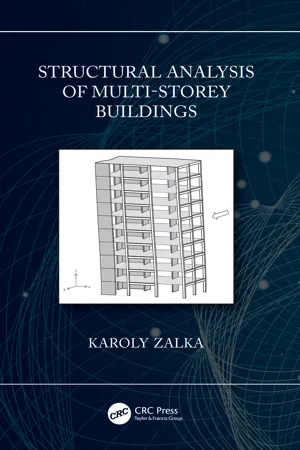
The structural analysis of multi-storey buildings can be carried out using discrete (computer-based) models or creating continuum models that lead to much simpler albeit normally approximate results. The book relies on the second approach and presents the theoretical background and the governing differential equations (for researchers) and simple closed-form solutions (for practicing structural engineers). The continuum models also help to understand how the stiffness and geometrical characteristics influence the three-dimensional behaviour of complex bracing systems. The back-of-the-envelop formulae for the maximum deflection and rotation, load shares, fundamental frequency and critical load facilitate quick global structural analysis for even large buildings. It is shown how the global critical load ratio can be used for monitoring the "health" of the structure acting as a performance indicator and "safety factor". Evaluating the results of over sixteen hundred calculations, the accuracy of the procedures is comprehensively demonstrated by comparing the discrete and continuum results. Nineteen worked examples illustrate the use of the methods, whose downloadable MathCad and Excel worksheets (www.crcpress.com/ 9780367350253) can also be used as templates for similar practical situations.
- 323 pages
- English
- ePUB (mobile friendly)
- Available on iOS & Android
eBook - ePub
Structural Analysis of Multi-Storey Buildings
About this book
Information
1
Introduction
When multi-storey buildings are investigated, two completely different approaches are available for the structural engineer. Choosing an analytical model is the preferred choice of those who rely on “conventional” methods of analysis. This approach often leads to simple, closed-form, albeit normally approximate solutions. Relying on discrete models offers the possibility of carrying out a more detailed but at the same time often fairly time-consuming analysis. Because of the complexity of discrete models, using a computer for the analysis is a must.
A couple of decades ago approximate methods played a very important and normally dominant role in the structural design of large and complex structures as often, because of the lack of computer power, it was not feasible, or practical, or sometimes possible, to carry out an “exact” analysis. Then more and more powerful computers with more and more sophisticated programs started to become available to wider and wider structural engineering communities. Such programs made it possible to deal with very big and complex structures. These programs make life fairly easy for the structural engineer. However, using complex computer programs may also have disadvantages. The more and more sophisticated and user-friendly programs may create an atmosphere when the structural engineer relies on them too much and finds less incentive to acquire an in-depth knowledge of the behaviour of the structure. And the lack of in-depth knowledge might easily lead to uneconomic or unsafe structures.
It may become tempting to pass the responsibility of the structural analysis on to the computer and then to accept the results without doubt. This may especially be the case when the structure is large and its three-dimensional behaviour is complex. Even the question “Do we need hand calculations at all?” can emerge. The answer, however, for several reasons, is “Yes, we need relatively simple hand calculations”. Simple hand calculations offer a useful way of making checks on the results given by the computer. Such checks are very important because when the structural engineer handles a great number of input and output data and evaluates the results, it is easy to overlook something or to make mistakes. Once a mistake is made, it may be difficult to find it. The term “Computer Aided Disaster”, or CAD for short, may be used as an eye-catching phrase or a sensationalist session title at conferences but the warning is justifiably on the wall: one avoidable catastrophe would be one more than can be accepted. The significance of the independent verification of the computer-based results cannot be overemphasised (Brohn, 1996; Smart, 1997; MacLeod, 2005).
Experience shows that the old verdict “This result must be correct as it was given by the computer” can still be heard. Even when it is obvious to the knowledgeable that the result in question is incorrect. A quick check using a back-of-the-envelope calculation could often remedy the situation in minutes.
But there are other advantages of developing and applying simple hand calculations. When such methods are developed, structural elements of secondary importance (e.g. partitions and other non-load-bearing structural elements) are normally ignored and the investigation centres on dominant aspects and neglects phenomena of secondary importance. As a consequence, a simple method with fewer aspects to concentrate on can give a clearer picture of the behaviour emphasising the most important key characteristics of the structure. This is also helpful in developing structural engineering common sense. Understanding the contributions of key structural characteristics is especially important with large and complex structures.
Perhaps the best way to tackle the task of the structural analysis of multistorey buildings is to employ both approaches: at the preliminary design stage simple hand methods can quickly help to establish the main structural dimensions and to point to efficient bracing system arrangements. More detailed computer-based analysis can follow. Before the final decision is made, it is essential to check the results of the computer analysis and confirm the adequacy of the key elements of the bracing system. Here, again, suitable simple methods can be very useful.
This book is concerned with the structural analysis of multi-storey buildings whose bracing system consists of frames, coupled shear walls, shear walls and cores. Such structures are generally large, contain a great number of structural elements and behave in a three-dimensional manner. Using the analytical approach, relatively simple models can be created for the analysis.
The continuum method will be used which is based on an equivalent medium that replaces the whole building. The discrete load and stiffnesses of the building will be modelled by continuous load and stiffnesses. This approach makes it possible to use analytical tools to produce relatively simple, closed-form solutions to the resulting differential equations and eigenvalue problems.
The fact that the methods in the book are all based on continuous models has another advantage. When the results of a finite element analysis (based on discrete models) are checked, it is advantageous to use a technique that is based on a different approach, i.e., on continuous medium.
Structural analysis is normally carried out at two levels. The structural engineer has to ensure that (a) the individual elements (beams, columns, floor slabs, etc.) are of adequate size and material to carry their load and (b) the structure as a whole has adequate stiffness and the bracing system fulfils its main role to provide sufficient stability to the building.
The book does not deal with individual structural elements. Its aim is to present simple analytical methods for the complex global analysis of whole structural systems in the three main structural engineering areas. Assuming three-dimensional behaviour, closed-form solutions will be given for the maximum rotation and deflection, the fundamental frequency and the critical load of the building.
Whenever methods of analysis are developed, certain assumptions have to be made. These assumptions reflect a compromise: they help to create relatively simple methods but at the same time they ensure that the results are of adequate accuracy. Accordingly, it will generally be assumed that the structures are
• at least four storeys high with identical storey heights
• regular in the sense that their characteristics do not vary over the height
• sway structures with built-in lower end at ground floor level and free upper end
and that
• the floor slabs have great in-plane and small out-of-plane stiffness
• the deformations are small and the material of the structures is linearly elastic
• P-delta effects are negligible.
Structural engineering research and practice often see researchers/structural designers who have specialized in one area with limited knowledge elsewhere. Designers are often reluctant to deal with theoretical matters; researchers often have little practical knowledge (or attitude); those dealing with stress analyses are sometimes ignorant of stability matters; people engaged in earthquake engineering may not be very good at the optimisation of bracing systems, etc.
This book offers a unified treatment for the different structures (frames, coupled shear walls, shear walls and cores, and their assemblies) and also for the different types of investigation (deflection, rotation, frequency, stability). The same terminology will be used throughout, and it will be shown that these seemingly independent areas (deformations, frequencies, critical loads—or stress, dynamic and stability analyses) are in fact very closely related. In addition, the global critical load ratio links them to the performance of the bracing system in a rather spectacular manner.
Although real multi-storey buildings seldom develop planar deformation only, Chapter 2 (dealing with the planar analysis of individual bracing units) is probably the key chapter of the book in the sense that it introduces most of the characteristic stiffnesses that will be used for the three-dimensional investigations of whole systems later on. It is also shown here how the complex behaviour can be traced back to the local bending, global bending and shear deformations (and their torsional equivalents) of the bracing system. All the characteristic types of bracing units are covered here: sway- and infilled frames, frames with cross-bracing, coupled shear walls, shear walls and cores.
Three-dimensional behaviour is the subject of Chapters 3, 4, 5 and 6. The investigations in Chapter 3 centre on buildings subjected to lateral load and the main aim is to present simple, closed-form solutions for the maximum deflection and rotation of the building. It is spectacularly shown how the key contributors to the resistance of a multi-storey building—the bending and shear stiffnesses, and their interaction—influence the performance of the bracing system. Chapter 4 deals with the frequency analysis of buildings. Closed-form formulae and tables make it possible to calculate the lateral and torsional frequencies of the building. The coupling of the lateral and torsional modes can be taken into account by a simple summation formula or, if a more accurate result is needed, by calculating the smallest root of a cubic equation. The often neglected but very important area of stability is covered in Chapter 5. In using critical load factors, simple (Euler-like) formulae are presented for the lateral and torsional critical loads. The combined sway-torsional critical load is obtained using a summation formula or calculating the smallest root of a cubic equation.
Chapter 6 introduces the global critical load ratio which is a useful tool for monitoring the “health” of the bracing system. It can be used to show in minutes whether a bracing system is adequate or not, or a more rigorous (second-order) analysis is needed. The global critical load ratio can also be used to assess different bracing system arrangements in order to choose the most economic one. The results of three comprehensive worked examples demonstrate the practical use of the global critical load ratio.
To illustrate the practical use of the methods and formulae presented in the book, nineteen examples worked out to the smallest details are included. The examples range from the deflection or frequency or stability analysis of individual bracing units to the complex deflection and frequency and stability analyses of bracing systems, considering both planar and spatial behaviour. The examples are to be found at the end of the relevant chapter/section.
Numerous approximate methods have been published for the structural analysis of multi-storey structures. Most of them deal with individual bracing units. Some of them can even handle three-dimensional behaviour. However, it is surprising how few, if any, have been backed up with convincing accuracy analysis. Chapter 7 is devoted to the very important but often neglected question of accuracy and reliability. Using 32 individual bracing units at different storey heights, the accuracy of the relevant formulae is demonstrated by comparing the results of the closed-form solutions presented in the book with the results of the “exact” (computer-based) analyses. Altogether 1631 checks are made in two groups. The first group contains 983 individual bracing units whose maximum deflection, fundamental frequency and critical load are determined. The second group contains the three-dimensional bracing systems of 648 multi-storey buildings. Here, too, the maximum deflection, the fundamental frequency and the critical load of these systems are determined. The results demonstrate the applicability and accuracy of the methods presented in the preceding chapters. Information regarding the accuracy of the procedures used in the nineteen worked examples concludes Chapter 7.
Although most of the formulae in the book are of the back-of-the-envelope type, due to the complexity of global three-dimensional analyses, some of the calculations may still seem to be rather cumbersome to carry out by hand. It is very rare, however, that a structural engineer today would wish to do actual hand-calculations, however simple they may be. Convenient spreadsheets and calculation worksheets make it possible to carry out the structural analysis and document its result at the same time in minutes. All the methods presented in the book are suitable for this type of application; in fact the worksheet version of all the nineteen worked examples has been prepared and made available for download. Each worksheet is prepared using both MathCad and Excel. These one-to eight-page long worksheets cover a very wide range of practical application and can also be used as templates for other similar structural engineering situations. Short summaries of the nineteen worksheets are given in the Appendix.
2
Individual bracing units: frames, (coupled) shear walls and cores
The bracing system of multi-storey buildings is normally made up of different units: frames, shear walls, coupled shear walls and cores. They all contribute to the overall resistance of the system but their contributions can be very different, both in weight and also in nature. It is ther...
Table of contents
- Cover
- Half Title
- Title Page
- Copyright Page
- Dedication
- Table of Contents
- Notations
- 1 Introduction
- 2 Individual bracing units: frames, (coupled) shear walls and cores
- 3 Deflection and rotation analysis of buildings under horizontal load
- 4 Frequency analysis of buildings
- 5 Stability analysis of buildings
- 6 Global structural analysis
- 7 Accuracy and reliability
- Appendix: List of worksheets
- References
- Subject index
- Author index
Trusted by 375,005 students
Access to over 1.5 million titles for a fair monthly price.
Study more efficiently using our study tools.
Frequently asked questions
Yes, you can cancel anytime from the Subscription tab in your account settings on the Perlego website. Your subscription will stay active until the end of your current billing period. Learn how to cancel your subscription
No, books cannot be downloaded as external files, such as PDFs, for use outside of Perlego. However, you can download books within the Perlego app for offline reading on mobile or tablet. Learn how to download books offline
Perlego offers two plans: Essential and Complete
- Essential is ideal for learners and professionals who enjoy exploring a wide range of subjects. Access the Essential Library with 800,000+ trusted titles and best-sellers across business, personal growth, and the humanities. Includes unlimited reading time and Standard Read Aloud voice.
- Complete: Perfect for advanced learners and researchers needing full, unrestricted access. Unlock 1.5M+ books across hundreds of subjects, including academic and specialized titles. The Complete Plan also includes advanced features like Premium Read Aloud and Research Assistant.
We are an online textbook subscription service, where you can get access to an entire online library for less than the price of a single book per month. With over 1.5 million books across 990+ topics, we’ve got you covered! Learn about our mission
Look out for the read-aloud symbol on your next book to see if you can listen to it. The read-aloud tool reads text aloud for you, highlighting the text as it is being read. You can pause it, speed it up and slow it down. Learn more about Read Aloud
Yes! You can use the Perlego app on both iOS and Android devices to read anytime, anywhere — even offline. Perfect for commutes or when you’re on the go.
Please note we cannot support devices running on iOS 13 and Android 7 or earlier. Learn more about using the app
Please note we cannot support devices running on iOS 13 and Android 7 or earlier. Learn more about using the app
Yes, you can access Structural Analysis of Multi-Storey Buildings by Karoly A. Zalka,Karoly Zalka in PDF and/or ePUB format, as well as other popular books in Technology & Engineering & Civil Engineering. We have over 1.5 million books available in our catalogue for you to explore.