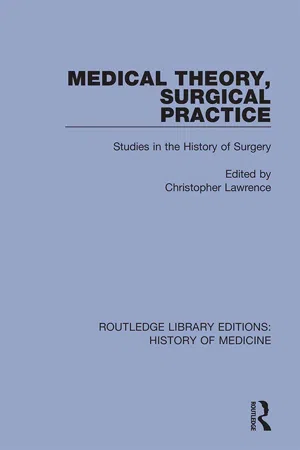
Originally published in 1992, Medical Theory, Surgical Practice examines medical and surgical concepts of disease and their relation to the practice of surgery, in particular historical settings. It emphasises that understanding concepts of disease does not just include recounting explicit accounts of disease given by medical men. It needs an analysis of the social relations embedded in such concepts. In doing this, the contributors illustrate how surgery rose from a relatively humble place in seventeenth century life to being seen as one of the great achievements of late Victorian culture. They examine how medical theory and surgical practices relate to social contexts, how physical diagnosis entered medicine and whether anaesthesia and Lister's antiseptic techniques really did cause a revolution in surgical practice.
- 338 pages
- English
- ePUB (mobile friendly)
- Available on iOS & Android
eBook - ePub
1
Democratic, divine and heroic: the history and historiography of surgery
Christopher Lawrence
Whether an operation was performed or not depended not so much on whether the surgeons were able to perform such an operation technically or not as on the medical theories prevailing at the time.1
Popular mythologies
In 1904 Frederick Dennis, Professor of Clinical Surgery at Cornell University, addressed the International Congress of Arts and Science at St Louis. Surveying the previous century, and chronicling what he described as ‘the victories gained in every field’ he said,
But while the other sciences have indeed thrilling stories to relate, and can point with just pride to excellent deeds performed, the science of surgery stands out in bold relief, and conspicuous grandeur, apart from and above the others, in that it deals directly with human life, that most precious of mortal possessions, often lending to it not only a helping, but a saving hand. At the same time, its story is so simple and yet so grand, that the child and the savant may alike participate in the pleasure which the wonderful narrative is fitted to convey.2
Dennis’s claims for the triumph of surgery were echoed in print by many other writers, by no means all of whom were surgeons. By 1900, in Europe and America the lesser of the healing arts, surgery, had, in the eyes of its practitioners and the public, eclipsed its more dignified superior, physic, in its therapeutic power. Late Victorians and Edwardians identified it with exploration and engineering as being among the great accomplishments of nineteenth-century civilisation.3 Surgeons became national heroes. Crowds thronged to Waterloo Station to dispatch Frederick Treves to the Boer War.4 Lister’s public funeral service packed Westminster Abbey with dignitaries from all over the world.5
Dennis’s simple and grand story utilised elements familiar to many Victorian tales: the march of science, the progress of civilisation and individual heroism. These ingredients remain essential to current popular histories of surgery in which the nineteenth century is represented as ‘the age of miracles’ and the long and simple history is seen as one of ‘the courage to fail’.6 Although Dennis’s story is much like the popular one told today, his story had been given that shape only in the last two decades of the nineteenth century. Prior to that, surgery’s history had been shaped and reshaped several times as surgeons in different epochs fashioned it to suit their particular ends and to define the enemies of their discipline. I examine here some of the ways in which the story was shaped in the Anglo-American world. Then I review works which suggest alternative approaches to surgical history. Finally I outline how it is possible to use Owsei Temkin’s work to construct a model for writing the history of surgery. Continental matters have, of course, been central to the creation of the history and historiography of surgery but will only be considered here in so far as they relate to the rather more parochial tale of British and American surgical affairs.
Much of the history of medieval, Renaissance and post-Renaissance surgery and thus of surgeons’ accounts of themselves has been written in the light of relations between medicine and surgery in the nineteenth century. More recent work has begun to change the view of the surgical past as merely a rags to riches, barber-surgeon to brain surgeon tale, a view which has eclipsed a possible history of surgery since the Middle Ages as an elite, socially successful, and theoretically informed occupation, often hostile to manual labour. In a revision of the received view of humanist surgery Vivian Nutton has argued that the distinction often (correctly) made by historians between Renaissance physician and surgeon has obscured the common cause of the learned men in these occupations and ignored the principal object of humanist medical polemic: barbers, barber-surgeons and vulgar practitioners.7 There are certainly plenty of medieval and Renaissance examples to show that some practising surgeons were thoroughly conversant with the theory of medicine and saw themselves as the equals (or better) of physicians. In the early fourteenth century Henri de Mondeville was proclaiming that he was, and any other surgeon should be, an artifex scientificus.8 As part of their claim to eminence medieval surgeons also told stories about themselves which were ‘secular parallels’ of narratives of miraculous cures.9 Throughout Europe in the sixteenth century, medical scholars (both physicians and surgeons) found in Galenic tracts with their wealth of surgical learning not an authority for dividing the healing arts but a model for the integration of medicine’.10 The vision of surgery as a learned profession and its enemies being ignorant interlopers rather than physicians can be found in the works of the London surgeons of the period. Thus Thomas Gale in 1563 averred surgery was ‘a longe arte, and requireth longe tyme in lernynge, and also exercising: as both the princes of physicke Hippocrates & Galen do testine’.11 Gale thanked the physician William Cunnyngham for help in composing his argument and savaged those who ‘under the name of chirurgions be nothynge else but open murtherers … and rude Empirikes’.12 Similarly the Paris-trained Scottish surgeon, Peter Lowe, averred, invoking Plato, that there was ‘nothing harder than Chirurgie’.13 It was a learned science and art, of high antiquity, esteemed by all men and yet also practised by deceivers ‘with their charmes, heartes full of poison and false promises’.14 Significantly Lowe was instrumental in the establishment in Glasgow of a Faculty of Physicians and Surgeons.15 Margaret Pelling and Charles Webster have argued that, up until the third quarter of the sixteenth century, these English surgeons viewed the physician as ‘their mentor and senior partner’. However, the generation which flowered at the end of the century, and which included William Clowes, George Baker, John Bannister and John Reed, quoted Galen ‘to undermine the traditional division between physic and surgery’.16 Clowes, indeed, argued that surgery had been practised by the great spiritual leaders of antiquity.17
In comparison with the relative profusion of elegant, learned and self-assured English surgical texts of the late sixteenth century there is a scarcity of seventeenth-century work and a lack of any consistent account of surgery’s place in the healing order.18 Translation rather than domestic stock was the textual base of English surgery. In both England and France the physician’s voice was more prominent. Alexander Read, author of a number of surgical works, was a physician who lectured to the Barber-Surgeons Company. Read’s works invoke much the same image of surgery as that of the late sixteenth-century writers: its antiquity, dignity and its great textual tradition. But there was no suggestion of it being united with physic.19 In the seventeenth century, the accounts which physicians and surgeons gave of each other began to be inflected with the language of experience. In this regard, surgeons (and physicians) began to find in Ambroise Paré the epitome of the surgeon as the experienced practitioner. One of his translators, Thomas Johnson (a physician), noted that Paré was ‘well versed in the writings of the antient and moderne physitians, and surgeons’, but added ‘his experience or practice (the chief help to attaine the highest perfection in this Art) it was wonderfull great’.20 With Richard Wiseman, writing in the 1670s, the new historical and programmatic possibilities of this view were thoroughly developed. Wiseman argued that his fellow practitioners should compare ‘the Empirical part of the Profession with the Rationall’, and although not contemptuous of renowned surgical texts, argued that ‘judgement and experience’ were worth more than the reading of ‘eminent chirurgicall Authors’ which simply amounted to ‘other mens [sic] authority’. Progress lay not in scrutinising the ancients but in adding ‘Observations to the bulk of what hath been heretofore heaped up’.21 For the seventeenth-century surgeon, the ‘Common Enemy’ as Daniel Turner called him remained the unlicensed practitioner.22 Wiseman’s outline of a new historical script for surgery, an independent discipline, growing cumulatively through empirical enquiry, lay relatively unnoticed until it was seized upon by the self-confident English surgical community of the late eighteenth century.
It seems to have been the polemical literature of these surgeons which first identified the early practice of surgery as crude and subservient to physic, a view which permitted them to stress that, within the very recent past, the ‘art’ of surgery, as they usually called it, had undergone a vast transformation and was now the equal, in status and therapeutic power, of physic.23 Where Renaissance surgeons found the source of their self-esteem and identity in newly translated ancient texts, English surgeons of the Enlightenment grounded their claims for recognition in their recent empirically acquired knowledge of anatomy, of operative techniques and of instrument design. Improvement was the key word used to describe these changes. In 1750 the London surgeon Samuel Sharp wrote that ‘Perhaps there never was a Period of Time in which any Art was more cultivated than Surgery has been for these last thirty years.24 Discussing amputation he noted that the disadvantages under which the ancients laboured when amputating ‘have been gradually removed by a succession of Improvements’.25 Similarly, in 1767 Benjamin Gooch, in his Historical Account of the Rise and Progress of Surgery and Anatomy, noted how surgery had lately received ‘great improvements’ mainly because ‘Anatomy is more universally known, and better understood’ and thus ‘the world must consequently have abler Surgeons than in former ages’.26 In 1789 John Justamond, surgeon to the Westminster Hospital, outlined the history of surgery in a similar manner. He identified its meteoric progress with his own century and reckoned the ‘father of surgery in this Kingdom’ to be William Cheselden, a man who had died only thirty-seven years previously.27 The origin of this progress, Justamond observed, lay in the recognition that anatomy and surgery were ‘sister arts’. That surgery was empirically based in anatomy did not mean that it was a rule-of-thumb art. Knowledge of anatomy had ‘reduced the practice of Surgery as well as Physic to fixed and rational principles’.28 Similarly Percivall Pott, one of the most cited hospital surgeons of the late eighteenth century, noted ‘Many and great are the improvements which the chirurgic art has received within these last fifty years.’29 The origin of this improvement lay in anatomy, ‘which kind of knowledge has been so cultivated in our times as to convert ignorance into a vice’.30 Ancient surgery, the source of inspiration for late sixteenth-century English surgeons, Pott now perceived as ‘coarse’ and ‘encumbered with a multitude of awkward unmanageable instruments’.31
Coupled with the English surgeons’ account of the role of empirical discovery in the recent history of their art was their designation of the surgeon’s personal attributes. Not surprisingly the emphasis lay on the surgeon’s senses. Gooch cited Celsus, on the necessity for ‘a strong, steady hand, a clear sight, with calmness and fortitude of mind’.32 Justamond f...
Table of contents
- Cover
- Half Title
- Title Page
- Copyright Page
- Original Title Page
- Original Copyright Page
- Contents
- List of figures
- Acknowledgements
- 1. Democratic, divine and heroic: the history and historiography of surgery
- 2. Seventeenth-century English surgery: the casebook of Joseph Binns
- 3. Surgery and scrophula
- 4. Giovanni Battista Morgagni and eighteenth-century physical examination
- 5. Physiological principles in the surgical writings of John Hunter
- 6. Practising on principle: Joseph Lister and the germ theories of disease
- 7. From conservative to radical surgery in late nineteenth-century America
- 8. Knowledge of bodies or bodies of knowledge? Surgeons, anatomists and rectal surgery, 1830–1985
- 9. Experiment and experience in anaesthesia: Alfred Goodman Levy and chloroform death, 1910–1960
- 10. The ambiguous artifact: surgical instruments and the surgical past
- Index
Trusted by 375,005 students
Access to over 1.5 million titles for a fair monthly price.
Study more efficiently using our study tools.
Frequently asked questions
Yes, you can cancel anytime from the Subscription tab in your account settings on the Perlego website. Your subscription will stay active until the end of your current billing period. Learn how to cancel your subscription
No, books cannot be downloaded as external files, such as PDFs, for use outside of Perlego. However, you can download books within the Perlego app for offline reading on mobile or tablet. Learn how to download books offline
Perlego offers two plans: Essential and Complete
- Essential is ideal for learners and professionals who enjoy exploring a wide range of subjects. Access the Essential Library with 800,000+ trusted titles and best-sellers across business, personal growth, and the humanities. Includes unlimited reading time and Standard Read Aloud voice.
- Complete: Perfect for advanced learners and researchers needing full, unrestricted access. Unlock 1.5M+ books across hundreds of subjects, including academic and specialized titles. The Complete Plan also includes advanced features like Premium Read Aloud and Research Assistant.
We are an online textbook subscription service, where you can get access to an entire online library for less than the price of a single book per month. With over 1.5 million books across 990+ topics, we’ve got you covered! Learn about our mission
Look out for the read-aloud symbol on your next book to see if you can listen to it. The read-aloud tool reads text aloud for you, highlighting the text as it is being read. You can pause it, speed it up and slow it down. Learn more about Read Aloud
Yes! You can use the Perlego app on both iOS and Android devices to read anytime, anywhere — even offline. Perfect for commutes or when you’re on the go.
Please note we cannot support devices running on iOS 13 and Android 7 or earlier. Learn more about using the app
Please note we cannot support devices running on iOS 13 and Android 7 or earlier. Learn more about using the app
Yes, you can access Medical Theory, Surgical Practice by Christopher Lawrence in PDF and/or ePUB format, as well as other popular books in History & World History. We have over 1.5 million books available in our catalogue for you to explore.