- 352 pages
- English
- ePUB (mobile friendly)
- Available on iOS & Android
eBook - ePub
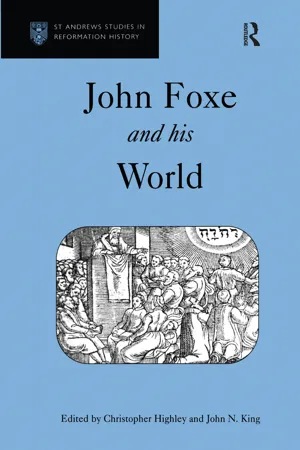
John Foxe and his World
About this book
Interest in John Foxe and his hugely influential text Acts and Monuments is particularly vibrant at present. This volume, the third to arise from a series of international colloquia on Foxe, collects essays by established and up-and-coming scholars. It broadly embraces five major areas of early modern studies: Roman Catholicism, women and gender, visual culture, the history of the book and historiography. Patrick Collinson provides an entire overview of the field of Foxe studies and further essays place Foxe and his work within the context of their times.
Part One
Historiography
Chapter One
The End of History: Thomas Norton’s “v periodes” and the Pattern of English Protestant Historiography
Anthony Martin
In early 1582, at a crucial point in the reign of Elizabeth, Thomas Norton, the forward Protestant, and a good friend of John Foxe, wrote a survey of national history, entitled, in manuscript, "Of the v periodes of 500 yeares." In this work, Norton divides British history into five separate periods, each of which is terminated by some catastrophic event, which Norton calls an "alteration." First, there is the end, upon the death of Gorboduc, around 500 BCE, of the Trojan dynasty, originally established by Brut. Second, the invasion of the Romans under Julius Caesar terminates British autonomy. The Roman period is followed by the Saxon invasions, and Saxon domination is ended in turn by the Norman Conquest. As Norton writes, the post-Conquest period is approaching or undergoing the fifth alteration, though this alteration will, he claims, differ considerably from preceding cataclysms. The significance of these epochal transformations is evident in the fact that they occur repeatedly, roughly once every 500 years, this "period" or "revolution," as Norton terms it, being the key to an understanding of the contemporary situation within the English state, and on the island of Britain.
Norton's division of history into separate periods, marked off from each other by catastrophes, was not in itself a novel conception in the mid to late sixteenth century. William Harrison, in his "Chronology," written around the same time as the "v periodes," and partly printed in the 1587 edition of Holinshed's Chronicles, refers to various schemata of historical periodization, and depicts the numerology of history as an expression of divine providence.1 In the same (1587) edition of Holinshed, Abraham Fleming reiterates Harrison's numerological references, and exhorts, "let these alterations of regiments be remembered and teach vs that therein the judgements of God reuealed themselues to speciall purposes."2 And, of course, John Foxe, in the earlier parts of the Acts and Monuments, makes a fivefold division of church history.3 Nevertheless, while Norton's division of history into five eras finds analogs in such contemporary historical writing, the "v periodes" is significant as much for its espousal of national identity, and its focus on the royal embodiment of that identity, as for the interpretation of providential history in which it engages. As part of an overall programme of national reformation, in close expectation of a terminus to the process of historical change, Norton views the pattern of history as meaningful, not simply as a pattern of repetition, but as a scheme which indicates its own, approaching end.
Throughout this work of historical exegesis, Norton makes frequent and marked reference to Britain and England, sometimes distinguishing between the two – with the former as a geographical entity, and the latter as an ethno-political institution – but at other times subsuming the two into a tradition of ethnic and political continuity reaching back to a legendary origin, and coinciding in the contemporary claims to English political suzerainty within the British archipelago. The question of the relationship of England, with its annexed principality of Wales, and claim to sovereignty over Ireland, and suzerainty over the northern kingdom of Scotland was, of course, a problem of considerable complexity and urgency in the sixteenth century.4 In the "v periodes" Norton does not precisely define these geopolitical entities, but clearly considers England and Wales to form the contemporary political institution of an aboriginal, ethnic national identity, while the Scots, and the nation of Scotland, are irreducibly foreign and incursive. (The question of Ireland, and its relation to an Anglo-British political hegemony, is noticeably absent from Norton's discussion of an insular history of invasion and alienation.)
Norton follows the popular legendary history, initiated in the Historia Brittonum and developed by Geoffrey of Monmouth in the Historia Regum Britanniae, in asserting that the island was named after its founder and first ruler, the Trojan prince, Brutus. This legend had been generally accepted from the mid-twelfth century on, and had received renewed currency in the sixteenth century, as the Welsh origins of the Tudors had been seen as relating to the later parts of the Galfridian stories, about Arthur, Merlin, and the last British king, Cadwallader. Though the skepticism of such humanist historians as Polydore Vergil was beginning to reduce the acceptability of some of the legends, a general belief in the veracity of the stories remained strong, only being undermined by Camden's linguistic and geopolitical analysis in his Britannia (1586).5 Noticeably, though Norton accepts the historical reality of Brut and Gorboduc, he does not mention the existence of Arthur in the part of his brief history which deals with the coming of the Saxons. The Galfridian history of Britain, which Norton follows in his description of the founding of Britain, and its subsequent division into separate nations, had been used on numerous occasions – by Edward I, and by Henry VIII, for example – to support English claims to overlordship, and under Elizabeth was combined with the Tudor myth of restored British rule, a myth of restoration to original sovereignty which is of crucial importance to Norton's historiography.6
Significantly, Norton views British history as providential – national history can be described as being directed and planned by God – and this history is in a sense dialectical, not in a progressive sense, but rather, in common with other sixteenth-century Protestant historiography, as a process of decline, of a swerving away from a primitive rectitude. Norton's historiography is fundamentally and irreducibly nationalistic: not only does he confine himself to British matters, but he depicts all foreign interventions or connections in the history as major causes of the deviation from the original state. Moreover, the dialectic of British history – that is a dialectic of division, alterity, and alienation – is resolved, potentially, in the person of Elizabeth, who embodies a possible end to history. However, as I shall discuss, Norton himself is personally implicated in his desire for a divine, deathless monarch, as she alone can validate the history he sketches out.
In the group who were connected with Foxe in the development of English Protestantism in the sixteenth century, Thomas Norton played a leading part. Indeed, in his multifarious activities – amanuensis, translator, poet, dramatist, lawyer, Member of Parliament, "man of business," and Londoner – Norton was a central figure in the first half of Elizabeth's reign, and was prominently involved in the areas of religious settlement, succession question, and the difficulties of Mary Stuart and the Catholic problem. If, as Patrick Collinson and other historians have suggested, the government of England was undertaken by Queen and Council, then Norton was one of the agents most intimately involved with the regime.7
Norton was born around 1532 in London to a middling sort of family, described by Michael Graves as "hybrid-gentry": Norton's father, a member of the Grocers' Company, made money in trade and commerce, and invested heavily in the lands made available by the Dissolution of the Monasteries and later sales of crown properties, as well as other real estate.8 Thomas, his eldest son and namesake, after studying at Cambridge in the 1540s, became amanuensis and tutor in the household of Edward Seymour, duke of Somerset, some time in or before 1550. In Somerset's household, Norton moved in circles that were central to sixteenth-century religious and political development. At this time, he met such significant Protestants as John Hooper and Thomas Becon, as well as possibly establishing contact with men who were later to be of considerable importance in his career: William Cecil, for example, who had been Somerset's secretary, and who was to be Norton's patron in future decades.
During his involvement in the Somerset circle, Norton began to correspond with Calvin, and he was later to translate Calvin's Institutes into English, a translation which remained the standard until the nineteenth century.9 Norton also developed his literary talents around this time: he wrote prefatory verses for William Turner's A preseruative ... agaynst ... Pelagius (1551), and two other poems which circulated in manuscript with ascription to Norton were printed in Tottel's Miscellany.10 In the 1562, and subsequent editions, of the Sternhold-Hopkins psalms, some 25 of the contributions are attributed to Norton.11
The most significant of Norton's literary works is the play, Gorboduc, or Ferrex and Porrex, co-written with Thomas Sackville for the Christmas festivities at Inner Temple, under the direction of Robert Dudley, as Master of the Revels.12 This play, on the theme of the division and destruction of the realm, was played twice in 1561-62: first, before the gentlemen of the Inner Temple and members of the Council, and then in front of Elizabeth, at Whitehall on 18 January 1562.13
Subsequently, Norton continued in a career as a lawyer and politician: he became legal counsel for the Stationers' Company in 1562, Remembrancer of the City of London from 1571, and solicitor for the Merchant Taylors' Company from 1581. As a member of successive Elizabethan Parliaments, Norton acted as a client for members of the Council, as well as promoting various bills.14 Early in his parliamentary career, in the session of 1563, Norton presented the draft petition to the House on the limitation of the succession. In particular, Norton was instrumental in the 1571 reintroduction to Parliament of his father-in-law Thomas Cranmer's Reformatio Legum Ecclesiasticarum, a venture involving John Day and John Foxe.15 At this time, he had several contacts with Foxe, particularly through Day, and indeed, according to a later memoir by his son, Robert, Norton was of the "greatest help" in the preparation and publication of the expanded 1563 edition of Acts and Monuments.16
At the very peak of his career, however, Norton fell from political favor, was imprisoned in the Tower of London, and though he was released after some months, his wife had become mentally incapable in the meantime, and Norton himself was only to live another two years.17 Nevertheless, during this enforced seclusion in the Tower, Norton wrote a number of pieces which have considerable bearing on the social, religious and political issues of the later sixteenth century. These pieces – the "Devices" and the "v periodes" – can contribute to a further assessment of the questions of nationalism, religion and the nature of the state, which have been the focus of critical and scholarly concern in recent years.18
The offense which led to Norton's imprisonment was, apparently, to have spoken out against the proposed marriage between Elizabeth and the duke of Anjou. Norton's outspokenness and subsequent confinement occurred during a crucial period for the Elizabethan regime, and indeed Norton's offense was itself a product of the sea change that the regime was undergoing. In the summer of 1578, Elizabeth had renewed the on-off marriage negotiations with the duke of Anjou, brother of the French king, and aspirant ruler of the Low Countries. Elizabeth, possibly seeking an alliance with France against Spain, seemed in the next year to be set on the match, a prospect that caused immense alarm and despondency to most of the Council.19 Whatever Elizabeth's real motives, and however consistent and coherent these were, by the autumn of 1579 public and private opposition to the match was being expressed, to Elizabeth's intense anger. Sidney, Spenser and others, in addition to the unfortunate Stubbs, expressed the common mood. After a hiatus, the marriage negotiations res...
Table of contents
- Cover
- Half Title
- Title
- Copyright
- Contents
- Dedication
- List of Figures
- Preface and Acknowledgments
- Notes on Contributors
- Abbreviations
- The World of John Foxe: An Introduction
- John Foxe and National Consciousness
- Part One Historiography
- Part Two History of the Book
- Part Three Visual Culture
- Part Four Roman Catholicism
- Part Five Women and Gender
- Afterword: John Foxe in the Twenty-First Century
- Index
Trusted by 375,005 students
Access to over 1.5 million titles for a fair monthly price.
Study more efficiently using our study tools.
Frequently asked questions
Yes, you can cancel anytime from the Subscription tab in your account settings on the Perlego website. Your subscription will stay active until the end of your current billing period. Learn how to cancel your subscription
No, books cannot be downloaded as external files, such as PDFs, for use outside of Perlego. However, you can download books within the Perlego app for offline reading on mobile or tablet. Learn how to download books offline
Perlego offers two plans: Essential and Complete
- Essential is ideal for learners and professionals who enjoy exploring a wide range of subjects. Access the Essential Library with 800,000+ trusted titles and best-sellers across business, personal growth, and the humanities. Includes unlimited reading time and Standard Read Aloud voice.
- Complete: Perfect for advanced learners and researchers needing full, unrestricted access. Unlock 1.5M+ books across hundreds of subjects, including academic and specialized titles. The Complete Plan also includes advanced features like Premium Read Aloud and Research Assistant.
We are an online textbook subscription service, where you can get access to an entire online library for less than the price of a single book per month. With over 1.5 million books across 990+ topics, we’ve got you covered! Learn about our mission
Look out for the read-aloud symbol on your next book to see if you can listen to it. The read-aloud tool reads text aloud for you, highlighting the text as it is being read. You can pause it, speed it up and slow it down. Learn more about Read Aloud
Yes! You can use the Perlego app on both iOS and Android devices to read anytime, anywhere — even offline. Perfect for commutes or when you’re on the go.
Please note we cannot support devices running on iOS 13 and Android 7 or earlier. Learn more about using the app
Please note we cannot support devices running on iOS 13 and Android 7 or earlier. Learn more about using the app
Yes, you can access John Foxe and his World by Christopher Highley,John N. King in PDF and/or ePUB format, as well as other popular books in History & World History. We have over 1.5 million books available in our catalogue for you to explore.