- 236 pages
- English
- ePUB (mobile friendly)
- Available on iOS & Android
eBook - ePub
About this book
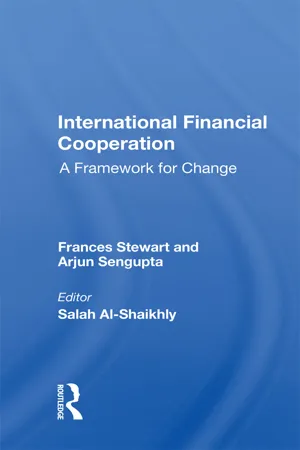
This book presents papers on the recycling of funds from surplus to deficit countries; stabilizing the existing International Financial System; securing an adequate level of investment return for surplus countries; the role of the special drawing rights; and mineral and energy financing.
Information
1 An Overview*
There is now widespread dissatisfaction with the international monetary system as a framework for trade and payments. This dissatisfaction is shared by those in very different situations and with different points of view. The system has been criticized by peoples and governments from different parts of the world – from the industrialized countries (ICs) and Third World countries including the oil-exporting countries (OPEC). In different ways and for different reasons, each has reason to be unhappy with the present system as shown by the spate of recent reports on the question – e.g., the UNDP/UNCTAD Report, the Brandt Commission, the Report of the Committee of Experts of the Commonwealth Secretariat, and the South-North Conference at Arusha.1
This study attempts to identify the main sources of dissatisfaction and major areas for reform, and to review and assess alternative proposals. How one looks at as broad an issue as the international monetary system which directly or indirectly affects most economic activities, obviously depends in large part on the question of whose interests one is primarily concerned with. This review takes the interests of the least developed countries (LDCs) and the interests of development as the major consideration. However, any realistic suggestions for reform must also take into account the interests of the other major parties involved in the system. In many (but not all) areas LDCs seem powerless on their own and reform can only emanate from the ICs and/or OPEC. OPEC on the other hand has always regarded itself as part of the Third World in any process of global negotiations. Moreover, a monetary system which leads to a steady expansion of world demand and assists in solving the problems of recession/inflation in ICs, and creates conditions for a stable outlet for international monetary surpluses, is likely to be in the interests of global development. Thus while we take development as the major objective, a central assumption is that any reform must also be in the interests of the relevant and significant decision makers internationally. One critical weakness of some of the proposals for reform appears to be that they ignore this requirement.
The Western industrialized countries and the Third World are composed of countries with often divergent interests. For example, within the Third World a distinction is made between OPEC and other developing countries. Within OPEC there is a significant distinction between the oil-exporting countries which are in substantial surplus on current account and those who are not. There are major differences within the other groups which become of considerable relevance in assessing the likelihood of support for particular reforms, as we shall see below.
During the past decade or so a series of developments –political and economic – have led to the current financial disarray and the powerful sense of dissatisfaction with the ruling system. Much of the disarray has been attributed to the collapse of Bretton Woods. The Bretton Woods era (1945-71) certainly witnessed a massive – possibly unparalleled – growth in world trade, combined with a stable payments system and up to the end of the 1960s a fairly low rate of inflation in the industrialized countries. The success of Bretton Woods however – in terms of its stability and acceptability – was not so much due to the particular institutions and rules of the game then adhered to (which themselves contained inherent contradictions),2 as to an underlying favourable set-up which was well designed for the economics and politics of the underlying situation. The Bretton Woods system collapsed when the underlying economic situation changed. A major underlying cause of international monetary problems today is that institutions have not adapted to the new situation. There is thus a form of institutional lag – hence the spate of proposed reforms.
Apart from this lag – which unavoidably accompanies any major change in world economy – there are some special problems today. First, problems of the world economy appear to be more intractable than those in the Bretton Woods era. The problems of inflation and unemployment in industrialized countries together with a threatened natural resource shortage have produced divergent interests in the world economy. It is not clear that there exists an equilibrium satisfactory to all parties. Institutional reform, though necessary, may not be able to counter underlying disequilibrium.
Secondly, earlier periods of stability (e.g. the UK dominated Gold Standard and the US dominated Bretton Woods system) have been monocentred, in the sense that there was a single dominant economy whose financial institutions, currency and military force also dominated the international monetary system. Thus during the nineteenth century, the UK simultaneously provided the financial mechanisms, the trade surpluses and the capital goods involved in overseas investment, as well as being dominant from a military point of view. The US filled a similar role after World War Two. Recently however there has been a major geographic fragmentation and division so that financial institutions, current account surpluses, capital goods production and military power are all located in different places, causing a form of monetary schizophrenia. Although the US and the UK still retain dominance in financial institutions, the current account surpluses are located in the OPEC countries and other OECD countries. Capital goods capacity on the other hand is spread around the world, especially in OECD and in some newly industrializing countries but not in OPEC. Absorptive capacity for these surpluses seems, however, mostly to be located in Third World countries. While, historically, military power reinforced economic power in the cases of the UK and US, today the economically strong industrialized countries – Germany, Japan – are militarily weak as are those in possession of financial surpluses. The polycentred nature of power produces uncertainties and disequilibrating mechanisms, but also offers potential for reforms. Moreover, to complicate any institutional reform designed to overcome the schizophrenia, the geographic location of current account surpluses and deficits varies substantially over time, with for example Germany and Japan in surplus one year and in deficit the next. Any satisfactory new mechanisms must allow for this instability.
Thirdly, the Third World has acquired a considerable political voice, if not power, and will no longer concur automatically with any situation that advanced countries find acceptable. This, together with the consensus that development and poverty eradication are important international policy objectives, considerably complicates the requirements for reform. For the first time the distribution of international resources between rich and poor nations is an important aspect of the international monetary system. Thus, though institutional lag forms an important aspect of the situation it is by no means the only source of difficulties.
This study considers changes in the financial system which might lead to a more satisfactory working of the system in the 1980s, particularly from the point of view of the Third World. Many of these changes can only occur if they have the support of other parties – the industrialized countries in some cases, OPEC in others. The need for such support limits and shapes potential changes. Other changes may be effected by the Third World itself: the practicability of these changes depends on cooperation among Third World countries. The study covers the following major problem areas:
1 Issues relating to recycling from countries in surplus on current account to deficit countries. A healthy world economic situation is likely to contain some countries in long run surplus on their current account, with others in long run deficit, permitting the less developed countries to invest more than they save, while the more developed countries save more than they invest. In general it is to be expected that LDCs would be in current account deficit and DCs in surplus – this should be a major mechanism for development. But clearly, such a situation must be accompanied by some financing mechanism (or recycling mechanism) which produces an appropriate distribution of surpluses/deficits and avoids short-term crises. A recycling problem arises where financial mechanisms are inadequate so that what would be the appropriate level and distribution of surpluses and deficits in the light of each country's objectives and their savings and investment potential is not realized because of deficiencies in financial mechanisms. Since the early seventies, with the emergence of the large OPEC surpluses, the recycling problem has arisen in a new form. During the seventies the private sector – especially US banks – filled the institutional need created by the sudden emergence of surpluses in a new part of the world. But while the resulting world economic situation was much better than in the absence of any such private mechanisms, there were various defects in the situation.
Chapter Two considers how the system operated in the 1970s and prospects for the 1980s, pointing to the areas where reforms are needed. Chapter Three discusses institutional alternatives, both in the international public sector and the private sector. Chapter Four identifies new financial mechanisms that might improve the recycling process. Chapter Five focuses on the problems of the poorest countries, which received only a fraction of the total external finance available in the 1970s, and considers various ways of increasing their access to finance.
2 The question of conditionality. The conditions (that is policy changes required of borrowing countries) for IMF financial support are playing an increasingly important role as more and more countries are forced to have recourse to those IMF facilities where strict conditions obtain and as other financial sources make their own actions dependent on IMF approval of country policies. Chapter Six examines the justification for conditionality and explores whether Third World countries could or should seek alternative conditionality.
3 The level of international reserves, and their distribution, is in part the result of a series of uncoordinated and unplanned events: the amount of dollars held overseas depends on the size of the US deficit, while their value depends on the exchange rate for dollars; the appreciation of gold has enormously increased the value of gold reserves, with a somewhat arbitrary distribution depending on the initial gold holdings; the Special Drawing Rights (SDRs) are the one planned element in international liquidity, but they account for only about 4 per cent of the total reserves. The LDCs find the present system unsatisfactory for a number of reasons: the arbitrary distribution of gains and losses in capital values, which despite the arbitrary nature, has tended to disfavour LDCs who hold a large amount of dollars and little gold; while the major industrialized countries, especially the US, are able to finance a deficit by printing dollars. Chapter Seven considers the merits of a commodity reserve currency and considers ways of extending the role of the existing system of SDRs.
4 A world view. Discussion of the international economic system, of adjustment, the IMF and conditionally and of the role of an international currency all point to a lacuna in the world system – the absence of any systematic world economic management. Chapter Eight summarizes the case for having more economic analysis and management at the global level and considers how far the existing lacuna is due to an institutional gap and how far to political problems.
5 South-South monetary arrangements. To a large extent discussions about the international monetary system have been directed to North-South arrangements. But this is one area where the Third World can also act on its own, and does not need to persuade the North. Deficiencies of South-South monetary arrangements cause biases in financial flows, leading to parallel biases in trade. Chapter Nine identifies and discusses alternative South-South monetary arrangements.
6 Action for the 1980s: Chapter Ten brings together the proposals made in the previous Chapters.
There are two significant aspects of the international monetary system today that we deal with only in passing: one is the debt problem and issues of debt rescheduling, the other is the question of exchange rates. These questions are discussed only as they impinge upon the issues we deal with more centrally. These omissions are due to constraints of time and the fact that there have been a number of recent reports on these issues.3
Notes
* We are very grateful for research assistance from Platon Tinios and Alan Robinson. During the course of this study we benefited from advice and comments from a large number of people. We are especially grateful to Carlos Diaz Alejandro, Graham Bird, Sidney Dell, Gerry Helleiner, Tony Killick, Michael McWilliam, Gustav Ranis, Paul Streeten, and Simon Teitel, as well as to officials at the World Bank and International Monetary Fund.
1 See S. Dell and R. Lawrence, The Balance of Payments Adjustment Process in Developing Countries, Pergamon, 1980 which reports on the UNDP/UNCTAD project; the Brandt Report 'North-South: A Programme for Survival', Pan Books, 1980; Report by a Commonwealth Group of Experts: The World Economic Crisis: A Commonwealth Perspective, 1980; and report on the South-North Conference, Arusha 1980, in Development Dialogue, 1980, 2.
2 See R. Triffin, Gold and the Dollar Crisis, Random House, 1960.
3 On debt and debt rescheduling see C. Hardy, Background Paper; N. Hope, 'Development in and Prospects for the External Debt of the Developing Countries – 1970-80 and Beyond', World Bank Staff Working Paper (forthcoming); G. K. Helleiner, 'Relief and Reform in Third World Debt', mimeo, 1978; on exchange rate policy in a world of floating rates, see G. K. Helleiner, "The Impact of the Exchange Rate System on the Developing Countries: a Report to the Group of Twenty-Four', 1981; G. K. Helleiner, Background Paper; D. Brodsky and G. Sampson, 'Exchange Rate Variations Facing Individual Industries in Developing Countries' and 'The Sources of Exchange Rate Instability: Dollar, French Franc, and SDR Pegging Countries', mimeo, 1980; W. Branson and L. Katseli-papaefstratiou, 'Exchange Rate Policy for Developing Countries', Economic Growth Center, Yale, Discussion Paper No. 300, November 1980; Foreign Exchange Markets Under Floating Rates, Group of Thirty, 1980; M. J. Stewart, 'Floating Exchange Rates in the 1970s and their impact on the World Economy', FMM (80) 9, Papers for Commonwealth Finance Ministers Meeting, September 1980.
2 Recycling in the 1970s and Prospects for the 1980s
Introduction
The 1973-4 oil-price rise led to a number of structural and policy changes in the world trading situation and in financial markets. The immediate consequence was a noticeable trade surplus among the oil-exporters of more than $60 billion, paralleled by similar deficits among oil-importers. While the world has seen large trade surpluses and deficits before, there were several features of this situation which made it unique and created particular problems....
Table of contents
- Cover
- Half Title
- Title
- Copyright
- Contents
- Foreword: The Background to the Project
- Acknowledgements
- Introduction: Issues in International Financial Cooperation
- 1 An Overview
- 2 Recycling in the 1970s and Prospects for the 1980s
- 3 Transfer of Resources: Institutional Alternatives
- 4 New Financial Mechanisms
- 5 Recycling to the Poorest Countries
- 6 Whose Conditionality?
- 7 International Currency Reform
- 8 A World View: The Case for a World Development Council
- 9 South-South Monetary Cooperation
- 10 Action for the 1980s
- Articles contributed towards the Final Report on International Financial Cooperation
- Index
Trusted by 375,005 students
Access to over 1.5 million titles for a fair monthly price.
Study more efficiently using our study tools.
Frequently asked questions
Yes, you can cancel anytime from the Subscription tab in your account settings on the Perlego website. Your subscription will stay active until the end of your current billing period. Learn how to cancel your subscription
No, books cannot be downloaded as external files, such as PDFs, for use outside of Perlego. However, you can download books within the Perlego app for offline reading on mobile or tablet. Learn how to download books offline
Perlego offers two plans: Essential and Complete
- Essential is ideal for learners and professionals who enjoy exploring a wide range of subjects. Access the Essential Library with 800,000+ trusted titles and best-sellers across business, personal growth, and the humanities. Includes unlimited reading time and Standard Read Aloud voice.
- Complete: Perfect for advanced learners and researchers needing full, unrestricted access. Unlock 1.5M+ books across hundreds of subjects, including academic and specialized titles. The Complete Plan also includes advanced features like Premium Read Aloud and Research Assistant.
We are an online textbook subscription service, where you can get access to an entire online library for less than the price of a single book per month. With over 1.5 million books across 990+ topics, we’ve got you covered! Learn about our mission
Look out for the read-aloud symbol on your next book to see if you can listen to it. The read-aloud tool reads text aloud for you, highlighting the text as it is being read. You can pause it, speed it up and slow it down. Learn more about Read Aloud
Yes! You can use the Perlego app on both iOS and Android devices to read anytime, anywhere — even offline. Perfect for commutes or when you’re on the go.
Please note we cannot support devices running on iOS 13 and Android 7 or earlier. Learn more about using the app
Please note we cannot support devices running on iOS 13 and Android 7 or earlier. Learn more about using the app
Yes, you can access International Financial Cooperation by Frances Stewart in PDF and/or ePUB format, as well as other popular books in Social Sciences & Sociology. We have over 1.5 million books available in our catalogue for you to explore.