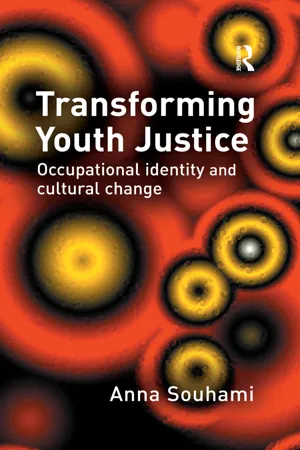
In 1997 the newly modernized Labour party swept into power promising a radical overhaul of the youth justice system. The creation of inter-agency Youth Offending Teams (YOTs) for the delivery of youth justice services were the cornerstone of the new approach. These new YOTs were designed to tackle an 'excuse culture' that was allegedto pervade the youth justice system and aimed to encourage the emergence of a shared culture among youth justice practitioners from different agencies. The transformation of the youth justice system brought about a period of intense disruption for the practitioners working within it. The nature and purpose of contemporary youth justice work was called into question and wider issues of occupational identity and culture became of crucial importance. Through a detailed ethnographic study of the formation of a YOT this book explores a previously neglected area of organisational cultures in criminal justice. It examines the nature of occupational culture and professional identity through the lived experience of youth justice professionals in this time of transition and change.It shows how profound and complex of the effects of organisational change are, and the fundamental challenges it raises for practitioners' sense of professional identity and vocation. Transforming Youth Justice makes a highly significant contribution not only to the way that professional cultures are understood in criminal justice, but to an understanding of the often dissonant relationship between policy and practice.
- 230 pages
- English
- ePUB (mobile friendly)
- Available on iOS & Android
eBook - ePub
Transforming Youth Justice
About this book
Information
Chapter 1
Transforming youth justice
At the time this study began, the youth justice system was under intense political scrutiny. Youth crime had become a key issue in the 1997 general election. A series of serious and high-profile offences by young people had seen a recent ‘repoliticisation’ (Pitts 1999) of youth crime in which it was thrust into the centre of national attention and debate, most importantly following the abduction and murder of two-year-old James Bulger by two 10-year-olds in 1993 (Newburn 1998). At the same time, an increasing preoccupation with low-level incivilities or ‘anti-social behaviour’ by young people had become central to the concerns of the prized electoral constituency of middle-class, middle England (Pitts 2000). The run-up to the general election therefore saw the emergent Labour government attempting to reposition itself as the party of ‘law and order’. Youth crime would be a ‘matter of priority’ (Labour Party 1996).
A series of consultative documents setting out their plans for a ‘major reform of youth justice’ (Labour Party 1996; Home Office 1997a, 1997b, 1997c, 1997e, 1997f, 1997g) and the establishment of a Task Force on Youth Justice (Home Office 1998b) were shortly followed by the White Paper No More Excuses (Home Office 1997d). This frenetic activity culminated the following year in the Crime and Disorder Act 1998: an ambitious and wide-ranging programme of legislative and organisational change, and one which set in train the processes described in this book.
This chapter sets the following research in its policy context and describes the climate facing youth justice professionals at the beginning of the study. What was the rationale behind Labour's strategy for the youth justice system? What were the nature of its proposed reforms? And what challenges did this hold for practitioners within it?
Youth justice in disarray
The government's assessment of the youth justice system was damning. The documentation surrounding the Crime and Disorder Act describes a system characterised by waste, inefficiency and complacency. In his foreword to the White Paper (Home Office 1997d), the then Home Secretary Jack Straw described an ‘excuse culture’ that had come to pervade the system and in which the practitioners and young offenders within it were colluding. The youth justice system ‘excuses itself for its inefficiency’. It ‘excuses the young offenders before it, implying that they cannot help their behaviour because of their social circumstances’. The system was infused by a culture of inactivity. Offenders were rarely ‘confronted with their behaviour or helped to take personal responsibility for their actions’.1
Drawing closely on the newly published Audit Commission report, Misspent Youth (Audit Commission 1996), which formed the basis of the subsequent reforms, the government described a catalogue of failings. Three main strands of its critique are particularly salient to this discussion. First, the youth justice system was incoherent. It was ‘in disarray. It simply does not work. It can scarcely be called a system at all because it lacks coherent objectives’ (Labour Party 1996: 1). Instead, there was a profound confusion about its purpose. ‘Concerns about the welfare of the young person have too often been seen as in conflict with the aims of protecting the public, punishing offences and preventing offending’ (Home Office 1997d: 2.1). The structures through which the youth justice system was organised allowed for the perpetuation of these central tensions. At the centre, responsibility for youth offending was spread across different governmental departments, each with different priorities and approaches to youth offending. As a result, ‘mixed messages’ were conveyed through the Home Office's ‘criminal justice’ approach towards young offenders and the ‘welfare’ approach of the Department of Health (Labour Party 1996). Such incoherence was reflected at a local level. Youth justice professionals were confused about the principles that should govern the way in which they should work with young offenders, which ‘creates real practical difficulties’ (Home Office 1997d: 2.1). The Audit Commission found that the agencies which worked with young offenders had different views about what they were trying to achieve (Labour Party 1996: 16). This resulted in inefficient tensions and inconsistencies, with agencies working at different purposes. As a result, the youth justice system was confusing for both the practitioners and the young people within it.
Second, little was being done to address offending behaviour. The Audit Commission noted that ‘all of the social services departments visited were committed to diverting transient young offenders (other than serious offenders) from the criminal justice system. But few offered alternatives which tackled offending behaviour’ (1996: 17). Agencies were ‘opposed in principle’ to offering interventions to those who received cautions and thus there was even less effort made to tackle offending behaviour outside the court system (1996: 23).
In general, the documentation surrounding the Act described a youth justice system characterised by waste and inefficiency. The Audit Commission had argued that the youth justice system was becoming increasingly inefficient and expensive. It reached an excoriating conclusion:
The current system for dealing with youth crime is inefficient and expensive, while little is being done to deal effectively with juvenile nuisance. The present arrangements are failing the young people, who are not being guided away from offending to constructive activities. They are also failing victims … And they lead to waste in a variety of forms … resources need to be shifted from processing young offenders to dealing with their behaviour. At the same time, efforts to prevent offending and other antisocial behaviour by young people need to be co-ordinated between the different agencies involved. (Audit Commission 1996: 96)
Reflecting the Audit Commission's analysis, the government could find little in the youth justice system to commend it. It was therefore in need of a ‘radical overhaul’ (Labour Party 1996). But how had this state of affairs arisen?
Origins
Neither the Audit Commission's report nor the documentation surrounding the Act situated their analysis of the operation of the youth justice system in its historical context. However, the features that it identifies for criticism are closely grounded in long-standing tensions and debates about the strategies, philosophies and principles that should govern work with young offenders.
Objectives
First, the ‘incoherence’ the government perceived in the objectives of the youth justice system describes a tension inherent since its inception. The development of a separate youth justice system for children was a response to the recognition that, because of the particular vulnerabilities of childhood and adolescence, children in trouble should be treated differently from adults. In other words, children should be dealt with in separate institutions and according to different principles: the requirement to punish coexists with a duty to protect their welfare. However, while these two objectives coexist, they are essentially incompatible (Muncie 2004). They incorporate very different assumptions about the scope and purpose of the youth justice system and the conception of responsibility of the young people subject to its interventions. The ‘welfare’ approach sees crime as just one indicator of potential problems. The criminal justice system is seen as a site of treatment: it attempts to meet the ‘needs’ of the individual child, rather than addressing the offence alone. In contrast, the ‘justice’ model emphasises criminal responsibility and a focus on the offence rather than the young person.
Each of these approaches has dominated different periods in the youth justice system in England and Wales.
For much of the twentieth century, the ‘welfare’ model dominated youth justice in England and Wales. This approach culminated in the Children and Young People's Act 1969, in which a philosophy of ‘treatment’ was so firmly entrenched that in effect it substituted ‘the principles and practices of child care for those of criminal justice’ in dealing with young offenders (Blagg and Smith 1989: 101). However, in the 1970s welfarism came under attack from all sides, and the Act was never fully implemented. It was argued that, through the guise of ‘treatment’ and ‘welfare’ objectives, young people frequently received ‘justice’ interventions which were not warranted by their behaviour alone. They were subject to the discretionary power of the professionals who assessed and supervised them and were denied full access to legal rights. In addition, the language of welfare and treatment invited public criticism that the youth justice system had become ‘soft’ on crime. Consequently, a ‘back to justice’ movement argued for a return to principles of due process and proportionality in sentencing, and for more tightly defined, time-limited interventions that focused on the offending behaviour rather than the young person themselves.
However, while the dominant approach to youth justice has swung between justice and welfare philosophies at different moments, elements of both approaches are visible at any one point. The tension between ‘punishment’ and ‘welfare’ objectives in the youth justice system – and thus the ‘incoherence’ and ‘confusion’ described by the Labour government in its underlying principles – is inherent in a system whose fundamental rationale is to take account of the particular needs and vulnerabilities of children while punishing their offending behaviour.
Addressing offending behaviour
Second, the Audit Commission's observation that social services departments appeared opposed ‘in principle’ to rigorous programmes to address offending behaviour reflects an influential movement that emerged the 1980s, in which it was held that the criminal justice system was not the appropriate place for intervention. Research seemed to show that welfare-focused criminal justice interventions had little impact on offending behaviour (e.g. Martinson 1974). But moreover, it was increasingly believed that formal intervention could do more harm than good. Drawing on labelling theory (e.g. Becker 1963; Lemert 1970) and informed by arguments that offending by young people is relatively ‘normal’ and, if left alone, young people would ‘grow out’ of crime (e.g. Rutherford 1986), it was argued that not only was state intervention unable to prevent reoffending, it had the potential to reinforce patterns of offending through the establishment of delinquent identities. Consequently it was argued that interventions by the formal criminal justice system had the potential to cause more harm than good and should thus be avoided or minimised wherever possible. As far as possible, therefore, it was held that more serious offenders should be diverted from custody and dealt with by tightly focused intermediate treatment programmes, and minor offenders should be dealt with by cautioning or other pre-prosecution disposals. In some areas, multiagency diversion panels (such as the influential Juvenile Liaison Bureaux in Northamptonshire2) were established to recommend an appropriate course of action to the police, and as a site of informal intervention.
This emerging ‘orthodoxy’ among youth justice practitioners (Haines and Drakeford 1998) was encouraged and consolidated by official endorsement. It corresponded with the priorities of the (then) Conservative government by rationalising the reach of state apparatus while simultaneously allowing the government to appear ‘tough’ by concentrating resources on more serious or persistent offenders (Pitts 1999, 2005). Further, the pro-diversionary movement among practitioners was strengthened by its apparent success. During the 1980s there was a significant and sustained decline both in the numbers of children and young people entering the courts, and in the use of custody for young people (Smith 2003). The decade was therefore widely held by practitioners to have seen a ‘successful revolution’ in youth justice (Jones 1989). As the strategy of its success, diversion continued to dominate practitioners’ thinking about youth justice interventions at the time of the Audit Commission's investigation in the mid-1990s.
Efficiency and effectiveness
The Audit Commission's emphasis on efficiency and effectiveness, and its report itself, is also situated in a particular way of thinking about youth justice. By the end of the 1980s, a further strategy for organising work with young offenders was developing which was not connected to questions of justice or welfare or particular strategies for intervention. Instead, and in line with a wider shift towards the ‘new public management’ (Hood 1991), an emerging ‘corporatist’ strategy (e.g. Pratt 1989) was concerned with managing the offending population as efficiently and effectively as possible. Its primary objectives were thus not transformative, such as, for example, the rehabilitation or treatment of the young person. Instead, policies aimed to make youth crime tolerable in the most efficient, economic way (e.g. Feeley and Simon 1992).
This approach was underpinned by a re-emerging optimism in the possibilities of the criminal justice system as a site for intervention. By the end of the 1980s, increasing attention was being paid to the ‘what works’ agenda, which emphasised the importance of evidence and outcomes in criminal justice interventions. Evaluative research appeared to show that, if directed appropriately, some forms of intervention could be successful in reducing offending behaviour for some young people (Muncie 2004). Thus in shaping policy options, moral questions about the purpose and process of intervention questions are side-stepped in favour of questions of cost-effectiveness and measurable, quantifiable outcomes (e.g. Muncie 2002, 2004). Actuarial techniques of risk assessment and classification became central to directing policy and practice.
The Audit Commission's emphasis on the benefits of multiagency work can be understood in this context. Firstly, it is premised on the understanding that crime has multiple causes and effects. In other words, young people will present multiple problems, which may be connected to a range of factors related to, for example, their family, social, economic, health or education needs. A ‘holistic’ approach which can simultaneously address all of these in a package of interventions will therefore be more effective. Secondly, by consolidating the diverse expertise and resources of staff from different agencies into a single structure it allows for a better coordinated and more efficient use of resources. Thirdly, by coopting various professional and interest groups into a collective whole with consistent aims and objectives, the capacity for conflict and disruption between these agencies is reduced (Pratt 1989). In other words, multiagency work attempts to ‘design out’ conflict (Pitts 2000: 9) between the different parts of the youth justice system to allow for its smooth running.3
Transforming youth justice
Through its reforms, the government hoped to put an end to these entrenched tensions and debates. The Crime and Disorder Act would ‘draw a line under the past’. The new legislation would ‘cut out the waste’ in the system and ‘refocus resources’ through the professionals within it (Home Office 1997d). Centrally, it would ‘resolv[e] some of the fundamental confusion between the relationship of welfare and punishment in dealing with young offenders at central and local government level’ (Labour Party 1996: 8).
In order to accomplish this, the new arrangements for youth justice would provide a more coherent, more managed and more interventionist youth justice system. The government sought to achieve this through (i) establishing an explicit central purpose for the youth justice system; (ii) organising intervention through particular notions of risk, outcome and evidence; and (iii) consolidating the delivery of youth justice services through inter-agency cooperation at both the national and local level.
(i) Preventing offending
The Crime and Disorder Act established ‘preventing offending by children and young persons’ (s.37(1)) as the principal aim of the youth justice system, and placed a statutory duty on all agencies working within it to have regard to this aim. By this, the government hoped to provide ‘unity of purpose and coherence of effort’ to work with young offenders (Home Office 1997d: 2.5). The White Paper which preceded the Act argued that this overarching aim resolved the tensions between the underlying principles of welfare, protection and punishment in youth justice work. It accepted that the protection of the welfare of children and young people required protection from the criminal law. However, it argued that ‘there is no conflict between protecting the welfare of a young offender and preventing that individual from offending again’ (Home Office 1997d: 2.1). Indeed, not to intervene was viewed as harmful, and as allowing ‘[young people] to go on wrecking their own lives as well as disrupting their families and communities’. Preventing offending by intervention through the criminal justice system is therefore seen as a means of promoting the welfare of the young person. Formal intervention is presented as an enabling opportunity, even an entitlement (Muncie 2002). As such, intervention should be early: ‘nipping crime in the bud’ was more effective, and thus more beneficial for the child, than allowing offending behaviour to ‘escalate out of control’ (Home Office 1997d: 2).
This was an approach to the prevention of youth crime that stood in stark contrast to the dominant orthodoxy of youth justice work in the previous decades, outlined above. Instead of attempting to reduce the likelihood of establishing criminal careers by reducing contact with the criminal justice system, prevention was to be achieved by targeting young people thought likely to offend and by drawing them into the system at an early stage. Indeed, by putting an end to cautioning, the Crime and Disorder Act effectively abandoned practices that divert young people from the formal criminal justice system (Goldson 2005). Through a raft of new disposals which the Crime and Disorder Act made available to the courts,4 the youth justice system now became characterised by a ‘robust interventionism’ (Pitts 2001: 169) in which, for example, formal intervention now applies to children as young as 10, for second (or in some cases their first) offence, and pre-emptive measures provide for intervention with children below the age of criminal responsibility, including those who haven't committed an offence but are...
Table of contents
- Front Cover
- Half Title
- Title Page
- Copyright
- Contents
- Acknowledgements
- Introduction
- 1 Transforming youth justice
- Part 1: A Youth Justice Team
- Part 2: Change and Ambiguity
- Part 3: A Youth Offending Team
- Appendix: Researching a Developing YOT
- References
- Index
Trusted by 375,005 students
Access to over 1.5 million titles for a fair monthly price.
Study more efficiently using our study tools.
Frequently asked questions
Yes, you can cancel anytime from the Subscription tab in your account settings on the Perlego website. Your subscription will stay active until the end of your current billing period. Learn how to cancel your subscription
No, books cannot be downloaded as external files, such as PDFs, for use outside of Perlego. However, you can download books within the Perlego app for offline reading on mobile or tablet. Learn how to download books offline
Perlego offers two plans: Essential and Complete
- Essential is ideal for learners and professionals who enjoy exploring a wide range of subjects. Access the Essential Library with 800,000+ trusted titles and best-sellers across business, personal growth, and the humanities. Includes unlimited reading time and Standard Read Aloud voice.
- Complete: Perfect for advanced learners and researchers needing full, unrestricted access. Unlock 1.5M+ books across hundreds of subjects, including academic and specialized titles. The Complete Plan also includes advanced features like Premium Read Aloud and Research Assistant.
We are an online textbook subscription service, where you can get access to an entire online library for less than the price of a single book per month. With over 1.5 million books across 990+ topics, we’ve got you covered! Learn about our mission
Look out for the read-aloud symbol on your next book to see if you can listen to it. The read-aloud tool reads text aloud for you, highlighting the text as it is being read. You can pause it, speed it up and slow it down. Learn more about Read Aloud
Yes! You can use the Perlego app on both iOS and Android devices to read anytime, anywhere — even offline. Perfect for commutes or when you’re on the go.
Please note we cannot support devices running on iOS 13 and Android 7 or earlier. Learn more about using the app
Please note we cannot support devices running on iOS 13 and Android 7 or earlier. Learn more about using the app
Yes, you can access Transforming Youth Justice by Anna Souhami in PDF and/or ePUB format, as well as other popular books in Social Sciences & Criminology. We have over 1.5 million books available in our catalogue for you to explore.