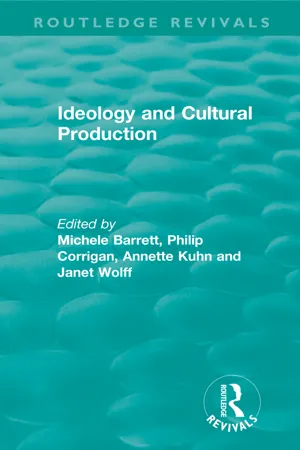
Originally published in 1979, Ideology and Cultural Production examines the contribution to the debate surrounding 'culture', 'ideology', and 'representation', in this collection of essays. Originally presented as papers at the 1978 British Sociological Conference on the theme of culture, the collection is tied together under the argument for a definition, which emphasizes the material and ideological conditions of cultural production. The volume discusses key issues, such as the break with 'super-structural theory', the question of economism, and the argument between culturalism and structuralism, as well as the central debates of determinism and autonomy.
eBook - ePub
Routledge Revivals: Ideology and Cultural Production (1979)
- 246 pages
- English
- ePUB (mobile friendly)
- Available on iOS & Android
eBook - ePub
Routledge Revivals: Ideology and Cultural Production (1979)
About this book
Information
1 Representation and Cultural Production
Michèle Barrett, Philip Corrigan, Annette Kuhn and Janet Wolff
The areas indicated by terms such as 'culture', 'ideology' and 'representation' have in recent years been the subject of extensive and increasing analysis and debate. As the editors of this collection of essays we aim at offering a contribution to this debate, not so much by taking up a position, but by attempting to locate problems and outline developments. The papers published here were originally given at the 1978 conference of the British Sociological Association, the theme of which was 'Culture'. As organisers of this conference we were faced with the problem of defining the area of work which would be embraced by that vexed and ambiguous term. This problem of definition led us to consider the more fundamental question of the relationship between work in the area of 'cultural studies' and the traditional concerns of institutionalised academic sociology. Given the virtual non-existence of any sociology of culture we were confronted by a field that was largely unmapped: consequently in selecting papers for the conference, we were unable to adopt a strategy either of reflecting 'the state of the art' or of providing a showcase for the 'best' work being done in the field. In defining the theme we were therefore necessarily forced to take up a position on what we considered to be important points of development and lines of future work.
The definition of 'culture' made public in our various statements for contributors was not in fact reflected in the range of work presented at the conference. This is by no means a matter of local interest to the several hundred people who attended the conference, but is much more generally symptomatic of the uneven development of work on culture, its diverse institutional bases, and the contradictory directions currently taken in such work. The conference did not seek to address the conventional anthropological notion of 'culture', nor did it seek to reflect the traditional emphasis in sociological work on the analysis of literature (the latter being extensively covered in the annual conferences held under the auspices of the Literature department of the University of Essex). Instead we wished to contribute to broader theoretical debate and to emphasise work on the material and ideological bases of cultural production in modern society, drawing on a wide range of instances such as film, television, the media, visual art and music. In relation to this, we wished to promote discussion of the 'cultural' aspects of current debates in the areas of language, science and sexuality, and to address the politics of gender, race and class in cultural production. In assigning a high priority to questions of gender and race through discussion of representations of gender difference and sexuality and by raising questions of cultural imperialism and racial stereotyping, we necessarily endorsed the recent break with conventional sociological and Marxist approaches in which culture and ideology are theorised as superstatetural reflections of class contradictions at the economic level.
The notion of culture which we would advance hinges on the concept of production. We see cultural products and practices in terms of the relations between their material conditions of existence and their work as representations which produce meanings. In other words, our concern is both with modes of production and with modes of signification. It is also clear that, thought in this way, studies of 'culture' may constitute a challenge to the traditional subject boundaries of academic institutions and discourses: they are by their nature interdisciplinary. Indeed it is no coincidence that much of the work done under the rubric of 'cultural studies' emerges from relations of production which are profoundly subversive of the individualistic notions of authorship common in much academic work. Various degrees of collective or collaborative work underpin a good part of the contents of this book. This was even more evident in the structure of the conference itself, with its emphasis on open workshop sessions, its inclusion of work from a variety of disciplines, and its attempt (while recognising the dangers of a simplistic elision of theory and practice) to challenge conventional barriers between those who produce critical and theoretical work and those who see themselves primarily as 'practitioners'.
The seven papers which follow are not intended in any way to be a 'representative sample' of the conference proceedings.1 Indeed many of the contributions we would have wanted to include could not be transposed into the medium of a book. Several sessions constituted informal presentations of work in progress, many depended upon visual, auditory or dramatic material, and others aimed to open up debate through brief contributions from a panel of speakers. Some of the themes raised in these panel sessions (on culture and ideology; language and discourse; cultural imperialism; debates in TV news research; Marxism, feminism and cultural practice; the state, culture and patronage) have, where possible, been drawn into this introductory essay. We have chosen to publish these particular papers because they focus the issues which we regard as central in constructing work around 'culture' defined as the socially and historically situated process of production of meanings. In saying this, however, we are not suggesting that the articles are to be seen in any way as exemplary, for to embrace such notions of excellence would be to suggest a closure which we would expressly regard as impossible at the present moment. However, they each raise and attempt to address some of the difficult and unresolved issues faced by studies of culture, and indicate the ways in which these issues were taken up at the conference.
There are, as we have already suggested, some acute problems in existing sociological work on culture. Bird, in 'Aesthetic Neutrality and the Sociology of Art', points to the general poverty of attempts to found specific theories of various cultural forms (such as literature). A tendency neither to engage with the major problems of social formation, class structuration and ideological configurations, nor to recognise the validity of critical judgements constituted within the instance being investigated, has led to analyses which regard cultural products as illustrations of the consequences and effects of determinations which are located externally. Some of these approaches are markedly reductive in a sense which is different from the normal use of that term. The term 'reduction' commonly indicates an attempt to deny the autonomy (even if relative) and the specificity (even if structured externally) of cultural practices. But there is another reduction which simply privileges the artefact itself, divorced from its conditions of production and existence, and claims that it alone provides the means of its own analysis. In the work of Leavis, for example, this surfaces in the notion of a correct reading. Other positions exist which, although fundamentally unlike that of Leavis, still take the text and its reading as the end, as well as the obvious beginning, of analysis.
The theoretical inadequacy of much sociological work on culture can only be combated by rigorous, historically informed analysis of cultural and ideological relations and practices. For only such work can resist the tendency to theoreticism so evident at present, and which indeed recalls Marx's comments on the 'violent abstraction' and 'metaphysical speculation' of many of his contemporaries (Sayer, 1979a, 1979b). One aspect of this theoreticism — the mobilisation of theory for its own sake - is ironically that it is not in Marx's terms theoretical enough: it has not grasped the phenomena. The general tendency towards theoreticism in work in the areas of culture and ideology is inextricably and integrally related to similar problems in the wider field of sociological debate. One particular manifestation of it is discussed below when we deal with the various polarisations of position which have been created and maintained to the detriment of constructive and rigorous debate. These polarisations, or dichotomies, are frequently assumed as means of mounting an easy attack; one has only to accuse another of 'culturalism', or 'historicism', or 'economism', or 'Althusserianism' (to name a few examples) to render engaged debate unnecessary. Such general, and often false, oppositions have been drawn from the most universalistic tendencies in current theoretical debate.
Three years ago, Raymond Williams presented a useful overview of 'Developments in the Sociology of Culture' which was later published in the BSA's journal Sociology (Williams, 1976c). There he began by noting both the 'specialized and marginal' way in which the sociology of culture was seen, and argued that it was also evidently underdeveloped. Williams then went on to list the contributions to the debate from sociology and from 'cultural studies': 'studies of effects, of explicitly structured institutions, and of intellectual formations' from sociology, and 'traditions, ... forms and ... the exceptionally complex relations between "forms" in this intellectual, literary and artistic sense and "forms" and "formations" in more familiar social senses' (1976c, pp. 498 and 500; italics in original). Williams then went on to note the centrality of the Marxist contribution to studies of culture and ideology, citing in particular the work of Althusser and also work in anthropology and linguistics. He concluded with the suggestion that future work would focus upon the materiality of signs, arguing that
the success of various kinds of formalism is due mainly to their correct emphasis on sign systems as the radical elements of all cultural process. It is not surprising that work of this kind is replacing criticism which still residually dominates humanistic studies but which can now be seen more clearly as the theoretical and practical generalization of specifically bourgeois uses of culture (the concepts criticism, literature and art, in their currently available forms, are all contemporaneous with bourgeois society, and are the theoretical forms of its cultural specialization and control) [1976c, p. 505].
Significant developments have taken place in the study of culture since that article was written, some of which we discuss below. But it is important to note that some of the tensions and contradictions which have recently emerged more clearly within cultural studies are actually implicit in these earlier formulations. Immediately prior to the publication of his book Marxism and Literature (1977a), Williams made it clear that he distanced himself quite radically from 'specialised literary studies' on the grounds that cultural studies embrace a much wider area. They do so in the concrete sense of what they cover, namely
all other forms of writing ... the related non-written activities of communication which extend from the new media as Art in the conventional sense to the new media not seen as art [Williams, 1977c p. 14].
This is true for the methodology and epistemology of cultural studies. Williams condemns formalism, and calls upon cultural studies to recognise the fundamental historicity of social life. In distancing himself from formalism, Williams specifically cites semiotics as profoundly non-historical or even anti-historical because of its roots in structuralism.
Such criticisms understand semiotic analysis as grounded in Saussure's formulation of a science of signs in society — semiology — in a synchronic rather than a diachronic linguistic theory (Saussure, 1974). Less commonly voiced is the criticism that semiotics is fundamentally idealist in that it is based on the Saussurean conceptualisation of the signified as a mental construct rather than as a material referent. Neither of these lines of criticism however takes account of various other tendencies in structural linguistics on which semiotics has drawn. In this context we could take as examples the work of Jakobson (1972) and Benveniste (1971), in which notions of address in language are mobilised. These arguments are founded on the notion that parole — the speech act as opposed to the underlying code (langue) — necessarily inscribes a source and an object of address. This operates notably through the personal pronoun, an observation which has led to the proposition that determinate conceptions of self and other are produced in language. As Benveniste argues:
it is by identifying himself as a unique person pronouncing I that each speaker sets himself up in turn as the 'subject' ... [1971 p. 220].
Considered in this way, language — or more specifically, the speech act - is the historically situated site of the creation of subjectivity. Indeed Lacanian psychoanalysis bases itself on the notion that a prior and necessary condition of the institution of subjectivity is the self-other split implied in the pronouncing of I and you (Lacan, 1968; Coward and Ellis, 1977). It is clear that in such a semiotics the question of the autonomy of the signification process becomes crucial. On the one hand, the Saussurean notion of the 'arbitrary' character of the signified in relation to any material world which might be posited as preexisting the subject seems to lead to an extreme non-determinist position. On the other, questions as to the degree and character of that autonomy and its external structuration remain the subject of contentious debate.
It is relevant to note here that the inscription of notions of subjectivity, address and context into a semiotics founded on structural linguistics does permit a move away from the formalist variant of semiotics which restricts itself to the specificity of textual practices. Williams' critique of this tendency is complemented by Hill's contribution to the present volume, 'Ideology, Economy and the British Cinema', in which it is argued that around 1970, Cahiers du Cinéma took up a position in which filmic and ideological specificity is considered independently of its determinations. Hill's critique is perhaps representative of the arguments which were levelled against semiotic approaches during the course of the conference, in the sense that the object of criticism is the earlier and more formalist version of the problematic. Discussion around more recent developments in semiotics tended to founder on the difficulty of the language in which such analyses are commonly couched. Although we would agree with some of the criticisms made at the conference of the inaccessibility of some of the theoretical language used, we would argue that a distinction should be made between the obscurantist tendency of theoreticism and the necessary conplexity involved in a precise analysis of language itself. Since thought and language are inseparable, innovation must necessarily involve a challenge to the limits historically set in language. The tendency to ascribe obscurantism to every theoretical presentation which demands considerable work from the reader or listener is a dangerous one.
Another, and related, development of structuralism — discourse theory — has also been drawn upon in the attempt to establish a general analysis of signification and signifying practices. Examples of this work may be found in journals such as Ideology and Consciousness and in the work of Hindess and Hirst (Cutler et al., 1977, 1978). However although this work has been the topic of considerable debate within sociology, there were relatively few contributions to, the conference which took it as a model. In spite of the fact that there was considerable and constructive discussion of developments in discourse theory as they relate to the analysis of subjectivity (as, for example, in the presentations by Colin Mercer and Cora Kaplan in a panel session on language and discourse), there were few echoes of Hirst's argument of a 'necessary non-correspondence' between the ideological and other levels. Hirst advances his argument through a critique of Althusser's essay 'Ideology and Ideological State Apparatuses' (hereafter the ISAs essay) (Althusser, 1971), and arrives, at a total, rather than a relative, autonomisation of all social realms. In this idealisation of social existence nothing exists outside of discourse. Arguing that the signified does not exist prior to its signification (Hirst, 1976b, p. 411), Hirst denies the materiality of language and the historicity of the determinations which make possible or impossible certain kinds of practices to which we refer as cultural. It is perhaps not surprising to find that such an approach has had limited purchase, at least in its most radical form, in work in the field of cultural studies.
A major debate which brought together a number of these issues took place recently in the magazine Screen, which has been influential in promoting work on semiotics and psychoanalysis. Rosalind Coward's article, 'Class, "Culture" and the Social Formation' (Coward, 1977a), argues against a view of culture held to be operational in cultural studies in general and in the work of the Birmingham University Centre for Contemporary Cultural Studies in particular. The reply from the Centre (Chambers et al., 1977) and Coward's subsequent response provide useful texts for establishing some of the major theoretical oppositions which dominated the conference and structure the field. Coward's original article is distinctive for its critique of the assumption of a non-contradictory subjectivity in work which mobilises the concept of 'culture'. This assumption involves the notion that the subject is the vehicle or site of the operation of social/historical forces, and does not acknowledge the subject as being in its own right a process of production and therefore a site of contradiction. This argument has been understood as one informed by a Hirstian anti-historicism, although in a more recent article Coward does in fact appeal to an understanding of the conditions of existence of discourses on representation and sexuality. In this later piece she argues that representations have to be analysed
in terms of the practices which work to produce definitions ... This begins a move away from an analysis in terms of direct correspondence with an economic formation but it does not reduce the imperative of understanding the conditions of existence of these discourses [Coward, 1978, p. 17].
Such an injunction suggests a movement towards theoretically informed historical work. As Raymond Williams argued in 1973:
We should look not for the components of a product but for the conditions of a practice. When we find ourselves looking at a particular work, or a group of works, often realising as we do so their irreducible individuality, we should find ourselves attending first to the reality of their practice and the conditions of the practice as it was then executed [Williams, 1973, p. 16].
This move towards specific historical work — which is in no sense a retreat from theoretical questions — has wider implications. It would first constitute a challenge to many of the arid dichotomies and false oppositions which seem to be a feature of theoreticism. Secondly, the kinds of theoretical work done in the past ten years or so have tended to accompany certain aspects of academic life, to be reinforced within, as it were, the relations of knowledge production and curricula in higher education. To pose the specificity of cultural practices is also to challenge the kind of theoretical 'imperialism' which has been a norm of such academic discourse. Icons and (significantly) Heroes have been promoted and equally rapidly disgraced with a bewildering ease which, curiously, leaves their earlier acolytes and epigones somehow more assured in their theoretical correctness. This process has been instrumental in the makin...
Table of contents
- Cover
- Title
- Copyright
- Half Title
- Original Title
- Original Copyright
- Contents
- Acknowledgements
- 1. Representation and Cultural Production
- 2. Aesthetic Neutrality and the Sociology of Art
- 3. Histories of Culture/Theories of Ideology: Notes on an Impasse
- 4. Sexuality and Reproduction: Three 'Official' Instances
- 5. Ideology, Economy and the British Cinema
- 6. Rethinking Stereotypes
- 7. Television as Text: Open University 'Case-Study' Programmes
- 8. Ideology and the Mass Media: the Question of Determination
- Bibliography
- Notes on Contributors
- Index
Trusted by 375,005 students
Access to over 1.5 million titles for a fair monthly price.
Study more efficiently using our study tools.
Frequently asked questions
Yes, you can cancel anytime from the Subscription tab in your account settings on the Perlego website. Your subscription will stay active until the end of your current billing period. Learn how to cancel your subscription
No, books cannot be downloaded as external files, such as PDFs, for use outside of Perlego. However, you can download books within the Perlego app for offline reading on mobile or tablet. Learn how to download books offline
Perlego offers two plans: Essential and Complete
- Essential is ideal for learners and professionals who enjoy exploring a wide range of subjects. Access the Essential Library with 800,000+ trusted titles and best-sellers across business, personal growth, and the humanities. Includes unlimited reading time and Standard Read Aloud voice.
- Complete: Perfect for advanced learners and researchers needing full, unrestricted access. Unlock 1.5M+ books across hundreds of subjects, including academic and specialized titles. The Complete Plan also includes advanced features like Premium Read Aloud and Research Assistant.
We are an online textbook subscription service, where you can get access to an entire online library for less than the price of a single book per month. With over 1.5 million books across 990+ topics, we’ve got you covered! Learn about our mission
Look out for the read-aloud symbol on your next book to see if you can listen to it. The read-aloud tool reads text aloud for you, highlighting the text as it is being read. You can pause it, speed it up and slow it down. Learn more about Read Aloud
Yes! You can use the Perlego app on both iOS and Android devices to read anytime, anywhere — even offline. Perfect for commutes or when you’re on the go.
Please note we cannot support devices running on iOS 13 and Android 7 or earlier. Learn more about using the app
Please note we cannot support devices running on iOS 13 and Android 7 or earlier. Learn more about using the app
Yes, you can access Routledge Revivals: Ideology and Cultural Production (1979) by Michele Barrett,Philip Corrigan,Annette Kuhn,Janet Wolff in PDF and/or ePUB format, as well as other popular books in Social Sciences & Sociology. We have over 1.5 million books available in our catalogue for you to explore.