Rapid industrialisation is promoted by many as the most feasible way of rejuvenating the Indian economy, and as a way of generating employment on a large scale. At the same time, the transfer of land from rural communities and indigenous groups for industrial parks, mining, or Special Economic Zones has emerged as perhaps the most explosive issue in India over the past decade. Industrialising Rural India sheds light on crucial political and social dynamics that unfold today as India seeks to accelerate industrial growth. The volume examines key aspects that are implicated in current processes of industrialisation in rural India, including the evolution of industrial and related policies; the contested role of land transfers, dispossession, and the destruction of the natural resource base more generally; and the popular resistance against industrial projects, extractive industries and Special Economic Zones.
Combining the work of scholars long established in their respective fields with the refreshing approach of younger scholars, Industrialising Rural India seeks to chart new ways in the study of contemporary industrialisation and its associated challenges in India. This cutting-edge interdisciplinary work will be of interest to scholars working on industrial development and land questions in India and South Asia alongside those with an interest in sociology , political science and development research.
eBook - ePub
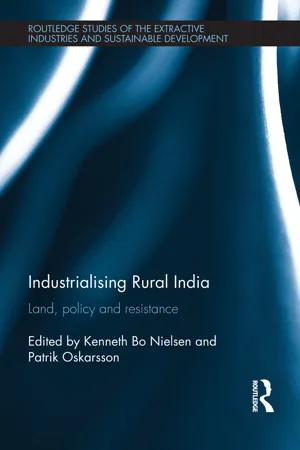
Industrialising Rural India
Land, policy and resistance
- 200 pages
- English
- ePUB (mobile friendly)
- Available on iOS & Android
eBook - ePub
Industrialising Rural India
Land, policy and resistance
About this book
Part I
Introduction
1 Industrialising rural India
Patrik Oskarsson and Kenneth Bo Nielsen
The challenge of industrialisation has emerged as one of the most burning issues in India today. With an agrarian crisis believed to be looming large across substantial tracts of India, and with the country's globally renowned IT and ITES sectors incapable of absorbing the large number of workers and migrants seeking a way out of a stagnating rural economy, rapid industrialisation is promoted by many as the quickest and most feasible way of 'moving people out of agriculture' while also rejuvenating an economy that has produced sluggish growth rates over the past several years. Nowhere is this as evident as in the current Indian prime minister Narendra Modi's spirited electoral campaign in the early months of 2014- Promising to transfer his 'Gujarat model' of development – enabled by an investor-friendly and pro-business regime – to the rest of India, Modi successfully captured the imagination of large sections of the Indian population, including the 'neo-middle class' (Jaffrelot 2015), who aspire for upward mobility and an improved quality of life.
At the same time, the transfer of land from marginal rural communities and indigenous groups for industrial parks, mining ventures or Special Economic Zones have undoubtedly been among the most contested issues in India over the past decade. Such contestation has been common enough to generate 'thousands of small wars against land acquisitions' (Levien 2011: 66) across India. As critics have repeatedly pointed out (Banerjee-Guha 2013; Levien 2013; Sampat 2015) the large-scale dispossession, displacement and destruction of rural livelihoods and cultures that have historically accompanied industrialisation processes around the world appear integral also to the kind of development policy currently pursued in India. What Banerjee-Guha calls a new 'multiscalar geopolitics of popular resistance' (Banerjee-Guha 2013: 167) has thus been a close companion to many recent industrial ventures across rural India, even if one takes into account the considerable inter-state variation that exists across India's federal geography.
In Industrialising Rural India, we aim to shed light on what we believe are some of the most crucial dynamics and contestations currently at work in present day India. The questions we explore include: How have policymakers sought to strike a balance – over time and across sectors – between the idea that industrialisation is the way ahead for the nation, and the compulsion to protect vulnerable groups unlikely to make a swift 'transition' from peasants to industrial workers? Who benefits and who loses from the current ways in which nature and resources are governed? And who gets to be heard and who is silenced in the uncertain struggles over land and social justice in the context of often top-down industrial change in rural India? In engaging these questions, we focus, first, on the making and remaking of economic and industrial policies over time, and interrogate their impact on rural lives and livelihoods; second, we analyse the consequences for land-dependent rural communities of how nature and society are governed in a context in which industrialisation is being promoted by political interests across the board; and, lastly, we engage with the myriad ways in which India's rich democratic heritage and freedom of expression allows for disagreement and active contestation in a situation in which land transfers for rural and/or extractive industries are altering rural mores and livelihoods. Empirically, we take the reader into an abandoned car factory in rural Bengal and to the coal mines of Meghalaya; to the Adivasi areas in Jharkhand and Odisha, rich in natural resources and minerals; to the scrapped Special Economic Zones in Goa; and on a tour of key policy documents of the postcolonial Indian state. While we have aimed to cover the vast field of industrial development and change in rural India in a broad sense, several chapters focus particularly on new extractive industries (of coal, bauxite, etc.). While this is a reflection of the research agendas of several of our contributors, we also believe that rural industrialisation based on the intensified exploitation of nature represents one of the most important elements of the contemporary moment and that it therefore merits particular attention.
In this introduction we contextualise the questions and cases outlined above, starting with a short overview of the shifting political economy of the Indian state and its industrial policies. We then move on to analyse why resistance to land dispossession for industrial purposes has increased in recent years. We briefly touch upon the impact so far of the Modi government's policies on industrialisation and eminent domain, before we round off with an overview of the chapters that follow.
Industrialisation and the Indian state
As is well known, India has gradually moved away from the so-called Nehru-Mahalanobis strategy of state-led development of the early post-Independence period. From 1947 onwards, India had aimed at creating self-sufficiency and an economy free from external domination. This was to be achieved through state-led economic planning, carried out (ostensibly) in relative isolation from the partisan squabbles of politics (Chatterjee 1997). The state assumed a central role in the supply-side of the economy by actively pursuing a strategy of rapid import-substitution industrialisation that focused on the building of state-owned industries producing capital goods. This approach was not very dissimilar from what many other newly independent nations attempted throughout the 1950s and 1960s, aiming for a high degree of self-reliance as the foundation of truly independent and socially just nations (Kohli 2004). While clearly inspired by socialist and communist countries the private sector was, however, allowed to live on, even if it was often severely straight-jacketed. In India, a 'license regime' was established to regulate domestic production in accordance with the dictates of planning. For a while, as Pedersen also shows in this volume, this policy rested on solid foundations – there was a near consensus across the board, from industrialists to left-of-centre politicians and radicals, on the need for national development, poverty alleviation, progress, and an interventionist role for the state (Kothari 2005; Ray and Katzenstein 2005).
As Pedersen notes (this volume), in the period of the first three five-year plans, from 1951 to 1966, India's industry grew at a rate never to be achieved again. To a large extent this growth was based upon the establishment of large industrial and infrastructural projects funded by the state. But this accomplishment notwithstanding, the state in India oftentimes emerged more as a regulatory rather than a developmental State (Corbridge and Harriss 2000: 113). And, by the 1970s it had – in spite of respectable industrial growth – largely failed to effect any significant reduction in poverty (Ray and Katzenstein 2005: 7–8); and since poverty reduction was one of the foundations on which the legitimacy of the state-led model of development rested, it lost much of its sheen. The comparatively lacklustre performance of the Indian economy stood in marked contrast to the booming economies emerging in Southeast and East Asia around the same time, adding to the emerging critique of the state-led model of economic development. In particular, critics writing from a (neo)liberal position argued that Indian planning as it had been practised so far combined the worst features of capitalism and socialism (Das 2006), and promoted an economic system that was over-licensed, bureaucratised, inefficient and corrupt (Bhagwati 1993).
While the Indian economy had experienced liberalising economic reforms already in the 1980s, these gathered momentum in the wake of a fiscal crisis in 1991, when India was on the verge of default. Ostensibly to stabilise its economy, India opted for the implementation of a package of structural and economic reforms. Shifting towards what Kohli (2009) has called a pro-business model of development, much of India's industrial licensing system was dismantled and private sector companies allowed to trade in industries that had once been arrogated by state-owned enterprises (see Eriksen, this volume, for further details). In addition, foreign investments in many areas were welcomed in a situation where the state was actively redefining its role in the economic process from that of planner to manager (Kurien 1994: 94; Rudolph and Rudolph 2001b).
The fact that India's economic reform process is commonly referred to as 'liberalisation' often gives rise to associations to 'neoliberalism', under which the market decides on most economic matters, the public sector is privatised, and global economic actors gain influence (Williamson 2008). Yet a number of key features in the Indian reforms experience stand out and set it apart from a model of 'pure' market liberalism. International companies have attempted to invest in India but have often not been very successful. And while we do find important cases of international investments in the field of rural industrial development –including mining and the processing of minerals – it is by and large Indian big business that has been the main beneficiary of economic reforms; and, importantly, the public sector remains strong (Kohli 2006). In fact, a key factor in the governance of industrialisation in India is the continued crucial importance of the state. Reduced state intervention in controls over export and import licenses have thus come with an increased state-presence elsewhere, including in areas such as land transfers and conversions, and environmental control procedures and clearances (Kohli 2007; Nayyar 2008) that are required to set up industries. As Eriksen shows in this volume, the Indian economy even after more than 25 years of economic reforms remains among the least 'liberal' in the world, when seen in a global, comparative perspective.
Yet although the reform process has proceeded piecemeal – with sectors such as agriculture, mining and retail remaining partially exempt for a longer period – there is little doubt that the broad thrust of the reforms has been to increase the powers of private capital. Indeed, to Chatterjee (2011) and others (Gupta 2012; Gupta and Sivaramakrishnan 2011; Kohli 2009), liberalisation signalled the decisive rise of the corporate capitalist class as the dominant group within the state apparatus, increasingly displacing other erstwhile dominant classes such as the rich farmers and the salariat (Bardhan 1984). Today, there is a virtual consensus among all major political parties about the need to prioritise rapid economic growth led by private investment, both domestic and foreign (Chatterjee 2008: 57), evidenced by the fact that successive waves of liberalising reforms have sought to be carried out irrespective of the combination of parties in power in New Delhi (Chandrasekhar 2011; Jenkins 1999). As a corollary of this shift in economic policy and emphasis, the very idea of 'development' has been redefined: As Chandra (2015: 50) has recently argued, business has increasingly acquired the ideological dominance to define what 'development' means in India today, reducing it to a 'shorthand for a package of vaguely defined terms including "urbanisation", "industrialisation", and "infrastructure creation", in which it is assumed that the private sector will take the lead'. Yet at the same time, business has not yet fully acquired a matching political dominance that allows it to pursue this agenda with full consent or compliance. This tension is at the heart of many current contestations over land, natural resources and industrial development in India today, and we explore it further in the next section.
Land acquisitions and resistance
We have in recent years, as noted above, seen more and more activities come to be included among activities seen as 'development', including the acquisition and allocation of land by governments in favour of profit-making, private industries (Reddy and Reddy 2007: 3325) and the setting up of Special Economic Zones (SEZ) with significant exemptions from regular legislation in a range of areas (see Bedi, this volume). A rapid increase in mining and the exploitation of natural resources such as coal, iron and bauxite on a large scale by private and public companies has also been an integral component of this shift; these are profit-making entities in their own right, but are also seen as necessary to support the wider economy. The consequence has been serious environmental degradation – air and water pollution, changing hydrological regimes, forest degradation, water scarcity and fugitive dust emissions – in and beyond the mineral-bearing areas, coupled with large profits and attendant corruption (especially for coal and iron ore) for those who are able to bend the law into approvals of mining leases. As the chapters in this volume show, land acquisitions, SEZs, mining and other extractive industries with their related forms of dispossession have been the target of considerable popular criticism, with critics sometimes labelling what they see happening around them as a 'land grab by capital' aided by 'the neoliberal and corporatised Indian state' (Kapoor 2011: 135–136).
In all of this, the role of the state remains crucial. Land transactions are impossible to carry out on the scale required for industrial use without the active intervention of governments, especially at the state level. For example, in the case of the now aborted Tata Motors factory in Singur in West Bengal that Majumder and Nielsen describe in this volume, the acquisition of around 997 acres of farmland ostensibly directly affected more than 10,000 land owners. While the intervention of the state via eminent domain ensured the acquisition of the full and contiguous area in little time, the alternative scenario where Tata Motors would have had to negotiate individual deals with so many landowners would have proven immensely cumbersome and would have likely led to a significant 'hold-out problem', the euphemism often used to designate what happens when landowners are capable of strategically navigating the land market to press for a higher price for the last remaining pieces of a planned industrial estate. To resolve land dilemmas prospective investors need the state, including judicial and administrative institutions and procedures for the orderly and lawful transfer of certain parcels of land, backed by the potential use of force and punitive measures by the police in case the 'land losers' do not agree to plans. The 'master manipulators' (Nielsen and Oskarsson 2016) of land transactions are, however, the elected politicians who, with an intimate knowledge of local social and political relations and with a firm grip on the local state machinery, work through networks of brokers and intermediaries at proposed sites to ensure that dominant interpretations of 'development' are able to embed themselves in particular parcels of increasingly valuable land (ibid.). Land transfers in this sense remain dependent on the 'patronage politics' of the state in a manner not radically different from that which prevailed under the licensing regime (Chandra 2015).
With a radically lower, liberalisation-induced level of national public investment, state governments have since the early 1980s increasingly been forced to compete for industrial investments in a completely new manner (Rudolph and Rudolph 2001a), potentially paving the way for a race to the bottom to attract industrial investments. In this context it is perhaps unsurprising that the ability of state governments to furnish land for investors has become 'the most important factor in inter-state competition for investment' (Levien 2012: 944). Land, permits and clearances thus often mediate the relationship between states and industrialists, even if this 'nexus' may be closer in some states than in others. It is in this context that land becomes a vital concern to farmers, agricultural labourers, forest-dwellers, top decision makers and industrialists alike, effectively making it the site on which diverging perspectives on, and interests in, rural industrialisation and the future political economy of India play out. And, it is a site of considerable ambivalence, ambiguity and indeterminacy, as several chapters in this volume illustrate: Farmers may be unwilling or unable to move out of agriculture, even if the prospects of industrial jobs are alluring; forest-dwellers face ongoing dispossession from rapidly expanding extractive industries, even as they are tempted w...
Table of contents
- Cover
- Title
- Copyright
- Contents
- List of illustrations
- List of contributors
- Acknowledgements
- PART I Introduction
- PART II Policy evolution
- PART III Governing nature and society
- PART IV The ambiguity of resistance
- Index
Trusted by 375,005 students
Access to over 1.5 million titles for a fair monthly price.
Study more efficiently using our study tools.
Frequently asked questions
Yes, you can cancel anytime from the Subscription tab in your account settings on the Perlego website. Your subscription will stay active until the end of your current billing period. Learn how to cancel your subscription
No, books cannot be downloaded as external files, such as PDFs, for use outside of Perlego. However, you can download books within the Perlego app for offline reading on mobile or tablet. Learn how to download books offline
Perlego offers two plans: Essential and Complete
- Essential is ideal for learners and professionals who enjoy exploring a wide range of subjects. Access the Essential Library with 800,000+ trusted titles and best-sellers across business, personal growth, and the humanities. Includes unlimited reading time and Standard Read Aloud voice.
- Complete: Perfect for advanced learners and researchers needing full, unrestricted access. Unlock 1.5M+ books across hundreds of subjects, including academic and specialized titles. The Complete Plan also includes advanced features like Premium Read Aloud and Research Assistant.
We are an online textbook subscription service, where you can get access to an entire online library for less than the price of a single book per month. With over 1.5 million books across 990+ topics, we’ve got you covered! Learn about our mission
Look out for the read-aloud symbol on your next book to see if you can listen to it. The read-aloud tool reads text aloud for you, highlighting the text as it is being read. You can pause it, speed it up and slow it down. Learn more about Read Aloud
Yes! You can use the Perlego app on both iOS and Android devices to read anytime, anywhere — even offline. Perfect for commutes or when you’re on the go.
Please note we cannot support devices running on iOS 13 and Android 7 or earlier. Learn more about using the app
Please note we cannot support devices running on iOS 13 and Android 7 or earlier. Learn more about using the app
Yes, you can access Industrialising Rural India by Kenneth Nielsen,Patrik Oskarsson,Kenneth Bo Nielsen in PDF and/or ePUB format, as well as other popular books in Economics & Sustainable Development. We have over 1.5 million books available in our catalogue for you to explore.