- 290 pages
- English
- ePUB (mobile friendly)
- Available on iOS & Android
eBook - ePub
About this book
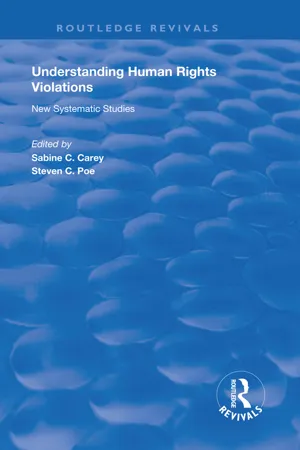
Originally published in 2004. This excellent volume presents a systematic analysis of various human rights violations around the globe, focusing on security and subsistence rights. The book collects important contributions to the theoretical development of the human rights phenomenon, covering a wide range of human rights issues and research approaches. The research presented combines a variety of qualitative and quantitative approaches and brings together both theoretical and empirical work. It places particular emphasis on making the advanced statistical methods that are used to test the arguments accessible to a wider readership. Understanding Human Rights Violations will prove a useful tool for all in the fields of international human rights, peace studies, political violence and international law, and offers a valuable introduction into the literature on human rights violations.
Information
PART I
HUMAN RIGHTS RESEARCH AND THE QUEST FOR DIGNITY
Chapter 1
Human Rights Research and the Quest for Human Dignity
There can be no doubt that systematic, social scientific scholarly research on human rights has proliferated in the last two decades. Research on human rights related topics has been published in the major journals of the political science discipline. The scholarly movement to study and promote human rights has grown and is quickly being institutionalized.1
In fact, scholars have been interested in human rights for quite some time, but until relatively recently most have adopted political theory, philosophical or legalistic perspectives (e.g., Van Dyke, 1973; Dworkin, 1978, and sources cited therein).2 Today, there are two complementary and interrelated veins of social science research adopting different approaches to studying human rights. The first stems from a movement by social science scholars who began to use systematic, qualitative methods to study human rights behaviours (e.g., Claude, 1976, Forsythe, 1983; Donnelly, 1989). A second vein of research has developed from early works that sought to overcome data availability problems in order to empirically test theories relating human rights to other phenomena (e.g., Strouse and Claude, 1976; Schoultz, 1981; Stohl, Carleton and Johnson, 1984).
It is undeniable that violations of human rights are causing pain, anguish and oftentimes death to citizens of most countries in the world most of the time. Yet even today human rights are given far less attention by empirical social science researchers than international wars and numerous other issues that seem much less important when one considers their relative human costs. Indeed, in terms of killing, human rights violations outside of a state of war are arguably more destructive of life than those that occur when wars are ongoing. Rummel once estimated that in the twentieth century far more people have been killed by democide, which includes acts of genocide, politicide and mass murder and other public killing by governments’ actions (which are the most serious abuses of the human right to personal integrity), than were killed in combat by governments in a state of war.3 The quickly developing human rights literature, of which each of the pieces in this volume is an example, is an illustration of recent scholarly work that attempts to remedy this historical imbalance.4
The reasons why human rights have been afforded much less attention by empirical social scientists than is warranted are not firmly established. However, several factors may be considered as likely suspects. It seems undeniable that much social scientific academic inquiry is a reaction to real-world political events and discourse. According to this line of thinking, systematic studies of human rights may be late to develop relative to the study of war because until very recently it was thought that, consistent with the dictates of national sovereignty, what governments did within their own borders was their own business. Indeed, it was not until the Universal Declaration of Human Rights, passed in 1948, that a meaningful challenge was made to this line of thought. And though the Declaration increasingly took on law-like status, the two U.N. Covenants that established many of the rights declared in the Universal Declaration as law did not enter into force until 1976.
So, while the likes of Louis Fry Richardson, Quincy Wright and later Kenneth Boulding, J. David Singer and others were looking systematically at the causes of wars, gathering data and institutionalizing a field of study around that issue, the concept of human rights had not yet appeared on most social scientists’ maps.
Perhaps another part of the story is the belief held by many in the social sciences that normative judgments should be avoided, since they are apt to introduce a systematic bias into research that is supposed to be scientific and therefore objective.5 To be fair, many students of international war and others in the international relations field are open about their own normative biases, but those biases frequently go unmentioned in their writings. In contrast, studies of human rights are normative from the outset, as is made clear even in the titles of publications on this topic. They are open about their assumption that there is something called human rights and that people are entitled to be treated with dignity, simply as a result of them being human (i.e., Donnelly, 1989). Proceeding from this value judgment, they set out to produce replicable, valid research that would be accepted by knowledgeable social scientists.
While we cannot speak for other human rights researchers, the editors of this collection are quite comfortable doing research of this kind in part because we believe that some normative judgments are made by social scientists at the beginning of any research programme, unless the choice of topics is either random or made by one’s instructor. Almost everyone who studies human behaviour chooses a topic based partly on what they consider to be important and/or interesting, and such judgments are naturally based partly on what that researcher values. This is no less the case for someone doing a game theoretic study of countries’ bargaining behaviour on trade issues, than it is for someone studying human rights or international war. What is different about human rights scholars is that they are open about their own normative assumptions, usually making them clear in the titles and abstracts of their research, where they choose to use the ‘human rights’ terminology. Should someone not accept these assumptions, they might still find value in the work, by substituting ‘repression’ or ‘starvation’ or other more value neutral terms for the term violation of human rights where appropriate.
A third explanation why empirical research on human rights has been relatively late to develop has to do with the predominant theoretical orientation of the field. A quarter of a century ago, Roy Preiswerk (1981) charged that at that time international relations scholars were ignoring human suffering and failing to do research ‘as if people really matter.’ Preiswerk’s criticism had some merit then, and perhaps even today, since most international relations scholars have approached their subject from realist and neo-realist theories, which primarily focus on the nation-state, or on the relations between nation-states in the international system. Even the liberal movement in international relations seems to stay mostly at that nation-state level of analysis. As such, most international relations scholars and their theories address the effects on actual peoples’ lives only rather indirectly. This is not to say that international relations research does not relate to issues that are of importance. Research on wars and the use of force, trade and a variety of international economic phenomena clearly addresses important issues that affect peoples’ lives, but frequently the linkages are indirect and not explicitly tackled.
On this score, research on human rights provides a much needed contrast to the thrust of mainstream international relations research. Like the human rights movement more generally, the scholarly movement that examines human rights asserts that people and their suffering are important and worthy of the attention of international relations scholars and those in other disciplines, and that governments and other entities should be held responsible for living up to certain standards in their treatment of people. Human rights researchers tie their intellectual and theory-building efforts to individuals’ suffering and to international efforts to ensure that people are treated with dignity.
The systematic human rights research conducted to date, including each of the following twelve chapters, may be seen as researchers’ efforts to respond systematically to Preiswerk’s challenge. The studies in this volume seek to apply the analytical tools of social science research, both qualitative and quantitative, to answer questions of why human dignity is so frequently being violated. They combine scholarly rigour with the desire to further our understanding of human rights violations in the hope that we will be better equipped in the future to prevent such suffering.
What do we mean by human rights? Human rights are those rights that people have just as a result because of being human and that are necessary to live a life of dignity (Donnelly, 1989). This volume concentrates on human rights that are internationally recognized in the Universal Declaration of Human Rights and in the International Human Right Covenants.6 More specifically, it focuses on personal (or physical) integrity rights and subsistence rights. Personal integrity rights, or security rights (Shue, 1980), are those rights that protect the integrity of a person’s life. They include the right to be free from torture, arbitrary imprisonment and murder. Subsistence rights, or basic human needs, refer to the right to an adequate standard of living, such as access to housing, food, clothing and medical care. Concentrating on these universally accepted rights allows us to generalize our arguments and findings across different regions and cultures of the world. By focusing on security and subsistence rights, we do not mean to suggest that these are the only rights necessary for a life in dignity. But without the respect of these rights, the enjoyment of other rights, such as social and cultural rights, is impossible (see also Shue, 1980).
In the remainder of this chapter, we briefly summarize the research that has been conducted on these issues to date, what has been learned and the goals that remain to be achieved. Then we briefly discuss how each chapter in this volume contributes to these goals. The volume is organized into five parts, including the present one. We provide more in-depth discussions in the beginning of each part, discussing the contributions of each chapter and putting them into context.
Empirical Human Rights Research
Early Studies of Foreign Aid Allocation
The first efforts to use quantitative methods to investigate human rights issues dealt with the allocation of U.S. foreign aid. In the 1970s, the Harkin Amendment to the U.S. foreign assistance act mandated that U.S. aid be tied to human rights issues, but observers of U.S. foreign policy questioned whether the purpose of this law was actually reflected in foreign policy outputs. The pioneer of empirical and quantitative human rights research was Lars Schoultz (1981). In his early studies, Schoultz asked whether the United States paid attention to human rights issues when allocating its foreign aid. Investigating U.S. aid allocation and the human rights performance of Latin American countries during the mid-1970s, he was led to conclude that during this time period, ‘United States aid was clearly distributed disproportionately to countries with repressive governments’ (Schoultz, 1981, p.167). This research was fraught with difficulties, but it did provide a starting point for later work. Soon, research looking at other periods and other parts of the world began to appear, and incremental improvements in the research approach and methods were achieved. Others were led by their analyses to conclude that human rights were ignored or overlooked by U.S. foreign policymakers (Stohl, Carleton, and Johnson, 1984; Stohl and Carleton, 1985).
However, in 1985 an important study by Cingranelli and Pasquarello appeared in the American Journal of Political Science. This article was an improvement over previous research in that it used multivariate methods to investigate the effects of human rights practices on U.S. aid allocation to a number of Western Hemispheric countries. After excluding El Salvador, an outlier, as a ‘nonroutin’ case, and accounting for a number of control variables, they found that human rights did appear to affect the allocation of U.S. foreign aid. Their findings were called into question by subsequent studies (Carleton and Stohl, 1987; McCormick and Mitchell, 1988) and demonstrated to result mainly from the exclusion of El Salvador. Some subsequent studies suggest that human rights do affect aid allocation by the U.S. government, but that they are weighed against strategic and economic concerns (e.g., Poe, 1992; Poe and Sirirangsi, 1994; Apodaca and Stohl, 1999). More recent research has sought to extend this research by focusing on and comparing other governments (Zanger, 2000; Neumayer, 2003). For example, the chapter by Bethany Barratt in this volume analyzes how human rights considerations influence aid allocation by Great Britain. Thus far the findings, as indicated by the more sophisticated recent research employing multivariate models, are that human rights appear to be considered. But what is most clear is that even if human rights are taken into consideration, they are frequently ‘trumpe’ by strategic or political concerns, and thus human rights policies, for example of the U.S., are applied inconsistently at best. The idea that human rights are ‘trumped,’ some would persuasively argue, is antithetical to the idea of what a ‘righ’ is (see Dworkin, 1978).
Looking back at the literature on this issue that has been conducted to date, we would say that thus far its contributions have not yet led to a substantial refinement in international relations or foreign policy...
Table of contents
- Cover
- Half Title
- Title Page
- Copyright Page
- Table of Contents
- List of Figures
- List of Tables
- List of Contributors
- Acknowledgements
- Dedication
- Part I: Human Rights Research and the Quest for Dignity
- Part II: Foreign Policy Analysis
- Part III: Development and Trade
- Part IV: Legal and Institutional Determinants of Human Rights
- Part V: New Directions in the Research on Human Rights Violations
- Part VI: Conclusion
- Index
Trusted by 375,005 students
Access to over 1.5 million titles for a fair monthly price.
Study more efficiently using our study tools.
Frequently asked questions
Yes, you can cancel anytime from the Subscription tab in your account settings on the Perlego website. Your subscription will stay active until the end of your current billing period. Learn how to cancel your subscription
No, books cannot be downloaded as external files, such as PDFs, for use outside of Perlego. However, you can download books within the Perlego app for offline reading on mobile or tablet. Learn how to download books offline
Perlego offers two plans: Essential and Complete
- Essential is ideal for learners and professionals who enjoy exploring a wide range of subjects. Access the Essential Library with 800,000+ trusted titles and best-sellers across business, personal growth, and the humanities. Includes unlimited reading time and Standard Read Aloud voice.
- Complete: Perfect for advanced learners and researchers needing full, unrestricted access. Unlock 1.5M+ books across hundreds of subjects, including academic and specialized titles. The Complete Plan also includes advanced features like Premium Read Aloud and Research Assistant.
We are an online textbook subscription service, where you can get access to an entire online library for less than the price of a single book per month. With over 1.5 million books across 990+ topics, we’ve got you covered! Learn about our mission
Look out for the read-aloud symbol on your next book to see if you can listen to it. The read-aloud tool reads text aloud for you, highlighting the text as it is being read. You can pause it, speed it up and slow it down. Learn more about Read Aloud
Yes! You can use the Perlego app on both iOS and Android devices to read anytime, anywhere — even offline. Perfect for commutes or when you’re on the go.
Please note we cannot support devices running on iOS 13 and Android 7 or earlier. Learn more about using the app
Please note we cannot support devices running on iOS 13 and Android 7 or earlier. Learn more about using the app
Yes, you can access Understanding Human Rights Violations by Steven C. Poe in PDF and/or ePUB format, as well as other popular books in Politics & International Relations & Politics. We have over 1.5 million books available in our catalogue for you to explore.