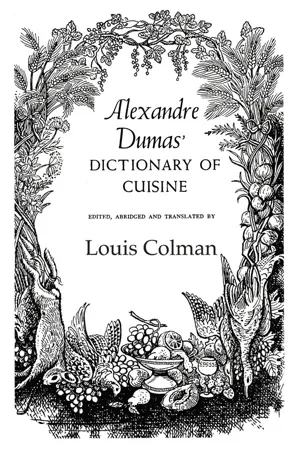
First published in 2005. A cookery book by the author of The Three Muskateers and The Count of Monte Cristo may seen an improbability. Yet Alexandre Dumas was an expert cook- his love of food was said to be equalled only by his love of women - and his Great Dictionary of Cuisine, written to be read by worldly people and used by professionals and published posthumously in 1873, it is a masterpiece in its own right. This abridged version of the Dictionary is designed to be both useful and entertaining. A glance at the Index will show that there are hundreds of recipes - for sauces, soups, meat, fish, eggs, poultry and game - not all kitchen-tested with modern ingredients, but well within the scope of an experienced and imaginative cook.
Man does not live on what he eats but on what he digests.
ABSINTHE. A perennial plant with bitter leaves, found everywhere in Europe. In the North, a wine called vermouth is made from it.
There are two varieties, the Roman and the Pontic, also known as marine absinthe. Absinthe that grows along the shore or high in the mountains is fine to eat. To the latter we owe the special flavour of animals that have fed upon it, highly esteemed by gourmands and known as pré-salé [salt-meadow].
Though its dispensers boast that the beverage called absinthe will strengthen the stomach and aid digestion, and though the Salerno school recommends absinthe for seasickness, it is impossible not to deplore its ravages among our soldiers and poets over the past forty years. There is not a regimental surgeon who will not tell you that absinthe has killed more Frenchmen in Africa than the flitta, the yataghan, and the guns of the Arabs put together.
Among our Bohemian poets absinthe has been called “the green Muse”. Several, and unfortunately not the poorest, have died from its poisoned embraces. Hégésippe Moreau, Amédée Roland, Alfred de Musset, our greatest poet after Hugo and Lamartine — all succumbed to its disastrous effects.
De Musset's fatal passion for absinthe, which may have given some of his verses their bitter flavour, caused the dignified Academy to descend to punning. It seems that de Musset frequently found himself in no condition to attend the academic sessions. Which prompted one of the forty Immortals to say that “he absinthes himself a bit too much”.
But absinthe has a competent defender in the author of the Memoirs of the Marquise de Créqui, who claims that a glass of candy absinthe can only aid the digestion. Here is his recipe:
Candy Cream of Absinthe. Eight quarts of brandy; 2 pounds of tips of absinthe leaves ; zest of 4 oranges or lemons ; 7 pounds of sugar; 1 gallon of river water. Distill the brandy, absinthe, and zests in a bain-marie [for which you use the river water], and reduce to 4 quarts. Add the sugar. When it has melted, stir and filter.
Absinthe is forbidden in all military barracks.
ACANTHUS. A plant celebrated in the history of the fine arts. Its very large, pleasingly shaped leaves were used to crown Corinthian columns.
Vitruvius tells of the introduction of acanthus leaves as ornaments. A young Corinthian girl having died just before a marriage she had looked forward to, her desolate nurse put various objects the girl had loved into a basket and placed it on her grave, covering it with a large tile to preserve the contents from the weather. It happened that an acanthus root was buried directly under the basket. The following spring the acanthus sprouted, its great leaves surrounding the basket, their tips curled around the tile. Callimachus, passing by, observed the lovely effect and decided to use it in the decoration of the Corinthian column.
The acanthus is fairly common in Greece, Italy, Spain, and southern France. But except in Greece and Arabia, where the leaves are eaten raw, it is not used for food.
ACETO-DOLCE. Fruits and pieces of vegetables pickled in vinegar, with new wine cooked down to the consistency of syrup added afterwards. The best aceto-dolce [literally, “sweet and sour”] is made with quartered quinces, to which is added syrup made from new muscat-grape wine or honey.
AMBERGRIS. Let us quote from the illustrious Professor Brillat-Savarin:
It is well for everyone to know that though ambergris, used as a perfume, may be harmful to those with delicate nerves, taken internally it is an exhilarating and sovereign tonic. Our ancestors made great use of it in their cooking and were none the worse.
Maréchal de Richelieu, of glorious memory, constantly chewed pastilles made of ambergris. As for me, on those days when I feel the weight of years, when I think with difficulty and feel myself oppressed by some unknown power, I take a piece of ambergris as big as a bean, crush it with sugar, and drink it in a big cup of chocolate. I have always found it worked wonders. With this tonic, life becomes easier, thought progresses with facility, and I do not suffer from the insomnia that would inevitably follow if I took a cup of coffee to achieve the same results.
One day I went to visit one of my best friends (M. Rubat). I was told he was ill, and in fact I found him by his fire in his dressing gown in an attitude of complete depression. His appearance frightened me. His face was pale, his eyes unnaturally bright, and his lower lip drooped, exposing the teeth in his lower jaw. The effect was hideous.
I inquired anxiously into the cause of this sudden change. He hesitated, but after I had pressed him, he said, blushing, “My friend, you know that my wife is jealous, and that this madness of hers has given me some very bad times. For several days she has had a frightful fit of it, and in trying to prove to her that she has lost none of my affection, and that there has been no diversion from the conjugal tribute, I have put myself in this condition.”
“So you forgot,” I told him, “that you're forty-five years old and that jealousy is a disease without a remedy. Don't you know that furens quid femina possit?” I said a few more ungallant things, because I was angry.
“Let's see,” I continued; “your pulse is faint, irregular, slow. What are you going to do?”
“The doctor has just left” he said. “He thinks I have a nervous fever and has ordered a bleeding. He's sending the surgeon.”
“The surgeon!” I cried. “Keep him away, or you're dead! Chase himaway as you would a murderer, and tell him I have taken possession of you, body and soul Besides, does your doctor know what brought on your illness?”
“Alas, no! False shame prevented me from making a complete confession to him.”
“Well, you must ask him to call again. I'mgoing to prepare you a potion suitable for your condition. Meanwhile, drink this.”
I gave him a glass of water saturated with sugar, which he drank with the confidence of an Alexander and the trust of a charcoal burner.
Then I left him and ran home to prepare a potion, which will be found in the Variétés [Part 2 of the Physiology], together with the various methods I used to speed up the process. For in such a case a few hours can cause irreparable damage.
I soon returned with my potion and found him better already. The colour was coming back into his cheeks, his eyes were less bright, but his lip still drooped like a frightful deformity.
The doctor soon reappeared. I told him what I had done, and the patient made his confession. The doctoral brow at first took on a severe aspect. But soon, looking at us with an ironic air, he said to my friend:
“You should not be surprised that I didn't guess at an illness that becomes neither your age nor your condition, and you were much too modest in hiding its cause, which can only do you honour. But I must scold you for having exposed me to an error that might have proved fatal. However,” he continued, with a bow in my direction, which I returned with interest, “my colleague has advised you correctly. Take his soup, and if, as I think, the fever leaves you, breakfast tomorrow on a cup of chocolate into which two egg yolks have been mixed.”
With these words, he took his hat and cane and left us very much tempted to be gay at his expense.
I gave my patient a big cup of my elixir of life soon after. He drank it avidly and wanted more, but I insisted he wait for two hours, and gave him another before I left.
Next day he had no fever and was almost well. He breakfasted as instructed, continued the potion, and the day after was able to attend to his usual occupations. But the rebellious lip did not stiffen again until after the third day.
Soon afterwards the whole affair became known, and all the ladies whispered together about it. Some of them admired my friend, most were sorry for him, and all glorified the professor of gastronomy.
Here is the recipe for the elixir, which it would be a pity not to leave to posterity:
Take 6 large onions, 3 carrots, a handful of parsley. Chop fine and brown with a piece of good fresh butter. Add 2 ounces of sugar candy,
ounce of crushed ambergris, a piece of toast, and 3 quarts of water. Boil for 45 minutes, adding water from time to time to maintain the full quantity of 3 quarts.
While this is going on, kill, pluck, and clean an old rooster, which you will pound, fiesh and bones, in a mortar with an iron pestle. Chop up 2 pounds of prime beef. Mix the meats and add a sufficient quantity of salt and pepper. Put into a pot over a hot fire and stir, adding butter every once in a while so it won't stick, until it is heated through and browned.
Add the bouillon little by little, stirring. When it is all mixed, boil briskly for 45 minutes, again adding hot water from time to time to keep up the liquid quantity.
The operation is finished now, and we have a potion whose effect is assured whenever the patient, though exhausted by any such cause as we have indicated, has at least kept his stomach in functioning condition.
To use it, give the patient 1 cup every 3 hours the first day until he goes to sleep. The following days, just 1 cup in the morning and 1 at night, until the whole is consumed. Meanwhile, keep the patient on a light but nourishing diet, such as chicken legs, fish, sweet fruits, and jams. It seldom becomes necessary to make a second batch. Towards the fourth day, the patient can resume his usual occupations and must try to be wiser in the future, if at all possible.
By leaving out the ambergris and the sugar, this same method may be used to improvise a fine-tasting soup worthy of the table of a connoisseur. The old rooster may be replaced by 4 old partridges and the beef by leg of lamb. The preparation will not be any less delightful or efficacious.
The method of chopping the meat and browning it before adding water can be utilized whenever one is in a hurry. It is based on the fact that meats so prepared can be heated to a much higher temperature than they can in water. It can be used whenever one needs a meat soup but can't spend 5 or 6 hours waiting for it, which can frequently happen, especially in the country. Naturally, those who use this method will glorify the professor.
ANCHOVY. A sea fish smaller than the finger, without scales and with a big head and big black eyes, a very big mouth, silvery body, and rounded back. They are abundant off the shores of Provence, and it is from there that we get them salted. The grilled anchovy has a delicate flavour and is easy to digest. They are also pickled with salt and vinegar. The pickled anchovy appears on our tables only as an hors d'oeuvre, or when it is used for seasoning. It has stimulating qualities that facilitate digestion whe...
Table of contents
Cover
Half Title
The Regan Paul Library of Culinary Arts
Title Page
Copyright Page
Table of Contents
Editor's Introduction
A Few Words to the Reader
Dedication: A Letter to Jules Janin
One More Word to the Public
The Dictionary
Index to Recipes
Trusted by 375,005 students
Access to over 1.5 million titles for a fair monthly price.
Study more efficiently using our study tools.
Frequently asked questions
Yes, you can cancel anytime from the Subscription tab in your account settings on the Perlego website. Your subscription will stay active until the end of your current billing period. Learn how to cancel your subscription
No, books cannot be downloaded as external files, such as PDFs, for use outside of Perlego. However, you can download books within the Perlego app for offline reading on mobile or tablet. Learn how to download books offline
Perlego offers two plans: Essential and Complete
Essential is ideal for learners and professionals who enjoy exploring a wide range of subjects. Access the Essential Library with 800,000+ trusted titles and best-sellers across business, personal growth, and the humanities. Includes unlimited reading time and Standard Read Aloud voice.
Complete: Perfect for advanced learners and researchers needing full, unrestricted access. Unlock 1.5M+ books across hundreds of subjects, including academic and specialized titles. The Complete Plan also includes advanced features like Premium Read Aloud and Research Assistant.
Both plans are available with monthly, semester, or annual billing cycles.
We are an online textbook subscription service, where you can get access to an entire online library for less than the price of a single book per month. With over 1.5 million books across 990+ topics, we’ve got you covered! Learn about our mission
Look out for the read-aloud symbol on your next book to see if you can listen to it. The read-aloud tool reads text aloud for you, highlighting the text as it is being read. You can pause it, speed it up and slow it down. Learn more about Read Aloud
Yes! You can use the Perlego app on both iOS and Android devices to read anytime, anywhere — even offline. Perfect for commutes or when you’re on the go. Please note we cannot support devices running on iOS 13 and Android 7 or earlier. Learn more about using the app
Yes, you can access Alexander Dumas Dictionary Of Cuisine by Dumas in PDF and/or ePUB format, as well as other popular books in Art & Anthropology. We have over 1.5 million books available in our catalogue for you to explore.