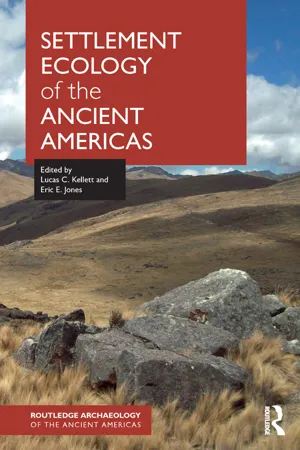
In this exciting new volume several leading researchers use settlement ecology, an emerging approach to the study of archaeological settlements, to examine the spatial arrangement of prehistoric settlement patterns across the Americas. Positioned at the intersection of geography, human ecology, anthropology, economics and archaeology, this diverse collection showcases successful applications of the settlement ecology approach in archaeological studies and also discusses associated techniques such as GIS, remote sensing and statistical and modeling applications. Using these methodological advancements the contributors investigate the specific social, cultural and environmental factors which mediated the placement and arrangement of different sites. Of particular relevance to scholars of landscape and settlement archaeology, Settlement Ecology of the Ancient Americas provides fresh insights not only into past societies, but also present and future populations in a rapidly changing world.
eBook - ePub
Settlement Ecology of the Ancient Americas
- 320 pages
- English
- ePUB (mobile friendly)
- Available on iOS & Android
eBook - ePub
Settlement Ecology of the Ancient Americas
About this book
Information
Part I
Overview
1 Settlement ecology of the ancient Americas
An introduction
Ancient settlement patterns have long fascinated archaeologists. Since its inception, settlement archaeology has played a crucial role in the comprehension of numerous complex archaeological topics, such as sociopolitical organization and development, state and imperial expansion, peer polity interaction, trade networks, demography, and economic organization, among others. The conceptual shift from a spatially limited and site-specific focus to a landscape-based regional perspective was indeed a watershed moment in archaeology (Willey 1953; see Billman 1999; Blanton et al. 2005). Through its multi-decade course of development, settlement pattern studies has matured into its own sub-field of archaeology where associated methodologies, technologies, and interpretive frameworks have continued to be refined (Kantner 2008; Kowalewski 2008).
The critical question in settlement archaeology can be stated as follows: why do people settle in a given place during a specific time and in a particular arrangement? Ostensibly, this appears to be a simple question, yet the corresponding answer often remains frustratingly elusive. This is because a prehistoric settlement pattern is the result of complex decision-making in the face of innumerable social, political, and economic factors. As such, analyzing specific rationale for particular settlement decisions presents an especially challenging problem for archaeologists. In a similar vein, mutual causation or equifinality have plagued settlement pattern studies, requiring such studies to remain descriptive rather than explanatory (Stone 1996). Yet, rather than fading away in the modern era of archaeology, settlement pattern studies have done the opposite and witnessed a new renaissance in large part due to the rapid technological advances (e.g. Global Positioning Systems [GPS]; Geographic Information Systems [GIS]; remotely sensed data; and unmanned aerial vehicles [UAV]) in the past two decades.
So, a number of readers who encounter this volume may likely first ask: do we really need another volume on ancient settlement patterns? Our answer to this question is yes for several reasons. First, the rapid change in technological innovation related to the recording, analyzing, and modeling of settlement patterns demands that archaeologists periodically address and evaluate how we use and interpret ancient settlement patterns. Second, while technology has rapidly “evolved,” there has been much less attention paid to reconceptualizing and the further development of theories behind settlement pattern analysis. As discussed below, archaeologists still most often describe rather than fully understand or explain settlement patterns and changes to them. A settlement ecology approach seeks to dissect settlement patterns and identify what influencing factors underlie how and why people decide to settle on a given landscape. Finally, a basic understanding of how prehistoric people settled in a particular area over time is especially relevant in today’s rapidly changing world. Decisions of where to live in the past shape the distribution of our modern settlement patterns. Across the Americas, the distribution of indigenous settlements had a significant impact on the settlement patterns of early European colonizers. Furthermore, in the face of globalization, modernization, climate change, and migration, humans today are still having to making the critical decision of where to live often in the face of complex and difficult circumstances. We hope that this volume can extend our thinking beyond the past and into the present and future to more fully comprehend settlement as an essential part of the human experience (see Moore 2012).
We presume a number of readers of this volume will also pose this question: what is settlement ecology? This will likely be followed by two other questions: where did it come from and is it really a new approach in settlement archaeology or just a rehash of previous models outlined decades ago? We argue that it is both. That is, it is both a new and more comprehensive way to think about ancient settlement patterns as well as a more sophisticated and refined synthesis of previous thinking and applications in regional studies and settlement archaeology. This volume attempts to bring together for the first time a group of scholars who are currently using a settlement ecology approach to answer complex archaeological questions across the Americas.
In this volume contributors tackle a range of questions that in some way link to ancient settlement patterning, including settlement formation, aggregation, dispersion, abandonment, relocation, fission-fusion, and many others. These broad overlapping settlement phenomena are typically a response to a wide range of physical (environmental) and non-physical (sociocultural) pressures, factors, or priorities that influence settlement decision-making and ultimately help concretize a settlement arrangement in material form. The authors in this volume seek to understand why particular settlement patterns are established and what caused them to change over space and time.
Defining settlement archaeology
In the simplest of terms, settlement archaeology is the study of settlement patterns. But how do we define a settlement pattern, and more importantly what does it signify to archaeologists about past cultures and their behaviors? Fish offers a useful definition of a settlement pattern:
a settlement pattern is a set of culturally significant locations, each of which occupies a specified position within an array that makes up a coherent distribution … settlement patterns are spatial matrices marking the intersection of human activities and the natural environment. As such they provide a basis for examining the relationship between cultural loci and relevant geographic variables. Settlement patterns simultaneously mark the intersection of human activities and their cultural environment. They encode relationships among spatially distinct elements of societies and reflect the cumulative outcomes of spatially expressed decisions and interactions.
(Fish 1999: 203)
This eloquent definition embodies the concept of a settlement pattern, by considering the significant components of space, culture, and geography. Thus, a working definition of settlement archaeology can be stated as the study of past culture through the examination of spatially defined loci of human activity.
Studies in settlement archaeology share a number of common characteristics, which set them apart from other approaches in archaeology. Marquardt and Crumley (1987: 1–9) outline several underlying components of such a settlement approach. First, settlement archaeology makes special efforts to understand the archaeological landscape, which is the totality of the archaeological record in a given region, reflecting the interaction between humans, their culture, and their environment. Second, it considers the spatial orientation among different archaeological sites and between archaeological sites and the physical environment. Third, such studies adopt a regional perspective that examines the totality of settlement across a large area. As we discuss below, these basic components of settlement archaeology are important in contemporary studies and approaches, including settlement ecology.
The origins of settlement ecology
Although the term settlement ecology was not coined until the mid-1990s, many of its principal tenets were in use well before. Processual archaeology in particular played an important role in how settlement patterns were originally conceived, how they were studied using archaeological methods, and how they were described through the development of middle-level theory (e.g. Chang 1972; Flannery 1976; Trigger 1967, 1968; Parsons 1971, 1972; see also Billman and Feinman 1999; see Kantner 2008 and Kowalewski 2008 for reviews). Within the processual movement, cultural ecology and systems theory approaches were most commonly used to explain settlement patterns and shifting cultural dynamics (e.g. Binford 1968; Flannery 1968; Plog 1975; Struever 1968). In this context, settlement systems were often seen as adaptive to external stimuli. The processual period also saw the widespread adoption of systematic ground survey in numerous parts of the world, which elevated the value and importance of settlement patterns in large regional archaeological studies (e.g. Adams 1965, 1981; Billman and Feinman 1999; Blanton 1978, 2005; Chang 1972; Flannery 1976; Gumerman 1971; Parsons 1971; Parsons et al. 2000, 2013; Peterson and Drennan 2005; Sanders 1965; Sanders et al. 1979; Willey 1956).
The processual era ushered in a shift from just describing broad patterns of settlement to also building deterministic models to explain and predict them. In addition, these models attempted to account for the specific determinants that influenced the formation of ancient settlement patterns (Trigger 1968; Peebles 1978). Most early considerations of settlement determinants included primarily environmental factors (e.g. water, resource availability) as well as population growth in reaction to environmental conditions (e.g. Brown et al. 1978; Flannery 1976; Peebles 1978; Sanders 1981). The majority of studies during this time were also focused on prehistoric hunter-gatherers (e.g. Binford 1980; Kelly 1985; Thomas 1972) much more so than on sedentary agrarian societies. The emphasis on the former was directly related to the rise of behavioral ecology (BE) and “optimal foraging theory” (OFT) within the field of archaeology and their shared focus on “two sets of phenomena: past human behavior and its material consequences” (Bird and O’Connell 2006: 143; see Schiffer 1987; Smith and Winterhalder 1992). In particular, behavioral ecology aims at modeling past human behavior using a “fitness related landscape” in which to understand human action. While BE has faded in popularity (as originally conceived), it has impacted on approaches to settlement archaeology since the latter often adopts assumptions of economic efficiency (e.g. resource maximization, travel cost reduction) to understand settlement patterns and their changes.
Settlement archaeology in the 1970s and 1980s also saw the heavy influence of geographic models (Hagget 1965; Johnson 1977) on the analysis of ancient settlement patterns, including Central Place Theory (CPT) (e.g. Christaller 1966; Crumley 1979; Evans and Gould 1982; Steponaitis 1978, 1981), Site Catchment Analysis (SCA) (e.g. Chisolm 1968; Higgs et al. 1967; Higgs and Vita-Finzi 1972; Vita-Finzi and Higgs 1970), and models of rural land use (Chisolm 1968; Von Thünen (1966) [1826]). Nearly all of these geographic models offer a series of assumptions, which help model human settlement arrangement. First, settlements are located on the landscape intentionally, not randomly, primarily for economic or material reasons. Second, through a detailed understanding of the surrounding physical landscape, one can understand settlement locations based on the spatial correlations between site location and local available resources. Third, since the costs of subsistence production and the related transport costs of goods and people increase as one moves away from a given settlement, people will place their settlements closest to the most critical of resources (otherwise known as the proximity principle). Finally, it is assumed that under normal conditions, the spatial arrangement of settlements is ordered in a predictable and hierarchical fashion (e.g. lattice patterns) to most efficiently produce and move goods among different sites (especially among market systems). While these geographic/spatial assumptions have been critiqued on several grounds (e.g. Crumley 1979; Stone 1996: 12–27), they still form an undeniable part of the continuing development of settlement archaeology, as well as the approach embodied by settlement ecology.
The 1980s and 1990s witnessed the increasing frustration of some archaeologists with the trajectory of processual archaeology and thus spawned post-processual theory and approaches. This paradigm heralded a return to a consideration of individual actors and their lived and sensorial experiences in the past. Landscape as a term came to signify something that is or was more culturally constructed, as space had no meaning separate from human actions and thus all places were assumed to have symbolic meaning (Tilley 1994). Settlement archaeology, like other sub-fields, saw a shift in how sites were viewed, experienced, and interpreted with deliberate consideration of use of space and the construction of place (i.e. Ingold 1993; Llobera 1996, 2001; Tilley and Bennett 2001). At the same time, individual monuments, as well as entire settlement patterns, witnessed a more inclusive examination of the ideological, religious, social, and cultural phenomena, which may have helped plan and place sites on the landscape (i.e. Lekson 1999; Thomas 1991).
In addition, the increased technological power and accessibility of GIS within archaeology witnessed an explosion in three-dimensional spatial modeling. Visual analyses, such as the popular viewshed analysis, showed some promise when used in an attempt to humanize the landscape and reconstruct the social relationships among groups of people and settlements (e.g. Llobera 2003, 2007; Wheatley 1995; Wheatley and Gillings 2000, 2002). Conversely, the ability of GIS to analyze the relationships between measurable features of the landscape and settlement patterns can also be given some credit for the survival of processual ideas through the post-processual movement. Studies of the environmental influences on settlement patterns gained convincing empirical support (e.g. Allen 1996; Kvamme 1990), and survey methods like predictive modeling showed real correlations between environmental features and past human behavior (Bevan and Conolly 2002; Kohler 1988; Warren 1990a, 1990b; Wescott and Brandon 2000).
Finally, before fully describing settlement ecology we must also briefly discuss the continuing role that landscape archaeology, including historical ecology, has played on settlement archaeology. Landscape archaeology can be broadly defined as the systematic study of how cultural and environmental variables influence the way humans interacted with their landscape (Ingold 1993 Hu, 2011: 80). Landscape archaeology has attempted to move past a site-centered, processual approach to understanding settlement patterns by treating the landscape as a formation of continuous culturally defined spaces in which humans actively create, use, manipulate, and experience landscapes (e.g. Ashmore and Knapp 1999; Crumley and Marquardt 1990; Gillings et al. 1999; Marquardt and Crumley 1987; Tilley 1994; Wagstaff 1987). Landscape archaeology remains a poorly defined term that subsumes a wide array of disparate approaches to landscape studies in archaeology, including more traditional scientific approaches as well as phenomenological and performative approaches (Bruno and Thomas 2010: Hu 2011: 80–81). In addition, while landscape archaeology has embraced geospatial technology (e.g. GIS, remote sensing) with mixed results, it has offered new and creative approaches to better comprehend how ancient peoples experienced their landscapes (Gillings and Goodrick 1996; Gillings et al. 1999; Hu 2011).
Historical ecology is a closely related approach to landscape archaeology. It also ...
Table of contents
- Cover
- Half Title
- Title Page
- Copyright Page
- Table of Contents
- List of figures
- List of tables
- List of contributors
- Part I Overview
- Part II North America
- Part III Central America
- Part IV South America
- Index
Trusted by 375,005 students
Access to over 1.5 million titles for a fair monthly price.
Study more efficiently using our study tools.
Frequently asked questions
Yes, you can cancel anytime from the Subscription tab in your account settings on the Perlego website. Your subscription will stay active until the end of your current billing period. Learn how to cancel your subscription
No, books cannot be downloaded as external files, such as PDFs, for use outside of Perlego. However, you can download books within the Perlego app for offline reading on mobile or tablet. Learn how to download books offline
Perlego offers two plans: Essential and Complete
- Essential is ideal for learners and professionals who enjoy exploring a wide range of subjects. Access the Essential Library with 800,000+ trusted titles and best-sellers across business, personal growth, and the humanities. Includes unlimited reading time and Standard Read Aloud voice.
- Complete: Perfect for advanced learners and researchers needing full, unrestricted access. Unlock 1.5M+ books across hundreds of subjects, including academic and specialized titles. The Complete Plan also includes advanced features like Premium Read Aloud and Research Assistant.
We are an online textbook subscription service, where you can get access to an entire online library for less than the price of a single book per month. With over 1.5 million books across 990+ topics, we’ve got you covered! Learn about our mission
Look out for the read-aloud symbol on your next book to see if you can listen to it. The read-aloud tool reads text aloud for you, highlighting the text as it is being read. You can pause it, speed it up and slow it down. Learn more about Read Aloud
Yes! You can use the Perlego app on both iOS and Android devices to read anytime, anywhere — even offline. Perfect for commutes or when you’re on the go.
Please note we cannot support devices running on iOS 13 and Android 7 or earlier. Learn more about using the app
Please note we cannot support devices running on iOS 13 and Android 7 or earlier. Learn more about using the app
Yes, you can access Settlement Ecology of the Ancient Americas by Lucas C. Kellett, Eric Jones, Lucas C. Kellett,Eric Jones in PDF and/or ePUB format, as well as other popular books in Ciencias sociales & Arqueología. We have over 1.5 million books available in our catalogue for you to explore.