![]()
Part I
Catalogue: Illustrations
HISTORICAL NOTES AND AN APPRAISAL OF ART
Section I
Farghana
Events of the Years 899–908 (1494–1503)
Memoirs: Folios 1–120; Plates 1–38
Section II
Kabul
Events of the Years 910–926 (1504–1520)
Memoirs: Folios 121–251; Plates 39–81
Section III
Hindustan
Events of the Years 932–936 (1525–1530)
Memoirs: Folios 252–382; Plates 82–145
![]()
Section I
Farghana
Events of the Years 899–908 (1494–1503)
Memoirs: Folios 1–121; Plates 1–38
Plate 1
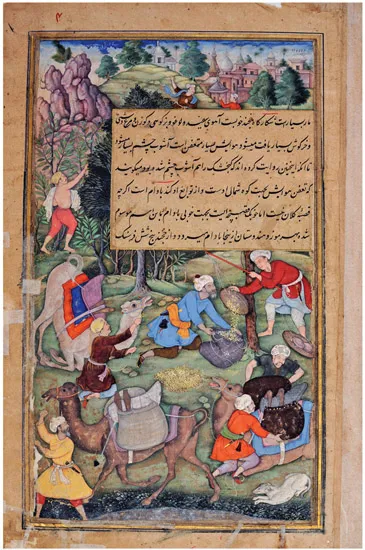
Folio 4a Traders in Kand-i badam (“almond town”); weighing and transport of almonds.
- Height: 23.4 cm, Width: 13.9 cm.
- Inscription: Surdas.1
- Soiled and stained on left-hand margin.
The Baburnama, being the autobiography of the Emperor Babur, written in Chaghtai Turkish. Fascimile of the Hyderabad manuscript (henceforth, The Baburnama), folios 4a–b (account of the year 899/1493–4).
Kand-i-badam (Village of the Almond) is a dependency of Khujand; although it is not a township (qasba), it is rather a good approach to one (qasbacha). Its almonds are excellent, hence its name; they all go to Hormuz or to Hindustan. It is five or six yighach2 east of Khujand.
(Beveridge 1921, I.8–9)
(See also Leyden and Erskine 1826/1921, I.6; Caldecott 1844, 4; Thackston 1996, 38.)
Reproduced: Randhawa (1983), 18, 62, no.1, pl.I (colour).
For another contemporary illustration, see Baburnama, British Museum and Library (Or. 3714), c.1598 (henceforth, Baburnama, BML), folio 6b. Reproduced: Suleiman (1970), pl.5 (colour).
A lively composition, characteristic of the sixteenth-century Mughal art of book illustration, testifies to an increasing impact of European art. The distant diminutive blurred landscape bears testimony of it. However, the depiction of hillocks with modulated contours and the stream in the foreground bordered with flowering shrubs relate to Persian art. Additionally, the depiction of trees with straight trunks, dense masses of foliage, and mounds of earth are characteristic of native tradition. The action-filled human figures further drew the Mughal style close to classical Indian art tradition. In fact, Persian art is bereft of lively action. In the present example, the gestures captured by the artist establish a psychological relationship between the figures. The thin shading and delicate modelling of objects promote naturalism in Mughal art, altogether absent in Persian painting. Randhawa writes: “There is action and movement in this painting which vividly depicts trade in almonds, and how they were brought to India from Central Asia” (Randhawa 1983, 18).
Plate 2
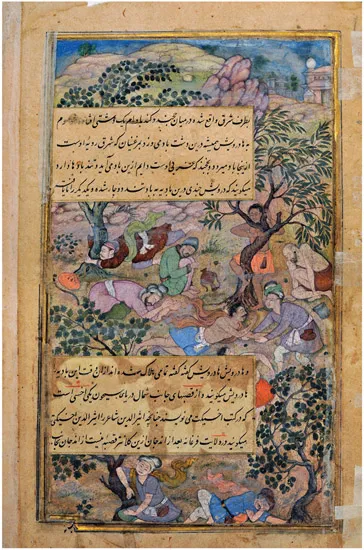
Folio 4b Dervishes caught in a storm between Kand-i badam and Khujand.
- Height: 23.3 cm, Width: 14.2 cm.
- Inscription: ‘Amal-i Surdas (Work of Surdas).
- Soiled and stained.
The Baburnama, folio 4b (account of the year 899/1493–4).
Bet ween Kand-i-badam and Khujand lies the waste known as Ha Darwesh. In this there is always (hamesha) wind; from it wind goes always (hamesha) to Marghinan on its east; from it wind comes continually (da’im) to Khujand on its west. It has violent, whirling winds. People say that some darweshes, encountering a whirlwind in this desert, lost one another and kept crying, “Hay Darwesh! Hay Darwesh!” till all had perished, and that the waste has been called Ha Darwesh ever since.
(Beveridge 1921, I.9)
It relates to the description of Farghana, its climate and limit of its surroundings.
(See also Leyden and Erskine 1826/1921, I.6; Caldecott 1844, 4; Thackston 1996, 38.)
Reproduced: Randhawa (1983), 62, no.2.
For another contemporary ill ustration, see Baburnama, BML, f.7a. Reproduced: Suleiman (1970), pl.6 (colour).
The Mughal artist has successfully captured the moments of storm and strong wind indicated thro ugh sweeping branches of trees and fleeing dervishes getting lost. The miserable condition of the dervishes leaves us upset. We could say then that the figures of dervishes imbued with the pity of distress and sufferings, totally absent in Persian art, put the Mughal School within the propositions of the indigenous trends.
Plate 3
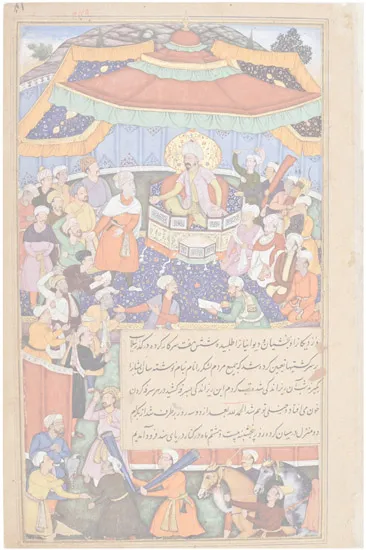
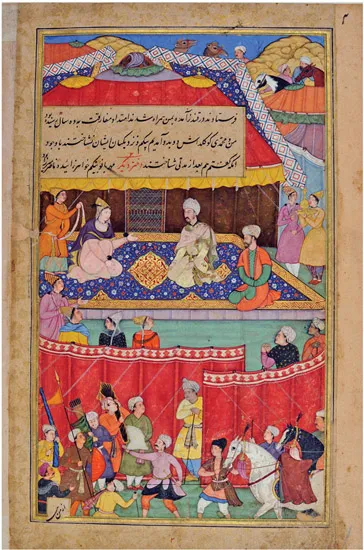
Folio 8b Babur meets Khanzada Begam and other ladies at Qunduz.
- Height: 23.5 cm, Width: 14.1 cm.
- Inscription (partly cut): ‘Amal-i Mansur (Work of Mansur).
The Baburnama, folio 9a (account of the year 899/1493–4).
Shaibani Khan came into conflict with Safavai ruler Shah Isma‘il who defeated and slew him at Merv on 2 December 1510. On receiving this news Babur immediately set out from Kabul and arrived at Qunduz in January 1511, where he was received by Khan Mirza, son of Sultan Ahmad Mirza. Shortly after Khanzada Begam arrived accompanied by Shah Isma‘il’s envoy and joined Babur.
Khan-zada Begim was in Merv when Shah Isma‘il (Safawi) defeated the Auzbegs near that town (916 AH/1510 AD); for my sake he treated her well, giving her a sufficient escort to Qunduz where she rejoined me. We had been apart for some ten years; when Muhammadi kukuldash and I went to see her, neither she nor those about her knew us, although I spoke. They recognized us after a time.
(Beveridge 1921, I.18)
(See also Leyden and Erskine 1826/1921, I.14; Hasan 1985, 40; Thackston 1996, 43.)
Reproduced: Das (1974), 33, 37, pl.13, fig.3; Randhawa (1975), 13; Randhawa (1983), 20, 62, no.8, pl.II (colour); Verma (1999), 43, 110, 125, pl.20; Das (2012), 4 5, fig.III.6 (colour).
For another contemporary illustration, see Baburn ama, BML, f.13b. Reproduced: Suleiman (1970), pl.7 (colour).
See also the miniature in State Museum of Oriental Cultures, Moscow (henceforth, SMOC). Reproduced: Tyulayev (1960), pl.1; Das (2012), 45, fig.III.6 (colour).
It is a ‘one-scene’ illustration with a clever use of receptacles, here tents and awnings, that divide the picture plane into units filled with activities related to the central theme. The foreground is busily occupied by the retainers of Babur. In the simple structure of this painting the artist has successfully defined the openness of the spaces by the enclosing qanats. The main action is represented in a pavilion with hangers-on outside. He breaks up the space with receptacles and leads the eye to the central figures.
The present miniature ascribed to Mansur is notable for the likeness of Babur derived from his existing portrait. This sensitive, three-quarter view of Babur may be the very picture that provided the model for numerous likenesses, such as those made for the Baburnama illustrations. It would be relevant to mention that the likenesses of the royal ladies are ideal types and not an authentic representation of them (Verma 1978, 31–2, pl.25; also in his 2005, 76–7).
An earliest solo work of Mansur, heavily burdened with the characteristics of the sixteenth-century Mughal art of book illustration in Akbar’s atelier, hardly incorporates in it signs of Mansur’s individuality. Nevertheless, the noticeable thing in this example is the use of deep pigments and contrasts, which was discarded soon by Mansur in favour of soothing and calm colours for achieving through their harmonious blends the subdued background and openness in his compositions, which he continues throughout.
Thin shading employed to model Babur’s face shows an attempt to achieve realism. Folds depicted in flowing costumes further show the painter’s capability to handle delicate shading, which was a typical virtuosity of the Western technique.
Plates 4–5
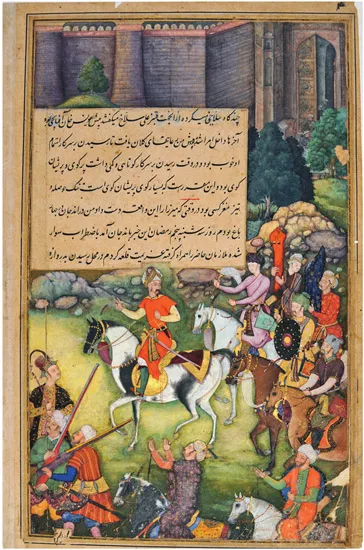
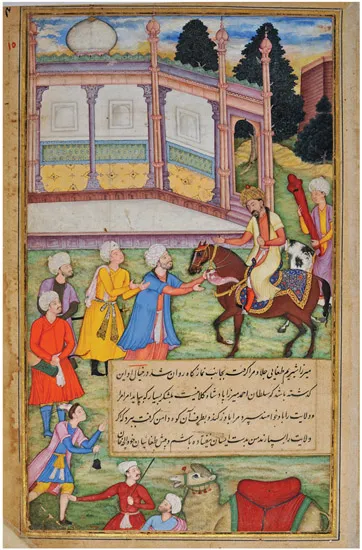
Folios 14b–15a (Two-page illustration) Shirim Taghai leading Babur to the Namaz-gah at Andijan.
Folio 14b Babur with his retainers getting near the Mirza’s Gate of the Andijan Fort.
- Height: 25.2 cm, Width: 15.5 cm.
- Inscription (cut on margin): ‘Amal-i… … (Work of… …).
Folio 15a Shirim Taghai in conversation with Babur and leading him to the Namaz-gah. Second part of the preceding illustration.
- Height: 25.1 cm, Width: 15 cm.
- The Baburnama, folios 15b–16a (account of the year 899/1493–4).
At the time of ‘Umar Shaikh Mirza’s accident, I was in the Four Gardens (Char-bagh) of Andijan. The new...