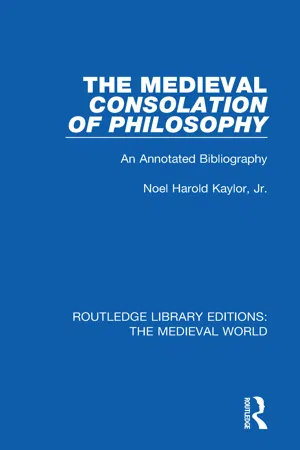
Originally published in 1992 The Medieval Consolation of Philosophy is an annotated bibliography looking at the scholarship generated by the translations of the works of Boethius. The book looks at translations which were produced in medieval England, France, and Germany and addresses the influence exercised by Boethius, which extended into almost every area of medieval intellectual and artistic life. The book acts in two ways, as a whole the book acts as a bibliography and study of the European tradition of Consolatio translations, but viewed on a chapter-by-chapter basis, it is a collection of independent bibliographies on the individual vernacular traditions. The book contains separate chapters looking at the Consolatio traditions of medieval France and Germany.
- 270 pages
- English
- ePUB (mobile friendly)
- Available on iOS & Android
eBook - ePub
CHAPTER IV
THE MEDIEVAL FRENCH TRADITION
Jean de Meun’s Consolatio Translation
The tradition of medieval French translations of the Consolatio is by far the richest and most complex of all: to date, thirteen different works have been noted and described, and more than a handful of these have appeared as printed editions. Of these thirteen, the first eleven date from a two-hundred-year period, the thirteenth and fourteenth centuries. So numerous are the manuscripts which survive that the types of studies they have stimulated are more diverse than for any of the other vernacular Consolatio traditions. The translations include works that are signed, unsigned, anonymous, forged, literary, semi-literate, conscientiously translated, heavily padded with interpolations, in verse, prose, and verse-prose; they are translated into a variety of dialects.
Because so few facts concerning Jean’s life are certain, this chapter will begin with a brief selection of entries which attempt to answer the question, who was Jean de Meun? Then, textual studies and related problems will be discussed.
An article published by Quichert provides information concerning a house which Jean occupied during his later years at Paris (Quichert 1880). These facts come to us from documents which survive from the early fourteenth century.
Jean’s personal bibliography is the subject of an article by Paulin Paris. Paris writes:
C’est au début de sa traduction du livre De consolatione de Boëce que Jean Clopinel [Jean de Meun] nous a donné ces précieuses indications. Après avoir achevé le Roman de la Rose, il traduisit le livre de Vegèce De re militari, le livre des Merveilles d’Irlande, celui d’Aelred De spirituelle amitié, les Épîtres d’Abélard et d’Héloïse, enfin la Consolation de philosophie [sic]. Si nous ajoutons à cette liste les deux ou trois poèmes dévots qu’il écrivit dans les dernières années de sa vie, nous aurons l’ensemble des oeuvres authentiques de Jean de Meun. Il en a probablement fait d’autres encore, mais les moyens nous manquent aujourd’hui de constater l’authenticité de celles qu’on lui a plus tard attribuées. (Paris 1881, 392)
Paris’ study describes all works by Jean, with the notable exception of the Roman de la Rose, and gives quotations from them. However, the Consolatio translation which Paris discusses is not the prose work which was finally satisfactorily ascribed to Jean de Meun, a problem which will be discussed fully in the next section of this chapter. For readers today, the usefulness of Paris’ article comes from its descriptions of Jean’s other works and the light they shed upon his translation methods.
The few biographical facts known about Jean are summarized in an article written for the Grande Encyclopédie by Antoine Thomas.
On sait peu de chose de sa biographie. Venu sans doute comme étudiant à l’université de Paris, il parait avoir passé la plus grande partie de sa vie dans cette ville, où il habitait en dernier lieu une maison de la rue Saint-Jacques. … (Thomas c.1900, 97)
Following this statement, the author discusses Jean’s works, particularly the Roman de la Rose. All the material is presented in less than two columns.
Indeed, it is from the Roman de la Rose that most information about Jean’s life has been deduced. For example, in her dissertation (Ralph 1940), Dorothy Marie Ralph draws conclusions about Jean’s importance as a thinker from her reading of that text. Gaston Paris once called Jean de Meun “le Voltaire du moyen âge”; using this observation as a statement of thesis, Ralph proceeds to compare the life, times, and works of these two writers who respectively symbolize for her the thirteenth and eighteenth centuries in France. Very few new facts are added in this work, however.
A very peculiar tradition is the subject of Albert B. Friedman’s study (Friedman 1950), “Jean de Meun an Englishman?” The author traces erroneous entries in early English literary histories which led readers to believe that the author of the Roman de la Rose was in fact an Englishman living in Paris. The source of this error is found to be a confusing bit of grammar in the earliest English reference to Jean and the eventual false identification of him with an obscure English author.
Norman Cohn draws information from evidence found in the Roman de la Rose to show that Jean’s world-view is that of a thirteenth-century academic under the influence of the newly rediscovered Aristotle (Cohn 1961). He analyzes Jean’s major concerns in three categories (the nature of the cosmos, new attitudes toward sex, and democratic and egalitarian social doctrine), finding him to be a progressive and penetrating thinker, very much in the mainstream of the philosophical currents of his day.
René Louis’ “Esquisse d’une biographie de Jean de Meun” (Louis 1975), treats the usual data gleaned from the Roman de la Rose, the later translations, and the Testament (apparently Jean’s last work). His discussion includes one of the few controversies surrounding Jean’s life: a certain Jean de Meun, archdeacon of Beauce, left a will which has been published, but critics have generally discounted the possibility that this Jean and the poet could be the same. Louis argues that they are the same, adding to his account the new facts which the will offers.
The handful of articles discussed above present our total knowledge of the life of Jean de Meun. As might be expected, this information falls into two rather distinct biographical realms: Jean’s thought and philosophy, on the one hand, and his life and times, on the other. This information is not enough to give a clear picture of the poet, but it does provide a basic temporal and philosophical frame of reference for researchers concerned with the Consolatio translation.
When we come to Jean de Meun’s translation itself, the problems become more complex, requiring in some cases a certain amount of detective work. Following one paragraph concerning the general studies of the translation, this section is divided into three parts. First, those articles are discussed which attempt to discern which translation Jean actually wrote. Second, studies are treated which represent work preliminary to the publication of an edition of Jean’s text Third, textual studies are treated.
Several general studies are useful as introductions to Jean’s Consolatio translation. First, there is Stewart’s Essay (Stewart 1891), in which his section on the French tradition includes a statement on Jean’s translation. When Stewart was writing, the fact that Jean had prepared a prose translation had not yet been established, but Stewart favors what proved to be the correct work because, as he indicates, it influenced Chaucer as he produced his Boece. An article by Charles-Victor Langlois (C.-V. Langlois 1928) places Jean’s translation in the context of all medieval French Consolatio translations. His description is brief, but it mentions most of the facts known at the time. Howard Patch devotes a section of his book, The Tradition of Boethius: A Study of His Importance in Medieval Culture (Patch 1935), to the French Consolatio tradition, giving some details on Jean’s translation. Antoine Thomas and Mario Roques expanded on the work of Charles-Victor Langlois, giving first-hand descriptions of the major manuscripts of the then-known French translations (Thomas and Roques 1938). Theirs is by far the best of the general articles on the French tradition. Roberto Crespo’s article in Italian offers a comprehensive study of Jean de Meun’s translation (Crespo 1969).
Jean de Meun wrote a preface to his Consolatio translation and a dedication to Philip VI, who commissioned the work. Roberto Crespo showed that much of the preface was translated directly from William of Aragon’s commentary (Crespo 1973). The preface and the dedication, however, are attached to two very different translations, one in prose and the other in prose and verse. Since it is unlikely that Jean wrote both of the translations, deciding which work could justifiably be ascribed to the poet of the Roman de la Rose became an early concern for critics. Glynnis Cropp has also examined this prologue (Cropp 1982, Romania), discovering that its sources include four pre-existing prologues. She also finds that the translator who produced the later, somewhat longer prologue, which is found attached to the Livre de Boece de Consolation (Dwyer 7), was probably the person responsible for producing the glosses in the glossed version of that translation.
The problem of the ambiguous works was first recognized by Léopold Delisle. He published a notice of forty-seven manuscripts found in the Bibliothèque Nationale which contain Consolatio translations, and among these he discerns eight translations, including manuscripts of the two translations in question. Working primarily on intuition, he assigned the prose work to Jean de Meun:
Des quarante-sept manuscripts de la Consolation philosophique que possède la Bibliothèque nationale, le seul qui me semble pouvoir être rapporté à la fin du XHIe siècle ou au commencement du XI Ve est un fragment de trois colonnes et demie, qui se trouve au fol. 48 du ms. latin 8654 B et qui est intitulé: “Ici sunt plusieurs notables de la translation du liver Boëce de Consolacion, que mestre Jehan de Meun translata en françois.…”La date du ms. latin 8654 B ne permet guère de suspecter l’exactitude de la rubrique qu’on vient de lire. Il faut en conclure que la traduction de la Consolation commençant par les mots “Halas! Je qui jadis fis jolives chançonnetes. … ” est bien l’oeuvre de Jean de Meung. (Delisle 1873, 5–6)
There follows, then, a brief description of this translation and of the translation containing the pirated dedication by Jean d...
Table of contents
- Cover
- Half Title
- Title Page
- Copyright Page
- Original Title Page
- Original Copyright Page
- Dedication
- Table of Contents
- Preface
- Original Half Title Page
- I. Introduction
- II. The Old English Tradition
- III. The Medieval German Tradition
- IV. The Medieval French Tradition
- V. The Middle English Tradition
- VI. Conclusion
- Bibliography
Trusted by 375,005 students
Access to over 1.5 million titles for a fair monthly price.
Study more efficiently using our study tools.
Frequently asked questions
Yes, you can cancel anytime from the Subscription tab in your account settings on the Perlego website. Your subscription will stay active until the end of your current billing period. Learn how to cancel your subscription
No, books cannot be downloaded as external files, such as PDFs, for use outside of Perlego. However, you can download books within the Perlego app for offline reading on mobile or tablet. Learn how to download books offline
Perlego offers two plans: Essential and Complete
- Essential is ideal for learners and professionals who enjoy exploring a wide range of subjects. Access the Essential Library with 800,000+ trusted titles and best-sellers across business, personal growth, and the humanities. Includes unlimited reading time and Standard Read Aloud voice.
- Complete: Perfect for advanced learners and researchers needing full, unrestricted access. Unlock 1.5M+ books across hundreds of subjects, including academic and specialized titles. The Complete Plan also includes advanced features like Premium Read Aloud and Research Assistant.
We are an online textbook subscription service, where you can get access to an entire online library for less than the price of a single book per month. With over 1.5 million books across 990+ topics, we’ve got you covered! Learn about our mission
Look out for the read-aloud symbol on your next book to see if you can listen to it. The read-aloud tool reads text aloud for you, highlighting the text as it is being read. You can pause it, speed it up and slow it down. Learn more about Read Aloud
Yes! You can use the Perlego app on both iOS and Android devices to read anytime, anywhere — even offline. Perfect for commutes or when you’re on the go.
Please note we cannot support devices running on iOS 13 and Android 7 or earlier. Learn more about using the app
Please note we cannot support devices running on iOS 13 and Android 7 or earlier. Learn more about using the app
Yes, you can access The Medieval Consolation of Philosophy by Noel Harold Kaylor, Jr. in PDF and/or ePUB format, as well as other popular books in History & World History. We have over 1.5 million books available in our catalogue for you to explore.