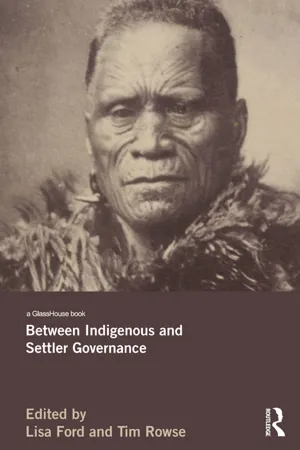
Between Indigenous and Settler Governance addresses the history, current development and future of Indigenous self-governance in four settler-colonial nations: Australia, Canada, New Zealand and the United States. Bringing together emerging scholars and leaders in the field of indigenous law and legal history, this collection offers a long-term view of the legal, political and administrative relationships between Indigenous collectivities and nation-states. Placing historical contingency and complexity at the center of analysis, the papers collected here examine in detail the process by which settler states both dissolved indigenous jurisdictions and left spaces – often unwittingly – for indigenous survival and corporate recovery. They emphasise the promise and the limits of modern opportunities for indigenous self-governance; whilst showing how all the players in modern settler colonialism build on a shared and multifaceted past. Indigenous tradition is not the only source of the principles and practices of indigenous self-determination; the essays in this book explore some ways that the legal, philosophical and economic structures of settler colonial liberalism have shaped opportunities for indigenous autonomy. Between Indigenous and Settler Governance will interest all those concerned with Indigenous peoples in settler-colonial nations.
- 228 pages
- English
- ePUB (mobile friendly)
- Available on iOS & Android
eBook - ePub
About this book
Information
Chapter 1
Locating indigenous self-determination in the margins of settler sovereignty
An introduction
In 2007, Australia, Canada, New Zealand and the United States underscored their peculiar historical, legal and political interconnections. Despite the fact that they constitute the archetype of settler colonialism, the CANZUS states alone voted against the United Nations Declaration on the Rights of Indigenous Peoples. All four countries had relented and signed the document by 2010. Nevertheless, their 2007 objections are revealing. They argued that indigenous rights to self-determination and control of national resources fell within domestic rather than international jurisdiction; such rights were contingent on local democratic processes conducted under the legitimate authority of national settler sovereignties. Their dissent from the Declaration did not reflect a history of distinct severity in the treatment of indigenous peoples. On the contrary, the CANZUS states had long provided conditions that were conducive to the growth of a global movement for indigenous rights and their indigenous peoples, though still poor and oppressed, have fared much better than their counterparts in other parts of the world (Merlan 2009: 306–12). Rather, this paradox draws our attention to a key historical and legal continuity between North America and Australasian settler colonialism; indigenous recovery in these interconnected polities has taken place in the gaps and fissures of setter sovereignties – spaces that are historically emergent, fluid and contested.
This volume examines the history, current development and future of ‘indigenous self-determination’ in the CANZUS states. Though we deal only with Anglophone settler polities here, we note that ‘indigenous’ has become a global category, and that its boundaries are sometimes stretched by the politics of self-ascription, and at other times narrowed by rules of tribal membership (Gover 2010). By ‘self-determination’ we comprehend a broad range of indigenous collective action. Not only do we use ‘self-determination’ to describe independent, territorial sovereignty, we use it to refer to informal practices of corporate consultation and assertion, and to more formal treaty- or constitution-based recognition of tempered indigenous sovereignty or jurisdiction within settler states (Pitty and Smith 2011; Muehlebach 2003).
The work gathered here focuses chiefly on the period when technologies of settler governance intruded on indigenous life with new intimacy and persistence, from the middle of the nineteenth century until the present. Our authors find that, even at their most racist and self-serving, settler states in Australasia and North America were complex institutions; their claims to jurisdiction, their efforts at dispossession, even their establishment of formal bureaucratic tyrannies over indigenous people were both presumptuous and unconsummated. This volume recovers some of the many different ways in which indigenous individuals and collectivities have crafted claims to equality, citizenship, difference, political autonomy and redress in the shadow of North American and Australasian settler sovereignties.
Our historical chapters find persistent pluralisms, where indigenous aspirations, collectivities and laws have continued and even structured the interaction of indigenous peoples with settler governments. Each suggests, in its way, that settler words like ‘conversion,’ ‘guardianship,’ ‘protection’ and ‘assimilation’ have obscured the breadth and resilience of modes of indigenous self-governance on missions, in reserves and in urban indigenous communities. Together they show that long after settler courts and parliaments defined and diminished indigenous jurisdictions, unexpected spaces remained open for some old and some very new modes of indigenous collective assertion. Some of these historical pluralisms are unsurprising: our contributors have recovered rich edifices of indigenous governance that set the rules of encounter on the trading frontiers of Canada, marshaled pan-Indian support in post-removal Indian Country in the United States and informed contemporary Māori–state engagements in New Zealand. Other modes of pluralism are unexpected: whether it be the enormously creative interaction between Christian conversion and indigenous resistance in nineteenth-century New Zealand and early twentieth-century Natal or the persistence of sorcery in contemporary Aboriginal communities.
Other chapters remind us that relationships between settler and indigenous governance are historically emergent – constantly reshaped both by historical context and by their ongoing interactions. Legal historians have clearly described the moment in the second quarter of the nineteenth century when CANZUS states predicated their sovereignty on exercises of jurisdiction over indigenous people in territory, markedly attenuating indigenous rights to govern themselves according to their own law (Ford 2010; Kercher 1995: 1–12; McHugh 2004). But some of our contributors suggest that this story is altogether too tidy. Settler states indulged in many moments of self-articulation. Before the nineteenth century, Vattel’s Law of Nations convinced many that indigenous rights had no place in the law of nations. Other constitutive moments came later; for example, when British settler colonies were given legislative power over indigenous affairs, between the 1850s and 1890s.
Indeed, settler state making is still a work in progress. The exercise of settler jurisdiction over indigenous people remains patchy, and evolving definitions of indigenous governance and indigenous land rights by settler courts constantly redefine the relationship among sovereignty, territory and jurisdiction. The contemporary relationship of indigenous rights to land (dominium) and to autonomy or sovereignty (imperium) has yet to be resolved by philosophers and lawyers (McHugh 2011: 240–43). Their uncertain relationship is evident in shifting Supreme Court definitions of the province of federal, state and Indian jurisdiction in the United States that have increasingly attenuated the capacity of long-established indigenous governments to govern Indian reservations. Meanwhile, the growing value of indigenous land claims in remote parts of Australia and Canada has proved even more challenging. On the one hand, indigenous land claims before settler courts have been predicated on ancient association, sacralized possession and corporate identity; even at their weakest, they subtly affirm indigenous corporate autonomy. On the other hand, mining booms and the ecological turn have transformed economic ‘wastelands’ into important sources of revenue, material bases that could be used to support much stronger institutions of governance among indigenous communities. Canadian and Australian courts in particular have yet to reconcile common law notions of ‘property’ with claims by Aborigines that they should be able to ‘speak for country’, regulate visitors, or negotiate with mining companies about access to mineral rights which have mostly been reserved to the Crown.
Nor is law the only mechanism through which indigenous collectivities have succeeded in altering the practices of settler statehood. Post-1960s reckonings with indigenous activism have resulted in the attenuation of executive and legislative policies of dispossession and assimilation in North America and Australasia. Since the 1960s, CANZUS states have all dabbled in self-determination, the recognition of their special duties to indigenous peoples and the return of tempered property rights to a lucky few indigenous communities. However, these ameliorative measures have always been ambivalent (Cronin 2007; Foley 2007; Kowal 2008) and in some ways have served to reaffirm settler sovereignties over indigenous peoples (McHugh 2011: 101). In recent decades, indigenous claims have slowly pushed CANZUS polities into a paradigm of negotiation which assumes the political or legal authority of indigenous collectivities to represent their members and to control resources. The neoliberal withdrawal of government has, arguably, made space for indigenous collective assertion by fostering mediated (if unequal) negotiations between indigenous peoples and mining corporations, even where indigenous peoples lack hard legal rights to the resources in play (Gover and Baird 2002; MacDonald and Muldoon 2006).
More challenging, perhaps, is this volume’s engagement with the impact of the colonial encounter on indigenous people. Drawing on a rich, pan-colonial historiography stretching from Africa (Cooper 2005) to Australia (Attwood 1989), many chapters in this volume insist that, like their settler oppressors, indigenous peoples are themselves historically emergent as individuals and collectivities. There is no eternal indigene and, as Tim Rowse argues, perhaps it is time to stop weighing indigenous articulations of selfhood and collective rights against ahistorical categories of authenticity. Contact with Europeans changed indigenous life and indigenous people – not just in the realm of ideas, but in the material details of life. Indigenous peoples have crafted new subjectivities in the context of their Christian conversion which facilitated new collective assertions. Some indigenous people have adopted Western forms of government which have both strengthened indigenous capacities for contemporary self-governance and goaded settler institutions into acts of further oppression. Settler contact opened new avenues for political discourse; as Bain Attwood pointed out some years ago, indigenous claims against settler states have probably always been hybrid discourses mediated through settler networks of people and of thought (Attwood 2003: xiii). Indeed, key indigenous intellectuals have accepted Western categories of thought about modernization, racial citizenship and assimilation and deployed them against settler oppression. Contemporary indigenous communities struggle to articulate their indigeneity through settler citizenship or, even more importantly, against rapidly changing economic structures that have reduced many indigenous people to welfare dependence, chronic illness and material want. At the same time, holders of the growing indigenous estate contend with each other about how to use, manage and dispose of their interests in land as conservators, culture-bearers and capitalists. The problem of reconciling this cacophony of indigenous subjectivities – capitalist, citizen, minority, Christian, pagan, hunter-gatherer, historical victim, repository of pre-contact culture and member of a semi-autonomous first people – forms one of the greatest problems of settler political theory and of contemporary indigenous politics (Anaya 2004; Anaya 1999; Kuper 2003; Rowse 1994; Waldron 1992; Waldron 2003). The historical remaking of indigenous peoples shapes and constrains their claims in dynamic interaction with the rich detritus of settler and indigenous custom, law and policy.
Every essay in this collection explores the messy array of gaps and perversities in settler regimes for indigenous governance. Together they illuminate the limitations and the possibilities of indigenous recovery historically, and in the face of ongoing dispossession and oppression. Some describe the emergence of new collectivities, new discourses and new practices that frame indigenous claims-making and self-determination to this day. Others have located and described those places in the margins of settler colonialism where the complexity of human interactions left space for indigenous peoples to express and adapt their corporate will and aspirations. These are tempered, circumscribed and problematic spaces. The most exciting essays here, it seems to me, explore how indigenous self-governance came to terms with settler sovereignty. They narrate histories of indigenous cultural and religious engagement, focus on past and present meeting points between laws, or find changing norms in the complexity of settler and indigenous practice that have created new places outside law for the expression of indigenous corporate ambitions. Indigenous collectivities have navigated multiple regimes of colonialism and bureaucratic management since 1800. Their successes and failures show that there are no inevitable or predetermined outcomes in the gap between settler and indigenous governance.
Chapter overviews
This volume starts with intellectual history. Ian Hunter criticizes an ahistorical tendency in postcolonial histories of early nineteenth-century indigenous–settler relations – to cast legal pluralism on colonial frontiers as the performance of a moral colonial statecraft, as if diplomats and state-makers had worked within something resembling our understanding of the normative rules attending interstate and quasi-state relations. Hunter invites us instead to understand the eighteenth-century law of nations in its own terms, according to its own distinct, historically situated morality. When Anglophone settler polities were most extensively settled, he reminds us, Vattel’s Law of Nations vindicated the sovereignty of ‘virtuous’ nations, while refusing to apply standards of just conduct to relations between nations and, particularly, to relations with semi-sedentary indigenous peoples. Thus, Vattel’s American admirers (including the drafters of the American Constitution) had no sense of legal obligation either to make or to honour treaties with American Indians. The extension of jurisdiction over indigenous people by the several states after 1800 and the diminished theory of indigenous sovereignty created by the Supreme Court in the 1820s and 1830s, were not moments of declension from admirable pluralism to unconscionable law. They marked the passing of the moral casuistry of the law of nations and the rise of the rule of law, imbued with its own tendencies to treat indigenous people unequally. In the history of settler–indigenous relationships, Hunter argues, the past provides no normative models; it serves only to explain the contemporary shape of our institutions and practices.
Paul McHugh and I describe a transformative moment in settler jurisprudence when the Crown – as erstwhile champion of native interests – disappeared into British colonial states. Responsibility for the management of indigenous peoples was transferred to Britain’s settler colonies in the 1860s in response to settler agitation and new programs of protection and assimilation. This chapter focuses on a series of cases from New Zealand and Canada that redefined the relationship of the Crown (a new settler Crown) with indigenous peoples. Settler polities did not use their new legislative power to displace the Crown as the primary agent of indigenous–settler relations. Rather, with the collaboration of their courts, they reinterpreted the prerogative powers of the Crown in ways that made the Crown both more powerful and less accountable in its relationships with indigenous peoples. The Crown ceased to comprise a governor answerable to a distant empire, and ‘shapeshifted’ into a body of ministers and bureaucrats charged with managing indigenous people under a complex body of legislation outside the jurisdiction of courts. New Crown jurisprudence entangled indigenous people in a new web of relationships with anthropologists, missionaries and administrators that was always complex, oppressive and unequal, but could not extinguish indigenous people’s collective aspirations.
We then cast back to three very different histories of pluralism – some stressing its promise, others its limits and cultural syncretism. Janna Promislow describes the quasi-legal negotiations surrounding the establishment of trading forts in Dene country in the McKenzie Valley in Canada’s Northwest Territories. Histories of pluralism, she argues, too often focus on court battles about jurisdiction. Informal, plural legal encounters also occurred on trading frontiers. Drawing from anthropology, ethnography and history, Promislow shows how we might use narratives of encounter between traders and various tribes in the region to recreate the indigenous rules of engagement that governed settler–indigenous relationships on Canada’s trading frontiers.
Tim Garrison describes the very different syncretic structures of governance generated by a pan-Indian meeting organized by Cherokee John Ross in Tahlequah in 1843. Ross used hybrid European models to construct an international accord in Indian Country after the forcible removal of the Cherokee from the southeastern United States to the new trans-Mississippi Indian Territory. The meeting at Tahlequah was diplomatic theatre aimed at encroaching settlers, neighbouring indigenous tribes and Ross’s rivals within the Cherokee nation. Like its pre-Removal state-making, Cherokee international diplomacy at Tahlequah was syncretic in nature, couching thoroughly Western notions of territorial sovereignty, extraterritorial jurisdiction and even cultural imperialism in the language and modes of post-contact indigenous treaty-making. While the resulting treaty was a qualified success, the proliferation of hybrid institutions in modern Indian Country attests to the success of Cherokee hybridity and Cherokee cultural imperialism in post-Removal United States.
Heather Douglas and Mark Finnane tell a contrasting history of pluralism in Australia. Long after Australian appellate courts ceased to consider indigenous people as self-governing peoples with their own laws, Australian bureaucracies and courts have left considerable latitude for indigenous law to punish crimes inter se (Finnane 2010; Finnane 2011: 244–59). Douglas and Finnane tell this story of pluralism through the reticence of settler courts to punish violence resulting from sorcery in indigenous communities from the mid-nineteenth century until the present. This is not a triumphal story of cultural survival, but a troubled story of social upheaval. Some anthropologists suggest that violence against alleged sorcerers has increased in indigenous communities in the face of chronic ill health and early death – it is itself an artefact of some of the worst impacts of settler colonialism on indigenous communities. Persistent legal pluralism, Douglas and Finnane remind us, is not always an uncomplicated good.
Our next series of chapters demonstrates how the effective plurality of colonial authority itself facilitated the survival of indigenous normative domains. In particular, it shows that while missions and states exercised authority over indigenous people, the concordance of their authorities was never assured. In this perspective, the missionary–indigenous encounter takes on particular significance in a history of indigenous self-assertion (cf. Comaroff and Comaroff 1991: 198–251; Elbourne 2003). Richard Boast and Norman Etherington investigate the ways in which missionaries acted (often unwittingly) to empower colonized peoples and to provoke conflict between missionaries and settler states. Boast notes the tremendous creativity attending Māori engagements with Christianity in New Zealand in the second half of the nineteenth century. Using the Anglican Christian Missionary Society’s encounter with the Māori in southeastern Waikato as a case study, he shows how some of the most devoted Māori converts to Anglicanism were radicalized by government oppression and Anglican ambivalence in the lead up to the New Zealand Land Wars. Multi-confessional evangelism, conversion and religious syncretism, he argues, are understudied elements of this crucial period of settler–indigenous conflict. The Christian encounter materially affected the form and nature of Māori collective resistance.
Norman Etherington, in our only chapter on Africa, contributes important comparative data about the complex relationship between Christian evangelism and settler colonialism in other Anglophone settler polities. His study of Natal at the turn of the twentieth century shows how well that state understood the radicalizing potential of missionary activity among Africans. While missionaries sought to transform indigenous culture, converts in southern Africa demanded ‘more say in the conduct of church affairs’ and used Christian conversion either to advocate for African supremacy or to secure positions of leadership in their communities. Both chapters suggest, in short, that missionary establishments were often sufficiently autonomous of state institutions to provide a space for individual and corporate indigenous agency.
This does not mean that the Christian encounter was not deeply transformative for indigenous peoples, as Tim Rowse points out in his exploration of the impact of Christian Universalism on the thought of four Australasian and North American indigenous activists in the nineteenth and early twentieth centuries. In a chapter that makes many readers uncomfortable, Rowse challenges us to move beyond assuming that Western categories of thought are always colonizing in nature and that ‘real’ indigenous people could only have employed them instrumentally or mimetically in the service of their people. B...
Table of contents
- Cover Page
- Title Page
- Copyright Page
- Contents
- List of figures and maps
- Acknowledgements
- Notes on contributors
- 1 Locating indigenous self-determination in the margins of settler sovereignty: an introduction
- 2 Vattel in revolutionary America: from the rules of war to the rule of law
- 3 Settler sovereignty and the shapeshifting Crown
- 4 ‘It would only be just’: a study of territoriality and trading posts along the Mackenzie River 1800–27
- 5 Pan-nationalism as a crisis management strategy: John Ross and the Tahlequah conference of 1843
- 6 Obstacles to ‘a proper exercise of jurisdiction’ – sorcery and criminal justice in the settler–indigenous encounter in Australia
- 7 Vanished theocracies: Christianity, war and politics in colonial New Zealand 1830–80
- 8 When settlers went to war against Christianity
- 9 The identity of indigenous political thought
- 10 Economy, change and self-determination: a Central Australian case
- 11 Land rights and development in Australia: caring for, benefiting from, governing the indigenous estate
- 12 Indigenous land rights and self-government: inseparable entitlements
- 13 Three perversities of Indian law
- 14 Section 223 and the shape of native title: the limits of jurisdictional thinking
- 15 Whakaeke i ngā ngaru – riding the waves: Māori legal traditions in New Zealand public life
- 16 Indigenous jurisdiction as a provocation of settler state political theory: the significance of human boundaries
- Bibliography
- Index
Trusted by 375,005 students
Access to over 1.5 million titles for a fair monthly price.
Study more efficiently using our study tools.
Frequently asked questions
Yes, you can cancel anytime from the Subscription tab in your account settings on the Perlego website. Your subscription will stay active until the end of your current billing period. Learn how to cancel your subscription
No, books cannot be downloaded as external files, such as PDFs, for use outside of Perlego. However, you can download books within the Perlego app for offline reading on mobile or tablet. Learn how to download books offline
Perlego offers two plans: Essential and Complete
- Essential is ideal for learners and professionals who enjoy exploring a wide range of subjects. Access the Essential Library with 800,000+ trusted titles and best-sellers across business, personal growth, and the humanities. Includes unlimited reading time and Standard Read Aloud voice.
- Complete: Perfect for advanced learners and researchers needing full, unrestricted access. Unlock 1.5M+ books across hundreds of subjects, including academic and specialized titles. The Complete Plan also includes advanced features like Premium Read Aloud and Research Assistant.
We are an online textbook subscription service, where you can get access to an entire online library for less than the price of a single book per month. With over 1.5 million books across 990+ topics, we’ve got you covered! Learn about our mission
Look out for the read-aloud symbol on your next book to see if you can listen to it. The read-aloud tool reads text aloud for you, highlighting the text as it is being read. You can pause it, speed it up and slow it down. Learn more about Read Aloud
Yes! You can use the Perlego app on both iOS and Android devices to read anytime, anywhere — even offline. Perfect for commutes or when you’re on the go.
Please note we cannot support devices running on iOS 13 and Android 7 or earlier. Learn more about using the app
Please note we cannot support devices running on iOS 13 and Android 7 or earlier. Learn more about using the app
Yes, you can access Between Indigenous and Settler Governance by Lisa Ford, Tim Rowse, Lisa Ford,Tim Rowse in PDF and/or ePUB format, as well as other popular books in Historia & Historia de Australia y Oceanía. We have over 1.5 million books available in our catalogue for you to explore.