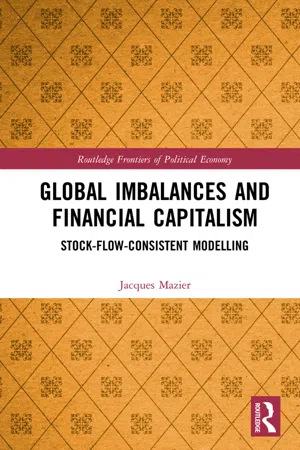
The past few decades have witnessed the emergence of economic imbalances at the world level and within the euro zone. The failure of mainstream economics to accurately predict financial crises, or model the effects of finance-led growth, highlights the need for alternative frameworks. A key text, Global Imbalances and Financial Capitalism: Stock-Flow-Consistent Modelling demonstrates that Stock-Flow-Consistent models are well adapted to study this growth regime due to their ability to analyse the real and financial sides of the economy in an integrated way. This approach is combined with an analysis of exchange rate misalignments using the Fundamental Equilibrium Exchange Rate (FEER) methodology, which serves to give a synthetic view of international imbalances. Together, these models describe how global and regional imbalances are created, as well as suggest appropriate tools through which they may be reduced. The book also considers alternative economic policies in the euro zone (international risk sharing, fiscal federalism, eurobonds, European investments, a multispeed euro zone) alongside alternative monetary policies. In particular, it examines the possibilities of using SDR (Special Drawing Rights) as a reserve asset to be issued to fight a global recession, to support the development of low-income countries, or as an anchor to improve global monetary stability. This text will be of interest to students, scholars, and researchers of economic theory and international monetary economics. It will also appeal to professional organisations who supervise international relations.
eBook - ePub
Global Imbalances and Financial Capitalism
Stock-Flow-Consistent Modelling
- 310 pages
- English
- ePUB (mobile friendly)
- Available on iOS & Android
eBook - ePub
Part I
Finance-led regime and global imbalances
A first glance
1A simple finance-led SFC model
Jacques Mazier and Luis Reyes
Introduction
The finance-led growth regime corresponds to the current stage of capitalism. It first settled in the United States and the United Kingdom at the beginning of the 1980s and spread in most of the countries with national specificities (Aglietta, 1998; Boyer, 2000). The main characteristic of this regime is the new corporate governance that prioritizes shareholders and financial accumulation at the expense of productive investment, with a large use of leverage effects. Rising income inequality has come along with these trends. These transformations have generated macroeconomic instability and weak growth despite the recovery of profits high levels. Financial accumulation and increasing inequalities limit domestic demand which can only be sustained by rising indebtedness. This regime is regulated by periodic financial crisis with an instability mainly caused by over-indebtedness and wealth effects. SFC models are well suited to study this growth regime as they analyse the real and financial sides of the economy simultaneously, taking into account the balance sheet constraints and revaluation effects.
This chapter, based on Mazier and Reyes (2014), presents a simple SFC model for a closed economy. First, we describe the stylised facts for France which is a representative country of the finance-led growth regime. Second, we give account of the most relevant works on SFC models and their ability to describe the real and financial cycles, with a discussion on firms’ closure either via debt or by new issuance of equities. Third, the model is presented rather in detail, given that the same structure is used in the other chapters of the book. Fourth, the dynamics of the model are studied with the help of simulations and shocks on th...
Table of contents
- Cover
- Half Title
- Series Information
- Title Page
- Copyright Page
- Contents
- Contributors
- Introduction
- Part I Finance-led regime and global imbalances: A first glance
- Part II European challenges
- Part III Enhancing regional and international monetary stability
- References
- Index
Trusted by 375,005 students
Access to over 1.5 million titles for a fair monthly price.
Study more efficiently using our study tools.
Frequently asked questions
Yes, you can cancel anytime from the Subscription tab in your account settings on the Perlego website. Your subscription will stay active until the end of your current billing period. Learn how to cancel your subscription
No, books cannot be downloaded as external files, such as PDFs, for use outside of Perlego. However, you can download books within the Perlego app for offline reading on mobile or tablet. Learn how to download books offline
Perlego offers two plans: Essential and Complete
- Essential is ideal for learners and professionals who enjoy exploring a wide range of subjects. Access the Essential Library with 800,000+ trusted titles and best-sellers across business, personal growth, and the humanities. Includes unlimited reading time and Standard Read Aloud voice.
- Complete: Perfect for advanced learners and researchers needing full, unrestricted access. Unlock 1.5M+ books across hundreds of subjects, including academic and specialized titles. The Complete Plan also includes advanced features like Premium Read Aloud and Research Assistant.
We are an online textbook subscription service, where you can get access to an entire online library for less than the price of a single book per month. With over 1.5 million books across 990+ topics, we’ve got you covered! Learn about our mission
Look out for the read-aloud symbol on your next book to see if you can listen to it. The read-aloud tool reads text aloud for you, highlighting the text as it is being read. You can pause it, speed it up and slow it down. Learn more about Read Aloud
Yes! You can use the Perlego app on both iOS and Android devices to read anytime, anywhere — even offline. Perfect for commutes or when you’re on the go.
Please note we cannot support devices running on iOS 13 and Android 7 or earlier. Learn more about using the app
Please note we cannot support devices running on iOS 13 and Android 7 or earlier. Learn more about using the app
Yes, you can access Global Imbalances and Financial Capitalism by Jacques Mazier in PDF and/or ePUB format, as well as other popular books in Economics & Economic Theory. We have over 1.5 million books available in our catalogue for you to explore.