The introduction of legislative structures for same-sex relationships provides a new lens for grappling with the politics of sexuality in schools and society. The emergence of civil partnership and same-sex marriage in Ireland brings to the fore international debates around public intimacy, religion in the public sphere, secularism and the politics of sexuality equality. Building on queer, feminist and affect theory in innovative ways, this book offers insight into the everyday negotiations of LGBT-Q teachers as they operate between and across the intersecting fields of education, religion and LGBT-Q politics. Neary illustrates the complexity of negotiating personal and professional identities for LGBT-Q teachers.
eBook - ePub
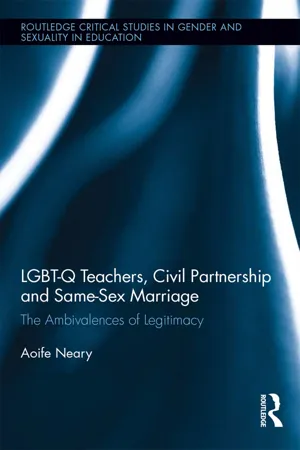
LGBT-Q Teachers, Civil Partnership and Same-Sex Marriage
The Ambivalences of Legitimacy
- 226 pages
- English
- ePUB (mobile friendly)
- Available on iOS & Android
eBook - ePub
About this book
Information
1 Introduction
Heterosexuality is not then simply an orientation toward others, it is also something that we are oriented around, even if it disappears from view.
(Ahmed 2006b, p. 560)
Sexuality in schools has been characterised by its simultaneous presence and absence from view. Those who do not identify as heterosexual or cisgender have been rendered invisible through silence and avoidance or made visible as the targets of policies and approaches that seek to ‘include’, ‘protect’ and create ‘safe’ spaces for wounded LGBT-Q sexualities. Furthermore, liberal societal discourses that forefront the ‘celebration’ of diversity and an imperative to ‘come out’ position LGBT-Q sexualities on a linear temporality of progress that suggests that things will get ‘better’ in the future. Such approaches and discourses largely position LGBT-Q sexualities as ‘other’, leaving what Adrienne Rich (1980) called ‘compulsory heterosexuality’ unmarked and intact. Michael Warner (1993) used the term ‘heteronormativity’ to denote how heterosexuality works pervasively as the ideal basis for all gender relations. In my experience of schooling and my time as a second-level teacher in Ireland, I have observed and waded through the workings of heteronormativity. Later in this introduction, I describe in more detail how I am thoroughly enmeshed in the subject matter of this book, but for now, suffice to say that I have not come to this project as a detached observer. This book is not an attempt to throw off the shackles of silence and celebrate a unified LGBT-Q identity. Nor does it seek to prescribe or instruct on how to make life better for those who identify as LGBT-Q. Instead, this book begins from the starting point of the experiences of LGBT-Q teachers as they entered into a legal structure for a same-sex relationship to explore the ways in which schools hinge on, work through and orientate around (hetero)sexuality.
This introduction first outlines the emergence of the research questions that were the starting point for this book and the unique contribution that this book makes to the field of sexuality and education. I then detail key theoretical influences and methodological decisions, whilst acknowledging some of the key tensions that dwell at the core of this book. The third section is an attempt to reflexively map my arrival to this topic; it is a methodological invitation to read this book with the incoherences and ambivalences of my stories in mind. Finally, I provide an overview of the key concerns of each chapter.
Background and Questions
LGBT-Q teachers worldwide have faced many challenges in negotiating their everyday lives. Complicated by legislative, religious and cultural constraints, moral panics about childhood innocence, reductive discourses about sexuality, negative stereotypes and heterosexualised public/private logics, many teachers describe significant work in managing their LGBT-Q identifications at school. Management strategies include attempts to separate personal and professional identities completely through covering, avoidance and/or passing as heterosexual. They also comprise attempts to ‘come out’ to colleagues and, much less often, parents and students in school communities. Across research with LGBT-Q teachers, a key concern is the achievement of a successful balance between maintaining teacher professionalism and appropriateness whilst being ‘authentic’ in openly identifying as LGBT-Q. The achievement of a normal and ordinary everyday professional existence appears to be central for LGBT-Q teachers.
In recent times, LGBT-Q politics across the globe have become predominantly concerned with securing rights for LGBT-Q people via the introduction of legal structures for same-sex relationships. There are a variety of arguments for and against the plethora of legal structures for same-sex relationships emerging worldwide. Such political approaches have been commended for the legal entitlements that they procure for same-sex couples as well as the powerful symbolism of equality that they enact for LGBT-Q people in general. Simultaneously, many have critiqued the abandonment of queer, radical approaches in favour of a project of normalisation, outlining how new boundaries of legitimacy are drawn with exclusionary effects for many people. In reflecting on how the introduction of legal structures for same-sex relationships will play out in schooling contexts, Mayo (2013, p. 544) asserts that it remains to be seen whether legal structures for same-sex relationships—such as marriage—either act ‘as a wedge that begins change or a change that marks conformity’ in schools. This book is the first foray into the terrain marked out by this provocation, and the Irish context provides a unique and generative starting point for opening up this topic.
Mirroring international trends, the LGBT-Q political landscape in Ireland has undergone a period of rapid change. Since the early 2000s, there were two largely separate campaigns for civil partnership (CP) and extending marriage to same-sex couples. In 2010, CP was introduced. It provided many of the securities, rights and entitlements accorded by civil marriage but there were significant deficiencies, particularly in relation to rights concerning children and understandings of the family. Following the introduction of CP, the campaign for marriage continued and in May 2015, Ireland became the first country in the world to extend marriage to same-sex couples as a result of a public vote. The study upon which this book is based was conducted between January 2010 and January 2014, and so it captures a unique moment in the history of LGBT-Q rights worldwide. By the end of 2012, over a thousand couples had entered into a CP in Ireland (GLEN 2013) and primary and second-level teachers were among those to have done so. And so, CP afforded a unique lens through which to grapple with the complexities of the everyday negotiations of LGBT-Q teachers in schools in a time of flux in the politics of sexuality. It also offered a lens through which to inquire into the overlapping fields of sexuality, religion and education. Ireland is unique in terms of its historical intertwined relationship between church and state, particularly in terms of its patronage of schools. However, closer examination reveals a more nuanced picture whereby, like many contexts, there has been a secular turn in the public sphere, even as religiosity continues to operate in cultural terms through tradition and ritual. As religion continues to feature strongly in debates about the politics of sexuality as they unfold in schools and society worldwide, the Irish context serves as a springboard from which to discuss this issue of universal significance.
The central question guiding the study on which this book is based was: ‘How are primary and second-level teachers negotiating personal and professional identities in their school contexts while planning/entering into a CP in Ireland?’ In addressing this overall question, three further questions facilitated inquiry into the various aspects at work here. The first question asked: How do key advocates in LGBT-Q politics in Ireland conceptualise the emergence of CP and its potential for LGBT-Q people in schools? This question guided inquiry into the workings of the politics of sexuality at a national level at this moment in time. It addressed the kinds of discourses—regarding sexuality and its presence in schooling—that were in circulation amongst LGBT-Q advocates, LGBT-Q advocacy groups, the media and mainstream politics. The second question asked: How do primary and second-level teachers conceptualise and approach CP? This question steered inquiry into the teachers’ motivations for, attachments to and investments in the new institution of CP. It sought an understanding of how they approached their CP and what it represents for them in their lives. The third question asked: How are primary and second-level teachers negotiating everyday life at school with regard to interactions with students, parents and colleagues; school ‘ethos’, management and policy around CP? This question directed an exploration of how primary and second-level teachers negotiated the various facets of school life while entering into a CP. Shaped by these questions, this book captures the immediacy of LGBT-Q teachers’ affective engagements with the newness of this cultural moment, making a new contribution to the field of research with LGBT-Q teachers as well as the relationship between schools and LGBT-Q identification more broadly. The ambivalences of legitimacy experienced by LGBT-Q teachers as they entered into a CP provide new insight into normalisation and sameness, recognition and affirmation, the intertwined nature of religiosity and normativity, and the changing politics of visibility and appropriateness in schooling contexts as legal structures for same-sex relationships are introduced. The context of Ireland provides an illustrative starting point from which to discuss these issues of transnational interest. I now turn to provide a synopsis of key methodological and theoretical influences and decisions shaping this book.
Methodological and Theoretical Influences and Decisions
In this book I employ several theoretical concepts and ideas as levers for thinking through LGBT-Q teachers’ negotiations of their school contexts while entering into a CP. Foucault’s (1978) conceptualisation of power and resistance as a dense and pervasive network of relations is a significant anchor. Foucault’s (1979; 1980; 2007) concepts of discourse, governmentality and disciplinary power underpin an analysis of the various ways in which heteronormalisation is sustained. Butler (2004) and Warner (1999) in particular facilitate an engagement with the specifics of normalisation and same-sex relationship recognition and how social institutions, structures and individuals are implicated in power relations that regulate, discipline and reward certain sexual expressions and practices. In accounting for LGBT-Q teachers’ agency, I call upon Foucault’s (1984; 1988; 1997) work on ethics and technologies of the self and Butler’s (1997) development of Foucault’s ideas around subjectivation, and I also give careful attention to the embodied dispositions of the teachers, calling predominantly on articulations and critiques of the habitus (Bourdieu 1977; 1990; Butler 1995; McNay 2004). These concepts help think through agency and resistance in material and discursive terms that hold indeterminate potential as opposed to ‘a regulatory narrative of progress in which educational research seeks to make school “better” for queers’ (Talburt and Rasmussen 2010, p. 3). Affect and emotion are central in my analyses of the politics of sexuality in schools and society and I explore how they work within relations of power in individual and social terms. Hochschild (1979; 1983) facilitates in-depth engagement with the cognitive, individual ‘emotional labour’ to follow ‘feeling rules’. Ahmed (2004a; 2004b; 2006a; 2008) provides a way into thinking about how power works through emotion and affect to bind collectives to face in particular directions (Ahmed 2006a; 2006b) and condition ambivalent attachments (Berlant 2011). Furthermore, Williams’s (1985; 2013; 2015) ‘structure of feeling’ augments the concept of the habitus to give focused attention on lived experience and feeling. In theorising the potential for moments and practices of resistance and transgression, I employ Foucault’s (1978) concept of reverse-discourse, Butler’s (1990) theory of performativity and Ahmed’s (2006a) diagonal lines, underlining social change as a messy process of simultaneous transgression and constraint.
In taking up these theoretical ideas, this book exists at the interplay between modernism and postmodernism, liberalism and post-structuralism, feminist and queer. It challenges notions of a unified sexual subject or fixed identity and disrupts processes of normalisation that are tethered by binaries such as heterosexual/homosexual. At the same time, it holds on—momentarily—to identities and binaries in ways that help think through how certain attachments and investments make life liveable. Talburt (2011) points out how, in recent times, the tensions between liberal versions of LGBT-Q studies and post-structural, queer studies have taken a new form. She notes how the Q for ‘queer’ has been co-opted by LGBT studies as an identity label. She posits that this is either a claim to the ‘edginess’ of queer or an attractive shorthand for LGBT-Q. Nevertheless, this is representative of the attempt to reconcile the radical with liberal rights in a new, hybrid ‘queer liberalism’. However, many have been critical of how liberalism has reduced LGBT-Q identity to a ‘mass-mediated consumer lifestyle and embattled legal category’ (Eng et al. 2005, p. 1). These terms are often used as if universal rather than socially contingent categories (Richardson and Monro 2012). Furthermore, they obscure the privileges and disadvantages conferred by intersectional identifications and positionalities such as gender, social class, race, ethnicity, national identity, age and ability.
My use of the LGBT-Q acronym always unsettles me. I understand ‘T’ as transgender: a term describing people whose gender identity, or gender expression, is different from the sex listed on their birth certificate. I understand ‘B’ as bisexual: a romantic, sexual and/or emotional attraction to people of either sex. I understand ‘L’ as lesbian: a woman who is romantically, sexually and/or emotionally attracted to women, and ‘G’ as gay: a man who is romantically, sexually and/or emotionally attracted to men. Finally, I understand ‘Q’ as both an umbrella identity sign that accounts for a variety of gender and sexuality identifications and a signal of the messiness and tensions of identity politics and representation. I am conscious that ‘L’ and ‘G’ most often appear as stable, unified identities that continue to stabilise the heterosexual/homosexual binary. I am aware that ‘B’ is often ignored and silenced perhaps because of its disturbance of the certainty and political usefulness of ‘L’ and ‘G’. I am also acutely aware that the ‘T’ and ‘Q’ are often included as an inclusive gesture that results in ‘T’ becoming conflated with ‘L’ and ‘G’ in a way that actually silences the vast spectrum of gender and sexuality.
Throughout this book I use the acronym LGBT-Q to refer to people who do not identify with and are not represented by the term heterosexual and/or cisgender. I am mindful that, in this book, I use LGBT-Q both in reviewing research that focuses only on some identifications as well as in representing all of the teachers in my study. Although not formally asked, some teachers identified themselves as lesbian or gay, one teacher identified as bisexual, several teachers didn’t specify a sexual identification and no teachers identified explicitly as transgender or queer. My intention for the dash (-) in my use of the LGBT-Q acronym is as a continuous thread that is unsettling. It is intended as an incessant reminder of the queer/liberal, modern/postmodern, feminist/queer tensions at which this study is located. It underscores how ‘a lot of queer things could be happening in programs and classes that might look disciplined and normalised [and] … some rather un-queer things could be happening in places that name themselves queer’ (Talburt 2011, p. 99). It also acts as a kind of ellipsis, acknowledging the plethora of gender and sexuality identities not present in this articulation of the acronym. Furthermore, cognisant of the fact that, reflecting the teaching profession in Ireland, all of the teachers in this study were white, the dash is a continuous reminder of the partiality of these teachers’ perspectives.
I began my inquiry for this study from the experiences and perspectives of LGBT-Q advocates and teachers as starting points for building towards a contemporary picture of the overlapping politics of schools, sexuality and religiosity. However, aligning with a post-structural approach, these ‘experiences’ are not perceived as brute data or transparent realities, nor are they ascribed epistemic privilege. Rather, I view all knowledge construction as partial and situated (Haraway 2004) and all experience as contested and contingent upon an ever-changing discursive terrain (Scott 1992). I also proceeded with a cognisance of the power dynamics involved in the production of knowledge and the notion of ‘giving voice’ (Spivak 1987; Stanley and Wise 1993; Mazzei and Jackson 2012) and a mindfulness that the mere idea of doing feminist or queer research does not preclude doing harm (Patai 1991). Following university ethical approval, ...
Table of contents
- Cover
- Title
- Copyright
- Dedication
- Contents
- Acknowledgments
- 1 Introduction
- 2 Schools and LGBT-Q Identification
- 3 LGBT-Q Rights: From Criminalisation to Marriage
- 4 Tools for (Re)Thinking and (Re)Imagining Legitimacy Across Schooling, Sexuality and Religiosity
- 5 LGBT-Q Politics and Ambivalent Promises of Normalisation
- 6 Ambivalent Negotiations of State Recognition and Collegial Affirmation
- 7 Cultural Legitimacy and Its Ambivalent Affective Attachments
- 8 Professional Legitimacy and Ambivalent Constructions of Appropriateness
- Conclusion
- Index
Trusted by 375,005 students
Access to over 1.5 million titles for a fair monthly price.
Study more efficiently using our study tools.
Frequently asked questions
Yes, you can cancel anytime from the Subscription tab in your account settings on the Perlego website. Your subscription will stay active until the end of your current billing period. Learn how to cancel your subscription
No, books cannot be downloaded as external files, such as PDFs, for use outside of Perlego. However, you can download books within the Perlego app for offline reading on mobile or tablet. Learn how to download books offline
Perlego offers two plans: Essential and Complete
- Essential is ideal for learners and professionals who enjoy exploring a wide range of subjects. Access the Essential Library with 800,000+ trusted titles and best-sellers across business, personal growth, and the humanities. Includes unlimited reading time and Standard Read Aloud voice.
- Complete: Perfect for advanced learners and researchers needing full, unrestricted access. Unlock 1.5M+ books across hundreds of subjects, including academic and specialized titles. The Complete Plan also includes advanced features like Premium Read Aloud and Research Assistant.
We are an online textbook subscription service, where you can get access to an entire online library for less than the price of a single book per month. With over 1.5 million books across 990+ topics, we’ve got you covered! Learn about our mission
Look out for the read-aloud symbol on your next book to see if you can listen to it. The read-aloud tool reads text aloud for you, highlighting the text as it is being read. You can pause it, speed it up and slow it down. Learn more about Read Aloud
Yes! You can use the Perlego app on both iOS and Android devices to read anytime, anywhere — even offline. Perfect for commutes or when you’re on the go.
Please note we cannot support devices running on iOS 13 and Android 7 or earlier. Learn more about using the app
Please note we cannot support devices running on iOS 13 and Android 7 or earlier. Learn more about using the app
Yes, you can access LGBT-Q Teachers, Civil Partnership and Same-Sex Marriage by Aoife Neary in PDF and/or ePUB format, as well as other popular books in Education & Education Theory & Practice. We have over 1.5 million books available in our catalogue for you to explore.