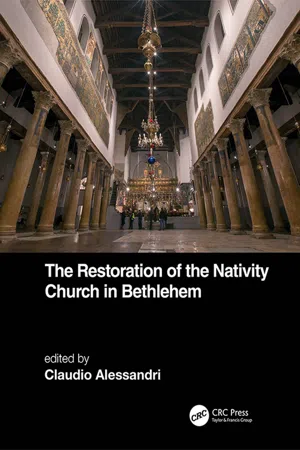
This book is a summary of the main restoration works carried out at the Church of the Nativity in Bethlehem that commenced in September 2013. Work on roof wooden structures, wall and floor mosaics, internal plasters, wooden architraves and painted columns of the naves, external wall surfaces and Narthex is all presented in a sequence of reports that accompany the reader up to the final interventions through accurate descriptions of historical and archaeological features, initial state of conservation and appropriate techniques of conservation and restoration.
Topics are treated with the methodological and linguistic rigor specific to each disciplinary sector involved even if, in the interest of making reading and comprehension easier, it was sometimes preferred to present only significant case studies, which are nevertheless representative of groups of wider and more complex problems. Through the reading of this work, the reader can simply fulfil his desire for knowledge and obtain answers to certain curiosities about the past history of the Church. At the same time, useful guidelines in dealing with conservation and restoration interventions at historic-architectural sites of similar complexity can be found.
The book is, therefore, addressed to a generic reader, interested in the history and conservation of one of the most representative examples of our heritage, but also, in light of its technical and scientific value, to university students, technicians, restorers, architects, structural engineers, archaeologists and historians.
Trusted by 375,005 students
Access to over 1.5 million titles for a fair monthly price.
Presidential Committee for the Restoration of the Church of the Nativity and C. Alessandri
A lot has been said and written so far about the history of the church of the Nativity. Many are the reports, historical documents, scientific articles that can be referenced in retracing the evolution of the church from its origins until today. It is not the intention of the authors to re-propose what has been said so far by authoritative sources and with the utmost abundance of details. The purpose of this book is only to accompany the reader along a path that began in distant 2009 and is now approaching a conclusion, or at least what has been always considered a fundamental goal.
The spiritual significance and the historical and artistic importance of the church of the Nativity have been known since its origin when Emperor Constantine erected it, like other Roman basilicas, as a symbol of Christianity and of the new alliance between the Roman Empire and the Church. Since then the church of the Nativity has always been touched, more or less directly, by the social and political events that have occurred not only in the Middle East but also in Christian Europe.
These events determined fortunes and misfortunes, splendor and decadence of the church and found a correspondence in the many changes made over time both in the structural system and in the decorative parts of the church. The basilica that could be still seen in the first decade of this century was a result of a long period of neglect, due to a paralyzing set of regulations, known as status quo, established in 1852 and later confirmed by the Treaties of Paris (1856), Berlin (1878), and Versailles (1919). The status quo defined the respective rights of the three religious Communities, the Greek Orthodox, the Franciscan Custody of the Holy Land and the Armenian Orthodox Patriarchate, that still have the management of the church. The status quo fixed, and still defines, duties and properties of the three Communities in a very precise way so that the permission to make repairs cannot be considered as a way to assert the hegemonic role in the church of one group instead of the other. Nevertheless, both maintenance and restoration remained difficult in such a context. The status quo implied that nothing could be done without a unanimous agreement of the three Communities, which was difficult, if not impossible to be achieved because of the mutual suspicions and rivalries. In 1920, the situation got worse when, during the British Mandate, a new Department of Antiquities was set up with the only duty to examine the repair proposals for Palestinian historical buildings. This was without providing any financial assistance to the Communities, which remained the only responsible parties for the conservation of the Holy Sites.
In consequence of this situation, the basilica remained in the shape received in the last significant restoration, dating back to 1842. This was despite the increasing structural problems of the roof and the progressive deterioration of mosaics, plasters and paintings on the columns. It is worth noting that the sumptuous marble revetments of many internal surfaces had been frequently stolen over the centuries, as witnessed by some pilgrims’ accounts. For instance, as stated by the Greek pilgrim Arsenios in 1512, some remnants of the marble revetments were preserved only in the bema and the choir, whereas the nave had been completely deprived of them [1].
The only intervention of conservation in the last century was Gustav Kühnel’s cleaning campaign carried out on the decorated surfaces of the church in the early 1980s [2]. An extensive survey was carried out also by Architect William Harvey during the British Mandatory with the aim of restoring significant parts of the church. The interventions were never undertaken; nevertheless, the archaeologic analysis performed provided extremely interesting data for a new re-reading of the history of the church.
Today the basilica is coming back to a new life thanks to an ongoing conservation and restoration program, which has finally overcome the long-lasting stalemate of the status quo. This program was the result of two concurrent events, the improvement of the relations among the three religious Communities, through a more open ecumenical dialog, and the engagement of the State of Palestine, as a mediating institution, in promoting mutual agreements. In fact, in 2008, a specific Committee was established by a decree of President Mahmoud Abbas with the aim of defining contents and methods of implementation of a detailed conservation and restoration program for the whole church. The Presidential Committee, still active today, is headed by Ziad Albandak and has several permanent members: Marwan Abdelhamid, Varsen Aghabekian, Nazmi Al Jubeh, Khouloud Daibes, Claudette Habesch, Nabil Kassis, Issa Kassissieh and the present Mayor of Bethlehem City, Anton Salman, who replaced in 2017 the former Mayor Vera Baboun. Its representative in relations with the international experts and the technical staff is Imad Nassar.
In August 2009 an international call for tenders was issued for studies on the state of conservation of the church and for the definition of a comprehensive conservation and restoration program. Applications were expected within December 2009. The call was mainly finalized to the restoration of the roof, which was the most deteriorated part of the church and the one in major need for repairs. However, a detailed analysis of the state of conservation of all the other components of the church (e.g. plastering, masonry, columns, paintings, wall and floor mosaics, floor, wooden architraves and external façades) was also required. The requested deliverables were not only the results of the diagnostic campaign but also guidelines and recommendations with annexed explanatory tables and technical drawings, which the future interventions of restoration should have referred to.
In June 2010, the contract for the execution of the work was awarded to an international consortium of experts (later called Consortium). This included engineers, architects, restorers, experts in the analysis of architectural structures and building materials, historians and archaeologists belonging to Italian Universities and research centres. The Consortium, which was coordinated by Prof. Claudio Alessandri of the University of Ferrara – Italy, as scientific director, was led by CFR (Consorzio Ferrara Ricerche – Ferrara – Italy) as the administrative project manager and was composed of SCDS Pro Inc. (laser scanning survey – Canada), LAP&T – LAAUM (historical and archaeological analysis – University of Siena – Italy), Benecon (analysis of masonry structures – II University of Naples – Italy), CNR Ivalsa (analysis of the roof structures – Florence – Italy), UNIFE (structural analysis – University of Ferrara – Italy), SSBAP (analyses of all decorated surfaces – University of Rome “La Sapienza”), and CDG, Community Development Group (local partner – Bethlehem – Palestine).
In September 2010 the agreement was signed off with the selected Consortium in the presence of the former Palestinian Prime Minister, Dr Salam Fayyad, the representatives of the three concerned Churches (Greek Orthodox Patriarchate, Holy Land Custody of the Holy Land and Armenian Patriarchate) and the President of CFR as a legal representative of the Consortium. The studies were commenced on September 23, 2010, and were divided into three stages: stage I (surveys and documentations – on-site investigations), stage II (studies and assessment – data processing), stage III (recommendations – conservation and restoration proposals and technical guidelines). In March 2011 they ended and the results were officially delivered to the Presidential Committee in July 2011 in the form of a final report containing the required technical recommendations and guidelines to which the designated restorers should have complied.
The work methodology, which was proposed in the report, was aimed at maintaining the integrity of the church and assuring the conservation and protection of the site with all its cultural and religious values. These goals had to be achieved by following as much as possible the principles of restoration, stated in the various Charters of Restoration, ICOMOS and UNESCO documents and by choosing and applying the most appropriate restoration techniques with full respect for the importance and uniqueness of the monument.
For this purpose, the outstanding universal value and authenticity of the Nativity church were deeply considered in all work stages, as a heritage to be preserved and transferred to future generations.
In more detail, as shown in the report through examples, guidelines and explanatory tables and drawings, the interventions had to respect the following methodological criteria:
the minimum intervention: it is appropriate (convenient) to intervene just when it is essential for the conservation of the monument;
the distinguishability: a difference must be maintained between original work and integration. The latter has to be done without affecting the “reading” of the “historical document”;
the potential reversibility: further interventions should be feasible in the future, in replacement of those already done, whenever new and more advanced technologies allow more appropriate remedies;
the expressive authenticity: all the new additions must be declared to avoid conflict with the original work;
chemical-physical compatibility between original and new materials.
Even in reducing the seismic vulnerability of the church, i.e. its propensity to suffer damages in the presence of an earthquake, the authors of the report suggested to dedicate more attention in choosing the techniques and procedures which were able to exploit as much as possible the existing architectural components and/or some features of the church (e.g. the roof structures, some masonry walls, particular construction systems etc.). In this way, considerable seismic improvements could be achieved without making significant changes to the main features of the church.
From 2011 and during 2012 the Presidential Committee reviewed the report through independent technical reviewers (ICCROM – International Centre for the Study of Preservation and Restoration of Cultural Property, ARUP – independent firm of designers, planners, engineers, consultants and technical specialists) and with the technical support of Consolidated Contractors Company (CCC). In parallel the Committee worked on securing the necessary funds to implement the restoration program.
According to the results of the survey campaign, the roof and its wooden structures were the parts of the church in very precarious condition and in a significant need for strong interventions of conservation and restoration which could guarantee the stability of the church and stop the damages due to rainwater infiltration in wall mosaics and plastering.
Therefore, the Presidential Committee decided to consider the restoration of the church’s roof and windows as a priority intervention. As a result, in April 2013, it launched an international call for its execution. This first work phase was called thereafter Phase I.
The evaluation jury, appointed by the Presidential Committee, was formed by Arup, CCC, the Consortium and a CDG representative. The contract was awarded to Piacenti S.p.A., an Italian company that had participated in the tender with four other companies and whose proposal had obtained the highest scores in both technical and financial offers. The construction management was awarded to Community Development Group (CDG) – Bethlehem with the external support of the Consortium, which had provided the comprehensive research report on the state of conservation of the church and the restoration measures to be taken.
Meanwhile, the basilica, which had already been placed in 2008 on the Watch List of the 100 most endangered sites by the World Monuments Fund, had become on June 29, 2012, the first Palestinian site to be listed as a World Heritage (WH) Site by the WH Committee. The proposal was approved by a secret vote with the only opposition of the United States and Israel. This was according to the UNESCO spokesperson Sue Williams, and following an emergency candidacy procedure that by-passed the usual 18-month process defined for most sites. The church was also placed on the List of WH sites in danger because of the serious damages which had occurred in the roof.
On August 26, 2013, the contract for the restoration of roof and windows was signed by the Committee’s Chairperson Ziad Albandak and the Contractor. This was during a ceremony held in the Presidential Palace of Bethlehem in the presence of Dr Rami Al Hamdallah, the current Palestinian Prime Minister, the representatives of the three religious Communities and other Ministers and officials.
Since the commencement of the works on September 15, 2013, the Committee received generous donations from different parts of the world. This encouraged the Committee to continue the restoration of other parts of the church with reference to a list of priorities previously agreed with the Consortium. These additional works included the restoration of the narthex and the narthex and basilica doors (Phase II), the external stone façades, internal wall plastering, wall mosaics and wooden architraves (Phase III), lighting and smoke detection systems, the restoration of all the columns of the nave along with their painted surfaces (24 out of 50 columns) and part of the floor mosaics (Phase IV). For the entire duration of the works, C. Alessandri and some members of the previous Consortium, such as B. Pizzo, S. Sarmati, V. Mallardo and G.A. Fichera offered their contribution in validating the technical documentation provided by Piacenti Company and in periodically supervising, on behalf of the Presidential Committee, the technical execution of the interventions. Meanwhile the Committee organized a campaign called “Adopt a Column” to attract more donors, especially from small businesses or families, in order to complete the restoration of the remaining columns and paints.
The key stages through which the entire restoration process was developed, from the beginning until today, are listed below. Each work phase will be described in detail in the next chapters:
Phase I:
2013:
organization of the worksite
2013–2015:
restoration of roof and windows
Phase II:
2014–2015:
doors of narthex and basilica
2014–2017:
narthex
Phase III:
2014–2017:
external facades
2014–2016:
plastering
2015–2016:
wall mosaics
2015–2016:
architraves
Phase IV:
2016-present:
columns and paints
2017:
lighting and smoke detection system
2018-present:
floor mosaics
Future Phases:
Remaining columns and paints
Remaining floor mosaics
Stone floor
Seismic reinforcement of the north and south corners
Seismic reinforcement of the south wall
On July 2, 2019, the World Heritage Committee, meeting in Baku, decided to remove the church of the Nativity and the Pilgrimage Route (Bethlehem) from the List of World Heritage in Danger. The Committee said its decision was due to the high quality of work carried out on the Nativity church, the restoration of its roof, exterior façades, mosaics and doors. It also welcomed the shelving of a project to dig a tunnel under Manger Square and the adoption of a management plan for the conservation of the site.
The restoration of the church of the Nativity has been and will always be an event of extraordinary cultural, religious and political importance. At present the church is the only Byzantine monument in all Palestine handed down in its almost original form, for which a global restoration was designed and above all completed with such a vast use, never seen in precedence, of economic and human resources, diverse and highly qualified professional skills and advanced technologies and instruments.
Since the initial study campaign, and also during the subsequent phases of design and implementation of the interventions, the work was always based on the closest collaboration between the various disciplines and skills that had to be involved. This strong interdisciplinary approach has allowed observers to have a continuous, global perception of the work that was being done, not relegated to the narrow sphere of the single problem, but extended to all the plurality of actions that were taking place or that had to be planned. This has allowed significant advantages, such as a coordination between the various interventions (with consequent saving of time, human resources and money), an optimization and a greater reliability of the choices made or to be made (thanks to a comparative analysis of the various problems involved), and finally a sharing of the information, particularly necessary in a complex and articulated working context such as that of the church of the Nativity.
After the archaeological campaign of Harvey in 1934 [3], the results of which offered the matter for further studies [4][5], the current program of interventions in the church represents the first new opportunity to resume an interrupted cultural discourse. It also offers the whole world new material for a deeper, and above all more complete, knowledge of the history and peculiarities of the church. As a matter of fact, the archaeological excavations carried out by Harvey remained incomplete. Begun in April 1934, they concerned only parts of the nave, the northern part of the transept and part of the choir and ceased very early to allow the Christmas celebrations in the same year. Thus, the findings only provided partial and fragmentary information, which was however still very useful for a more correct knowledge of the past history of the church. In fact, they provided material for new and more detailed investigations and made it possible to give answers to some questions that had remained unresolved until then.
Even the scienti...
Table of contents
Cover
Half Title
Title
Copyright
Contents
Authors and their affiliations
Technical staff and acknowledgements
1 Introduction
2 The restoration site
3 Roof and windows
4 Mosaics
5 Plasters
6 Paintings on columns
7 Exterior wall surfaces
8 Wooden architraves
9 The narthex
10 Monitoring
Index
Frequently asked questions
Yes, you can cancel anytime from the Subscription tab in your account settings on the Perlego website. Your subscription will stay active until the end of your current billing period. Learn how to cancel your subscription
No, books cannot be downloaded as external files, such as PDFs, for use outside of Perlego. However, you can download books within the Perlego app for offline reading on mobile or tablet. Learn how to download books offline
Perlego offers two plans: Essential and Complete
Essential is ideal for learners and professionals who enjoy exploring a wide range of subjects. Access the Essential Library with 800,000+ trusted titles and best-sellers across business, personal growth, and the humanities. Includes unlimited reading time and Standard Read Aloud voice.
Complete: Perfect for advanced learners and researchers needing full, unrestricted access. Unlock 1.5M+ books across hundreds of subjects, including academic and specialized titles. The Complete Plan also includes advanced features like Premium Read Aloud and Research Assistant.
Both plans are available with monthly, semester, or annual billing cycles.
We are an online textbook subscription service, where you can get access to an entire online library for less than the price of a single book per month. With over 1.5 million books across 990+ topics, we’ve got you covered! Learn about our mission
Look out for the read-aloud symbol on your next book to see if you can listen to it. The read-aloud tool reads text aloud for you, highlighting the text as it is being read. You can pause it, speed it up and slow it down. Learn more about Read Aloud
Yes! You can use the Perlego app on both iOS and Android devices to read anytime, anywhere — even offline. Perfect for commutes or when you’re on the go. Please note we cannot support devices running on iOS 13 and Android 7 or earlier. Learn more about using the app
Yes, you can access The Restoration of the Nativity Church in Bethlehem by Claudio Alessandri in PDF and/or ePUB format, as well as other popular books in Architecture & Architecture General. We have over 1.5 million books available in our catalogue for you to explore.