This is the classic text on the art of sugar boiling and all its branches, covering the manufacture of fondants, creams, chocolates, pastilles, jujubes (jelly babies) comfits, lozenges (plain and medicated), caramels, noyeaus, nougats, jap nuggets and pralines. There are also discussions on the practicalities of ice creams, ices, jams, jellies and marmalades, table jellies, preserved and crystallized fruits, candied peel and English and Scotch pastry.
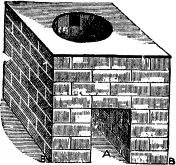
SUGAR boiling, like every other craft, requires a place to do it, and fitted accordingly. The requisites and requirements can be easily suited to the accommodation and the purse of the would-be confectioner. A work to be useful for all must cater for all, and include information for the smaller shopkeeper as well as the larger maker. To begin at the bottom, one can easily imagine a person whose only ambition is to make a little toffee and hardbake for the window fit for children. This can be done at a very small outlay for utensils. Where circumstances compel us to be very economical, we can manage with a saucepan, a clean clay pipe, a few toffee tins, a large pair of scissors, and an ordinary kitchen fire. This is rather a primitive arrangement, but it will answer the purpose. The tins should be made of stout tinned iron, about 15 inches long and 8 or 10 inches wide and 1 inch deep, wired round the top for strength. A copper saucepan would be much preferable to an iron one. We can make with these appliances Everton toffee, cocoanut candy, and such like, and at a pinch clove stick and hand cut balls. The next tool to be added should be a small cast-iron pouring plate, say 3 feet long by 1 foot 8 inches wide, costing about £1. Fix this to a rough bench about 2 feet 4 inches high, letting the pouring plate form as it were the top of a table. This will be very useful, and will enable us to extend our operations to sticks,—striped and plain,—also creams of various kinds. A pouring plate of this, size will allow 12 or 14 lbs. of sugar to cool at a time. The next move is an important one, viz., the erection of a sugar boiler’s furnace. It is not very costly but is certainly indispensable where quality and variety are required. A great economy in time and money will be effected ; the boiled sugar will be a much better colour, so that cheaper sugar may be used for brown or yellow goods, while one can make acid drops and other white goods from granulated, Dutch crushed, or loaf sugar, which otherwise would be impossible on an ordinary kitchen fire. The furnace may be erected in a back kitchen, cellar, or outhouse, of ordinary size, while the requisites are few. Here is a drawing, cut from a photograph, which will form a guide to any bricklayer or handy man, and shows almost every brick and where to place it. To build this, 100 common bricks, 12 fire bricks, a cast-iron furnace top, a 13 inch flat grate or furnace bottom, a piece of iron bar 12 inches long, 6 inches wide, and a
inch thick would be required. If the floor is stone, you could commence to build ; if of wood, either take the wood up and put down concrete, or lay a thick stone slab over the floor, the ash pit thus is well protected against fire. In commencing to build, first form your ash pit (A) by raising the two pillars (BB) four bricks high and three bricks from back to front, or, in other words, 2 feet 3 inches. Leave a space of 9 inches across for the ashes ; the stove will then be 2 feet 3 inches square. When the pillars are four bricks high, lay the piece of 12 inch iron between the two pillars to carry the top course of bricks ; let the ash pit be 18 inches from the front ; build in the back solid. Now place the square grate between the two pillars,
inches from the front of the stove. Now form a circle 9 inches in diameter, by placing the fire-bricks on their ends round the grate, then build up the sides of the stove to the level of the top of the fire-bricks ; pack the fire-bricks well up with rubble, cementing the whole firmly with fire-clay. The furnace must be built near a chimney ; when the flue is being formed, half one of the fire-bricks, which stand upright and form a small flue, having the iron stove top for a covering, letting it run into the chimney. Build up the chimney all round the flue, so that it might have a good draught. When the furnace has been built and the top surface levelled, the furnace top should be placed on damp mortar or fire-clay, so that it will adhere firmly. In this case, the cast-iron plate should be 2 feet 3 inches square, with a nine inch hole in the centre. It will then match the brick-work built as per instructions, but a stove-top can be had any size with larger or smaller hole and the brick-work built accordingly. Reducing rings are also made to fit the stove top, which will make the hole smaller. These are very useful for boiling smaller quantities of sugar for stripes and other purposes. The cost of plate and necessary iron work—about £1 10s—from any machine maker.
Pouring Plate.
Confectioner’s Furnace.
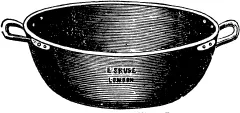
Having got the furnace fixed, it is now absolutely necessary to have a copper-pan,—the size, according to trade requirements,—but as some sugars foam a great deal, it is just as well to have a large one. We must expect to do big things when we have a furnace to work with.
Copper Sugar Boiling Pan.
COPPER SUGAR BOILING PAN.
A pan something of the above shape, say 12 inches across the top and 6 inches deep, would be sufficient to boil from 14 to 20 lbs. of sugar at a time. With these simple appliances (but more slab room) we could make 2 cwt. of various sorts of boiled sugars per diem. There is no need to go further with these directions, as when additional work is required, the experience already gained with these appliances will show the beginner what he requires much better than books ; besides which machine makers will give him any information respecting their various, ever-changing, and augmenting labour-saving appliances.
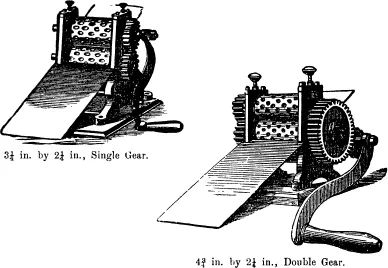
Drop Machines.
I cannot go any further into the mysteries of this art successfully, unless we provide ourselves with something like the above machine to enable us to make drops. They are indispensable, and if we are to go on, we must have them. They enable us to make drops, and as every confectioner sells drops, these machines are constructed to suit all classes of trade, big and little. The small ones make just as nice drops as the large ones, and the smallest will turn out in the course of a day 2 to 3 cwt., so that for retail purposes a small machine would generally suffice. A description of the machines may not be out of place, and will guide the reader in his selection. Here are 2 illustrations, showing what is known as the smaller sizes in common use—the first block showing
inches long by
in diameter, with cog wheels at one end only ; the other block shows a
inches long by
inches in diameter, double gear, i.e., having cog wheels at each end, the latter being larger are more easily turned by having 2 sets of cogs, the former being smaller 2 sets are unnecessary.
The frame or stand in which the rollers are fitted is made to a standard gauge, and it admits of any number of rollers being placed in the same frame ; one pair of rollers may be taken out and replaced by another pair in one minute, so that one frame is all that is necessary for any number of rollers.
The rollers are made to cut and mould almost any shape or pattern—i.e. raspberries, pears, grapes, horses, dogs, leaves, in endless variety.
The smallest frame costs 16/-, and each pair of rollers to fit about 30/- The larger sizes are considerably dearer. For latest prices, apply to the makers. Beginners, in selecting machines, should have the rollers as useful as possible, and not buy fancy shapes to begin with, because the rollers will simply cut or print the pattern they were intended for, and nothing else can b...
Table of contents
Cover
Title
Copyright
Preface
Sugar Boiling
The Workshop
Index
Trusted by 375,005 students
Access to over 1.5 million titles for a fair monthly price.
Study more efficiently using our study tools.
Frequently asked questions
Yes, you can cancel anytime from the Subscription tab in your account settings on the Perlego website. Your subscription will stay active until the end of your current billing period. Learn how to cancel your subscription
No, books cannot be downloaded as external files, such as PDFs, for use outside of Perlego. However, you can download books within the Perlego app for offline reading on mobile or tablet. Learn how to download books offline
Perlego offers two plans: Essential and Complete
Essential is ideal for learners and professionals who enjoy exploring a wide range of subjects. Access the Essential Library with 800,000+ trusted titles and best-sellers across business, personal growth, and the humanities. Includes unlimited reading time and Standard Read Aloud voice.
Complete: Perfect for advanced learners and researchers needing full, unrestricted access. Unlock 1.5M+ books across hundreds of subjects, including academic and specialized titles. The Complete Plan also includes advanced features like Premium Read Aloud and Research Assistant.
Both plans are available with monthly, semester, or annual billing cycles.
We are an online textbook subscription service, where you can get access to an entire online library for less than the price of a single book per month. With over 1.5 million books across 990+ topics, we’ve got you covered! Learn about our mission
Look out for the read-aloud symbol on your next book to see if you can listen to it. The read-aloud tool reads text aloud for you, highlighting the text as it is being read. You can pause it, speed it up and slow it down. Learn more about Read Aloud
Yes! You can use the Perlego app on both iOS and Android devices to read anytime, anywhere — even offline. Perfect for commutes or when you’re on the go. Please note we cannot support devices running on iOS 13 and Android 7 or earlier. Learn more about using the app
Yes, you can access Skuse's Complete Confectioner by E. Skuse,Skuse in PDF and/or ePUB format, as well as other popular books in Social Sciences & Anthropology. We have over 1.5 million books available in our catalogue for you to explore.