This work is intended for advanced readers interested in methods of sustainable land management - the prevention and control of land degradation. It offers a coherent view of the situation concerning land degradation and the human response to the problem. It is generally recognized that technological solutions alone cannot solve the problems of land degradation. This book discusses the role of land use and land management policies, programmes, insitutional innovations, and economic incentives for the control and prevention of land degradation. Special attention is given to legal issues at the international level and in individual countries.
- 536 pages
- English
- ePUB (mobile friendly)
- Available on iOS & Android
eBook - ePub
Response to Land Degradation
About this book
Information
1
Introduction
A steadily increasing world population and continuing degradation of extensive areas of land threaten the fundamental processes of the natural and agricultural ecosystems on earth and the quality of human life. Although there may be contrary arguments, the capacity of the earth is finite, as is its capacity to provide food and fibre for consumption throughout ecosystems along the food chain to human beings. Destruction of habitat ensures loss of biodiversity and a loss of resilience in natural ecosystems; poor standards of husbandry can lead to degradation of land under agriculture and may be compounded by industrial pollutants.
In this introduction and subsequent chapters, the problems of land degradation are discussed within a framework of driving forces, pressures, state, impacts, and responses (DPSIR). This framework provides a comprehensive view for the analysis of the problems and offers a methodology within which responses to land degradation can be developed. Definitions are given in an attempt to provide a standardized vocabulary and common understanding of the terms used. This is essential in developing an international setting for what this book describes as an ‘enabling environment’ to bring land degradation under control. In order that this can take place, it is necessary to first adopt sound ecological standards as a basis for the future use of land and soils. The current, exploitative, cultural attitude towards land and soils is unsuccessful in providing a sustainable form of production and so alternative strategies need to be developed urgently. These must be effective at all levels from the practical point of view of the individual land user, as well as from the standpoint of national, regional, and international policies.
It has been forecast that the population of the world will increase from the present 6.0 billion to around 7.6 billion by 2020 (estimated from the data in Table 1 and Figure 1). In order to provide sufficient food, both for these additional people and to raise the standard of provision for those who currently have an inadequate diet, a large increase in food production must take place. This increase in food production must come from approximately the same land area that is now being farmed, as the remainder is too dry, too wet, too cold or too steep and mountainous to make a significant contribution. This inevitably means greater pressure will be put on prime lands, and especially those with the most fertile soils, to provide the extra food required. Whether productivity can be increased or even maintained on prime lands is not clear. As demand increases further, there will be increasing pressure also for cropping on more sensitive and less productive areas, such as semi-arid pastoral land.
Fortunately, in the past 50 years, despite the enormous increases in agricultural production that have taken place, there are still large areas where land quality has remained fairly stable. There is growing recognition, however, among people working in rural development that land degradation, particularly salinization, soil erosion, soil nutrient depletion, and physical deterioration of soil structure, is widespread and increasing. Dramatic impacts of land degradation have been documented in some areas, with loss of productive lands, and even the displacement of people from their homelands. Where significant degradation has occurred, it often represents a serious threat to food security, particularly in poorer developing countries. Land degradation also threatens other environmental resources, both through direct effects, such as reduced habitat quality for biodiversity, and hydrological functions, and indirectly by forcing farmers to clear additional land to compensate for yield declines or land abandonment.
Table 1. World population growth.
Year | World population (millions) |
1804 | 1,000 |
1927 | 2,000 |
1960 | 3,000 |
1974 | 4,000 |
1987 | 5,000 |
2000 | 6,000 |
2050 | 8,900 |
Source: UN (1998).
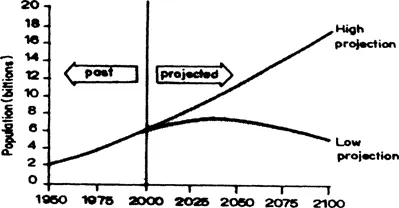
Source: Adapted from Cincotta and Engelman (2000).
The long-term impacts of land degradation depend upon future trends in land management, and the resilience of soils for recovery. It has been shown that in some cases market forces, and the self-interest of landowners to maintain the fertility and productivity of their lands, will eventually bring land degradation under control. In other cases, however, forests have been destroyed, soils have been eroded down to bedrock or become highly saline. The cost of restorative action for advanced degradation is prohibitively expensive and beyond the capabilities of individual farmers with little or no income. Some of the regions of the world where land degradation is currently most severe are the breadbaskets and rice bowls of their countries or areas of large, poor rural populations with few alternative livelihood options.
However, opinions have been divided about the global significance of land degradation for food security and the level of priority it should receive in public investment. Many soil scientists, ecologists, environmentalists, and agriculturalists and others who work ‘out in the field’ see continuing depletion and removal of natural vegetation, loss of biodiversity, and the erosion, pollution, and compaction of soils. To them, these are clear signs that environmental degradation is a major threat to biological diversity, future agricultural productivity, and the quality of life on earth, which justify an energetic response. Others, however, in particular economists, planners, and social scientists, want to understand how the economic, social, and environmental losses associated with land degradation compare with those caused by other factors. They argue that investments in land conservation and rehabilitation must compete for scarce resources with efforts to resolve other pressing problems, such as pest damage, post-harvest losses, marketing problems, bad pricing policies, and declining agricultural research budgets. Before committing scarce investment resources, they also want to see evidence that interventions really work.
Until fairly recently, these questions about the extent and impacts of land degradation, and the desirability of investments in land rehabilitation, have been debated largely without the benefit of reliable data. Fortunately, the past decade has seen the generation of important new data sets on land quality, the impacts of land degradation, and the efficacy and efficiency of technologies, institutions, and policies to promote good land husbandry. An objective of this book is to make known more widely the scientific advances made by diverse disciplines, and the practical lessons learned by various development actors, on how to respond appropriately and effectively to land degradation.
This introduction briefly describes the framework and structure of the book, defines key terms that will be used throughout, and suggests a new approach for promoting good land husbandry and rehabilitation.
Framework
Degradation is the result of a number of interrelated factors that can result in a downward spiral, ending in land that is chemically or physically too degraded for productive use or environmental service, and often also results in degraded visual amenity. The existing driving forces produce pressures that result in the current state of land resources, with a negative impact on society and the environment. This, in turn, may stimulate a response. Human activity may directly or indirectly influence the degradation or rehabilitation process at every stage. This sequence has been referred to as the DPSIR (driving forces, pressures, state, impacts, responses) framework within which the human response to degradation takes place (Box 1.1). The DPSIR framework has been adopted for the organization of this book.
The book is structured into 11 chapters. The Introduction forms the opening chapter. Chapter 2, Setting the scene, provides an overview of the issues of land degradation from historical and contemporary perspectives. Chapter 3, 4 and 5 analyze degradation processes themselves in the sequence of driving forces and pressures, state of the world’s soil resources, and impacts upon society and the environment. The driving forces fuelling land degradation may result from increased human population, urban expansion, war, tourism, agricultural production demands, transport, infrastructure, industrial or extractive activity and natural events such as climate change or simple water stress. These forces introduce pressures into the environment through noxious emissions to air, water, and land; nutrient mining; deforestation; forest and rangeland fires; or overgrazing. The state of land resources is described at global, regional, and national scales, using data that have become available only recently. Land degradation is interpreted in terms of the immediate past land use history and pressures that have brought about its current state, and includes biological or physical deterioration, eutrophication or nutrient depletion, salinization, acidification or chemical contamination. These changes in the state of land resources may have significant impacts on food supply, agricultural incomes, and environmental services of the land, such as habitat for biodiversity and hydrological functions. Impacts are estimated at a global scale, and documented in greater detail in national and sub-regional case studies.
Chapter 6, 7, 8, 9 and 10 describe the responses humans have made to the problems of land degradation. Chapter 6 describes tools for monitoring and assessment that have been recently developed. These methods have revolutionized the study of land degradation in the past two decades. Chapter 7 tells how conservation of agricultural land and rehabilitation of degraded land are being implemented, emphasizing new technological approaches. Institutional innovations are also emerging, to support the farmers who are the principal land managers. Key innovations described in Chapter 8 include a range of participatory approaches to land conservation and rehabilitation, and direct and indirect incentives to farmers. To encourage these innovations at a national scale requires suitable reform of national law and policy (Chapter 9) related to land tenure, land use and management, public investment and resource pricing. International initiatives (Chapter 10) provide an essential umbrella of agreements, protocols, and conventions, and critical investment resources, to encourage and support national actions to promote sustainable land management. The final chapter, Future responses, summarizes the salient points from the papers presented for policy-makers, and stresses the need for maintaining or forming institutions and organizations—at local, national, and international levels—that have the intellectual capability and organizational responsibility to address land degradation problems and promote appropriate legislation and policy.
Box 1.1 Using the soil DPSIR framework—driving forces, pressures, state, impacts, and responses—for evaluating land degradation
The DPSIR framework is an approach to soil and land degradation, developed by the European Environment Agency, for describing, monitoring, and controlling environmental pro...
Table of contents
- Cover
- Half Title
- Title Page
- Copyright Page
- Foreword
- Preface and Acknowledgments
- Table of Contents
- Contributors
- Chapter 1 Introduction
- Chapter 2 Setting the scene
- Chapter 3 Driving forces and pressures
- Chapter 4 State of the world’s land resources
- Chapter 5 Impacts on society and the environment
- Chapter 6 Tools for monitoring and assessment
- Chapter 7 Conservation and rehabilitation
- Chapter 8 Institutional innovations
- Chapter 9 Law and policy
- Chapter 10 International initiatives
- Chapter 11 Future responses
- Index
- The Editors
Trusted by 375,005 students
Access to over 1.5 million titles for a fair monthly price.
Study more efficiently using our study tools.
Frequently asked questions
Yes, you can cancel anytime from the Subscription tab in your account settings on the Perlego website. Your subscription will stay active until the end of your current billing period. Learn how to cancel your subscription
No, books cannot be downloaded as external files, such as PDFs, for use outside of Perlego. However, you can download books within the Perlego app for offline reading on mobile or tablet. Learn how to download books offline
Perlego offers two plans: Essential and Complete
- Essential is ideal for learners and professionals who enjoy exploring a wide range of subjects. Access the Essential Library with 800,000+ trusted titles and best-sellers across business, personal growth, and the humanities. Includes unlimited reading time and Standard Read Aloud voice.
- Complete: Perfect for advanced learners and researchers needing full, unrestricted access. Unlock 1.5M+ books across hundreds of subjects, including academic and specialized titles. The Complete Plan also includes advanced features like Premium Read Aloud and Research Assistant.
We are an online textbook subscription service, where you can get access to an entire online library for less than the price of a single book per month. With over 1.5 million books across 990+ topics, we’ve got you covered! Learn about our mission
Look out for the read-aloud symbol on your next book to see if you can listen to it. The read-aloud tool reads text aloud for you, highlighting the text as it is being read. You can pause it, speed it up and slow it down. Learn more about Read Aloud
Yes! You can use the Perlego app on both iOS and Android devices to read anytime, anywhere — even offline. Perfect for commutes or when you’re on the go.
Please note we cannot support devices running on iOS 13 and Android 7 or earlier. Learn more about using the app
Please note we cannot support devices running on iOS 13 and Android 7 or earlier. Learn more about using the app
Yes, you can access Response to Land Degradation by E M Bridges in PDF and/or ePUB format, as well as other popular books in Biological Sciences & Environmental Law. We have over 1.5 million books available in our catalogue for you to explore.