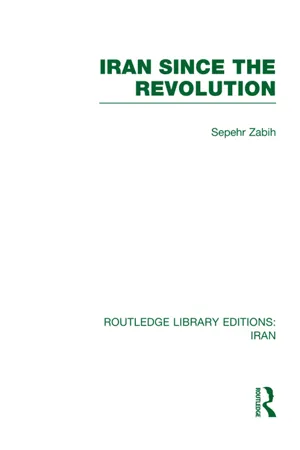
Since the turn of the century Iran has experienced three major political upheavals in the struggle to democratize her political systems. The last revolution inaugurated an era of unprecedented turmoil and instead of fulfilling its democratic aim, paved the way for an even more despotic theocracy. To put the revolution in a proper perspective, some attempt is made to explain the reasons for Khomeini's success in acquiring first, the symbolic leadership of the anti-Shah revolution, and then, the monopolistic control of power in Iran. How and why the other claimants to power were shunted aside and later brutally repressed is a further theme for discussion. The domestic and external ramifications of the revolution are examined in detail; in particular the rise of the anti-American feeling which culminated in the hostage crisis. In conclusion, an analysis is offered of the instrumentalities of power available to the Islamic Republic, and several scenarios are explored in which Iran's competing forces may converge to determine whether this third revolution will finally succeed in subordinating political authority to popular democratic consent.
- 260 pages
- English
- ePUB (mobile friendly)
- Available on iOS & Android
eBook - ePub
Iran Since the Revolution (RLE Iran D)
About this book
Information
1
WHY AND HOW KHOMEINI SUCCEEDED
Although the focus of this book is on Iran since the 1979 revolution, an understanding of how and why that revolution succeeded in bringing Khomeini to power is indispensable for putting events since 1979 into their proper perspective.
Much has been written on the causes of the 1979 revolution by scholars, journalists and diplomats alike. Some who played a critical role from its inception until the deviation from its original course some time in December 1979, when a controversial Islamic constitution was adopted, have also publicized their accounts. To evaluate the academic worth or the objectivity of all these accounts is beyond the scope of this study. What is evident is that the whole true story of the revolution remains to be told. More time needs to elapse before a definitive account of the revolution can be offered. Thus, for example, former President Carter and his National Security Adviser, Zbigniew Brzezinski, are still to be heard from. On the Iranian side, Mehdi Bazargan, Generals Gharabaghi and Fardoust, Banisadr and the late Beheshti, men who have or had intimate knowledge of the critical events between 16 January and 11 February 1979, have, by and large, been silent or their knowledge has been inaccessible to researchers and specialists.
To contend that the full story of this momentous event cannot yet be told does not mean that aspects of the revolution cannot be studied. This writer and many others have attempted to do so over the last few years.1 Some of the American diplomats serving in the field or in various intelligence and State Department agencies have also disclosed their personal knowledge of these events.
For the purpose of this study, instead of reviewing the totality of circumstances and causes which gave birth to the revolution, the author intends to ask a different set of questions under the general heading of ‘How Khomeini Dominated the Revolution’. This is done because one of the author’s chief assumptions is that Khomeini’s total leadership was unplanned and avoidable. It is further contended that barely three months after his seizure of power, the majority of the anti-Shah political groups and personalities began to realize their errors in pledging loyalty to him, and one after another deserted him.
By the revolution’s first anniversary Khomeini had already lost the support of secular-liberal forces. By the end of another year non-fundamentalist Islamic groups and anti-Soviet leftist organizations had joined the opposition. More significantly, towards the end of 1979 four of the grand Ayattolahs began to oppose him with varying degrees of vehemence. Put differently, what began as an authentic and anti-dictatorial popular revolution based on a broad coalition of all anti-Shah forces was soon transformed into an Islamic fundamentalist power-grab, in the process of which that coalition disintegrated irreversibly.
This was not merely a peaceful and democratic transfer of power from one group to another. It entailed a particular form of radicalization of the revolution. It had to do with the form and substance of the new Iranian political system. Who could rule the country, in the interest of whom and with what degree of accountability, were the critical issues at stake. The absence of a consensus of response to these and similar issues, and more significantly the failure to develop a legitimate mechanism to resolve the existing differences of perception of Iran’s new social and political system, have heavily affected the course of events since 1979.
With regard to Khomeini’s seizure of control of the revolutionary coalition and his subsequent transformation of the course of the revolution, attention should be paid both to external and to internal causes.
Since the deposed Pahlavi regime relied heavily on the USA, the American connection with events in Iran in 1978–9 must be probed. By the same token, since the disintegration of the armed forces enabled the revolutionary forces to change the power transition from a fairly peaceful one into a violent insurrectionary one, the collapse of the Imperial Army requires careful scrutiny.
The American Connection
Most accounts of American behaviour, particularly in the latter phase of the year-long revolutionary turmoil, seem to agree on several cogent factors:2 first, the incoherence and confusion of the Carter Administration; secondly, a State Department seemingly hypnotized by an abstract model of human rights; thirdly, a weakened and undermined intelligence community which was incapable of predicting the crisis or, when it began to unfold, of making a correct assessment of what it portended. These three factors combined to produce a débâcle for the United States in Iran, with far-reaching ramifications, many of which have not yet been fully comprehended.
The American authors Michael Ledeen and William Lewis offer one of the best analyses of the American dilemma in the Iranian revolution.3 According to them, not only had high government functionaries such as Brzezinski made their opposition to the Shah known before they joined the Carter Administration, but important Democratic senators like Kennedy, Mondale, Cranston, Church and Fraser had gone on record criticizing various aspects of US-Iranian relations. Within the staffs of these senators, influential advisers in international affairs had long before joined anti-Shah groups: among them was Robert Hunter, the former foreign-policy adviser to Senator Kennedy. When accompanying Kennedy as a guest of the Shah, he was denied an audience with the Iranian ruler in order to present his misgivings about human rights violations in Iran.
Within the National Security Council (NSC) Brzezinski and Hunter were not the only ones with reservations about the Shah. David Aaron, deputy assistant to the President for national security affairs and a close collaborator of Vice-President Mondale, had declared that ‘This administration is different. If the Shah thinks that he will get all the arms that he wants, he shall have surprizes.’ This view was shared by other members of the Council and it accurately reflected that of Mondale.
Kennedy, Mondale, Cranston. Church and Fraser, known as the ‘Vietnam era’ senators, supported these critics of the Shah in the NSC. They felt it was immoral for the USA to provide an uninterrupted flow of arms to a ruler who was guilty of grave violations of human rights. But among the close associates of Carter’s foreign-policy establishment there was neither unanimity nor consistency concerning the Iranian crisis.
At the outset reports from the embassy in Iran were by and large optimistic. William Sullivan, who replaced Richard Helm as US ambassador, reflected the views of his predecessor by portraying basically a monarch who exercised total control and a military sufficiently strong to resist attack from any radical neighbours. Did it, therefore, follow that the Shah could continue his liberalization policies? If there was a link between the Shah’s strength and his ability to liberalize Iranian society, would it not follow that the US should simultaneously enhance the position of the Shah?
Few in the USA realized the inherent contradictions between these two factors. Liberalization for the educated Iranians meant the loosening of the Shah’s grip on power. It meant genuinely free elections, a constitutional democracy, a free press, and in short the transformation of the Iranian political system from a dynastic autocracy to a responssible democratic state. For these Iranians, those who thought this transformation might be achieved without an erosion of the Shah’s power were simply uneducated or myopic.
Why the US embassy could not comprehend the contradictions between the two propositions is the subject of much speculation Ledeen and Lewis feel that the two ambassadors, each for personal and career reasons, were reluctant to unsettle their superiors in Washington with facts which they were not ready to accept.4 Other sources indicate that the two were as much victims of the perplexity of Iranian politics and the complexity of the Shah’s personality as were many perceptive Iranian insiders in close contact with the American officials.
The beginning of 1978 was thus marked by a formal US policy which relied on the premise that the Shah’s strength would not be sapped by progressive liberalization. President Carter had set the tone by his infamous New Year toast in Tehran in which he observed that Iran, ‘under the Shah’s enlightened leadership’, had become ‘an island of stability’. The best estimate of the expectations of US officials about the Iranian situation was that once the President had set the main tone of the policy it should be permitted to proceed, and if it generated undesirable results then it could be re-evaluated and revised if necessary.
Within the foreign-policy establishment there were those who wished that the policy would not succeed, for its failure would simply prove them right. There were others who thought it was essential to persuade the Shah to implement such liberalization policies as would eventually democratize the Iranian political system and make the Shah dispensable.
The period between January and August was a period of ‘wait and see’ for the United States. Major upheavals in Qom in January, and in Tabriz in February when for two days it was in the hands of insurgents, had been successfully contained. Daily the Shah would announce the release of more political prisoners, and the controlled media was given a little more freedom in news coverage. At the end of June a confident Shah was quoted as saying that he would simply not permit a second Tabriz as long as he was alive.5 US embassy reports were by and large positive. Ambassador Sullivan decided to leave on his summer vacation and was physically absent until late September. Every indication disproved the alleged contradiction in a dual policy towards Iran which sought simultaneously to strengthen the Shah and to liberalize Iran’s political system.
This optimistic view was verified in testimony before various congressional committees. Thus, in late August the Central Intelligence Agency (CIA) could estimate that the country was neither in a prerevolutionary nor a revolutionary situation. The Defense Intelligence Agency (DIA) in its 28 September estimates could foresee another ten years of rule by the Shah.6
Bearing in mind that the events of August and September were the turning point in Iranian political developments, these optimistic estimates would seem, to say the least, outdated by about sixty days. Blaming over-reliance on the SAVAK (A Farsi acronym for State Security and Information Organization) or restrictions on CIA and DIA activities due to President Carter’s objection to secret operations for this massive intelligence failure, would not suffice either. By the time the US ambassador returned to his post in Tehran in late September, he had sufficient time and reliable sources to ascertain the gravity of the Iranian developments. As will be seen later, at the end of October the ambassador still believed that his Iranian contacts, both inside and outside the government, were unnecessarily panicky and that the dual policy of backing the Shah and his liberalization policies would succeed.
Were the American officials the only foreign observers guilty of misinformation and misconception about Iran in the summer of 1978? Ledeen and Lewis have credited the French and Israeli diplomatic and intelligence services with a more accurate and perceptive analysis of the Iranian situation. This author had the opportunity of talking to a number of Israeli officials including Uri Lubrani, head of Israel’s mission to Tehran, during a flight out of Tehran on 17 July 1978. The Israeli officials were most knowledgeable about two interrelated aspects of the Iranian scene. One was the activities of the religious opposition, and the other was the political mood of the Bazaar. Relying on a community of fairly well-integrated Iranian Jewish merchants, they predicted rightly that the Bazaar would play the critical role in the outcome of the ongoing struggle. Liberalization policies were immaterial for them. These policies might influence the students and the Western-educated secular upper middle classes, but the lower classes, the small Bazaar traders who were subjected to Islamization by the Shia clergy, would not be impressed by the effects of the political Westernization of Iran.7
When pressed for a prognosis, the Israeli diplomats appeared not to be of the same mind. Some gave the Shah another two or three years; others thought his departure would be voluntary, in favour of his son and by a peaceful transition of power. None underestimated the Shah’s ability to use the military to safeguard his reign. By the same token none even conceived the slightest notion that the Shah’s determination would become progressively paralysed to the point that he would become a victim of political and personal fatalism. As a precautionary measure, however, in August the chief Israeli diplomat, Dr Karni informed the Iranian Jewish community that they should be aware of the progressive Islamization of the lower-class Bazaari population and maintain a low profile in their commercial activities. In point of fact that advice was not well heeded. The Jewish community proved no more prescient as to the exact course of the Iranian turmoil than other segments of the population.
At any rate, as the tempo of public agitation increased and the regime failed to show any determination in coping with the crisis in a measured and well-thought-out manner, the United States too began to show signs of reassessing the Iranian situation. As far as the Shah was concerned, however, this process had begun not in mid autumn but in mid summer of 1978. His testimony on America’s withdrawal of support is unambiguous. ‘I did not know it then – but it is clear to me that the Americans wanted me out’, he wrote shortly before his death.8 By the time the leaders of the Western democracies met on 4 January 1979 in Guadeloupe, the Shah believed that France, West Germany and Britain had come to accept the American position. Nor was this totally unprecedented. The Shah felt that the withdrawal of US support evolved gradually. Thus, the student demonstrations in Washington in November 1977 were part of an organized effort to discredit him and his government to which the oil companies and the CIA contributed financially and otherwise. It was inconceivable to the Shah that the US government could not have prevented a student rally within the earshot of the president if it had really wished to do so. The suspicion that the USA might have been in collusion with the Soviets also worried the Shah: he related a conversation with Nelson Rockefeller in which he wondered whether it was conceivable that the Americans and the Russians had divided the world between them.
President Carter’s concern for human rights is blamed for playing a considerable role in the Shah’s downfall. Puzzled at US insistence that there was no contradiction between supporting him and pushing for liberalizing his regime, he tried hard to secure America’s unequivocal support for his regime. Nearly all accounts agree that instead of unconditional support he received mixed signals. His dilemma was aggravated further, on the one hand, because he felt US support was conditional on continuous liberalization policies in Iran and, on the other, because he feared pursuing such policies in the midst of an economic crisis was bound to undermine his regime.
Numerous attempts were made by the Shah to ascertain the real intentions of the USA during the crisis in the autumn of 1978. One particular attempt early in October involved former Prime Minister Amir Abbas Hoveyda (later executed), US Ambassador William Sullivan and a special envoy with close ties to the latter. Frustrated at the failure of diplomatic and official channels to secure an ironclad guarantee of US support for the Shah, Hoveyda, who had been just recently dismissed as Minister of the Imperial Court, summoned a former chancellor of the National University whom he believed to have close ties with the United States, to find out what Washington was really up to.9 When the former chancellor assured him that he did not believe the USA was fomenting public protest against the Shah, Hoveyda expressed agreement with his analysis but thought that the Shah should accept US non-involvement in the worsening turmoil. Hoveyda asked the former chancellor to get in touch with Ambassador Sullivan and report back to him so that he could try once more to assure the Shah that the Americans were not behind the opposition campaign. In a lengthy discussion with Sullivan, the former chancellor was told that he had full authority to express total US support for the Shah.
Here is a copy of a top-secret (for your eyes only) report that I just sent to Washington to say that the Shah was irreplaceable and that the US should go all the way with him. The trouble with you guys is that you panic easily. Our people report that the opposition meetings are poorly attended and organized haphazardly; and therefore they should be regarded as a nuisance and not a threat.
Reassured by the ambassador, the former chancellor reported back to Hoveyda, who arranged an immediate audience with the Shah to assu...
Table of contents
- Cover
- Halftitle
- Title
- Copyright
- Contents
- Preface
- 1. Why and How Khomeini Succeeded
- 2. The Dynamics of Power
- 3. The Hostage Crisis
- 4. The Presidency and the Majlis
- 5. The Resurgence of Opposition
- 6. The Left and the Islamic Republic
- 7. The Demise of Banisadr
- 8. Armed Struggle Against the Regime
- 9. The Islamic Republic and the World
- 10. A Prognosis
- Postscript
- Selected Bibliography
- Index
Trusted by 375,005 students
Access to over 1.5 million titles for a fair monthly price.
Study more efficiently using our study tools.
Frequently asked questions
Yes, you can cancel anytime from the Subscription tab in your account settings on the Perlego website. Your subscription will stay active until the end of your current billing period. Learn how to cancel your subscription
No, books cannot be downloaded as external files, such as PDFs, for use outside of Perlego. However, you can download books within the Perlego app for offline reading on mobile or tablet. Learn how to download books offline
Perlego offers two plans: Essential and Complete
- Essential is ideal for learners and professionals who enjoy exploring a wide range of subjects. Access the Essential Library with 800,000+ trusted titles and best-sellers across business, personal growth, and the humanities. Includes unlimited reading time and Standard Read Aloud voice.
- Complete: Perfect for advanced learners and researchers needing full, unrestricted access. Unlock 1.5M+ books across hundreds of subjects, including academic and specialized titles. The Complete Plan also includes advanced features like Premium Read Aloud and Research Assistant.
We are an online textbook subscription service, where you can get access to an entire online library for less than the price of a single book per month. With over 1.5 million books across 990+ topics, we’ve got you covered! Learn about our mission
Look out for the read-aloud symbol on your next book to see if you can listen to it. The read-aloud tool reads text aloud for you, highlighting the text as it is being read. You can pause it, speed it up and slow it down. Learn more about Read Aloud
Yes! You can use the Perlego app on both iOS and Android devices to read anytime, anywhere — even offline. Perfect for commutes or when you’re on the go.
Please note we cannot support devices running on iOS 13 and Android 7 or earlier. Learn more about using the app
Please note we cannot support devices running on iOS 13 and Android 7 or earlier. Learn more about using the app
Yes, you can access Iran Since the Revolution (RLE Iran D) by Sepehr Zabir in PDF and/or ePUB format, as well as other popular books in Social Sciences & Regional Studies. We have over 1.5 million books available in our catalogue for you to explore.