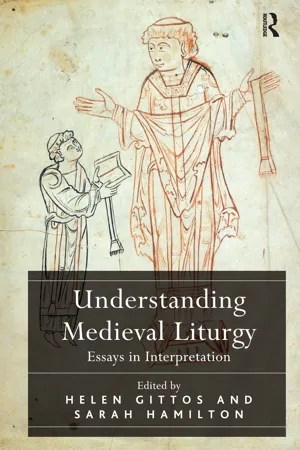
eBook - ePub
Understanding Medieval Liturgy
Essays in Interpretation
- 352 pages
- English
- ePUB (mobile friendly)
- Available on iOS & Android
eBook - ePub
Understanding Medieval Liturgy
Essays in Interpretation
About this book
This book provides an introduction to current work and new directions in the study of medieval liturgy. It focuses primarily on so-called occasional rituals such as burial, church consecration, exorcism and excommunication rather than on the Mass and Office. Recent research on such rites challenges many established ideas, especially about the extent to which they differed from place to place and over time, and how the surviving evidence should be interpreted. These essays are designed to offer guidance about current thinking, especially for those who are new to the subject, want to know more about it, or wish to conduct research on liturgical topics. Bringing together scholars working in different disciplines (history, literature, architectural history, musicology and theology), time periods (from the ninth to the fifteenth centuries) and intellectual traditions, this collection demonstrates the great potential that liturgical evidence offers for understanding many aspects of the Middle Ages. It includes essays that discuss the practicalities of researching liturgical rituals; show through case studies the problems caused by over-reliance on modern editions; explore the range of sources for particular ceremonies and the sort of questions which can be asked of them; and go beyond the rites themselves to investigate how liturgy was practised and understood in the medieval period.
PART I
Researching Rites
Chapter 1
Researching the History of Rites
Helen Gittos
Preliminaries
Thousands of medieval manuscripts containing materials for use in so-called 'occasional' rites such as baptism, burial and Palm Sunday survive from Western Europe.1 Yet their value as historical sources has hardly begun to be realized. There are two main reasons for this. The first is the enduring perception that the medieval liturgy was conservative - traditional, slow to change, and therefore not very useful for historians to study. Here, for example, is the end of an essay by John Blair about baptismal fonts in Anglo-Saxon England:
Encouraged by the materials that they study, liturgists tend to lay great stress on uniformity. From a liturgists perspective this paper is rather iconoclastic, proposing as it does a high degree of diversity and informality in English local practice during the ninth to eleventh centuries.2
Although some previous generations of liturgists did emphasize uniformity, Blair's statement could not be less true of current work in the field. The diversity in early medieval baptismal rites that he proposes on the basis of the archaeological evidence is precisely what one finds in the liturgical sources. Susan Keefe, in her work on baptism in the Carolingian Empire repeatedly stresses this: 'one can truly be amazed at the amount of liturgical diversity'; 'diversity ... characterized public worship'.3 It is the degree to which medieval liturgy was diverse, informal, and frequently revised and rewritten that makes it so valuable as historical evidence.
The second reason why liturgical sources are undervalued is that they are perceived as being difficult to use:
Liturgical history is pure scholarship: painstakingly detailed, extremely technical, highly esoteric ... Its practitioners, like the initiates of an ancient mystery cult, pour the fruits of their researches into learned journals with splendidly arcane titles like Ephemerides Liturgicae and Sacris Erudiri. It is hard for a mere layman to penetrate these mysteries....4
In fact liturgical sources present only the same kinds of problems as other types of medieval texts such as charters, writs or law codes. Just as with other sources, in order to be able to use liturgical manuscripts one needs to familiarize oneself with the conventions of the genre but they are far from being impenetrable and arcane. In this chapter I will discuss the potential of liturgical rites as sources, some practical ways in which one can work with this material, some problems that are likely to be encountered, and some possible directions for future research. My focus is on how one can go about doing such work rather than providing a survey of the historiography.
Potential: What are Rites Evidence For?
Medieval liturgical sources for rites such as Palm Sunday, baptism and penance are of immense value for many reasons. One of these has already been mentioned: these rituals were repeatedly revised and never standardized - it is rare to find any version of a ritual that is identical to any other. One of the recurring features of manuscript-based studies of such rites is that their authors remark on the comparative diversity of whatever ritual they are considering. Susan Keefe's previously cited characterization of baptismal rites in the Carolingian period is particularly emphatic but essentially typical; similar statements have been made about the diversity of Anglo-Saxon rites for blessing holy oils, liturgies for excommunication and the consecration of churches from the central Middle Ages, blessings of pilgrims and crusaders in the twelfth and thirteenth centuries, and rites for public penance in thirteenth- and fourteenth-century France.5 Contemporaries were aware of this. Walahfrid Strabo, abbot of Reichenau (Germany), writing in c. 840-42 discusses at length the 'great diversity in the li turgy' in his own time and mentions the different versions of the psalms used, and the many variations in baptismal practices. He was tolerant of these differences and, for example, willing to accept the validity of triple or single immersion or effusion.6 He was aware that much of the liturgical material available in his day had been written only recently and was content that 'new compositions ... are not to be rejected' so long as they were doctrinally orthodox.7 Later on, in the eleventh century, Lanfranc, archbishop of Canterbury (1070-89), was involved in various disagreements with John, archbishop of Rouen, about vestments. In a surviving letter he draws on his own experience: 'I have often watched various bishops of different provinces dedicating churches, and I have observed most scrupulously all that they did. In some respects their practice differed'.8 In relation to a detail in the rite for ordaining a subdeacon, he talks about the different rubrics found in 'our own books of episcopal ordines, of which we have many from different parts of the world'.9 This letter is fascinating because it provides evidence for an interest in liturgical minutiae, the importance of witnessed precedents ('I was present when St Leo himself, supreme bishop of the Roman see, dedicated the church of Remiremont ...'), and for the academic study of liturgical books.10 Even in the late Middle Ages, diversity had not disappeared: a late fifteenth-century scribe somewhat exasperatedly introduced the rite for dedicating a church in a manuscript from Besancon by saying: 'Concerning the dedication or consecration of churches there is so much variety among various rites, that not only do they not agree in many things, but they can even contradict one another'.11 It is not yet clear when liturgies became more stable because less work has been done on the rites of the later Middle Ages than those of earlier periods. However, it has been suggested that this only happened once texts intended to be authoritative and official began to be printed by Pope Pius V in the 1560s.12
The extent of diversity is such that where one does, occasionally, find evidence for a group of texts that are substantially similar, this is notable.13 The eleventh-century customaries associated with the monastery of Cluny (France) are one example and are discussed in Chapter 9. In this case it appears that their homogeneity reflects the authority that Cluny had. Sometimes Cluniac monks used a written customary as part of the process of reforming another monastery.14 More often, though, the Cluniac customaries were not used as practical documents to guide daily life but as 'inspirational texts' which 'offered their readers the opportunity to learn about admirable monastic lives'15 These customaries sometimes offered models of how to live a good life rather than rules for how to do so. Most of the time, though, medieval rites were 'living' texts that were regularly tinkered with and therefore provide evidence for current ideas and concerns.16
The extent of diversity results from many different causes. Sometimes one can uncover the precise historical contexts in which these changes were made. It is clear, for example, that rites were repeatedly revised by liturgists at Canterbury Cathedral throughout the later tenth and eleventh centuries, and enough manuscripts survive that one can see in some detail the successive changes that were made.17 In some cases these can be associated with particular individuals, such as Archbishop Dunstan's (959-88) interest in the Candlemas ceremony, or the changes to the Palm Sunday service made by Lanfranc (1070-89).18 In other cases they can be related to particular circumstances, such as the monasticization of the cathedral, or the desire to control the proliferation of newly constructed local churches.19 Many other examples could be cited. We have, for example, evidence for the rite written by Hincmar, archbishop of Rheims (845-82), for the coronation of Charles the Bald as king of Lotharingia in 869.20 We can read the new liturgies created by Goscelin of Saint-Bertin for the saints of St Augustine's abbey, Canterbury in preparation for their move into the rebuilt church at the end of the eleventh century.21 One can trace the creation of new rites for consecrating cemeteries in the tenth century as bishops tried to control popular enthusiasm, or for blessing crusaders in the twelfth century, or the revival of interest in celebrating Gaudete Sunday as part of an attempt by Pope Innocent II (1130-43) to establish himself in Rome.22 When it is possible to identify the circumstances in which particular rites were created their value as evidence increases substantially.
This is especially true when texts and the manuscripts in which they are found can be associated with particular people. Although liturgical books were usually compiled anonymously, they were often personal books, commissioned by particular individuals for their own use, even if these persons are not named. Amongst the best sources for occasional rites are pontificals and manuals, books containing rites to be conducted by bishops and priests respectively. There is evidence that these were often treated as personal books and sometimes subsequently preserved as memorials of the people for whom they were made. We seem to have the pontificals made for Dunstan and Anselm, archbishops of Canterbury (959-88 and 1093-1109), Hugues de Salins, archbishop of Besançon (1031-66), Gundekar, bishop of Eichstätt (1057-75), David de Bernham, bishop of St Andrews (1240-53), and the benedictional (a book containing episcopal blessings for use in the mass) of Æthelwold, bishop of Winchester (963-84) amongst many others,23 Sometimes there may be good reason to think the commissioners of these books were the deans and precentors who were really in charge of the liturgy, rather than often-absent figureheads, but even so they remain useful evidence for the state of the liturgy in those cathedrals at that time, perhaps for the process of negotiation undertaken with an incoming incumbent: a book may have been produced by a cathedral to try to persuade a new bishop that these were the local customs he should follow.24 Although we rarely know the names of the priests for whom manuals were written, the surviving manuscripts, which tend to be small, workaday books, are precious evidence for the decisions of their owners, and historians are increasingly paying attention to them. We have, for example, the liturgical manuscripts of a priest ministering in south-eastern Gaul probably in the late seventh century, another belonging to someone working near Liege, Belgium c. 800, and a third from a priest associated with Sherborne Cathedral, Dorset c. 1060; there are many more that deserve study.25 Even when they are anonymous, it is possible to recover a great deal of information about the authors and compilers of specific liturgies and particular manuscripts.
Sometimes one can use rites to make inferences about the decisions taken by individuals but more often they enable one to examine changes in political, theological or social ideas. This is partly because rites tended to be created and altered by making use of material that already existed:
One of the advantages for the historian in studying any ritual is the potential it can offer for observing processes within a defined matrix, rather than simply apprehending a single event or series of events caught in a particular moment... ritual provides a structural framework in which ... relationships ... can be understood over a long period.26
The existence of diversity within common forms means such sources are idea...
Table of contents
- Cover
- Half Title
- Title
- Copyright
- Contents
- List of Figures and Tables
- Notes on Contributors
- Acknowledgements
- List of Abbreviations
- Introduction
- PART I: RESEARCHING RITES
- PART II: QUESTIONING AUTHORITY AND TRADITION
- PART III: DIVERSITY
- PART IV: TEXTS AND PERFORMANCES
- Bibliography
- Index
Trusted by 375,005 students
Access to over 1.5 million titles for a fair monthly price.
Study more efficiently using our study tools.
Frequently asked questions
Yes, you can cancel anytime from the Subscription tab in your account settings on the Perlego website. Your subscription will stay active until the end of your current billing period. Learn how to cancel your subscription
No, books cannot be downloaded as external files, such as PDFs, for use outside of Perlego. However, you can download books within the Perlego app for offline reading on mobile or tablet. Learn how to download books offline
Perlego offers two plans: Essential and Complete
- Essential is ideal for learners and professionals who enjoy exploring a wide range of subjects. Access the Essential Library with 800,000+ trusted titles and best-sellers across business, personal growth, and the humanities. Includes unlimited reading time and Standard Read Aloud voice.
- Complete: Perfect for advanced learners and researchers needing full, unrestricted access. Unlock 1.5M+ books across hundreds of subjects, including academic and specialized titles. The Complete Plan also includes advanced features like Premium Read Aloud and Research Assistant.
We are an online textbook subscription service, where you can get access to an entire online library for less than the price of a single book per month. With over 1.5 million books across 990+ topics, we’ve got you covered! Learn about our mission
Look out for the read-aloud symbol on your next book to see if you can listen to it. The read-aloud tool reads text aloud for you, highlighting the text as it is being read. You can pause it, speed it up and slow it down. Learn more about Read Aloud
Yes! You can use the Perlego app on both iOS and Android devices to read anytime, anywhere — even offline. Perfect for commutes or when you’re on the go.
Please note we cannot support devices running on iOS 13 and Android 7 or earlier. Learn more about using the app
Please note we cannot support devices running on iOS 13 and Android 7 or earlier. Learn more about using the app
Yes, you can access Understanding Medieval Liturgy by Helen Gittos, Sarah Hamilton, Helen Gittos,Sarah Hamilton in PDF and/or ePUB format, as well as other popular books in History & European Medieval History. We have over 1.5 million books available in our catalogue for you to explore.