eBook - ePub
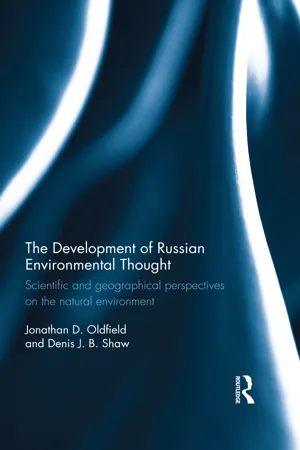
The Development of Russian Environmental Thought
Scientific and Geographical Perspectives on the Natural Environment
- 196 pages
- English
- ePUB (mobile friendly)
- Available on iOS & Android
eBook - ePub
The Development of Russian Environmental Thought
Scientific and Geographical Perspectives on the Natural Environment
About this book
This book provides a comprehensive overview of the very rich thinking about environmental issues which has grown up in Russia since the nineteenth century, a body of knowledge and thought which is not well known to Western scholars and environmentalists. It shows how in the late nineteenth century there emerged in Russia distinct and strongly articulated representations of the earth's physical systems within many branches of the natural sciences, representations which typically emphasised the completely integrated nature of natural systems. It stresses the importance in these developments of V V Dokuchaev who significantly advanced the field of soil science. It goes on to discuss how this distinctly Russian approach to the environment developed further through the work of geographers and other environmental scientists down to the late Soviet period.
Information
1 Introduction
Landscapes and earth systems – Russian geographical perspectives on the natural environment, 1880s–1960s
DOI: 10.4324/9781315670171-1
‘The students of the Geography Faculty asked me to speak about how I became a geographer – I became a geographer through studying nature itself.’L. S. Berg (October, 1947)
Introduction
The beguilingly simple question, ‘How did Russian geographers conceptualize the physical environment?’ formed a general starting point for this work. It was prompted by a sense that Russian geography has been influenced during the course of the last century and more by a central desire to comprehend the natural world as a complex system of highly interrelated parts. Thus, at its heart, this book is interested in how we think about the physical environment that surrounds us and how such understanding is influenced by an array of experiential and contextual factors. More specifically, we aim to explore Russian scientific ideas about the physical environment and the various ways in which such ideas were shaped and developed during a period of marked social upheaval and change in Russia. The empirical focus is on the work, ideas, and activities of Russian geographers and their colleagues in cognate disciplines. This raises difficulties of definition, particularly in the early part of the analysis, since a number of the main protagonists roved across several disciplinary areas. In addition, they often had limited formal links with geography as it developed within the Russian university system. Nevertheless, as will be shown, their work and general approach would provide an important backdrop to later developments in Soviet geographical thinking. The focus on geography is not accidental, but reflects the disciplinary background and long-standing scholarly interests of the two authors. Furthermore, it acknowledges the relatively limited engagement with the work of Russian geographers in the English-language literature in spite of their discipline's enduring efforts both to describe and explain the functioning of the physical environment and their understated attempts to contribute to broader understandings of anthropogenic environmental change.
The book commences in the 1880s, a decade which coincides both with the emergence of the discipline of soil science, an event which had considerable significance for geography, and also with geography's initiation as a Russian university subject. We conclude in the 1960s, when Soviet geography was faced with a series of new challenges which would require a separate volume to describe adequately. Our aim is to accent those trends or events which appear to us to be particularly significant for understanding the evolution of geographical thinking concerning the physical environment within Russia.
In view of the empirical focus of the book, we have a broader interest in contributing to an understanding of the geography of the geographical sciences (e.g. Buttimer and Mels, 2006; Livingstone, 1992; Withers, 2010). Writing in the early 2000s, the British geographer Charles Withers (2001, pp. 81–82) pointed to a shift in interest by English-speaking geographers from an examination of their discipline's history to a much broader geography of science agenda which links productively with recent developments in the sociology of science (see below). However, there is clearly still much to be done in terms of examining the different ways in which geography has been understood, conceived, and practised in different times and places, and this, we would argue, is particularly true of the Russian case. A focus on the Russian geographical tradition draws attention to a range of themes which tend to remain rather muted in the Anglo–North American tradition. In particular, the emphasis placed on physical geography and the interrelationships between different natural phenomena at the earth's surface, which forms the basis of much of the discussion in this volume, features less prominently in histories of British and North American geography (e.g. Martin and James, 1993).
In exploring the different ways in which Russian geographers and their scientific colleagues have conceptualized the environment, the book's findings have broader relevance for Russian environmental history and historical geography. General environmental histories of society–nature interaction at the global level as well as associated scholarship concerning urgent environmental issues such as anthropogenic climate change tend to place only limited emphasis on the Russian experience or else highlight a host of negative legacies linked in particular to the Soviet period (e.g. McNeil, 2000; Weart, 2003). Allied to this, there has been a sense that Russia has little of value to add to ongoing debates in these areas. The reasons for this are in some cases linked to linguistic barriers and, for much of the twentieth century, ideological and political differences. A further influence concerns the character of the assessments of the Soviet Union's environmental situation that began to emerge during the late Soviet period which focussed on the country's strained environmental situation (e.g. Feshbach and Friendly, 1992; Komarov, 1980; Pryde, 1972). Collectively, these publications tended to advance a picture of environmental disaster and crisis, identifying systemic issues as well as a number of representative events such as the 1986 Chernobyl’ nuclear explosion, the Aral Sea crisis, the poor land management associated with Khrushchev's Virgin Lands campaign, and the controversy over industrial development on the southern shores of Lake Baikal (see Brain, 2012; Josephson et al., 2013).
There is little doubt that the Soviet system resulted in considerable and wide-ranging environmental problems. However, an overwhelming focus on such issues draws attention away from other aspects of the Soviet Union's, and more broadly Russia's, environmental history. Recent years have seen efforts to redress this imbalance, with authors stressing various elements of Russia's past in order to highlight traditions of ecological thought (e.g. Gare, 1996) and environmentalism (e.g. Brain, 2011), as well as broader nature protection activities underpinned by both state and civic action (e.g. Shtilmark, 2003; Weiner, 1999; Yanitsky, 2012; 2014; see also Bruno, 2007; Oldfield, 2005). The current book seeks to add to this growing literature by examining the ways in which Russian geographers developed sophisticated understandings of the physical environment and associated processes. As such, it dovetails with recent scholarship in both the English and Russian languages (see Oldfield, Lajus, and Shaw, 2015), which has advanced our knowledge of the work of Russian natural scientists and their efforts to make sense of the physical environment around them, simultaneously providing deeper insight into the connections between scientific practice and the broader socio-cultural context. For example, David Moon's monograph The Plough that Broke the Steppes (2013; see also Moon, 2005) illustrates this trend with its detailed examination of the Russian steppe region during the nineteenth century. At the heart of Moon's work is an interest in how Russian society comprehended an ostensibly new natural environment as people migrated from the forested northern and central parts of European Russia towards the open grasslands further south. Related scholarship concerning the intellectual and socio-political origins of Russian conceptualizations of chernozem (black earth) soil has been carried out by both Western and Russian historians (e.g. Evtuhov, 2006; Fedotova, 2010). In addition to work on soils, further studies have examined the situated understanding of natural hazards (e.g. Bruno, 2013; Elie, 2013), marine fauna (Lajus et al., 2007), and permafrost (Chu, 2011). These focused studies (often adding to earlier Russian and Soviet work) have been complemented by examinations of the formation of natural scientific understanding via the interplay of state initiatives, professional academics, and amateur scientists during the nineteenth century (e.g. Loskutova, 2012), the expeditionary activities of the Russian Academy of Sciences from the mid-eighteenth century (e.g. Bonhomme, 2012; Moon, 2010), and the involvement of Russian natural scientists in large-scale multilateral programmes such as the International Polar Years (e.g. Lajus and Sörlin, 2014).
Conceptual underpinnings
In exploring the contribution of Russian geographers and cognate scientists to understandings of the physical environment, this book is sensitive to the notion of science as a situated practice with the potential to vary over space and through time in response to a shifting constellation of contingent shaping factors. The tendency for different socio-cultural contexts to give rise to specific understandings of, and relationships to, the environment has been explored with respect to a number of areas including environmental ethics (e.g. Callicott, 1997) and environmental politics (e.g. Jamison, 2001), and the book draws inspiration from these general works.
Over the course of the last two decades or so, a considerable volume of scholarship has reflected upon the multiple and various ways in which scientific practice and understanding are fashioned by attendant socio-cultural factors (e.g. see Finnegan, 2008; Golinski, 1998; Latour, 1999; Livingstone, 2003; Rupke, 2011; Shapin, 1998; Withers, 2009). As Livingstone notes in his 2003 monograph Putting Science in Its Place: ‘What passes as science is contingent on time and place; it is persistently under negotiation’ (Livingstone, 2003, p. 13). He goes on to highlight three ‘geographical motifs’ to assist in the exploration of what we might call the geography of science, namely, ‘site’, ‘region’, and ‘circulation’ (see also Withers, 2010, p. 6; Livingstone and Withers, 2011). These three motifs seek to capture, respectively, the stages of knowledge production, the shaping influence on science of ‘regional cultures, provincial politics, national styles’, and the movement of knowledge from place to place (Livingstone, 2003, pp. 14–16). Indeed, the way in which knowledge travels, both within and between national contexts, has received increased attention in recent years (e.g. Secord, 2004; see also Oldfield and Shaw, 2013), and this has been augmented by related scholarship concerning the emergence and affective qualities of international and transnational scientific networks (e.g. see Crawford et al., 1993; Turchetti et al., 2012).
While such literatures have provided a key source of inspiration in thinking through various elements of this study, we have not applied them in a rigidly systematic manner. Similarly, we have not attempted to explore the relationship between specific shaping factors (e.g. state organs, leading scientists, institutional cultures, etc.) and associated scientific practices and understandings in isolation. Instead, we have opted for a broad approach which is responsive to dominant discourses and debates evident in the geographical and related scientific literature forming the empirical heart of the current study. As a consequence of this, the book is structured around four emergent chronological periods of differing length which provide a framework for examining changing geographical ideas about the natural environment. The demarcation of these distinct periods is not intended to represent a series of impermeable temporal divisions signifying substantive changes in the character of Russian or Soviet geography and associated understandings of the natural world. Indeed, as will be shown, there is a marked continuity of ideas between the periods, and this forms a key emergent aspect of the analysis. At the same time, the divisions do reflect our sense of distinctive phases in the development of geographical thinking concerning the physical environment, phases during which certain shaping factors and approaches to the natural world were very much to the fore. For example, the core empirical chapters draw attention to the varying influence of individual scientists and their schools of thought, academic rivalries and linked debates, and also to the over-arching relationship between scientific practice and the state. The state emerges as a pervasive factor after 1917.
While the general approach of the book emphasizes the situated nature of scientific thought and activity, we remain sensitive to the ability of individual scientists and their associated schools of thought to render a significant influence over the direction of scientific endeavour in a given time and place, underpinned or else assisted by a range of contingent factors. Chapter three's focus on the activities of the soil scientist V. V. Dokuchaev (1846–1903) and his school and their subsequent impact on Russian geographical thought during the late tsarist period is indicative of this. In Dokuchaev's case, he was able to carve out a distinctive disciplinary area – pedology – which advanced new insights into how soil was perceived and understood and yet also drew from existing intellectual traditions concerning the relationship between organic and inorganic matter. This facilitated the acceptance of his basic ideas amongst a significant section of the Russian scientific community. Allied to this, he was based at a prestigious academic institution (St Petersburg University) and immersed in the vibrant milieu of the city's intellectual networks, playing a major role in leading civic bodies such as the Free Economic Society. This enabled him to produce work that addressed key concerns and that was cognizant of the latest advances in understanding and insight. In addition to such factors, Dokuchaev's clear concern for applied science allied to his exhaustive work in the field made him sensitive to the rhythms of the natural environment and provided him with opportunities to disseminate his understanding amongst the cohort of students and younger colleagues who accompanied him on his fieldwork activities. This combination of factors enabled Dokuchaev's work to influence a range of natural scientists towards the end of the nineteenth century and beyond at a time when geography was beginning to establish itself within Russia's higher education system. The fact that his work displayed an interest in understanding and explaining the geographical expression of various natural phenomena acting together in a complex way at the earth's surface had obvious relevance for the fledgling university science, even if Dokuchaev himself was rarely acknowledged directly by geographers at the time.
Science and the state
The shifting relationship between science and the state forms a major backdrop to much of the book, and it is worth dwelling a little on some of the key aspects of this interaction. The role of politics in shaping Russian science, particularly during the Soviet period, is highlighted by Susan Solomon as part of her introduction to a special issue of the journal Kritika concerning ‘Circulation of Knowledge and the Human Sciences in Russia’ (Solomon, 2008). Here she cautions that there has been a tendency on the part of scholars to focus on the state's ability to constrain scientific endeavour with only limited attention being devoted to its enabling function in this area (Solomon, 2008, p. 26). Allied to this, considerable attention has been devoted to the malign influence of the state on the direction of science during the Stalin period when the Communist Party exercised consid...
Table of contents
- Cover
- Half Title Page
- Title Page
- Copyright Page
- Table of Contents
- List of illustrations
- Preface and acknowledgements
- Note on transliteration and place names
- Glossary
- 1 Introduction: landscapes and earth systems – Russian geographical perspectives on the natural environment, 1880s–1960s
- 2 The origins of the Russian geographical tradition: from Peter the Great to ca. 1880
- 3 V. V. Dokuchaev and his school: soil science, natural historical zones, and geographical understandings of the natural world
- 4 Landscape science and the physical-geographical envelope: conceptualizations of the physical environment during the early Soviet and Stalin periods
- 5 The post-Second World War period (1945–1953): crisis in science and the Great Stalin Plan for the Transformation of Nature
- 6 Nature–society debate and new directions in the Soviet geographical sciences, post-1953
- 7 Conclusion
- Bibliography
- Index
Trusted by 375,005 students
Access to over 1.5 million titles for a fair monthly price.
Study more efficiently using our study tools.
Frequently asked questions
Yes, you can cancel anytime from the Subscription tab in your account settings on the Perlego website. Your subscription will stay active until the end of your current billing period. Learn how to cancel your subscription
No, books cannot be downloaded as external files, such as PDFs, for use outside of Perlego. However, you can download books within the Perlego app for offline reading on mobile or tablet. Learn how to download books offline
Perlego offers two plans: Essential and Complete
- Essential is ideal for learners and professionals who enjoy exploring a wide range of subjects. Access the Essential Library with 800,000+ trusted titles and best-sellers across business, personal growth, and the humanities. Includes unlimited reading time and Standard Read Aloud voice.
- Complete: Perfect for advanced learners and researchers needing full, unrestricted access. Unlock 1.5M+ books across hundreds of subjects, including academic and specialized titles. The Complete Plan also includes advanced features like Premium Read Aloud and Research Assistant.
We are an online textbook subscription service, where you can get access to an entire online library for less than the price of a single book per month. With over 1.5 million books across 990+ topics, we’ve got you covered! Learn about our mission
Look out for the read-aloud symbol on your next book to see if you can listen to it. The read-aloud tool reads text aloud for you, highlighting the text as it is being read. You can pause it, speed it up and slow it down. Learn more about Read Aloud
Yes! You can use the Perlego app on both iOS and Android devices to read anytime, anywhere — even offline. Perfect for commutes or when you’re on the go.
Please note we cannot support devices running on iOS 13 and Android 7 or earlier. Learn more about using the app
Please note we cannot support devices running on iOS 13 and Android 7 or earlier. Learn more about using the app
Yes, you can access The Development of Russian Environmental Thought by Jonathan Oldfield,Denis Shaw,Denis J B Shaw in PDF and/or ePUB format, as well as other popular books in Social Sciences & Regional Studies. We have over 1.5 million books available in our catalogue for you to explore.