- 256 pages
- English
- ePUB (mobile friendly)
- Available on iOS & Android
eBook - ePub
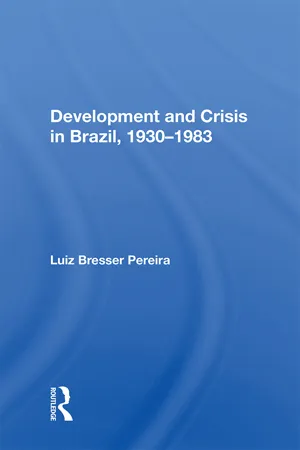
Development and Crisis in Brazil, 1930-1983
About this book
In this first English-language edition of a book that has seen thirteen printings in Brazil, Dr. Bresser Pereira analyzes Brazil's economy and politics from 1930, when the Brazilian industrial revolution began, up to July 1983. First addressing the period of strong development in Brazil between 1930 and 1961, he discusses at length the import-substitution model of industrialization; the emergence of new classes—industrialists, industrial workers, and especially the new technobureaucratic middle classes; the conflict between the traditional agrarian ideologies of coffee planters and the nationalistic and industrializing ideologies of the new classes; and the new realities of the 1950s that led to the crisis of the populist alliance between the industrial bourgeoisie and the workers. Next he explores the economic and political crisis of the sixties, centering on the Revolution of 1964, when an industrialized and fully capitalist— but still underdeveloped—Brazil experienced the cyclical movements of capitalism. The final chapters of the book examine the Brazilian "miracle" of 1967-1973, the economic slowdown of the 1970s that culminated in the severe recession of 1981, the dialectics between the process of abertura led by the military regime established in 1964 and the redemocratization process demanded by civil society, and the "total crisis of 1983."
Information
1
The Concept of Development
Introduction
Development is a process of economic, political, and social transformation through which the rise in the population's standard of living tends to become automatic and autonomous. It is a total social process in which the economic, political, and social structures of a country undergo continual and profound transformations. It makes no sense to speak of development as only economic, only political, or only social; this type of compartmentalized, segmented development does not really exist except for the purposes of didactic exposition. If economic development does not bring political and social modifications with it, if social and political development are not simultaneously the result and the cause of economic transformations, then in fact they are not development. The changes observed in one of these sectors will have been so superficial, so shallow, that they will leave no lasting traces.
A social system is made up of economic relations as much as social and political ones. And, as the expression "system" itself suggests, these relations are interdependent in such a way that when some relations undergo alterations, the others will necessarily be influenced. In this book the term development will always refer to a determinate social system that will be geographically localized. It will always, however, be a social system, and therefore its parts will be interdependent. When real modifications are made in the economic structure there will be repercussions in the political and social structure and vice versa. If the repercussions are small, if the increase in income, for example, is not accompanied by political and social transformations, this increase is not significant for development and should not be considered as such.
Development, therefore, is a total transformation. Perhaps its most important result, or at least the most direct, is the improvement of the standard of living. This is why the expression "economic development" is generally used as a synonym for "development." In the development process the economic aspect is preponderant. But in specific moments the political sector can become the dynamic focus of development, as has occurred, paradoxically, in the communist countries. These phenomena, however, always appear as exceptions. The general rule is that the dominant characteristic of development is the process of economic transformation, and the major result is an improvement in the standard of living of the people in the place where it has occurred.
The use of the term "standard of living" rather than "per capita income" is intentional. It is a universally accepted objective in modern societies to seek to improve the standard of living, to increase the general welfare. It thus becomes very significant to identify development with raising the standard of living. On the other hand, although per capita income is one indicator for determining the standard of living, it is a very deficient one. Many times an increase in per capita income does not improve the standard of living of the population in general because it is absorbed by a minimal, privileged sector. Being unlikely to stimulate political and social transformations, such growth in income must be regarded as uncertain and unstable, and certainly cannot be called economic development.
In order for a real development to occur, the improvement in the standard of living must move toward becoming automatic, autonomous, and necessary. It becomes automatic in the sense that the process of economic development becomes self-generating. When, for example, a country attains the stage of commercial capitalism, reinvestment stimulated by profit becomes the rule and development becomes automatic. When a more advanced industrial capitalist stage is reached, development tends to become not only automatic but necessary, meaning that continued reinvestment and the growth of businesses become the conditions of their survival. The tendency toward autonomy in the growth of income, which generally characterizes economic development, is due to the fact that, once initiated, development not only tends to be self-generating in the necessary form but also tends to find the necessary dynamic factors within itself, particularly in its domestic market.
This concept of development ought not to be confused with that of W. W. Rostow. He is correct in pointing out that development is an historical process, that it occurs through stages, and that it eventually becomes self-sustaining. However, as the sixth chapter of this book will explain, the self-sustaining character of development must be recognized to have several limitations. It does not occur in a deterministic manner, taking place automatically, without reference to human will, after a country has its industrial revolution.
Nor do I accept Rostow's concept of linear development, according to which all countries pass through approximately the same stages. Development and underdevelopment as they exist today are interdependent phenomena. When the countries that are today developed had their Industrial Revolution in the past century, the underdeveloped countries were put into a situation of economic dependence in a development model based on the exportation of primary products. The import-substitution process that has occurred in this century has very different characteristics from the Industrial Revolution of the industrialized countries. This book will thus be analyzing an original process of industrialization that does not simply repeat the experience of the large, industrial European countries and the United States.
Using this restricted definition, according to which societal transformations must be simultaneously economic, political, and social, resulting most directly in an increase in the standard of living that becomes automatic, autonomous, and necessary, that is, self-generating, one can define the concept of development historically. All these conditions come together only when, in a specific country or region, the relations and techniques of production have acquired a dominantly capitalist or socialist mark; when the government of society, the administration of production, and the social conventions themselves have been guided by and embody the spirit of rationalism; and, finally, when the basic social wealth is no longer land, as it is in traditional economic systems, or even commodities, as in commercial capitalism, but rather capital invested in buildings and equipment geared to production, as in industrial socialism and capitalism.
In these terms one cannot speak of the development of ancient Greece or the Egypt of the pharaohs. In the same way, the Brazil of the gold or sugarcane eras cannot be referred to in terms of development. There were increases in wealth, but as a rule they benefited only an elite. The accompanying social and political changes did not have major importance, since they did not achieve a change in the social structure or the power system of these regions, and these gains in wealth were not automatic, autonomous, and necessary. Therefore, there was no development in the modern sense of the word, the sense in which it is being used in this book.
Generally speaking, a country's development is marked by a clearly defined beginning. As a historically defined process, development appears only when the economic system in which it occurs becomes dominantly capitalist or socialist. However, in a still essentially traditional society, a growth can occur that provides the basis for development. This is what occurred in Brazil from the middle of the nineteenth century until 1930. Yet real development begins only when the traditional society enters into crisis: when rational criteria begin to replace the traditional ones; when capital begins to have more importance than land; when competence begins to take the place of blood relationships; when law imposes itself on custom; when impersonal and bureaucratic relations begin to replace personal and patrimonial characteristics. Development starts when the dual system of gentlemen and servants begins to give way to a pluralistic society, and when political power ceases to be the privilege of a clearly defined oligarchy and becomes continually more diffuse. Development begins when the economy of a traditional agricultural base starts to give way to a modern and industrial economy; when the basic unit of production is no longer the family but the enterprise, and no longer even the family enterprise but rather the bureaucratic enterprise; when traditional labor methods give way to rational ones, and productivity and efficiency become basic objectives of the productive unit; when economic development becomes the objective of the society; when reinvestment becomes a condition of survival for the enterprise; and finally, when the standard of living begins to improve in an automatic, autonomous, and necessary manner.
In order for this transformation to begin and for economic development to take place in a society, a political revolution is not absolutely necessary, although in the majority of cases that is what has occurred. It is essential, however, that the traditionally dominant class—generally an aristocratic oligarchy—be replaced in the political control of the society by a middleclass group. This substitution will be much more rapid, and will be completed much more radically, if there is a political revolution. Cromwell's revolution in England and the Brazilian Revolution of 1930 were much less radical socially and ideologically than the French Revolution or the Russian Revolution of 1917. Consequently, in the former countries the rise to power of the middle-class groups and the loss of power by the aristocracy were more gradual than in those countries where a complete takeover by force occurred, as, especially, in the case of the Russian Revolution. As an exception, political power may be seized by a faction of the aristocracy rather than a middle-class group, as occurred in Japan.
In the great majority of cases, however, development begins at the moment when political power rests predominantly or exclusively in the hands of a recognized middle-class group, whether bourgeois businessmen, nationalist politicians or military men, or communist politicians or military men. All the industrial countries of the capitalist world fall within the first case, except for the countries that are still in the first stage of development, such as Brazil. In the second group are countries such as India, Egypt, and Mexico. The communist countries constitute the third case. In those countries where development is initiated by nationalist politicians and the military, the economic system tends to be indefinite for a certain period. Private ownership of the means of production is allowed, but the socialized sector of the economy is large. After a certain time, however, the tendencies of the economic system in question begin to align themselves in a predominantly capitalist form, as in Mexico, or a predominantly socialist form, as is occurring in India and Egypt.
When a middle-class group takes power and becomes the dominant class, this takeover (together with a series of other economic factors that will be discussed later) signals the beginning of the development process. This is the phase of the country's history that some have called an industrial revolution, in order to point out the basic identification of development with the process of industrialization. Others call it a national revolution, especially when it occurs in a colonial or semicolonial country, which needs both industrialization and nationalism to weaken its traditional oligarchy and to disengage itself from the system of the imperialist powers in order to begin development. W. W. Rostow has called it the takeoff, to emphasize the break with the chronic stagnation that characterizes traditional societies.
The National Revolution
The year 1930 marks the beginning of the Brazilian National Revolution. Until then Brazil was a typically semicolonial country. With the industrialization that began at that point, it started on the path to development. For a series of reasons, among which those of an economic order are salient, Brazil's history took a decisive turn. An acceleration of change took place. After many years of continuous and uniform progression, events occurred with such impact that history took one of those typical leaps in a new direction. All areas of the nation's life were affected: the economic, the cultural, the social, and the political. The entire nation underwent a profound change marked by a violent crisis over a decrease in the coffee market and, therefore, in all foreign trade. Old structures, ancient prejudices, rigid class structures, and deep-rooted privileges could be seen to be crumbling.
In the economic sphere the transformations are notable. In the first place there was the rapid appearance of a domestic market. One basic characteristic of a semicolonial economy is a limited domestic market; the great majority of the population, working in the country, is outside the national market, producing for its own consumption, living in miserable conditions in circumstances that make it impossible for a strong domestic market to appear. The change in this situation in Brazil, which received an initial impetus from the installation of coffee cultivation and the abolition of slavery, became more widespread only after 1930. Second, there was a rapid modification in the structure of the foreign market, especially in terms of imports. As a semicolonial country Brazil exported primary products in exchange for manufactured products. The industrial boom that took place after 1930 allowed the rapid development of substitutions for these imports. Thus, today Brazil imports virtually no important manufactured consumer products; they are produced nationally. Concomitantly, the dependence of the economy, and therefore of the national income, on exports has diminished drastically. The basic objective has become not to produce more for export (at extremely low prices in relation to imports) but to produce more for internal consumption.
Developmental transformations are always interdependent; another factor in Brazil's economic transformation was industrial development, which today involves heavy industry and equipment manufacture. Rapid industrialization was actually the dominant cause of the changes during this period, and the domestic market was the fundamental result. Finally, there was both an extraordinary growth and a redistribution of national income. Brazil ceased to be basically an agricultural country. In addition to agriculture and trade, two new sectors began to show an important growth: industry and the state.
The social scene offers another basic transformation to be analyzed. A colonial society is characterized by the simplicity of its social structure, with a primary division of labor. After 1930 the diversification of Brazilian society received a new and decisive impetus. Previously the social structure had represented only two basic classes: the rulers, landed gentlemen intimately involved in the high-level commercial exportation of coffee and importation of manufactured products, and the ruled, an enormous rural subproletariat living in extreme misery. Between the small ruling class, totally alienated by the foreign interests on which they depended, and the immense ruled class, a small middle class could be found living in the cities—a parasitical middle class supported fundamentally in the public employ, in a system where the government functioned as the agent of employment and policing, at the orders of the dominant oligarchy. This was the structure of Brazilian society under the old Republic, a situation whose disappearance some incorrigible wishful thinkers still lament.
After 1930 two new classes began to be clearly discernible: the industrial bourgeoisie and the urban proletariat. These two classes have come to mark national society decisively within recent times. The traditional middle class also expanded rapidly. It still continued in great part to be linked to parasitical public bureaucracy. The state itself, however, dropped its passive attitude as a mere instrument used by the ruling class to maintain the social order, and began to participate actively in national development, eventually becoming the principal element behind development. Thus bureaucracy has for the most part ceased to be parasitical. And the middle class found in industry and in all its related activities an ideal field of work. In the same way that a good proportion of the rural subproletariat rose to the category of rural proletariat, with greatly improved living conditions, a part of the old urban proletariat is already tending to become middle-class or has already achieved this new status. Thus there is a new structure to Brazilian society, and the change is being completed by the fall into decadence—although it still has great power—of the old dominant class, which has begun to fight ever more consciously against the rise of the new classes.
In politics, the transformations have been less notable. Semicolonial Brazil was politically characterized by the dominance of a small oligarchy of landed gentlemen who had in the government and in international capitalism, respectively, their principal instrument and major raison d'être. In this simultaneously feudal and capitalist regime, political power was limited, by definition, to land owners. Those who held it, seeking to present a democratic image, made use of the state not only to maintain the established order but also as their basic political instrument. They accomplished this exercise through a system of "client politics" by which the dominant class purchased the votes of the poor for promises of compensation, generally in the form of public employment. The small number of voters and their total dependence on the dominant class made this bargain easy.
In addition, since they generally produced for export to the direct benefit of international capitalism—which received many advantages and gave little in return (although sufficient for a high standard of living for those few in the oligarchy)—the agrarian-commercial aristocracy could count on the support of international capitalism. In other words, the Brazilian system of production and commerce was of direct interest to the industrialized nations, which got all the advantages of trading manufactured products for primary products, and therefore supported the ruling class that offered them these advantages.
With the Revolution of 1930 the oligarchy lost its power and began to decline. The emerging social classes described above developed rapidly, beginning to participate in government together with the classes that, although essentially defeated in 1930, had hastened to join the new order. What, then, was the underlying characteristic of the governments of Getúlio Vargas, Eurico Gaspar Dutra, Vargas again, and Juscelino Kubitschek? They were basically governments of compromise, in which forces antagonistic to each other, although all favorable toward industrialization in one form or another, shared power. The old oligarchy, although defeated, still continued to retain enormous economic and political force, since open opposition to it would have been very difficult.
After 1930 the characteristics of these various participants became continually more defined. On the one side, struggling for the return of the old regime, were the large estate coffee-growers, and those involved in coffee exportation and international capitalism, supported by the parasitical middle class linked by economic or social (or even family) ties to the old dominant class. On the other side was the government, joining together the opposition classes that sought power to defend their interests: the industrialist class, the proletarian class, and a new middle class. Obviously, it was indeed a government of compromise, of unstable composition. Getúlio Vargas, despite his many errors, was the talented coordinator and at the same time leader of the truly new currents within this government. I shall not make a profound analysis of the Vargas period, but rather focus on the most fundamental characteristics of this government. Vargas was a typical populist leader. Unlike many other populist leaders, however, he was sufficiently capable to accomplish his true mission. He formed a compromise government, knowing how to concede but not losing sight of his objective, as so many facts confirm, including the economic and social results of his regime.
At the end of the Second World War, there arose from these colliding forces within the first Vargas government the large national political parties that the Revolution of 1964 would later extinguish. These were no longer merely all representatives of the same social class, the dominant oligarchy, as had been true before 1930. In 1945, with the return to democratic order, these parties were soon defined, despite their contradictory and hesitant nature. The UDN [National Democratic Union] represented the forces defeated in 1930, as well as the parasitic middle class aligned with them. Its liberal, agrarian, typically reactionary characteristics soon became visible. On the other hand, the PTB [Brazilian Labor Party] and the PSD [Social Democratic Party] stemmed directly from the Vargas base. The first represented its newest and most popular facet, being an amalgam of genuine and government-manipulated union leaders and the new middle class. Despite its innumerable shortcomings the PTB was defined as the party of the moderate left. The PSD, for its part, was representative of widely contrasting and undefined forces in the Vargas government. Because it is possible to find a tendency toward industrialization and planned economic development in the PSD, it can be considered the archtypical hybrid Brazilian political party, the center party.
The observable transformations in the cultural scene were also profound, but they can be summed up by saying that Brazil became aware of itself. Until then Brazil had not known itself. Just as a child refuses to recognize its own nature, the nation had no notion of its own reality. It then began to confront the basic problem of Brazilian culture, the deep colonialist inferiority compl...
Table of contents
- Cover
- Half Title
- Title
- Copyright
- Contents
- List of Tables and Figures
- Foreword
- Introduction
- 1 The Concept of Development
- 2 Import-Substitution Industrialization
- 3 Social Development and the Emergence of New Classes
- 4 Political Development and the Crisis of the Populist Alliance
- 5 The Crisis of the 1960s
- 6 The Viability of Capitalist Development
- 7 The Post-1966 Expansion and the New Model
- 8 The Crisis of the 1970s
- 9 The Dialectic of Redemocratization and Abertura
- 10 Conclusion: Fifty Years of Development and Crisis
- Notes
- Abbreviations
- Bibliography
- Index
Trusted by 375,005 students
Access to over 1.5 million titles for a fair monthly price.
Study more efficiently using our study tools.
Frequently asked questions
Yes, you can cancel anytime from the Subscription tab in your account settings on the Perlego website. Your subscription will stay active until the end of your current billing period. Learn how to cancel your subscription
No, books cannot be downloaded as external files, such as PDFs, for use outside of Perlego. However, you can download books within the Perlego app for offline reading on mobile or tablet. Learn how to download books offline
Perlego offers two plans: Essential and Complete
- Essential is ideal for learners and professionals who enjoy exploring a wide range of subjects. Access the Essential Library with 800,000+ trusted titles and best-sellers across business, personal growth, and the humanities. Includes unlimited reading time and Standard Read Aloud voice.
- Complete: Perfect for advanced learners and researchers needing full, unrestricted access. Unlock 1.5M+ books across hundreds of subjects, including academic and specialized titles. The Complete Plan also includes advanced features like Premium Read Aloud and Research Assistant.
We are an online textbook subscription service, where you can get access to an entire online library for less than the price of a single book per month. With over 1.5 million books across 990+ topics, we’ve got you covered! Learn about our mission
Look out for the read-aloud symbol on your next book to see if you can listen to it. The read-aloud tool reads text aloud for you, highlighting the text as it is being read. You can pause it, speed it up and slow it down. Learn more about Read Aloud
Yes! You can use the Perlego app on both iOS and Android devices to read anytime, anywhere — even offline. Perfect for commutes or when you’re on the go.
Please note we cannot support devices running on iOS 13 and Android 7 or earlier. Learn more about using the app
Please note we cannot support devices running on iOS 13 and Android 7 or earlier. Learn more about using the app
Yes, you can access Development and Crisis in Brazil, 1930-1983 by Luiz Bresser Pereira in PDF and/or ePUB format, as well as other popular books in Politics & International Relations & Politics. We have over 1.5 million books available in our catalogue for you to explore.