There is increasing interest in the area of protective vests, either for protection against bullets or protection from the most realistic threats within domestic frontline operations: edged weapon, knives, and medical needles. This volume addresses that need. This new book provides an in-depth survey of the state-of-the-art research and practical techniques in the area of protected fabrics, especially stab-resistant and bulletproof fabrics.
The book covers: • The history of protective armor: the long history of the art of protective armor manufacturing. • Materials used for body armor: the design and materials used for soft armor to increase its perforation-resistance utilizing high-performance fibers. • Anti-stab and anti-bullet armor design: the different design parameters required for the design of flexible armor in order to stop high-velocity projectiles. • The comfort of the body armor design: the flexibility, thermal resistivity, and evaporative moisture resistivity through the fabric. • Methods of testing the flexible body armors: testing the components of flexible body armor, according to the level of the protection required, such as NIJ Standards, HOSDB Body Armour Standards for UK Police, and the German SK1 Standard, among others.
Written by an expert in textile composite material engineering, this volume fills an important gap in the area of protective fabric against stabbing or bullets and provides invaluable practical knowledge for body armor design.
PART I Historical Background and Developments of Body Armor
Chapter 1
History of Protection Armor
ABSTRACT
The body armor has been invented to protect the wearer from the surrounding environmental hazards such as chemical, fire, UV, radiation, heat or to protect warriors from impact of bullet, sharp fragments or being stabbed by knife or spikes. Through the evolution of the mankind, thousands of types of the body protection were developed for a personal safeguard. In the modern era, there is an increase attention to develop a body armor that ensure the safety, comfort, and light weight by the application of modern high performance fibers. In this chapter, a historical background of the body armor is given with a special emphasize on the contemporary bullet proof and stab resistance armors classifications and their future development.
1.1 Introduction
In the last 7000 years of the history, mankind passed through several periods which may be classified as Classical Era (3600 BC–500 AD), Postclassical Era (500–1500), Early Modern Period (1500–1750), Mid-Modern Period (1750–1914), and Modern Period (1914–2018).1 It can also be chronicled according to the main events; the historian deals generally with the big events which happen and also the decay of the empires in the different parts of the known world. History, as the action of human beings, is always the result of big events, such as wars, natural catastrophes, inventions, discoveries, or social and political changes.
The start of civilization in a certain area was due to the availability of the living resources that permit the gathering of communities and their unification to form a nation with enough numbers that was able to use the resources and also develop an army to defend them, set rules and regulations to arrange their daily activities, and finally, the capability of science and technology to develop and innovate new methods and tools to increase their competencies.
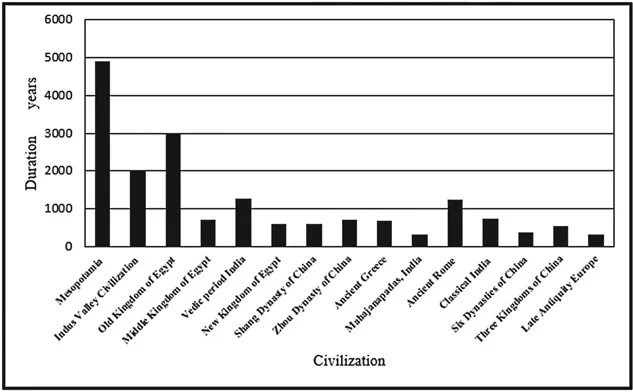
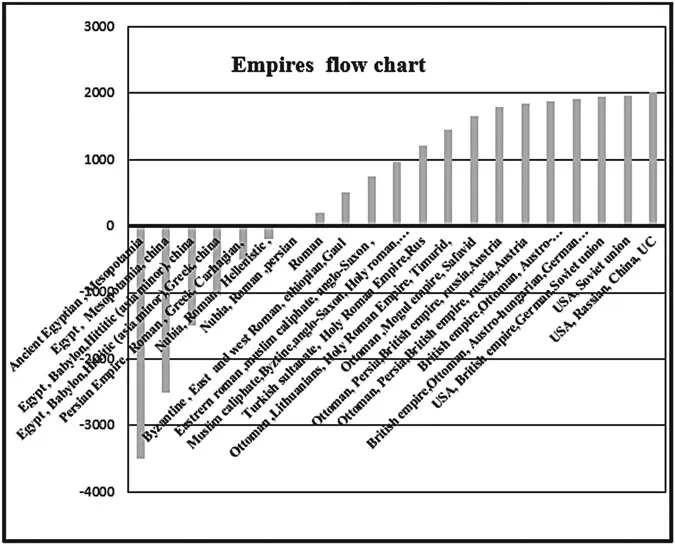
Figure 1.1 illustrates the period ofthe start and decay ofeach civilization. Usually, it depended on several factors either geographical, wars, natural disasters, or the internal troubles and division of their under-controlled states and finally most important, the rise of another civilization that starts to compete and try to conquer. The civilizations in North Africa, Mediterranean, and north Asia started to grow, flourish, and decade due to several reasons. The most important one was the collision between the existing civilizations and the growing new civilizations that conquered through the application of new weapons, war strategy, or allies.2Figure 1.2 illustrates different empires and their existing period. It is interesting to notice that in each period, several empires can exist and because of that, they fought with each other, leading to the disappearance of one and strengthening of the other. This happened to the Mesopotamian, Egyptian, Babylonian, Persian, and even the Roman empires. Generally, the development of an empire is about a central state, extending political control over territory and people as much as it can by military, economic, or cultural means.3
FIGURE 1.1 The duration of the different ancient civilizations (6000 BC–600 AD).
FIGURE 1.2 The main empires in the Middle East, Europe, and North America through different ages.
History tells that the humans are in a constant fight and all the time there is an increased demand for more advanced weapons and protective armors.
1.2 The Body Armor History and Evolution
Defense budget report found that the outlays on weapons and equipment rose in FY 2017 to a global total of $1.57 trillion. The United States is still the biggest global spender.4,5 The military expenditure as a share of GDP of the different countries varies between 1% and 13.7%.6
The armor history and advancement are accomplished with the development of weapons that have been continuously progressive over the history of humanity. Over the centuries, different cultures developed body armor to use during battle.7 Egyptian, Mesopotamian, Persians, and Greeks used multilayer fabric or leather. Several hundred millions of dollars are yearly spent on the development of weapons. The progress in the types of weapons has been going in parallel with the achievements of science and technology. The shape and effectiveness of the weapons were resultant of the degree of threat, starting from the spears invented in 40,000 BC and developed through the different periods of the human civilizations.7 It can be looked back at 25,000 BC, flexible dart was invented; at 23,000 BC, boomerang; at 20,000 BC, bows and arrows; at 5300 BC, projectile weapons; at 5000 BC, first metal daggers and swords; at 500 BC, siege weapon, the ballista (a kind of scaled-up crossbow); in between 800 and 1300 AD, gunpowder, fire arrow, and primitive bombs; in between 1200 and 1600, large swords, hand cannons, fire arms; in between 1368 and 1750, firearms technology moved forward; in between 1750 and 1800, rockets became a permanent fixture and submarines were used in battles; in between 1800 and 1850, shrapnel shells, revolving gun; in between 1850 and 1900, first machine guns, military submarine, fully automatic machine gun, and first bulletproof vest was invented; in between 1900 and 1950, gun silencer, first tan...
Table of contents
Cover
Half Title
Title Page
Copyright Page
Dedication
About the Author
Table of Contents
Abbreviations
Preface
Introduction
Acknowledgements
PART I: Historical Background and Developments of Body Armor
PART II: Textile Materials for Flexible Protective Armor
PART III: Protective Armor Design Aspects
PART IV: Protective Armor Testing Methods: Fibers, Yarns, Fabrics, and Protective Vests
Appendix I: Testing Standards For Fibers, Yarns, And Protective Fabrics
Appendix II: Additional Test Procedures for Bulletproof Vests
Index
Trusted by 375,005 students
Access to over 1.5 million titles for a fair monthly price.
Study more efficiently using our study tools.
Frequently asked questions
Yes, you can cancel anytime from the Subscription tab in your account settings on the Perlego website. Your subscription will stay active until the end of your current billing period. Learn how to cancel your subscription
No, books cannot be downloaded as external files, such as PDFs, for use outside of Perlego. However, you can download books within the Perlego app for offline reading on mobile or tablet. Learn how to download books offline
We are an online textbook subscription service, where you can get access to an entire online library for less than the price of a single book per month. With over 1.5 million books across 990+ topics, we’ve got you covered! Learn about our mission
Look out for the read-aloud symbol on your next book to see if you can listen to it. The read-aloud tool reads text aloud for you, highlighting the text as it is being read. You can pause it, speed it up and slow it down. Learn more about Read Aloud
Yes! You can use the Perlego app on both iOS and Android devices to read anytime, anywhere — even offline. Perfect for commutes or when you’re on the go. Please note we cannot support devices running on iOS 13 and Android 7 or earlier. Learn more about using the app
Yes, you can access Protective Armor Engineering Design by Magdi El Messiry in PDF and/or ePUB format, as well as other popular books in Design & Fashion Design. We have over 1.5 million books available in our catalogue for you to explore.