- 464 pages
- English
- ePUB (mobile friendly)
- Available on iOS & Android
eBook - ePub
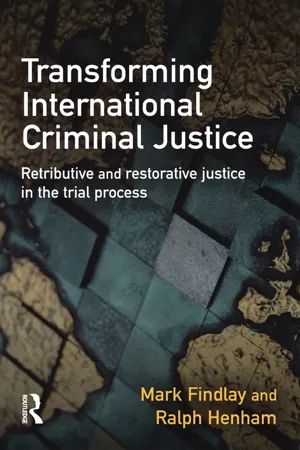
Transforming International Criminal Justice
About this book
This book sets out an agenda to transform international criminal trials and the delivery of international criminal justice to victim communities through collaboration of currently competing paradigms. It reflects a transformation of thinking about the comparative analysis of the trial process, and seeks to advance the boundaries of international criminal justice through wider access and inclusivity in an environment of rights protection.Collaborative justice is advanced as providing the future context of international criminal trials. The book's radical dimension is its argument for the harmonization of restorative and retributive justice within the international criminal trial. The focus is initially on the trial process, a key symbol of developing international styles of justice. It examines theoretical models and political applications of criminal justice through detailed empirical analysis, in order to explore the underlying relationship of theory and empirical study, applying the outcome in theory testing and policy evaluation in several different jurisdictions. The book injects a significant comparative dimension into the study of international criminal justice.This is achieved through searching the traditional foundations of internationalism in justice by employing an original methodology to enable a multi-dimensional exploration of contexts (local, regional and global), so recognising the importance of difference within an agenda suggesting synthesis.The book argues for a concept of international trial within a 'rights paradigm', understood against different procedural traditions and practices, and provides a detailed description of trials and trial decision-making in various jurisdictions. Transforming International Criminal Justice also sets out to develop effective research strategies as part of its interrogation of specific trial narratives and meanings in contemporary legal cultures. Key themes are those of internationalisation, fair trial and the exercise of discretion in justice resolutions (sentencing in particular), and the lay/professional relationship and its dynamics. Finally, the book provides a searching critique of the relevance of existing criminology and legal sociology in relation to international criminal justice, and speculates on trial transformation and the merger of retributive and restorative international criminal justice. comparative analysis of the criminal trial process internationallyargues for harmonization of retributive and restorative justice within the international criminal trialsets out an agenda to transform international criminal trials and the delivery of international criminal justice to victim communities
Information
Chapter 1
Theorizing the contextual analysis of trial process
Introduction
The main purpose of this chapter is to provide a comprehensive account of the theoretical position adopted by the authors in the comparative contextual analysis (CCA)1 of trial process. The development of CCA is driven by the need to provide a theoretically informed methodology capable of addressing two interconnected purposes:
1 To examine the manner in which civil law and common law process styles are influencing the operation and development of international criminal trials
2 To understand how the essentials of criminal trial process and practices in chosen jurisdictions (national and international) are constructed, negotiated and relate to one another.
More particularly, the achievement of these aspirations necessarily requires reflection on the most appropriate theoretical framework to inform the comparative endeavour and creative methodologies for dealing with jurisdictional idiosyncrasies and transitional processes which challenge comparison at a variety of levels.2
This chapter concentrates on describing the theoretical underpinning to the project and of CCA more broadly. The theoretical base is designed to support both inductive and deductive methodologies whilst maintaining critical awareness of the comparative challenge. The flexibility of our theoretical position is ultimately driven by the desire to achieve particular policy outcomes through appropriate methodological devices. These include the capacity to prefer particular trial practices for the achievement of international criminal justice (ICJ). We, therefore, anticipate that through the adoption of such methodologies will emerge (and be confirmed) certain theoretical insights into:
• the place of the trial within criminal justice;
• the essential mechanisms of decision-making within the trial;
• key procedural components within the trial which accord with (or challenge) ideologies of criminal justice;
• common issues and relationships across levels of trial analysis; and
• motivations behind the form of international criminal trial process and hence ICJ.
It is axiomatic that research such as this cannot advance unless (or until) it is informed by theory, and the proof of empirical research implies the need to approach the observation of trial phenomena with some theoretical predisposition. For example, in the context of analytical induction, the essential place of discretion in the operation of trial traditions, and its ability to generate a procedural environment within which internationalization may be achieved conventionally, provides a method for theorizing the language of decision-making. In this sense the trial is theorized as a series of decisions, the relationships which produce these decisions and their contexts. Yet, whether theory motivates a language for research (such as discretion), or whether the research data build a language to inform theory, the analysis of trial practice will enable a more theoretically balanced analysis of policy goals as an applied purpose for the theoretical exercise. In the present case it is to reveal what comprises ICJ in the sense of a trial, and what alternative processes of resolution might offer.
We now propose to illustrate how (and on what basis) we have developed elements of social theory in the criminal justice context to accommodate and underpin the CCA of criminal trials.
Levels of analysis
Comparative analysis of the criminal trial process raises significant theoretical difficulties. These involve recognition that, in developing any theoretical foundations we are governed by the following:
1 Significance of context3 – the need to understand the interaction between legal and social processes in the trial setting.4 These may be ideologically driven.
2 The requirement to disentangle competing interests and relationships that comprise the trial environment and produce its essential decisions – in this the theoretical context must be capable of identifying and accommodating the rival agendas of respective trial participants in order that the ideological significance of the trial as a social process can be contextualized.
3 The continual presence of symbolic as well as process concerns – here the theoretical accommodation must also extend beyond symbolism to conceptualize power and locate symbolic elements in the trial process as significant in the recursive practices of decision-making in the courtroom.
4 The difficulty of drawing out from the description of processes and the narrative of players interpretations of social action and actual behaviour – in this sense, the theoretical framework, whilst not being prescriptive of narrative and descriptive interpretations, must both facilitate their understanding as representing recursively organized processes and provide a conceptualization of these processes which will sustain a reliable and valid methodology.
5 The challenge provided by narrative analysis – conceptualizing the trial process as capable of accommodating notions of difference and synthesis within competing procedural traditions.
6 The various levels (and contexts) of comparison – internal and external, not dichotomous.
7 The challenge of specificity versus universality (for the purposes of comparison).
8 Finally, the importance of sites for decision-making and shared practices (relationships) with emphasis on the dynamics of process (human interaction) rather than structure or function.
The theoretical problems and underlying assumptions informing comparative trial research require a cohesive theoretical framework within which both the research methodology and the empirical findings can be located, and the links between them identified. That CCA requires an appreciation of the social reality of historical, social, political and economic variables as impacting on the trial process means it becomes necessary to deconstruct ways in which criminal justice processes are conceptualized and operate in respective jurisdictions. This involves a recognition that, along with any shift in trial context, the normative significance of process may represent different philosophical interpretations of what constitutes epistemologically accepted empirical ‘truths’.
The moral validity of principles about punishment is contextually contingent, as are the symbols and structures which manifest these (Norrie 1996b; Henham 1999a). As a consequence, a theoretical framework for this research should be capable of elucidating both objective and subjective conceptions of process (Henham 2000a). Norrie (1996b) suggests this theorizing should emphasize the dialectic form of justice within different cultures by recognizing that external, or purely historical and structural, accounts of process fail to account for human subjectivity and ambivalence about justice (as a search for common threads both at the level of ideology and process). As our discussion will develop, this holds especially true for emerging representations of ICJ.
Recognizing the moral and cultural relativity of concepts such as ‘justice’ and ‘fairness’ requires a contextual appreciation of the subjectivity of trial participants’ experiences in terms of these measures. Such terms may, nevertheless, be justifiable according to particular ‘objective’ criteria. The deconstruction of participant experience in a trial so contextualized offers a phenomenological account of process and its ideological significance. It also enables us to identify the major dimensions of what might constitute comparable justice referents across jurisdictional boundaries and provides linkage to process. The process representation on which this book will rely is trial decision-making in various comparative contexts and through unique personal relationships.
There must, therefore, be recognition that social theory is generally capable of conceptualizing the sociohistorical context and consequences, but not the human subjectivity, of moral action. This is highly significant in terms of its methodological implications for any analysis of the criminal trial process. Ideally such analysis should be capable of providing mechanisms of ‘description and explanation’ of social phenomena which comprise trial decisions and that reflect internal/external (objective/subjective) experiences of social reality for trial participants, and hence the basis for comparison we have selected.
The methodological capability of research instruments must, therefore, reflect that fact–value distinction5 in the following, where appropriate:
1 Descriptive analysis of information available to the court.
2 How such information is assimilated as an ‘objective’ process.
3 How this both structures and impacts on decision-making processes.6
4 Identification of points where judicial perceptions of case material are shared.
5 Wider contextual exploration of discretionary decision-making in a manner conducive to the comparative endeavour.
At the comparative level of different jurisdictions the research theory and methodology must also reflect the dimensions of cultural diversity, spatial and temporal relativity. It must also be both simultaneously relevant at the one-dimensional (local) and multi-dimensional (global) level of analysis. Notwithstanding, theory and methodology must also be equally sensitive to the distorting effect of simple, false or rigid conceptual dichotomies, while maintaining a reflexive and critical analytical stance.
Contextual analysis, as a precursor to the comparative endeavour, tends to highlight the unique features of each trial and by so doing cautions against viewing the objects of comparison as simple or opposing. For instance, the theoretical approach to the comparative project must acknowledge the cultural significance of the legal and social variables chosen for analysis within particular jurisdictions in terms of the reasons for their selection and their effects. Coincidently, it should also recognize the global forces that provide an international focus for the recognition of certain legal rules that transcend the boundaries of the unitary state.7
Comparison
As suggested earlier, in order to appreciate the trial beyond its localized manifestations, a contextual analysis needs to be comparative at many levels. The identified interest in globalization (Findlay 1999a)8 and the internationalization of criminal procedure suggest several dualities that dominate the CCA to follow. Initially, the comparison will be within context (e.g. the trial as an essential institutional feature of traditions of criminal justice within nominated legal cultures). Concurrently, the comparison of context with context (e.g. locality and globe) will evolve. The latter holds out much for critically appreciating the representations of trial justice, and the interests which promote them. To achieve its fullest potential within the theme of globalization (internationalization), comparative research should, therefore, concentrate:
• within a nominated cultural9 context;
• across two or more contexts within the same culture;
• across time and space within a culture in transition;
• culture to culture; and (not or)
• simultaneously at the local and global levels (Findlay 1999a: vii).
The trial assumes a variety of social functions dependent on context. These may coexist while contradicting or challenging any single understanding of trial justice. With the criminal trial being culturally relative, it has the potential within any particular culture to represent criminal justice. The popular knowledge of justice (both local and global) anticipates and endorses this. However, the trial’s existence and representation at a global level may argue for the unity and generalization of justice.
Recently, Findlay (1999a) argued the virtues of CCA when examining the relationship between crime and globalization. This means an interactive project where context is employed over community or culture, to enable comparative analysis without sacrificing specificity. Context is seen as an actual place. CCA provides the potential to reconcile ‘an acute sensitivity to the peculiarities of the local’, with ‘the universalizing imperative’. The novelty in this approach to comparative analysis is not the rediscovery of context. Rather it is in the multilevelled applications which context invites. Nelken identifies the need to ensure, when analysing any feature of criminal justice, that it ‘resonates’ with the rest of the culture in context before a comparison is advanced.
Cultural ideals and values of criminal justice do not necessarily reflect their wider diffusion in the culture. In many societies there is a wide gulf between legal and general culture, as where the criminal law purports to maintain principles of impersonal equality before the law in societies where clientilistic and other particular practices are widespread (Nelken 1997b: 563; also Findlay 1997a).
The recognition of difference is crucial to the success of CCA and not just for the purpose of sounding simplistically preferential. There potential is therefore through comparison, to understand the complexity of culture and not only seek explanations for features of culture, such as crime and justice. Comparative investigation turns into the hermeneutic exercise of trying to use evidence about crime and its control to resolve puzzles about culture (Nelken 1994: 225).
An enlivening, if underdeveloped, capacity of comparative analysis is to move away from ‘cause and effect’ as a narrow frame of analytical reference. When examining institutions and strategies of crime control, a causal focus tends both to distort the place and purpose of criminal justice, and the motivations for the analytical project. CCA recognizes the possibility of simultaneously viewing crime and control from several dimensions. This emphasis on interaction and transition avoids simplistic assumptions about criminal justice, and the unfounded construction of policy. It should also prevent the abstraction of effective social control mechanisms from their essential contextual supports, to the extent where an appreciation of the impact of context over control is lost.
Research into trial traditions as a focus for comparative legal/cultural analysis has regularly suffered from what David Nelken refers to as ‘comparison by juxtaposition’ (1997b). This may be explained through answers to Nelken’s question about what the comparison is supposed to be achieving. Rather than the style of analysis, it might be ‘the disguised hegemonic project and the avowed search for global legal concepts’ (Zedner 1995: 519), which is laid open to criticism. The inclusion of comparative analysis amongst the characteristics of intellectual and admi...
Table of contents
- Cover
- Half Title
- Title Page
- Copyright Page
- Table of Contents
- List of figures and tables
- Table of cases
- Table of legislation
- Introduction
- PART I
- PART II
- PART III
- References
- Index
Trusted by 375,005 students
Access to over 1.5 million titles for a fair monthly price.
Study more efficiently using our study tools.
Frequently asked questions
Yes, you can cancel anytime from the Subscription tab in your account settings on the Perlego website. Your subscription will stay active until the end of your current billing period. Learn how to cancel your subscription
No, books cannot be downloaded as external files, such as PDFs, for use outside of Perlego. However, you can download books within the Perlego app for offline reading on mobile or tablet. Learn how to download books offline
Perlego offers two plans: Essential and Complete
- Essential is ideal for learners and professionals who enjoy exploring a wide range of subjects. Access the Essential Library with 800,000+ trusted titles and best-sellers across business, personal growth, and the humanities. Includes unlimited reading time and Standard Read Aloud voice.
- Complete: Perfect for advanced learners and researchers needing full, unrestricted access. Unlock 1.5M+ books across hundreds of subjects, including academic and specialized titles. The Complete Plan also includes advanced features like Premium Read Aloud and Research Assistant.
We are an online textbook subscription service, where you can get access to an entire online library for less than the price of a single book per month. With over 1.5 million books across 990+ topics, we’ve got you covered! Learn about our mission
Look out for the read-aloud symbol on your next book to see if you can listen to it. The read-aloud tool reads text aloud for you, highlighting the text as it is being read. You can pause it, speed it up and slow it down. Learn more about Read Aloud
Yes! You can use the Perlego app on both iOS and Android devices to read anytime, anywhere — even offline. Perfect for commutes or when you’re on the go.
Please note we cannot support devices running on iOS 13 and Android 7 or earlier. Learn more about using the app
Please note we cannot support devices running on iOS 13 and Android 7 or earlier. Learn more about using the app
Yes, you can access Transforming International Criminal Justice by Mark Findlay,Ralph Henham,Mark J. Findlay in PDF and/or ePUB format, as well as other popular books in Social Sciences & Criminology. We have over 1.5 million books available in our catalogue for you to explore.