- 152 pages
- English
- ePUB (mobile friendly)
- Available on iOS & Android
eBook - ePub
About this book
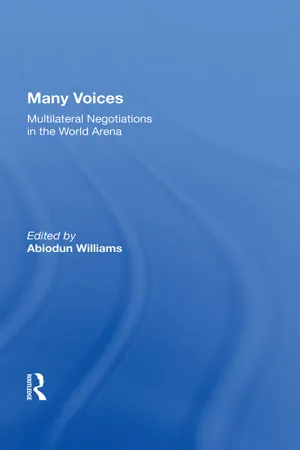
International negotiations increasingly involve a myriad of state and nonstate actors who approach major issues from a variety of standpoints and work to determine outcomes acceptable to all. Great powers, military allies, business and industry, LDCs, international organizations, and even domestic politics enter into negotiations on complex issues-ranging from defense and national security to environmental protection and Third World development-that now dominate the global agenda. Abiodun Williams has assembled a collection of case studies that illustrate the variety and dynamism of this complex decisionmaking process. Cases including conflict resolution in Indochina and mining in Antarctica show students the role of contending national objectives, necessary trade-offs, and efforts at coalition building, as well as the influence of personality and persuasion on the outcomes of major negotiations. A case exploring the investment activities of transnational corporations and their impact on developing countries is organized as a simulation exercise that offers students rare insight into negotiations under UN auspices and the impact of regional bloc politics on multilateral diplomacy.
Information
1
Introduction
Interest in the study of diplomacy and negotiation is not a new phenomenon. Since the early eighteenth century, when François de Callieres published his classic, On the Manner of Negotiating with Princes, much ink has been spilt on the subject.1 A recently published bibliography on negotiations is an ample volume of 417 pages.2 The study of negotiation continues to be a growth industry, as scholars and practitioners of all stripes attempt to make sense-some with more success than others-of its complex and often opaque nature. Our understanding of the subject has been greatly enhanced by the literature that has been published during the past three decades. Although many of the contributions have come from political scientists, they by no means have cornered the market. Economists, sociologists, psychologists, historians, and lawyers have illuminated this territory, and political scientists themselves have often drawn on the insights of other disciplines.
Contending Approaches
There are a number of contending analytical approaches to negotiation. Influenced by the tradition of economics, some students of negotiation view it in terms of a “game,” with its own set of “players” and “rules.” A deductive method of analysis is usually employed, with a strong emphasis on bargaining strategies utilized by rational individuals.3 Many other studies focus on giving advice on how to negotiate successfully. In contrast to game theorists, authors of these practical guides favor the inductive method, and a wide array of case studies inform their analyses. Underlying the didactic approach is the belief that negotiation can be taught through the mastery of certain methods and principles. Advocates of that approach reject the view that the tricks of the trade can only be learned by a process of professional osmosis. Whether negotiation is viewed as a “zero-sum game” or as a “win-win” enterprise, the advice proferred runs the gamut from how to prepare for negotiations to strategies to be used during the process and pitfalls to be avoided.4 A third sociopsychological approach focuses on the character of individual negotiators and the impact of their personalities, worldviews, and philosophies on the conduct of negotiations.5 A closely related method of analysis, but much broader in scope, can be characterized as the cultural-national perspective. The emphasis here is on, not individual attributes or traits, but the influence of culture and national background on different negotiating styles.6
Although there has been a plethora of studies on negotiation generally, and on bilateral negotiations in particular, relatively few have concentrated on multilateral negotiation. This, to some degree, is a reflection of the difficulty involved in having to take into account the many relevant variables that affect the nature, process, and outcome of multilateral negotiations. Although it is generally recognized that there are differences between bilateral and multilateral negotiation, multilateral negotiation is often regarded as merely an enlarged version of what occurs bilaterally. Its distinctive elements and the skills required for success have seldom been articulated. The search continues for the important but elusive comprehensive analytical framework that can be used to further our understanding of this cardinal component of modern international relations.
In attempting a typology of multilateral negotiations, one is immediately confronted with definitional problems. It is customary to define a multilateral negotiation as a negotiation involving more than two participants. Definitions in this context are not necessarily right or wrong, but some are more useful than others. This definition, which is both minimalist and maximalist, is not particularly helpful, as it obscures the fact that there can be significant differences, for example, between a negotiation having five participants and one with fifty. Midgaard and Underdal distinguish three kinds of multilateral negotiations on the basis of the number of participants. Small multilateral negotiations they define as having fewer than seven parties, intermediate ones have between seven and twenty, and large multilateral negotiations have over twenty.7 This classification is not particularly helpful either because the smallest multilateral negotiations today often have around twenty parties. It is useful to consider small multilateral negotiations as having up to twenty parties, medium-sized ones as having between twenty and sixty, and large ones as those with over sixty participants.8
Actors
Since the Treaty of Westphalia in 1648 laid the foundation of the modern international system, sovereign states have been the primary actors in the international system. Traditionally, the actors who have participated in multilateral negotiations have been states and their governmental representatives. One of the most significant developments since the end of World War Π is the dramatic increase in the number of independent states. In 1945, when the United Nations was founded, the organization had only 51 members, but nearly 180 states have joined the world body. This quantitative change in the nature of the international system has had a profound impact on world politics and, in particular, has led to greater complexity in the conduct of multilateral negotiations. Although the sovereign equality of states is a fundamental principle of the international system, there are vast disparities between different states in terms of their military strength, economic resources, and diplomatic leverage. Similar or unequal capabilities between states may result in symmetrical or asymmetrical negotiations.
Although states are still the primary participants in multilateral negotiations, an increasing number of nonstate actors, such as international organizations (e.g., the United Nations-UN), regional organizations (e.g., the European Economic Community—EEC), nongovernmental organizations (e.g., the International Olympic Committee), and multinational corporations (MNCs; e.g., IBM), are now involved in multilateral negotiations.9 The number of nonstate actors has grown as substantially as that of states in the post-World War Π period. For example, in 1940 there were about 500 nongovernmental organizations, but by the end of the 1980s this number had increased to over 4,000. Some nonstate actors, such as multinational corporations, have not only mushroomed numerically but have increased the scope of their influence in the global economy as well.
Many contemporary multilateral negotiations are conducted under the auspices of an international organization, especially the United Nations. The United Nations has sponsored negotiations dealing with a vast array of security, economic, environmental, and social issues. The General Assembly, the only organ in which all member states are represented, has played a crucial role in negotiating different multilateral treaties, such as the Law of the Sea Treaty and the Genocide Convention, which prohibits acts aimed at eliminating a national, ethnic, racial, or religious group. The choice of a forum in which negotiations take place is a crucial one that can send certain signals to the parties, affect the outcome, and set a precedent for the future. The genesis of the first United Nations Conference on Trade and Development (UNCTAD), which was held in 1964, can be traced to the fact that less developed countries (LDCs) were disenchanted with certain international economic institutions, especially the General Agreement on Tariffs and Trade (GATT), which they felt were not adequately addressing their developmental concerns. They favored a separate forum under the aegis of the United Nations, which they felt would be a more hospitable environment in which to discuss matters of trade and development.
Issues
Multilateral negotiations have historically dealt with what were considered to be issues of “high politics,” peace, and security. The Congress of Vienna in 1815, the first modern multilateral conference, was convoked in order to lay the foundations of a new European order in the wake of the ravages of the Napoleonic wars. Republics were absorbed, several monarchies were reinstated, and a nineteenth-century equivalent of the Holy Roman Empire was created. Subsequent multilateral conferences in the nineteenth century, such as the Berlin Congress of 1884-1885, in which the African continent was divided among the major European powers, continued this tradition. Nowadays, however, multilateral negotiations cover a broad range of issues: security, economics, trade and finance, environment, natural resources, human rights, science and technology. This reflects the growing complexity of world affairs and the concomitant increase in the number of issues on the international diplomatic agenda. Human rights, social issues, and problems with global resource management are becoming as important as, if not more important than, concerns with war and peace.
The Role of Coalitions
A distinguishing feature of multilateral negotiations is the frequent formation of blocs, groups, or coalitions among the various participants, which later may become permanent or institutionalized.10 Many of these blocs are deliberate creations of their members on the basis of shared characteristics or common interests. There are regional alliances, whose organizing principle is geography, such as the traditional regional groups in the United Nations: the African Group, the Asian Group, the Latin American Group, and the Western European and Others Group; political coalitions (e.g., the Arab League, Commonwealth, Nonaligned); blocs based on intergovernmental economic treaties (e.g., Benelux, Organization for Economic Cooperation and Development [OECD], and African, Caribbean, and Pacific countries associated with the European Community [ACP]); and groups that share other attributes such as a similar level of economic development (e.g., the Group of 77).
In many North-South negotiations, blocs play an important role in the process. In UNCTAD, the Group of 77 (now composed of some 120 countries) represents the developing countries; Group B is made up of the industrialized countries that are members of the OECD; and Group D is composed of the former Socialist countries of Eastern Europe, but the latter have played a limited role in UNCTAD negotiations. Although these groups endeavor to present a united front during negotiations, they are not monolithic entities. The members of the Group of 77 (G-77) include oil-producing countries such as Nigeria and Venezuela, newly industrializing countries such as South Korea and Brazil, and much poorer states such as Chad. Differences in economic systems and levels of economic performance also exist among members of Group B, although not to the same degree as in the Group of 77.
Before and during negotiations, groups sometimes form spontaneously to deal with particular problems or in response to a crisis. The Coastal States Group, composed of about seventy-six coastal countries, was established a year before the start of the Third United Nations Conference on the Law of the Sea (1973-1982) to secure extended coastal-state jurisdiction, especially with regard to the exclusive economic zone. During the concluding period of the eleventh session of the conference, the Group of 12, which earned the sobriquet the “Good Samaritans,” was formed in order to fashion a consensus text and to prevent a divisive vote.11
As Johan Kaufmann demonstrated, groups perform a multiplicity of functions. They exchange information on all or part of the agenda of a conference either in advance or during the negotiations; develop common general positions on key agenda items without committing themselves to voting in a particular way, develop unified positions on some agenda items with definite voting commitments; agree on common candidates from the group or on supporting candidates from other groups; select a common spokesperson and reach agreement on the statement to be delivered; and take joint action in favor of or against a proposal.12 But coalitions are a mixed blessing. They can make the negotiating environment less complex and enhance the efficient conduct of negotiations. However, there is always the possibility of an attack of “coalitionitis,” as blocs may become rigid and inflexible, stumbling blocks to success. Negotiating blocs are not necessarily more amenable to reason and moderation than individual states. In order not to become hostage to the negative tendencies of coalitions, the Commission on Transnational Corporations adopted an innovative procedure during the preliminary stages of the negotiations on a code of conduct. It departed from the usual practice of having the various regional groups in the United Nations submit their respective draft proposals that then formed the bases of often prolonged, and sometimes acrimonious, debates. Instead, its working group drafted an outline of the code, and the chairman submitted additional proposals known as “formulations.” Negotiations and the subsequent drafting of the text were based on the outline and formulations.
Because multilateral negotiations usually include numerous parties, they are potentially unwieldy and thus must contend with the problems that result from their size and number. There are a greater number of objectives to be reconciled, many different cultural and political attitudes to be accommodated, more voices to be heard, and more feathers to become ruffled. The formation of blocs is one mechanism that is frequently employed to cope with difficulties that stem from size, but it is not the only one. Like many national legislatures and assemblies, the setting up of committees or working groups is an important element in multilateral negotiations. For example, committees may be created to deal with a particular problem or to draft the text of a treaty.
Rules of Procedure
Another strategy to cope with the challenges of size is the adoption of formal rules of...
Table of contents
- Cover
- Half Title
- Series Page
- Title
- Copyright
- Dedication
- CONTENTS
- Foreword
- Acknowledgments
- 1 INTRODUCTION
- 2 NEGOTIATING A SETTLEMENT IN INDOCHINA
- 3 NEGOTIATING NATO’S DEPLOYMENT OF INTERMEDIATE NUCLEAR FORCES
- 4 NEGOTIATIONS AT UNCTAD I
- 5 NEGOTIATING THE MONTREAL OZONE PROTOCOL
- 6 NEGOTIATING A MINERALS REGIME FOR ANTARCTICA
- 7 NEGOTIATING THE CODE OF CONDUCT FOR TRANSNATIONAL CORPORATIONS
- About the Book and Editor
Trusted by 375,005 students
Access to over 1.5 million titles for a fair monthly price.
Study more efficiently using our study tools.
Frequently asked questions
Yes, you can cancel anytime from the Subscription tab in your account settings on the Perlego website. Your subscription will stay active until the end of your current billing period. Learn how to cancel your subscription
No, books cannot be downloaded as external files, such as PDFs, for use outside of Perlego. However, you can download books within the Perlego app for offline reading on mobile or tablet. Learn how to download books offline
Perlego offers two plans: Essential and Complete
- Essential is ideal for learners and professionals who enjoy exploring a wide range of subjects. Access the Essential Library with 800,000+ trusted titles and best-sellers across business, personal growth, and the humanities. Includes unlimited reading time and Standard Read Aloud voice.
- Complete: Perfect for advanced learners and researchers needing full, unrestricted access. Unlock 1.5M+ books across hundreds of subjects, including academic and specialized titles. The Complete Plan also includes advanced features like Premium Read Aloud and Research Assistant.
We are an online textbook subscription service, where you can get access to an entire online library for less than the price of a single book per month. With over 1.5 million books across 990+ topics, we’ve got you covered! Learn about our mission
Look out for the read-aloud symbol on your next book to see if you can listen to it. The read-aloud tool reads text aloud for you, highlighting the text as it is being read. You can pause it, speed it up and slow it down. Learn more about Read Aloud
Yes! You can use the Perlego app on both iOS and Android devices to read anytime, anywhere — even offline. Perfect for commutes or when you’re on the go.
Please note we cannot support devices running on iOS 13 and Android 7 or earlier. Learn more about using the app
Please note we cannot support devices running on iOS 13 and Android 7 or earlier. Learn more about using the app
Yes, you can access Many Voices by Abiodun Williams in PDF and/or ePUB format, as well as other popular books in Politics & International Relations & Politics. We have over 1.5 million books available in our catalogue for you to explore.