- 320 pages
- English
- ePUB (mobile friendly)
- Available on iOS & Android
eBook - ePub
About this book
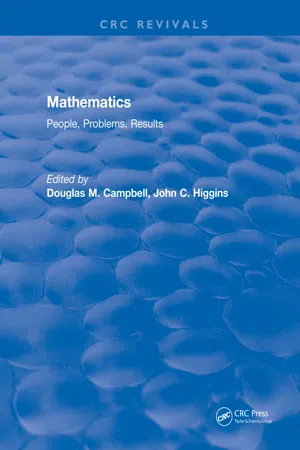
To understand why mathematics exists and why it is perpetuated one must know something of its history and of the lives and results of famous mathematicians. This three-volume collection of entertaining articles will captivate those with a special interest in mathematics as well as arouse those with even the slightest curiosity about the most sophisticated sciences.
Information
part one
Historical Sketches
THE HISTORY OF mathematics, while somewhat less colorful than that of humanity, is very nearly as long. The construction of regular geometric figures (such as circles, triangles, and ellipses), counting by means of tally sticks, and a wide variety of other mathematical activities predate recorded history nearly everywhere. Peoples as diverse as the builders of Stonehenge in southwest England and the Anasazi Indians of New Mexico and Arizona left physical monuments that hint of substantial mathematical insights. The independent discoveries of the Pythagorean and other theorems in Babylon, China, and elsewhere suggest that mathematical discovery may be a fundamental human activity—a way for humanity to impose order and stability on a capricious universe, a practice as widespread and ancient as religion itself. The essays in this first part provide a number of insights into specific aspects of the recorded history of mathematics.
The accounts begin with the earliest documented mathematical activities in Egypt and Babylon. While scholarly debate constantly rearranges the skyline at the farthest edge of recorded history, it can be stated with some confidence that about 5,000 years ago, that is, 3000 B.C., the Egyptians possessed a serviceable and surprisingly sophisticated arithmetic. As their monumental history unfolded, this body of knowledge was refined, expanded, and developed to eventually include the rudiments of what we would call geometry. The Babylonian civilizations—Mesopotamian might be more accurate—were essentially contemporary with the Egyptian culture, but the Babylonians apparently developed independently an even more useful and advanced arithmetic than that of the Egyptians. The Babylonians computed a variety of square roots, solved second degree equations, solved systems of first degree equations, knew the Pythagorean theorem (a2 + b2 = c2 for the lengths a, b, c of a right triangle), and knew that the distance around a circle was at least 3-1/8 times the distance across it. They may have understood a great deal more; our knowledge of their civilization is limited by the lack of relevant documents.
From its recorded beginnings in Egypt and Mesopotamia the development of mathematics in the West has had a relatively continuous trace whose gross outline can be discerned. The mathematical lore of the major Near Eastern civilizations was widely transmitted throughout the Mediterranean area. That this lore provided seed for the amazing development of mathematics in Greece beginning about the sixth century B.C. can hardly be doubted although direct links are difficult to find. Whatever their initial inspiration, the Greeks created an abstract discipline of power, beauty, subtlety, and rigor such that mathematics as we now know it may fairly be said to have started then and there. For centuries after Greece’s golden age, the study of mathematics in Europe was almost exclusively the rediscovery of bits and fragments of those sublime Greek achievements.
The mathematical heritage of the world outside western Europe and the Hellenistic world is less well focused. It is well known that the highly developed civilizations of both ancient India and China had in their possession a substantial body of mathematical knowledge. However, the precise outlines of this body of knowledge and its development and dissemination are much less clear. The reasons for this are various and well beyond the scope of this introduction. The mathematics of the pre-Columbian Americas is also presently unknown although existing physical ruins would suggest a level of knowledge at least on a par with that of ancient Egypt.
In contrast to our rather clouded view of the Far East, the development of mathematics in the Islamic world and its essential contribution to the development of math in Europe are well documented. Much of what western Europe learned of Greek mathematics came not directly from Greek documents but from Islamic sources. This is not to suggest that Islamic cultures served only as a conduit for Greek achievements. They created much of their own—for example, our present system of writing numbers is an Islamic creation. But the Islamic civilization, too, was heavily indebted to Greek writings for much of its mathematics. That they were able to add significantly to what they inherited from the Greeks is a tribute both to their genius and to the universality of mathematics as a creative art.
The civilization of western Europe and its modem offspring in the Americas, eastern Europe, and Japan have, over the last 500 years, expanded their Greek/Islamic heritage into the amazing structure that is modern mathematics. While it is difficult to find any major western European contribution to mathematics prior to the fourteenth century, it is equally difficult to find any mathematical accomplishment after that time that was not either begun or duplicated in western Europe. From the time Cardano published the general solution for cubic equations in 1545, nothing that has been done outside of Western civilization has had any significance at all in the development of mathematics. For example, although Chinese mathematics predated Newton and Leibniz in discussing some aspects of calculus, this event had absolutely no impact on the development of mathematics anywhere in the world, including China. The history of mathematics after 1500 is the history of mathematics in western Europe, and our emphasis on this area is the result not of cultural bias but of historical fact.
One cannot hope to gain from the vignettes presented here an accurate view of the history and development of mathematics. What we hope these articles will accomplish is arousal of the reader’s curiosity to learn more; in learning more the reader may appreciate better the monument of ideas that is mathematics.
Egyptian Mathematics and Astronomy
Otto Neugebauer
Otto Neugebauer is the world’s leading authority on the history of the exact sciences in Egypt and Babylon. Born and educated in Germany, he currently resides in the United States.
Neugebauer may disconcert the reader when he states, “The fact that Egyptian mathematics did not contribute pontively to the development of mathematical knowledge does not imply that it is of no interest to the historian.” Hearing a man announce that he has come to bury Caesar and not to praise him, one might be tempted to just ignore his discourse entirely. But Neugebauer’s interest is really in astronomy, and he wants to explain why the Egyptians did not develop a competent astronomy. As a historian Neugebauer knows of the Egyptians’ interest in the field and he knows of the great achievements made by Greek and late Babylonian astronomers. Thus he presents a history of primitive mathematical operations, done for routine problems, lacking an overall theory of proof or abstractness.
It is of interest to compare in Neugebauer’s and Gillings’s articles their choice of examples and the development of each discussion from the standpoint of what each author is trying to accomplish, since they have such different attitudes toward Egyptian mathematics.
Neugebauer also presents a satirical letter from a papyrus of the New Kingdom. One can early imagine it being updated and read on the floor of the U.S. Senate as an example of the uselessness of the new math now taught in some grammar schools. Apparently some things never change.
OF ALL THE civilizations of antiquity, the Egyptian seems to me to have been the most pleasant. The excellent protection which desert and sea provide for the Nile valley prevented the excessive development of the spirit of heroism which must often have made life in Greece hell on earth. There is probably no other country in the ancient world where cultivated life could be maintained through so many centuries in peace and security. Of course not even Egypt was spared from severe outside and interior struggles; but, by and large, peace in Mesopotamia or Greece must have been as exceptional a state as war in Egypt.
It is not surprising that the static character of Egyptian culture has often been emphasized. Actually there was as little innate conservatism in Egypt as in any other human society. A serious student of Egyptian language, art, religion, administration, etc. can clearly distinguish continuous change in all aspects of life from the early dynastic periods until the time when Egypt lost its independence and eventually became submerged in the Hellenistic world.
The validity of this statement should not be contested by reference to the fact that mathematics and astronomy played a uniformly insignificant role in all periods of Egyptian history. Otherwise one should deny the development of art and architecture during the Middle Ages on the basis of the invariably low level of the sciences in Western Europe. One must simply realize that mathematics and astronomy had practically no effect on the realities of life in the ancient civilizations. The mathematical requirements for even the most developed economic structures of antiquity can be satisfied with elementary household arithmetic which no mathematician would call mathematics. On the other hand the requirements for the applicability of mathematics to problems of engineering are such that ancient mathematics fell far short of any practical application. Astronomy on the other hand had a much deeper effect on the philosophical attitude of the ancients in so far as it influenced their picture of the world in which we live. But one should not forget that to a large extent the development of ancient astronomy was relegated to the status of an auxiliary tool when the theoretical aspects of astronomical lore were eventually dominated by their astrological interpretation. The only practical applications of theoretical astronomy may be found in the theory of sun dials and of mathematical geography. There is no trace of any use of spherical astronomy for a theory of navigation. It is only since the Renaissance that practical aspects of mathematical discoveries and the theoretical consequences of astronomical theory have become a vital component in human life.
The fact that Egyptian mathematics did not contribute positively to the development of mathematical knowledge does not imply that it is of no interest to the historian. On the contrary, the fact that Egyptian mathematics has preserved a relatively primitive level makes it possible to investigate a stage of development which is no longer available in so simple a form, except in the Egyptian documents.
To some extent Egyptian mathematics has had some, though rather negative, influence on later periods. Its arithmetic was widely based on the use of unit fractions, a practice which probably influenced the Hellenistic and Roman administrative offices and thus spread further into other regions of the Roman empire, though similar methods were probably developed more or less independently in other regions. The handling of unit fractions was certainly taught wherever mathematics was included in a curriculum. The influence of this practice is visible even in the works of the stature of the Almagest, where final results are often expressed with unit fractions in spite of the fact that the computations themselves were carried out with sexagesimal fractions. Sometimes the accuracy of the results is sacrificed in favor of a nicer appearance in the form of unit fractions. And this old tradition doubtless contributed much to restricting the sexagesimal place value notation to a purely scientific use.
There are two major results which we obtain from the study of Egyptian mathematics. The first consists in the establishment of the fact that the whole procedure of Egyptian mathematics is essentially additive. The second result concerns a deeper insight into the development of computation with fractions. We shall discuss both points separately.
What we mean by the “additivity” of Egyptian mathematics can easily be explained. For ordinary additions and subtractions nothing needs to be said. It simply consists in the proper collection and counting of the marks for units, tens, hundreds, etc., of which Egyptian number signs are composed. But also multiplication and division are reduced to the same process by breaking up any higher multiple into a sum of consecutive duplications. And each duplication is nothing but the addition of a number to itself. Thus a multiplication by 16 is carried out by means of four consecutive duplications, where only the last partial result is utilized. A multiplication by 18 would add the r...
Table of contents
- Cover
- Title Page
- Copyright Page
- Table of Contents
- Preface
- Chronological Table
- Part One: Historical Sketches
- Part Two: Some Mathematical Lives
- Part Three: The Development of Mathematics
- Appendix: Hubert’s 23 Problems
Trusted by 375,005 students
Access to over 1.5 million titles for a fair monthly price.
Study more efficiently using our study tools.
Frequently asked questions
Yes, you can cancel anytime from the Subscription tab in your account settings on the Perlego website. Your subscription will stay active until the end of your current billing period. Learn how to cancel your subscription
No, books cannot be downloaded as external files, such as PDFs, for use outside of Perlego. However, you can download books within the Perlego app for offline reading on mobile or tablet. Learn how to download books offline
Perlego offers two plans: Essential and Complete
- Essential is ideal for learners and professionals who enjoy exploring a wide range of subjects. Access the Essential Library with 800,000+ trusted titles and best-sellers across business, personal growth, and the humanities. Includes unlimited reading time and Standard Read Aloud voice.
- Complete: Perfect for advanced learners and researchers needing full, unrestricted access. Unlock 1.5M+ books across hundreds of subjects, including academic and specialized titles. The Complete Plan also includes advanced features like Premium Read Aloud and Research Assistant.
We are an online textbook subscription service, where you can get access to an entire online library for less than the price of a single book per month. With over 1.5 million books across 990+ topics, we’ve got you covered! Learn about our mission
Look out for the read-aloud symbol on your next book to see if you can listen to it. The read-aloud tool reads text aloud for you, highlighting the text as it is being read. You can pause it, speed it up and slow it down. Learn more about Read Aloud
Yes! You can use the Perlego app on both iOS and Android devices to read anytime, anywhere — even offline. Perfect for commutes or when you’re on the go.
Please note we cannot support devices running on iOS 13 and Android 7 or earlier. Learn more about using the app
Please note we cannot support devices running on iOS 13 and Android 7 or earlier. Learn more about using the app
Yes, you can access Mathematics by Douglas M. Campbell in PDF and/or ePUB format, as well as other popular books in Mathematics & Mathematics General. We have over 1.5 million books available in our catalogue for you to explore.