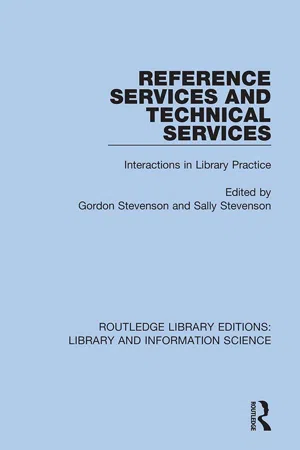
This book, first published in 1984, analyses the provision of more effective library service by relying more heavily on collaboration between reference and technical services librarians.
eBook - ePub
Reference Services and Technical Services
Interactions in Library Practice
- 182 pages
- English
- ePUB (mobile friendly)
- Available on iOS & Android
eBook - ePub
Reference Services and Technical Services
Interactions in Library Practice
About this book
Information
SUBJECT ORGANIZATION AND ACCESS
The Flaw of Subject Access in the Library Catalog: An Opinion
Norman D. Stevens
In a recent editorial in Information Technology and Libraries Pauline A. Cochrane points out that studies of the use of existing online public access catalogs show that “the great majority of users are performing topical subject searches.”1 This, she points out, confirms the findings of some earlier catalog use studies and argues for the need for greater attention to subject analysis and subject access in the online public access catalog. Ms. Cochrane is not alone in this effort. Phyllis Richmond, another leading catalog theorist, also discusses “Futuristic Aspects of Subject Access”2 in a recent issue of Library Resources & Technical Services. Taken by the apparent degree to which users turn to the online public access catalog for subject information, and the evident ease with which new and nifty ways of providing subject, or at least pseudo-subject, analysis, there is a rush by designers of these new catalogs and library planners to assume responsibility for providing subject analysis and subject access to information as a key component of these new tools. A recent report by the Council on Library Resources on Subject Access states as an assumption that “the optimum subject search tool is the online public access catalog equipped with sophisticated search capabilities including natural language and controlled vocabulary searches.”3
Norman D. Stevens is Librarian, University of Connecticut, Storrs, CT 06269.
Certainly improvement is needed. Exhortations and efforts such as those mentioned, including those of CLR, are welcome. The flaws of the past in terms of the extent and nature of subject access in the card catalog are clearly evident. There are too few entry points for the material in the catalog; the quality of subject analysis has often been extremely poor; and the use of outmoded terminology, which it is difficult, for both practical and psychological reasons, to update is a severe limitation. There has been no shortage of articles and books demonstrating those shortcomings of the card catalog as a tool for subject access. Efforts to correct those flaws and to substantially improve the level and quality of subject access in the library catalog are much needed, long overdue, and clearly welcome.
Unfortunately we tend to look for simple solutions and we tend to ignore the past. Few of the online public access catalog designers are likely to take the time and the effort—although they should—to read Francis Miksa’s new book The Subject in the Dictionary Catalog from Cutter to the Present. It is especially disappointing to note that the CLR conference, did not include historians like Miksa. That is disappointing because the quality of Miksa’s writing and the logic of his thinking, especially in his chapter of “Summary and Observations,” have far more to say to us on this subject than the simplistic thoughts of the CLR report. In particular Miksa’s opinion that ‘‘the role of user considerations, at least in the way they are presently conceived and applied, must be allowed to die an honorable death”4 is significant. Likewise we need to heed his caution that “the time has come to take seriously the professional nature of subject information systems engineering.”5
In our rush to judgment on this issue, whether we take Miksa’s ideas into account or not, we also need to think about the underlying major flaw in the provision of subject access which has been characteristic of the card catalog and will, at least in the foreseeable future, certainly continue to be true of the online public access catalog. In seeking to overcome the apparent flaws of subject access we must not lose sight of this major flaw either in the design of those catalogs or in our efforts to persuade patrons to use the catalog for subject information. We need to continue to caution them about its major limitations. Libraries have for a long time abdicated responsibility for direct access to a broad range of subject information. What we have provided in our catalogs is, at best, a limited approach to the subject content of a small part of our collections. We have concentrated our efforts, in terms of the provision of local bibliographic records, on the identification and description of discrete physical units, whether those be books, periodicals, maps, or other items. We have created in the catalog a tool which does a reasonably complete job of providing information about all of those units within the library. The user, and the librarian, can approach the catalog with a known-item search in hand with reasonable confidence that, if he/she knows how to use the catalog, a successful search can be completed that will indicate whether or not the library owns the particular item. Whether or not it is actually on the shelf is, of course, something else.
To use the catalog for subject information is quite another situation. At its very best, even in the more sophisticated forms that an online catalog can provide, the catalog can provide only very partial and incomplete information about the availability of information on a particular subject in that library’s collections. A topical subject search for a few books that might touch on a subject is one thing. Seeking specific subject information is another. The wealth of subject information contained in any library’s collection, even a small library, not just in the discrete physical units contained in the catalog but in the discrete bibliographic units more adequately dealt with in a range of indexing and abstracting services, subject bibliographies, and other tools is something else again. We need to be careful not to mislead the user into thinking that he/she will find the same degree and level of information in the catalog when conducting a subject search as will be true with a known-item search. Any effort to improve subject access to information through the catalog which assumes that the catalog, at least as it now exists, can be a major means for identifying and locating information on a subject basis is sadly mistaken. We need to begin to identify ways in which the vastly superior subject access to information found in indexing and abstracting services and similar tools can be effectively integrated with the online catalog. Given our past neglect we should not expect the online catalog to be the sole source for subject information. For at least the foreseeable future the competent reference librarian will be, in my opinion, a far better guide to the location of information on a subject in the library’s collection than any online catalog yet available or planned. We must not fail to recognize that. We should not expect to substitute efforts at subject analysis on the part of catalogers for those broader professional skills. If patrons want good subject information, and if we expect to provide them with that information, the online public access catalog, with whatever subject access it may provide, will have to be complemented with reference librarians.
NOTES
1. Pauline A. Cochrane “A Paradigm Shift in Library Science,” Information Technology and Libraries 2:3–4, 1983.
2. Phyllis A. Richmond “Futuristic Aspects of Subject Access,” Library Resources & Technical Services 27:88–93, 1983.
3. Subject Access. Washington, D.C., Council on Library Resources, 1982. p. 68.
4. Francis Miksa The Subject in the Dictionary Catalog from Cutter to the Present. Chicago, ALA, 1983. p. 404.
5. Ibid., p. 410.
User Categories and User Convenience in Subject Cataloging
Francis Miksa
INTRODUCTION1
One of the most pervasive beliefs of American subject catalogers is that the subject heading element of the dictionary catalog should be constructed on the principle of user convenience. In its narrowest sense, this means that individual subject headings should be chosen on the basis of what terms are commonly used by patrons in their subject searching. Charles A. Cutter had this in mind in his discussion of equally useful compound subject names: “When there is any decided usage (i. e. custom of the public to designate the subjects by one of the names rather than by the others) let it be followed.2 In a broader sense the idea of user convenience means that all aspects of subject heading work—choices concerning specificity, term syntax, synonyms, etc.—should reflect the way users approach the catalog. David J. Haykin, the first chief of the Subject Cataloging Division of the Library of Congress, expressed this more comprehensive view in 1951 when he concluded that, “the reader is the focus in all cataloging principles and practice.”3
The chief difficulty with these conceptions, and one which has led some to doubt the idea of user convenience, is their vagueness in referring to users. It is not enough to say that the subject heading system should be convenient to users. One must also be able to identify in some meaningful way who the users are that are to be served and what constitutes their “convenience.” Paul S. Dunkin, among others, questioned whether this could be done:
Is there such a creature as “the user”; or are there (as with costs) many users each with his individual habits?… Even if we find “the user,” can we safely build our practice to fit him—or shall we keep on making studies to find out if “the user” (just as you and I) changes habits and ways of thinking from time to time?4
Francis Miksa is Acting Dean, School of Library and Information Science, Louisiana State University, Baton Rouge, Louisiana.
Dunkin’s questions to the contrary, subject catalogers have not been remiss in identifying users and what is necessary for making the subject catalog convenient for them. They have done so in terms of user categories—identifying users in terms of recognizable groups. The makeup of these user categories has changed significantly over the years, however, and aspects of user categories, especially those more recently identified, raise questions as to whether they are a meaningful way to conceptualize patrons at all.
The purpose of this paper is to summarize and offer critical observations about the kinds of user categories to which subject catalogers have resorted over the years. It is assumed that the usefulness of this task is not limited to what it says for subject catalogers alone, but extends as well to other kinds of library professionals—in the case here to reference librarians—insofar as they too tend to justify their work on the basis of user categories and their characteristics.5
CUTTER AND USER CONVENIENCE6
Charles A. Cutter, who is generally thought of as the father of the dictionary catalog and the first to state the idea of user convenience, divided the library’s public into three general kinds of “inquirers”:
- those who want something quickly;
- those who want to make a thorough study of some specific subject; and
- those who want to study fully some general class of subjects.7
He concluded that the first group was the “loudest and largest” of the three. While this group was most dependent on a catalog and was, in fact, the reason for the popularity of the “ordinary dictionary catalogue,” its members were essentially “desultory” in their approach to books, subject searching, and the use of the library in general. They were impatient, wanting an answer for their book search as quickly as possible, regardless of what that yielded. They were also generally undisciplined in their searching and, in fact, “averse to mental effort,” often uncomprehending of the fact that useful information might be found under synonymous terms or that topics were by definition part of a structured universe of subjects. What they most often searched for were books that were listed under captions for general categories of literature—as if to say, “I want a philosophical work” or “I want a fiction work” or “I want a religious work.” In Cutter’s opinion, they did not care “about the particular subject of the book so much as whether it be well written and interesting.”8
The other two groups of inquirers were set apart from the first by two essential factors. First, to varying degrees they approached subject searching with an awareness of classificatory subject relationships. Second, to varying degrees they understood that subject searching was tantamount to disciplined investigation that required patience, effort, and the realization that not all their needs could be met by any catalog. These two categories differed essentially only in the breadth of their searching strategy. The second group tended to focus on specific subjects, aware of the need, for example, to find the various works on those subjects and compare them critically as to their...
Table of contents
- Cover
- Half Title
- Title Page
- Copyright Page
- Original Title Page
- Original Copyright Page
- Contents
- Introduction
- Historical Background
- An Overview
- Organizational Arrangements
- Document Description
- Subject Organization And Access
- Readers’ Forum
- Forthcoming In The Reference Librarian
Trusted by 375,005 students
Access to over 1.5 million titles for a fair monthly price.
Study more efficiently using our study tools.
Frequently asked questions
Yes, you can cancel anytime from the Subscription tab in your account settings on the Perlego website. Your subscription will stay active until the end of your current billing period. Learn how to cancel your subscription
No, books cannot be downloaded as external files, such as PDFs, for use outside of Perlego. However, you can download books within the Perlego app for offline reading on mobile or tablet. Learn how to download books offline
Perlego offers two plans: Essential and Complete
- Essential is ideal for learners and professionals who enjoy exploring a wide range of subjects. Access the Essential Library with 800,000+ trusted titles and best-sellers across business, personal growth, and the humanities. Includes unlimited reading time and Standard Read Aloud voice.
- Complete: Perfect for advanced learners and researchers needing full, unrestricted access. Unlock 1.5M+ books across hundreds of subjects, including academic and specialized titles. The Complete Plan also includes advanced features like Premium Read Aloud and Research Assistant.
We are an online textbook subscription service, where you can get access to an entire online library for less than the price of a single book per month. With over 1.5 million books across 990+ topics, we’ve got you covered! Learn about our mission
Look out for the read-aloud symbol on your next book to see if you can listen to it. The read-aloud tool reads text aloud for you, highlighting the text as it is being read. You can pause it, speed it up and slow it down. Learn more about Read Aloud
Yes! You can use the Perlego app on both iOS and Android devices to read anytime, anywhere — even offline. Perfect for commutes or when you’re on the go.
Please note we cannot support devices running on iOS 13 and Android 7 or earlier. Learn more about using the app
Please note we cannot support devices running on iOS 13 and Android 7 or earlier. Learn more about using the app
Yes, you can access Reference Services and Technical Services by Gordon Stevenson,Sally Stevenson in PDF and/or ePUB format, as well as other popular books in Languages & Linguistics & Library & Information Science. We have over 1.5 million books available in our catalogue for you to explore.