- 172 pages
- English
- ePUB (mobile friendly)
- Available on iOS & Android
eBook - ePub
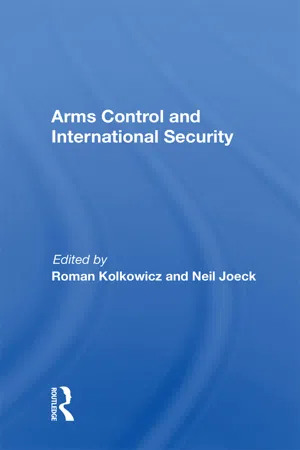
Arms Control And International Security
About this book
Designed to introduce the reader to the critical issues of arms control and international security in the 1980s, this collection of provocative and challenging articles encourages a rethinking of conventional wisdom on strategic policy. The authors succinctly convey the tensions existing between those who would eliminate the weapons on which strategic deterrence has rested and those who see the Soviet nuclear buildup as a challenge that must be met with increased armaments. They reflect, as well, on the conceptual tension between eliminating nuclear weapons and answering the question of how defense can be managed in the nuclear era. Their contributions are at times compelling, at times frustrating, but at all times informative and of critical importance.
Information
Part 1
The Current Situation in Arms Control and International Security
1
Security Without Order: Nuclear Deterrence and Crisis Management in the 1980s
Christoph Bertram
A remarkable military—as opposed to a political—stability between East arid West characterizes international security today. This balance shows its familiar robustness in the nuclear strategic field. The conventional balance in the defined areas of East-West deterrence in Europe and the Far East favors the Soviet Union on most indicators, but the risk of any conflict becoming nuclear continues to be a major deterrent.
Two ambiguities stand out in this picture. For one, the Soviet advantage in theater nuclear forces, while impressive, cannot easily be translated into a military advantage given the absence of any real likelihood that nuclear conflict could remain limited. Soviet theater nuclear improvements are, however, undermining the credibility of NATO's nuclear forces for deterrence and providing justification for NATO's Long-Range Theater Nuclear Force Modernization Program.
The second ambiguity concerns extra-European military contingencies, in particular the Gulf region. (Central America—for all the international emotions it generates—is not an issue of international security unless the United States decides to make it one.) The Soviet geographic advantage in the Gulf region is such that the West cannot establish military equality but instead must rely on the Soviet Union's recognition that central Western security interests are at stake there and on the credibility of overall deterrence. Although this requires some Western military intervention capability, it does not require the capability to fight and win a regional conflict with the Soviets.
Effective Deterrence
This rather relaxed view of the military balance depends, of course, on a belief in the continuing relevance of nuclear deterrence. Deterrence has worked in the past, but it is not easy to attribute the absence of war to one cause alone. Indeed, there are many reasons why war has not broken out between East and West since the nuclear age began. Perhaps the Soviet Union has had no serious interest in attacking. Perhaps it has not been in a position to attack with any confidence; after all, widespread Western notions of conventional Soviet superiority have often been influenced by the tendency to compare the other side's strengths with one's own weaknesses, rather than to compare strengths with strengths and weaknesses with weaknesses. And perhaps the Soviet Union felt itself threatened and was just building up what it regarded as an adequate defense.
There may be more reasons, but none is fully convincing in itself or in combination with others unless the threat of nuclear war is brought in. After all, Europe did not have a long tradition of peacefulness before the first nuclear device was detonated. On the contrary, the thirty-seven year period of warlessness which today separates us from that detonation is an exception, not a rule, in Europe's troubled history. Moreover, these thirty-seven years have not been without conflict potential: a divided Germany, an exposed city of Berlin, the overthrow of governments in Eastern Europe, Soviet intervention in neighboring countries, ideological and political confrontation between East and West, rapidly changing military technology, the permanent presence of massive armed forces on both sides, the language of deterrence.
And yet, war has not broken out—probably because war in the nuclear age and between nuclear powers clearly has no winners, only losers. If nuclear deterrence has achieved this, it has been an effective instrument for keeping the peace. As the only empirical data we have on nuclear deterrence, this cannot be taken lightly. Many people claim that our security would be enhanced if only nuclear weapons could be disinvented or banned, but the experience of the past thirty-seven years suggests that the existence of nuclear weapons has prevented, not promoted war.
Will this continue to be the case? Nobody can be sure, of course, but the popular view that nuclear war is becoming more likely is not based on particularly convincing propositions. One proposition is that the passage of time alone makes nuclear war more likely because as we become more accustomed to the nuclear age we may forget how terrible nuclear weapons are. The persistence of antinuclear movements, however, particularly among the young, negates this proposition. As for the possibility of a nuclear accident, electronic devices have reduced that danger, and all states possessing nuclear weapons have taken great pains to ensure that political leadership alone will decide whether or not the nuclear threshold is passed. The accidents today are computer failures, and one cannot dismiss them lightly, particularly if they should occur at the height of an international crisis. But all computer failures that I am aware of have not overcome human incredulity that a nuclear attack could occur out of the blue; the failures have not, therefore, led anywhere close to the irreversible step of launching a nuclear strike—the nuclear caution prevailed. And that caution is likely to be greater as the risk becomes greater. Parity between the two major powers, the ability by both sides to destroy the other after having been attacked by nuclear weapons, means an increase, not a decrease, in nuclear caution, and not even the greatest accuracy of delivery will change that. There is no way the nuclear attacker can assume that he will survive.
Limited War
But would that caution prevail if nuclear wars could be limited—if in other words, the major powers could use nuclear weapons without risking their own survival? Nobody knows the answer to that hypothetical question. But the likelihood of limiting a nuclear exchange to certain weapons or to certain territories is so remote that the question will remain hypothetical for the foreseeable future.
Nuclear war will be limited only if governments have the means to limit it. In fact, they do not have such means. Technically, limitation would depend on electronic installations (command and control) that would not survive a nuclear exchange and that are themselves likely targets for nuclear or nonnuclear preemption. Politically, limited war would depend on both sides agreeing to limit—at best a possibility for tacit conformity, but not a reliable basis for nuclear planning.
These technical and political obstacles mean one thing: Any side that launches a nuclear weapon against the other must assume that it now has lost control over the course of events. Thus escalation to the highest level of mutual nuclear destruction is inherent in the first use of any nuclear weapon. Another outcome would be a miracle, and miracles are not a basis for an assessment of the future.
To sum up this first thesis: (1) Nuclear deterrence has worked, and it will continue to work. (2) Deterrence has not become weaker; parity has made it stronger. (3) Since limited nuclear war is highly unlikely—if not impossible—deterrence will continue to apply also in the regional context as long as there is a reasonable possibility that nuclear weapons would be involved in any major conflict.
Unacceptable Ambiguities
Yet this is a thesis that seems to aim against many current convictions. Why should this be so? One reason is that people have difficulty discussing deterrence in terms that do not imply its failure. Rather than examining why deterrence has worked, analysts and critics look for reasons why it does not work, and they examine nuclear stability from the hypothetical perspective that nuclear war has actually broken out.
This tempting approach needs to be resisted. Nobody knows what will happen once deterrence fails. Would both sides, as the textbook strategists have it, resort immediately to devastating surprise attacks on the other? This is what the apostles of strategic bombing predicted before the outbreak of World War II, In fact, however, even after that war had been declared and hostilities started on a grand and irreversible scale, all parties to the war—including the aggressor Germany—showed marked reluctance to use strategic bombing for fear of reprisal!
The difference between peacetime calculations and wartime action is likely to be even more marked in the case of nuclear weapons, because they could lead not only to deadly reprisal but also to an immediate loss on control over events. Political leaders will, in all probability, bend over backward to avoid an early nuclear decision, and for a protracted phase the conflict will be a drôle de guerre indeed, with even conventional operations conducted in such a way that the other side need not feel pushed into the corner of nuclear retaliation.
This example underlines how totally unreliable it is to project measures taken to enhance deterrence in peacetime into the environment of nuclear war. The conceptual weakness of deterrence lies here: In order to be credible to the deterred, the deterror must make preparations to execute the conditional threat. But there is little analytical value in assuming that these measures will also be the guide for what will happen once deterrence fails. There is no automaticity of transmission; deterrence and its failure are fundamentally different situations.
The other reason why the argument for deterrence finds itself under critique lies, paradoxically, in the very robustness of nuclear deterrence. Deterrence is neither significantly strengthened by doubling or trebling the number of nuclear warheads, nor weakened by scrapping half of the superpowers' arsenals. Overkill does not make nuclear war more likely. Overkill capacities can be criticized as wasteful, which they often are, but not as a threat to peace, which they are not.
Although reassuring, this robustness of deterrence is also corrupting because it does not provide a sufficiently obvious limit of how much is enough. This combination of robustness and lack of clear limits made it possible, for instance, for the United States to adhere publicly, until the early 1970s, to a concept of minimum deterrence against cities when at the same time it was developing a nuclear arsenal more geared for selective nuclear strikes against military targets. It may also explain the simultaneity of Leonid Brezhnev's assurance in November 1981 that nuclear war cannot be limited, and the exposure that same month of an old Russian submarine carrying a nuclear device on a reconnaissance mission in Swedish waters.
These ambiguities of deterrence, which may be familiar to that small in-group of professional analysts, are in the long run unacceptable for two reasons: They frustrate arms control, and they undermine the political support necessary for democratic countries to continue relying on nuclear weapons for their security.
How Much Is Enough?
The ambiguities have produced concepts that are essentially open ended. The most obvious example is the concept of limited nuclear options. The conviction developed in the late 1960s that deterrence had to be refined to consider more limited nuclear use was not without some merits. Could a conventional war in Europe really be credibly deterred by an explicit U.S. threat of all-out nuclear war? Or was such a suicidal riposte void of deterrent credibility? These questions, however, were not accompanied by any criteria of sufficiency. Instead, helped along by the rapidly growing accuracy of nuclear delivery systems and by the proliferation of nuclear warheads, military planners proliferated limited-nuclear-option packages—on military installations, key economic concentrations, military and political command posts—always with the argument that it would be good to have additional options. The strategic analytical community provided the conceptual rationale for this attitude through the general conviction that nuclear weapons should be good for something more than just the last resort.
As a result, Western strategy (and probably Soviet strategy as well) has lost the important ability to answer the question, "How much is enough?" The inability to define what one needs for deterrence may not be a danger to deterrence, but it is a danger to arms control because one can only define what one does not need if one has first defined what one does need.
At the moment, Western strategic requirements are limited by the money that is available rather than by functional concepts. This tends to make arms control agreements both militarily arbitrary and politically vulnerable—arbitrary, and hence controversial, because there is no single logic to the agreements; politically vulnerable because to overcome military controversy governments have to oversell the political symbolism. We have all witnessed this with SALT II, the treaty negotiated since 1973, finally signed in 1979, and then fallen victim in 1980 to the deterioration of U.S.-Soviet relations and the passions of the U.S. Senate.
Nuclear arms control has other problems, of course, and the instrument, which was hailed with so much genuine hope in the 1960s, has witnessed growing difficulties: of verification, of preventing circumvention, of catching up with the dynamics of technological change. But these are secondary difficulties. As long as the "How much is enough?" question remains open, we cannot make real progress toward effective, militarily defendable, and politically acceptable arms control.
Nuclear Weapons and Domestic Support
The other reason why the ambiguity of deterrence is unacceptable lies in the nature of democratic societies. It is difficult to ask people to live with the fact that their security is based on the ability to blow up the world and themselves with it. It is barely—and only barely—acceptable if it is clear that nuclear force will not be used to fight a war but only to deter war.
The currently dominant strategic school of thought has tended to blur this fundamental distinction. In its fascination with limited nuclear options, highly subtle scenarios of nuclear sparring, and counterforce missions, the strategy has not only provided legitimacy for the military's instinct to regard any weapon as an instrument in war, but has also created doubt about the determination to deter, and to deter only.
Significantly, these technocrats of nuclear theology have been more concerned with the effect of their concepts on the Soviet Union than on their own population. Nothing underlines this apolitical approach more than the very term designed to cover all potential uses of nuclear weapons short of a disarming first strike or a cataclysmic retaliation—warfighting. This term means anything from one to thousands of nuclear explosions. As a result, U.S. nuclear doctrine has perhaps scared the Soviets, but it has certainly scared our own population—not only in Europe but in the United States.
This is not the only, or even the determining, source of support for the peace movement in Europe. Other factors, from concern over President Reagan's bellicose rhetoric to fears about the economic future, have probably been at least as decisive in giving an impetus to the antinuclear movement in European countries. But the games that strategists have played in the past ten years have also caused many people to fear that nuclear war is becoming more likely and that the search for deterrence only leads us down the steep path to nuclear extinction.
The lesson for strategists in the West seems clear: One does not play around with deterrence with impunity. Even if a concept of elaborate and distinct nuclear options and limited nuclear exchanges were to enhance deterrence vis-à-vis the Soviet Union—and I have expressed my doubts on this earlier—it would not be a concept that governments in democratic countries could adopt. To do so would sooner or later invite such controversy in domestic political constituencies that nuclear decisions and policies would themselves lack credibility. A recent example is NATO's 1979 decision to modernize theater nuclear forces and negotiate weapons control at the same time. Because of the domestic controversy over nuclear weapons in many member countries, governments have great difficulty convincing the Soviet Union that NATO will in fact implement the 1979 decision unless the Soviets accept curbs on their own burgeoning nuclear forces. Perhaps the Reagan administration's claim that negotiations over strategic weapons will only succeed if we first build up U.S. strategic forces may invite a similar difficulty.
Criteria of Restraint
To promote arms control and to maintain the deterrent credibility of democratic governments, we need to reduce the ambiguities of deterrence. But how? I cannot pretend that I have the full answer, but let me sketch out what might be some sensible guidelines for sizing Western nuclear forces for the 1980s and 1990s. First, we need to recognize that, as McGeorge Bundy has recently put it, mutual assured destruction is a basic condition, not one doctrine among many, for the nuclear age. There is no getting away from the essential unusability of nuclear weapons for other than the most dire situations of national (or alliance) survival.
This does not mean, however, that the only option for nuclear planners should be massive retaliation. Because our political leaders must be able to respond at the level of attack and not be forced into suicidal responses, we need more than this one option—particularly in the Western Alliance if it wants to retain the deterrent effect of U.S. nuclear forces against a Soviet military attack in Europe.
Many people in Europe insist that the United States should do away with all U.S. nuclear weapons in Europe and instead threaten to use its strategic arsenal for the sake of Europe. This move would not increase Western deterrence; it would not be politically acceptable in the United States and hence not credible. If extending deterrence to its allies meant that the United States would immediately risk its own survival, no U.S. president could count on the necessary political support. Therefore, nuclear options that do not deliberately (even if perhaps inevitably) push the world into extinction are essential, although we do not need to engage in the proliferation of nuclear options and scenarios of the past decade. The robustness and primitiveness of deterrence mean that nuclear options below a cataclysmic response can also be rugged and rather primitive—and few in number.
A second reasonable guideline is that the requirement for nuclear forces should be dictated by the minimum performance needed for credible deterrence, not by the number of forces, or even the number of targets, the other side has. Both sides have forces significantly larger than needed for credible deterrence, and the trend toward more accurate nuclear delivery systems provides a capability for which there is no rational need. What, for instance, is the essential contribution of the thousands of cruise missiles that the United States wants to deploy in the mid-1980s? Or take two recent European examples: the British Trident 2 decision and the rationale behind NATO's nuclear modernization program. For the "last resort deterrent," which is all Britain can ever acquire, Trident 2 vastly exceeds requirements (as it does for the United States). Its deterrent effect will thus be continuously challenged by widespread political uneasiness, even if the Conservatives remain in power long enough to see the program through to completion.
The NATO modernization program for long-range theater nuclear force is equally controversial. Although a sensible program, by and large, many of its supporters have mistakenly justified it by arguing that this is the correct response to the Soviet SS-20 missile program. This is the old and u...
Table of contents
- Cover
- Half Title
- Title
- Copyright
- Contents
- Preface
- Acknowledgments
- Part 1 The Current Situation in Arms Control and International Security
- Part 2 Arms Control Policy and Prospects
- Part 3 Arms Control and Technology
- Part 4 Arms Control and International Security: Europe and the Soviet Union
- Part 5 The Alternative to Arms Control
- Suggestions for Additional Reading
- List of Abbreviations
- About the Contributors
- Other Titles in the Studies in International and Strategic Affairs Series
- Index
Trusted by 375,005 students
Access to over 1.5 million titles for a fair monthly price.
Study more efficiently using our study tools.
Frequently asked questions
Yes, you can cancel anytime from the Subscription tab in your account settings on the Perlego website. Your subscription will stay active until the end of your current billing period. Learn how to cancel your subscription
No, books cannot be downloaded as external files, such as PDFs, for use outside of Perlego. However, you can download books within the Perlego app for offline reading on mobile or tablet. Learn how to download books offline
Perlego offers two plans: Essential and Complete
- Essential is ideal for learners and professionals who enjoy exploring a wide range of subjects. Access the Essential Library with 800,000+ trusted titles and best-sellers across business, personal growth, and the humanities. Includes unlimited reading time and Standard Read Aloud voice.
- Complete: Perfect for advanced learners and researchers needing full, unrestricted access. Unlock 1.5M+ books across hundreds of subjects, including academic and specialized titles. The Complete Plan also includes advanced features like Premium Read Aloud and Research Assistant.
We are an online textbook subscription service, where you can get access to an entire online library for less than the price of a single book per month. With over 1.5 million books across 990+ topics, we’ve got you covered! Learn about our mission
Look out for the read-aloud symbol on your next book to see if you can listen to it. The read-aloud tool reads text aloud for you, highlighting the text as it is being read. You can pause it, speed it up and slow it down. Learn more about Read Aloud
Yes! You can use the Perlego app on both iOS and Android devices to read anytime, anywhere — even offline. Perfect for commutes or when you’re on the go.
Please note we cannot support devices running on iOS 13 and Android 7 or earlier. Learn more about using the app
Please note we cannot support devices running on iOS 13 and Android 7 or earlier. Learn more about using the app
Yes, you can access Arms Control And International Security by Roman Kolkowicz in PDF and/or ePUB format, as well as other popular books in Politics & International Relations & Politics. We have over 1.5 million books available in our catalogue for you to explore.