- 338 pages
- English
- ePUB (mobile friendly)
- Available on iOS & Android
eBook - ePub
About this book
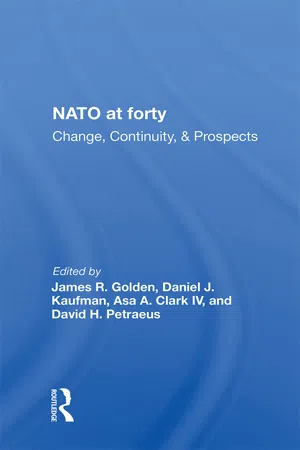
This book addresses the evolving role of North Atlantic Treaty Organization (NATO). It seeks to answer whether NATO is capable of adjusting to changes in the forces that have held it together and have made it the centerpiece of the national security strategies of its members.
Trusted by 375,005 students
Access to over 1.5 million titles for a fair monthly price.
Study more efficiently using our study tools.
Information
Part One
Introduction
1
The Challenge to NATO
James R. Golden
The success of the NATO Alliance over the past four decades has been extraordinary. The mere survival of the Alliance for forty years is noteworthy; that those forty years have been unbroken by war among the major powers is unprecedented in the modern era. To be sure, factors other than NATO have contributed to the absence of war in Europe— the most important being the advent of the "nuclear revolution" in warfare. Nonetheless, NATO has made an important contribution to the maintenance of peace among the major powers. Indeed, though Alliance members have often disagreed over a vast array of NATO issues, the overriding interest in peace with freedom has kept them together and helped prevent war on the continent.
Beyond that broad desire for peace, NATO's durability may be traced to three major sources: agreement on the nature of the threats to the fundamental interests of the Alliance members; the evolution of a collective response to those threats that meets the political, economic, and military requirements of the allies; and the absence of any politically acceptable alternatives to the current structure of the Alliance. The central question facing NATO forty years after its creation, however, is whether the Alliance, as currently structured, equipped, and funded, will continue to play an effective role in meeting the vital security needs of its members. Despite the attention given to disputes among Alliance members, it is unlikely that NATO will collapse with a bang sparked by internal friction, but it could fade with a whimper of irrelevance in the face of shifting economic, political, technological, and military realities. NATO will almost certainly be alive on the eve of the twenty-first century to celebrate its fiftieth anniversary. However, unless the Alliance has the resilience to respond to emerging challenges, by the turn of the century it may be less relevant to the central security concerns of its members.
This book addresses the evolving role of NATO. In particular, it seeks to answer the question: Is NATO, as currently configured, capable of adjusting to changes in the forces that have held it together and have made it the centerpiece of the national security strategies of its members, or is it an anachronistic institution whose influence will fade in coming years? The answer is sought by exploring three subordinate questions:
- First, what were the political, economic, military, and technological conditions that led to the creation of NATO and influenced its early evolution?
- Second, how have those conditions changed since the inception of NATO, and what are the implications of those changes for the Alliance?
- Third, what are the possible alternative futures of NATO based on those implications?
The Alliance in Perspective
Elements of NATO Security
NATO has played a central role in the national security policies of its members during the forty years of its existence. The key to that role has been the effective linkage of American and European capabilities in responding to postwar security challenges.
The four decades of peace among the world's great powers since World War II have eclipsed the former modern-era record of the Pax Britannica in the nineteenth century.1 The dominant strategic position of the British empire in that earlier period, sustained through enormous naval power and by a demonstrated willingness to commit sufficient land forces to maintain a balance of power on the continent, eventually gave way in the face of the emerging power of Germany. Two world wars ultimately were fought to reconcile the power balance to German strength.
The United States emerged from World War II in a position of strategic dominance, sustained by naval, air, and nuclear forces, and— like the British empire a century earlier—the will to commit land power to maintain the balance on a divided European continent. But while the United States held a commanding global position, particularly due to America's nuclear monopoly, the Soviet Union emerged as the dominant European power. The enduring dilemma of European security since World War II has, therefore, been how to maintain the linkage of U.S. strategic strength to the European theater in order to offset the regional, primarily ground force, preeminence of the Soviet Union.
NATO's ability to maintain this linkage has required the achievement of two interrelated tasks. First, the United States has had to maintain "central deterrence" through sufficient strategic nuclear forces to deter a nuclear attack on the United States. Second, the United States has had to extend the American nuclear deterrent to dissuade aggression against Europe as well. To achieve this "extended deterrence," the United States has had to demonstrate the capability and willingness to augment European forces with American conventional and nuclear forces. Through this combination of forces, the Alliance has sought to deter aggression by posing threats of retaliation and denial—that is, by taking retaliatory action against any aggressor and by denying an aggressor his objectives. Should deterrence fail, these forces also provide the means for defending the Alliance and for negotiating an end to hostilities. Extended deterrence has required the maintenance of Western conventional forces carefully balanced to meet conflicting military and political objectives. These forces have had to be sufficient to convince Americans and Europeans that defense without resort to nuclear weapons would at least be possible, but not so strong as to convince continental Europeans that a lengthy conventional defense might actually be contemplated or to indicate a lack of American will to employ nuclear weapons on Europe's behalf if necessary.
The elements of NATO deterrent strategy always have been highly interdependent. The foundation has been central deterrence, of course, because a United States that believed itself incapable of deterring a strategic nuclear attack on its homeland would not be credible in extending its strategic nuclear umbrella elsewhere. But extended deterrence has also required conventional capabilities for military responses short of strategic escalation. Conventional forces have helped not only to prevent thoughts of "smash and grab" offensives but also to enhance the perceived credibility of nuclear escalation. The threatened use of massive nuclear retaliation in the face of small-scale aggression would not be credible, but the presence of conventional forces makes some response more likely and increases the risk of escalation. Otherwise the absence of response to minor challenges would slowly erode the credibility of any nuclear escalation. In short, an important aspect of conventional forces has been to ensure that extended deterrence is credible and politically acceptable.
Interdependence among the elements of NATO security has provided the centrifugal impetus for endless debate over alliance strategy and operational doctrine, but the same interdependence has also created the centripetal pressure that has held the Alliance together. While extended deterrence has required a U.S. strategic nuclear umbrella and the forward deployment of forces in Europe, it has also required European conventional forces and benefitted from European nuclear forces. Neither partner can achieve credible extended deterrence alone.
NATO and the Atlantic Community
North America and Western Europe are bound by historical, cultural, and philosophical ties as much as by strategic interests. The trans-Atlantic partners share a commitment to the sanctity of individual rights and the rule of law. They are bound together by an integrated economic network characterized by expanding interdependence. The broader fabric of community woven by those common ties surrounds the security arrangements that emerged in the postwar period.
Strategic linkage was essential to postwar Alliance security, but security was only one dimension of the interconnected web of economic, military, and political issues facing the Western allies.2 A political framework was needed within which a restructured Europe could deal with the new balance of power on the continent and with other regions of the world. An economic framework was needed to provide for rapid recovery, to resolve the monetary and trade problems that had helped produce World War II, and to deal with the aspirations of developing nations. Moreover, the new relationships had to be forged in the shadow of a divided continent and a hostile Soviet Union.
These pressures forced the community of states in the North Atlantic region to evolve as much from economic, political, and military necessity as from deliberate choice. The complexities of organizational structure and process led to the consideration of those interrelated factors in separate institutions that emerged in the postwar era.3 The fact that the institutions are distinct, however, should not conceal the important policy linkages among them. The North Atlantic Treaty Organization, therefore, is best understood as just one of a set of interlocking institutions—the Council of Europe, the Nordic Council, the European Economic Community, the International Monetary Fund, the World Bank, the European Free Trade Area, the Benelux Customs Union, the Western European Union, the European Political Cooperation movement, Eurogroup, the Independent European Program Group, the European Organization for Nuclear Research, the European Space Agency, and the Summit Group of Seven—with overlapping memberships and overlapping responsibilities. This list of institutions suggests the array of common interests that have bound the members of what is often broadly termed the "Alliance." As but one of those institutions—albeit one of the most prominent—the North Atlantic Treaty Organization has benefitted from and contributed to a community extending beyond the narrow confines of a defensive military alliance.
NATO was therefore able to link U.S. strategic nuclear strength to the European region in a context of economic and political legitimacy. NATO provided the security structure for the North Atlantic community, and in the context of that structure the member nations' conventional and nuclear capabilities provided the means. Cooperation in a common security effort fostered accomplishment of more than just security needs; it also made possible the resolution of thorny political issues, such as the emergence of the Federal Republic of Germany as a major regional power, that might otherwise have been intractable. In this sense NATO provided a political and security superstructure within which common political and economic interests could be pursued.
Chapter 2 of this book, "The Foundations of NATO: A Personal Memoir" by General Andrew J, Goodpaster, discusses the factors that led to the formation and early evolution of NATO, From his perspective as an advisor to General Dwight D. Eisenhower, General Goodpaster first summarizes the key decisions on collective forces, command arrangements, and force requirements that framed the military structure of the Alliance. Based on his subsequent experience as Supreme Commander of Allied Forces in Europe, he then enumerates the enduring objectives of the Alliance. His analysis sets the stage for a review of the forces of change and continuity that have influenced the development of the Alliance since 1949 and that, in the coming years, will shape the future of the European and North American community.
Change and Continuity: Political and Economic Forces
The longevity of the Alliance, paradoxically, is grounded in political and military ambiguity. The interlocking doctrines of extended deterrence and forward defense embodied in the strategy of flexible response, for example, are remarkable not so much for their military brilliance as for their political ambivalence. Although critics of the Alliance have long called for greater precision in defining political relationships and military doctrines, such clarity was not required so long as economic, political, and military trends reinforced the primacy of NATO as the organizing principle of national defenses. The formula for success in the first four decades, however, may no longer be applicable in the coming decades.
The cohesion of the Alliance over its first forty years has been the product of numerous interconnected dynamic forces that have been self-correcting and stabilizing. Inevitable internal squabbles have often served less to highlight differences than to underscore the depths of common interests. In the economic and political area, stability has been fostered by three major factors: the nature of the security threat; perceptions of a favorable balance of benefits over costs associated with membership in the Alliance; and the persistence of national desires that have limited the extent of European political integration.
The importance of the Alliance was sustained by the clear and present danger posed by the Soviet Union and the Warsaw Pact, and by the perception that NATO responded effectively to the central threat to the vital national security interests of its members. As a result, political factions that rejected NATO and sought alternative security strategies were destined to remain in the minority. Indeed, only when such parties moved into the mainstream and supported NATO, as the Social Democratic party in West Germany did at the end of the 1960s, for example, did they become real contenders for national power.
Economic recovery permitted the Western democracies to expand the provision of both social services and defense expenditures simultaneously. In this context, defense outlays were viewed as a legitimate part of a broad social contract. Moreover, the credibility of extended deterrence meant that European defense contributions had a significant impact on European security by cementing the linkage to U.S. strategic nuclear forces. Credible deterrence could be obtained at acceptable economic costs.
The political and economic acceptability of the alliance strategy of flexible response, and the perception that the distribution of responsibilities and burdens within the Alliance was acceptable, all worked to enhance the perceived benefits and reduce the costs of the Alliance. Despite the success of economic integration, the continuing political division within Western Europe limited the evolution of a viable European alternative to the NATO defense structure. Political fragmentation continues to favor the status quo represented by NATO, although the impetus of a single European market by 1992 could ultimately have broader political implications. Changes in the nature of the threat and the costs of the Alliance's current strategy, however, now threaten the traditional stability of the Alliance.
The Nature of the Threat
The postwar hegemony of the Soviet Union in Eastern Europe, guaranteed by Soviet military forces, made the potential use of force against Western Europe a realistic threat. Although the Soviet Union periodically sought a political foothold in the Western democracies through local communist parties or other sympathetic factions, the maintenance of substantial Soviet forces in Eastern Europe, not to mention the actual use of force in quelling dissidents there, ensured that Soviet military power would be perceived as a clear and present danger by an overwhelming majority in the West. The creation of the Warsaw Pact reinforced the Western conviction that the primary threat to European and North American security was in Europe.
Crises outside the region—Korea, Indochina, Suez, Lebanon, Vietnam—neither disturbed this conviction nor upset the underlying balance of power. In reaction to North Korea's attack on South Korea, for example, the forces committed in Asia were limited and the defenses in Europe (where, it was assumed, the true Communist objective lay) were strengthened. The United States emerged from the war in Vietnam in the 1970s with lower defense spending in general, but with expanding outlays for NATO forces. President Jimmy Carter even proposed pulling substantial forces out of Korea to sustain commitments to NATO. The East-West confrontation in Europe remained the cornerstone of national defense policies.
By the early 1980s, however, the primacy of Europe as the organizing principle of U.S. defense policy, in particular, had come into question. In response to the Soviet occupation of Afghanistan, President Carter declared in early 1980 that the Persian Gulf was an area of vital national interest. The Reagan administration pointed to the global threat of Soviet adventurism, the immediate threat to Central America posed by Cuba and Nicaragua, and the rise in state-sponsored terrorism. Maritime strategists argued that the Pacific Basin demanded increased U.S. attention, based on trends in Soviet power projection and shifts in the patterns of international trade.
Europeans, however, tended to view the U.S. Rapid Deployment Force as an irrelevant solution to the political problems of the Middle East, saw Afghanistan as an isolated area of vital interest to the Soviet Union (and largely within the Soviet sphere of influence), and interpreted the challenge in Central America in economic and social rather than East-West military terms. These Europeans did not share the U.S. interest in blocking what Americans perceived as a global Soviet challenge.
The divergence of views on the relative importance of "out-of-area" issues coincided with a changing view of both the situation in Eastern Europe and the nature of the threat from the Warsaw Pact. Eastern Europe experienced dismal economic performances and rising national debts. At the same time, weaknesses in managing an increasingly complex economy produced slower rates of real output growth in the Soviet Union. These economic weaknesses revealed a less monolithic threat from the East. East Germany remained a close Soviet ally, with a surprisingly strong economic performance, rising military outlays, and solid support for the status quo, but the rest of Eastern Europe appeared to be more of a weight on a struggling Soviet economy than a foundation for Soviet influence. In this context the "Gorbachev challenge" is, in Michael Howard's terms, "systemic" rather than "personal," reflecting shifting economic relationships that will inevitably have long term implications for the Alliance.4
Not surprisingly, European and U.S. analysts differed on the correct policy response in view of these trends. To many in the United St...
Table of contents
- Cover
- Half Title
- Title
- Copyright
- Dedication
- Contents
- Foreword
- Preface
- Acknowledgments
- Part One Introduction
- Part Two Change and Continuity in the Atlantic Alliance: Political and Economic Forces
- Part Three Change and Continuity in the Atlantic Alliance: Military and Technological Forces
- Part Four Enduring Issues Confronting the Alliance
- Part Five Alternative Visions of the Future
- About the Editors and Contributors
Frequently asked questions
Yes, you can cancel anytime from the Subscription tab in your account settings on the Perlego website. Your subscription will stay active until the end of your current billing period. Learn how to cancel your subscription
No, books cannot be downloaded as external files, such as PDFs, for use outside of Perlego. However, you can download books within the Perlego app for offline reading on mobile or tablet. Learn how to download books offline
Perlego offers two plans: Essential and Complete
- Essential is ideal for learners and professionals who enjoy exploring a wide range of subjects. Access the Essential Library with 800,000+ trusted titles and best-sellers across business, personal growth, and the humanities. Includes unlimited reading time and Standard Read Aloud voice.
- Complete: Perfect for advanced learners and researchers needing full, unrestricted access. Unlock 1.5M+ books across hundreds of subjects, including academic and specialized titles. The Complete Plan also includes advanced features like Premium Read Aloud and Research Assistant.
We are an online textbook subscription service, where you can get access to an entire online library for less than the price of a single book per month. With over 1.5 million books across 990+ topics, we’ve got you covered! Learn about our mission
Look out for the read-aloud symbol on your next book to see if you can listen to it. The read-aloud tool reads text aloud for you, highlighting the text as it is being read. You can pause it, speed it up and slow it down. Learn more about Read Aloud
Yes! You can use the Perlego app on both iOS and Android devices to read anytime, anywhere — even offline. Perfect for commutes or when you’re on the go.
Please note we cannot support devices running on iOS 13 and Android 7 or earlier. Learn more about using the app
Please note we cannot support devices running on iOS 13 and Android 7 or earlier. Learn more about using the app
Yes, you can access Nato At Forty by James R. Golden in PDF and/or ePUB format, as well as other popular books in Politics & International Relations & Politics. We have over 1.5 million books available in our catalogue for you to explore.