- 56 pages
- English
- ePUB (mobile friendly)
- Available on iOS & Android
eBook - ePub
Nuclear Arms Control Choices
About this book
This book focuses the public debate on fundamental political problem by defining three approaches to arms control. The three approaches are (l) extend or modify the SALT II Treaty; (2) restructure the present or planned nuclear forces; and (3) establish overall equivalence.
Information
1.
Approaches to Arms Control
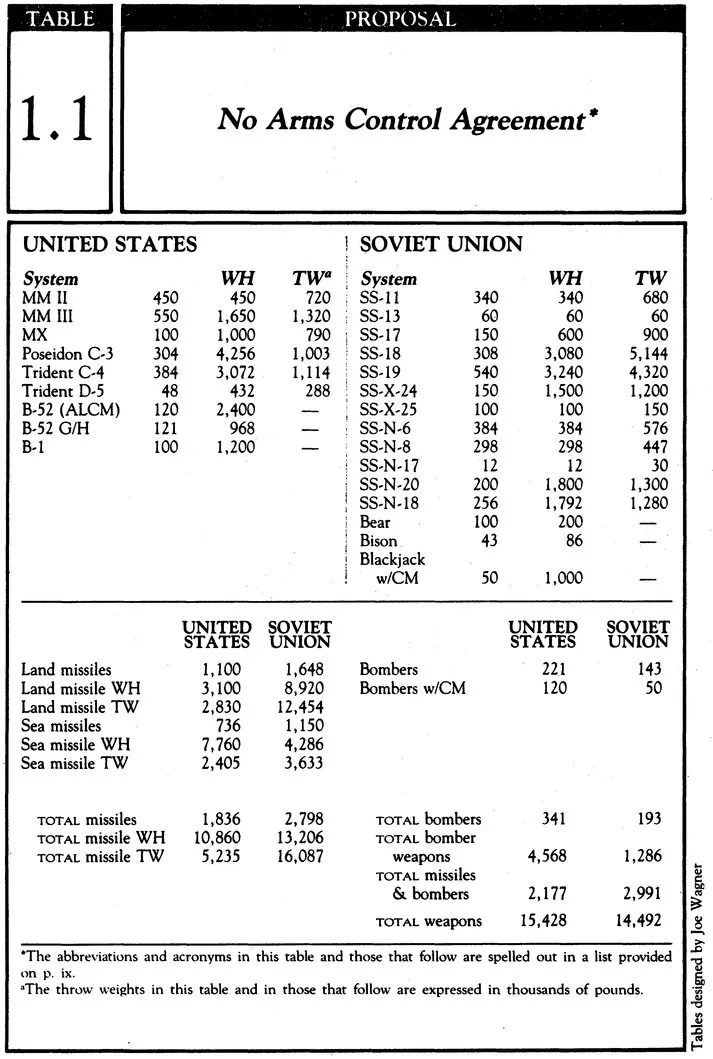
IN THE ABSENCE OF ANY ARMS CONTROL AGREEMENT, the United States and the Soviet Union would be expected to deploy new land- and sea-based missiles, to modernize their bomber forces, and to introduce long-range cruise missiles. The resulting balance would leave each side with about 15,000 strategic nuclear weapons, or about 5,000 more than today (see Table 1.1). The Soviet Union would increase its advantage in missile throw weight. The United States would continue to lead in warheads on sea-launched ballistic missiles (SLBMs) and in bomber weapons. Both the United States and the Soviet Union would have sufficient missile capability to put at risk the other side's land-based missile force, even in a mobile or some other alternative basing mode.2
Extend or Modify SALT II
Both the United States and the Soviet Union indicate they are currently abiding by the SALT II Treaty.3 Therefore, one arms control approach would be to extend or modify that treaty.
SALT II placed a ceiling until 1985 on the number of strategic nuclear delivery vehicles (SNDVs) of 2,250. It also included a set of subceilings: on the number of land-based missiles with multiple independently targeted reentry vehicles (MIRVs) at 820; on MIRVed land- and sea-based missiles at 1,200; and on MIRVed missiles plus bombers with cruise missiles at 1,320.
The objectives of such an agreement would be essentially the same as those for SALT I and SALT II: to place some constraints on the buildup of strategic nuclear forces on both sides; to achieve modest reductions; to introduce some degree of predictability into calculations about future capabilities; and to deny certain kinds of modernization, especially in destabilizing weapons.
If SALT II were extended to 1990 (see Table 1.2), both the United States and the Soviet Union would be able to maintain forces similar to those in the past; the Soviet Union would continue to emphasize land-based ICBMs and the United States a more balanced triad. Each side would be able to proceed with its planned modernization program for strategic nuclear forces, which by 1990 for the United States would include the MX missile, the Trident submarine and Trident I and II missiles, and the B-l bomber. The Soviet Union would be able to modernize its ICBMs, SLBMs, and bombers, while retaining its SS-18 and SS-19 missile force. The Soviet Union could pursue its planned deployment of MIRVed sea-based systems (the SS-N-18 and SS-N-20) and replace some of its older weapons with new systems of the same kind or with up to 120 bombers with cruise missiles.
Each side would nevertheless be required to reduce some of its existing strategic nuclear forces in order to proceed with its modernization plans and to meet the various SALT II ceilings. The United States would have to dismantle about 200 Minuteman III missiles. From among the older Bear bombers and the single-warhead SLBMs and ICBMs, the Soviet Union would have to retire about 230 launchers in order to meet the overall SALT II limit of 2,250. An additional 370 would have to be relinquished if the Soviets carried out their projected modernization program for 1990.
An extension or SALT II would need to address certain issues that were finessed in 1979. For instance, should limits be placed on sea-launched cruise missiles (SLCMs) and on the Soviet Backfire bomber? If these systems were counted under the ceilings, additional reductions would have to be made by each side.
A SALT II Treaty extension would constrain the Soviet Union more than the United States. The Soviet Union would, however, retain a substantial advantage (three and four times respectively) in ICBM missile warheads and throw weight. It would also continue to maintain an ICBM force with sufficient capability to destroy the U.S. ICBM force in its planned basing. With the deployment of one hundred MX missiles,
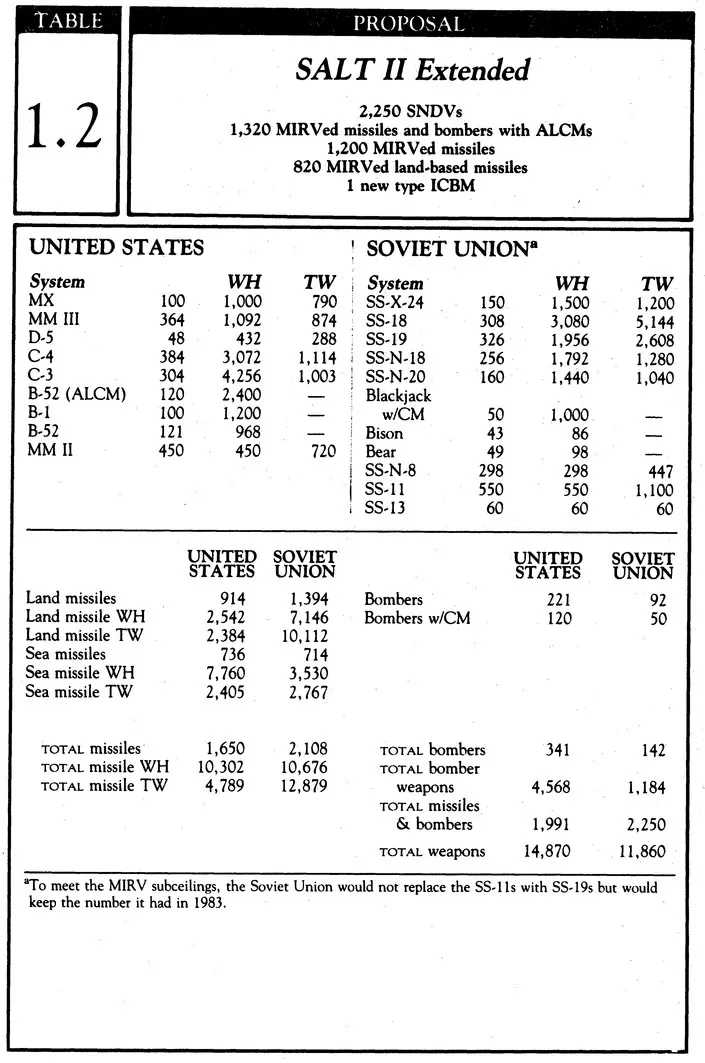
the U.S. ICBM force would not have a comparable capability against Soviet ICBMs, although it would have a significant one. The United States would retain a substantial advantage in SLBM warheads (two times) and in bomber weapons (four times).
The planned forces on both sides were shaped with SALT II limits in mind, or vice versa. As a result, extending the SALT II Treaty to 1990 would not produce strategic nuclear forces very different from those that would occur in the absence of any agreement. The overall number of warheads on each side would be somewhat less than if SALT II lapsed, but the nuclear forces could be modernized and the relative capabilities would be about the same. In either case, the number of warheads on each side would increase substantially between now and 1990.
To provide for more significant reductions, the SALT II Treaty could he modified by establishing new ceilings, as the Soviet Union has proposed. Its current START proposal calls for a reduction in SNDVs to 1,800 as well as for reductions in each of the SALT II subceilings: to 1,200 for MIRVed missiles plus bombers with cruise missiles; to 1,080 for MIRVed missiles; and to 680 for land-based MIRVed missiles. The Soviet Union has backed off from its original proposals to ban Trident II missiles and air-launched cruise missiles (ALCMs) with ranges of more than 600 km. They have, however, continued to call for a ban on sea-launched cruise missiles (SLCMs) with a range greater than 600 km.4
Under its START proposal (see Table 1.3), the Soviet Union could introduce a modern bomber force and still be permitted to expand its MIRVed sea-based force. In order to proceed with its planned modernization program for 1990, the Soviet Union would have to reduce approximately 900 of its single-warhead ICBMs and SLBMs and about 250 of its existing MIRVed ICBMs.
The Soviet START proposal would permit the United States to pursue its planned strategic nuclear force modernization program for 1990, on the condition that it give up about 100 more Minuteman III missiles than required in the case of just extending the SALT II Treaty. The SLCM provision of the Soviet START proposal would, however, prevent the United States from deploying as planned SLCMs with nuclear warheads on its submarine and surface fleet. The Soviet Union would still retain its SLCMs, which have the capability to strike important targets in the United States even though their range is less than 600 km.
The overall effects of the Soviet START proposal would not be much different from those of an agreement extending SALT II: The
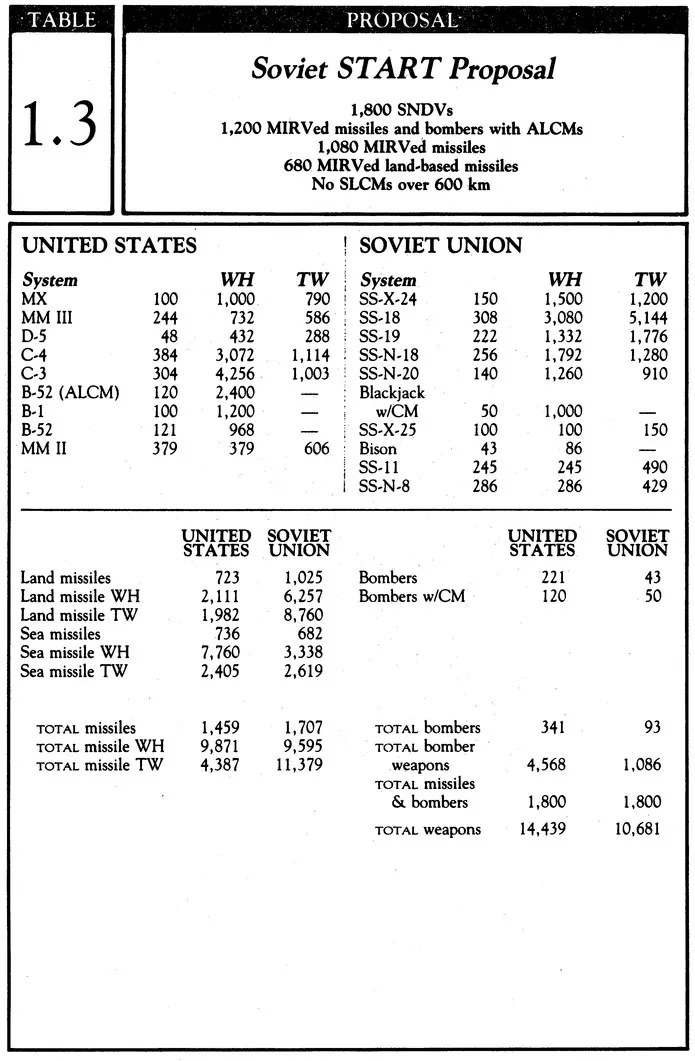
United States would have more than 14,000 strategic nuclear weapons, and the Soviet Union about 11,000. The Soviet Union would retain its lead in ICBM missile warheads and throw weight. The United States would maintain an advantage in SLBM warheads and in bomber weapons. Given the number of missiles permitted in the proposal, and their projected accuracies, the force postures on each side would be less survivable than they are at present. It should be noted in this connection that the task of reducing ICBM vulnerability through rebasing would be quite difficult.
Modifying the SALT II Treaty agreement so as to obtain major U.S. and Soviet reductions in planned strategic nuclear forces would require subceilings that are well below those in the current Soviet START proposal, in addition to which limits would have to be placed on the number of new types of missiles and bombers.
Restructure the Nuclear Forces
A second approach to arms control would be to seek specific and more substantial objectives. Proposals for deep missile reductions, a freeze, a build-down of nuclear forces, or movement to single-warhead missiles would all fall under this approach. In effect, this approach would require a restructuring of the present or planned strategic nuclear force postures on one or both sides.
Deep Missile Reductions.
The Reagan administration has been particularly concerned with the instabilities created by land-based missiles and by disparities in missile throw weight. The U.S. START proposal calls for reducing the number of ICBM and SLBM warheads from current levels of more than 8,000 to a ceiling of 5,000. It seeks to redress the Soviet advantage in missile throw weight either by a direct limit or by establishing subceilings on Soviet heavy and medium missiles—the SS-17, SS-18, and SS-19. It constrains the number of bombers on each side to planned U.S. levels of 400, with the Soviet Backfire bomber included in the bomber ceiling. It places no constraints on sea-launched cruise missiles.5
This proposal (see Table 1.4) would enable the United States to deploy the MX missile, the Trident II missile, and the B-1 bomber. The Minuteman II missiles, however, as well as about 800 Minuteman III and Poseidon missiles would have to be retired. Given the planned U.S.
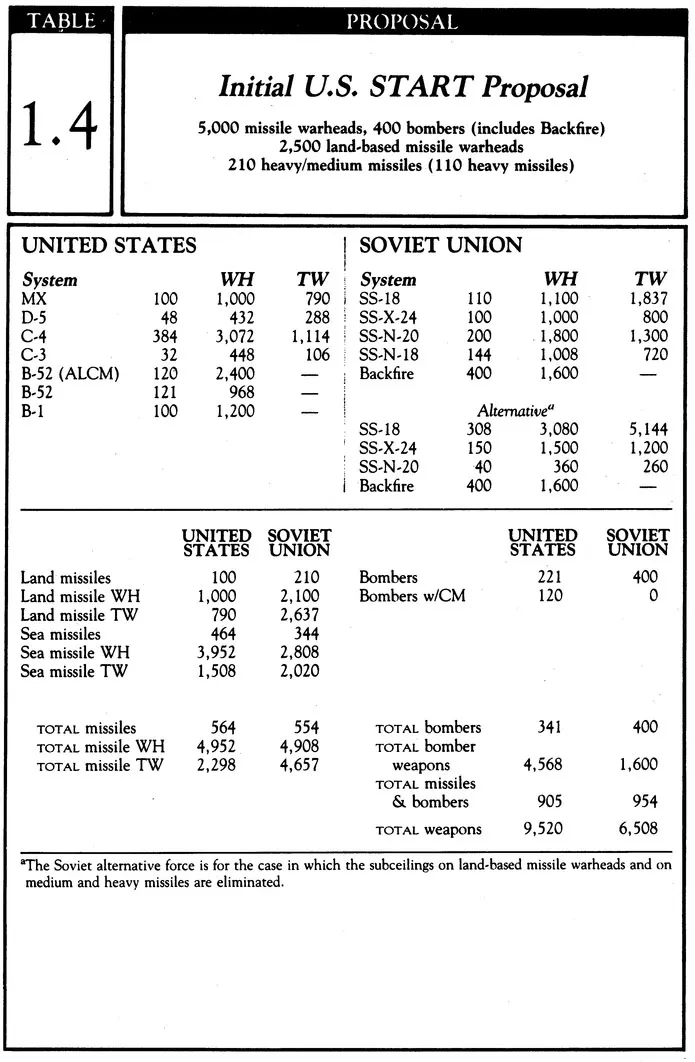
bomber program (100 B-ls and 241 B-52s), the United States could count almost all the 56 FB-111 aircraft and still remain under the bomber ceiling.
The proposal would require the Soviets to make much greater reductions and, thus, to face fairly difficult choices. One way they could meet the overall warhead ceiling of 5,000 in 1990 would be to reduce by approximately 1,000 their current nu...
Table of contents
- Cover
- Half Title
- Title
- Copyright
- Series Page
- Contents
- Abbreviations
- Introduction
- 1. Approaches to Arms Control
- 2. Gray-Area Issues
- 3. Perspectives
- 4. Recommendations
- Notes
- Annex
Trusted by 375,005 students
Access to over 1.5 million titles for a fair monthly price.
Study more efficiently using our study tools.
Frequently asked questions
Yes, you can cancel anytime from the Subscription tab in your account settings on the Perlego website. Your subscription will stay active until the end of your current billing period. Learn how to cancel your subscription
No, books cannot be downloaded as external files, such as PDFs, for use outside of Perlego. However, you can download books within the Perlego app for offline reading on mobile or tablet. Learn how to download books offline
Perlego offers two plans: Essential and Complete
- Essential is ideal for learners and professionals who enjoy exploring a wide range of subjects. Access the Essential Library with 800,000+ trusted titles and best-sellers across business, personal growth, and the humanities. Includes unlimited reading time and Standard Read Aloud voice.
- Complete: Perfect for advanced learners and researchers needing full, unrestricted access. Unlock 1.5M+ books across hundreds of subjects, including academic and specialized titles. The Complete Plan also includes advanced features like Premium Read Aloud and Research Assistant.
We are an online textbook subscription service, where you can get access to an entire online library for less than the price of a single book per month. With over 1.5 million books across 990+ topics, we’ve got you covered! Learn about our mission
Look out for the read-aloud symbol on your next book to see if you can listen to it. The read-aloud tool reads text aloud for you, highlighting the text as it is being read. You can pause it, speed it up and slow it down. Learn more about Read Aloud
Yes! You can use the Perlego app on both iOS and Android devices to read anytime, anywhere — even offline. Perfect for commutes or when you’re on the go.
Please note we cannot support devices running on iOS 13 and Android 7 or earlier. Learn more about using the app
Please note we cannot support devices running on iOS 13 and Android 7 or earlier. Learn more about using the app
Yes, you can access Nuclear Arms Control Choices by Harold Brown in PDF and/or ePUB format, as well as other popular books in Politics & International Relations & Politics. We have over 1.5 million books available in our catalogue for you to explore.