Sheet Metal Forming Optimization
eBook - ePub

Sheet Metal Forming Optimization

Bioinspired Approaches

  1. 234 pages
  2. English
  3. ePUB (mobile friendly)
  4. Available on iOS & Android
eBook - ePub

Sheet Metal Forming Optimization

Bioinspired Approaches

About this book

Automotive and aerospace components, utensils, and many other products are manufactured by a forming/drawing process on press machines of very thin sheet metal, 0.8 to 1.2 mm. It is imperative to study the effect of all involved parameters on output of this type of manufacturing process. This book offers the readers with application and suitability of various evolutionary, swarm, and bio-inspired optimization algorithms for sheet metal forming processes. Book initiates by presenting basics of metal forming, formability followed by discussion of process parameters in detail, prominent modes of failure, basics of optimization and various bioinspired approaches followed by optimization studies on various industrial components applying bioinspired optimization algorithms.

Key Features:

• Focus on description of basic investigation of metal forming, as well as evolutionary optimization

• Presentation of innovative optimization methodologies to close the gap between those formulations and industrial problems, aimed at industrial professionals

• Includes mathematical modeling of drawing/forming process

• Discusses key performance parameters, such as Thinning, Fracture, and Wrinkling

• Includes both numerical and experimental analysis
Frequently asked questions

Yes, you can cancel anytime from the Subscription tab in your account settings on the Perlego website. Your subscription will stay active until the end of your current billing period. Learn how to cancel your subscription.
No, books cannot be downloaded as external files, such as PDFs, for use outside of Perlego. However, you can download books within the Perlego app for offline reading on mobile or tablet. Learn more here.
Perlego offers two plans: Essential and Complete
  • Essential is ideal for learners and professionals who enjoy exploring a wide range of subjects. Access the Essential Library with 800,000+ trusted titles and best-sellers across business, personal growth, and the humanities. Includes unlimited reading time and Standard Read Aloud voice.
  • Complete: Perfect for advanced learners and researchers needing full, unrestricted access. Unlock 1.4M+ books across hundreds of subjects, including academic and specialized titles. The Complete Plan also includes advanced features like Premium Read Aloud and Research Assistant.
Both plans are available with monthly, semester, or annual billing cycles.
We are an online textbook subscription service, where you can get access to an entire online library for less than the price of a single book per month. With over 1 million books across 1000+ topics, we’ve got you covered! Learn more here.
Look out for the read-aloud symbol on your next book to see if you can listen to it. The read-aloud tool reads text aloud for you, highlighting the text as it is being read. You can pause it, speed it up and slow it down. Learn more here.
Yes! You can use the Perlego app on both iOS or Android devices to read anytime, anywhere — even offline. Perfect for commutes or when you’re on the go.
Please note we cannot support devices running on iOS 13 and Android 7 or earlier. Learn more about using the app.
Yes, you can access Sheet Metal Forming Optimization by Ganesh M. Kakandikar,Vilas M. Nandedkar in PDF and/or ePUB format, as well as other popular books in Physical Sciences & Mechanics. We have over one million books available in our catalogue for you to explore.

Information

Publisher
CRC Press
Year
2017
Print ISBN
9781498796149
eBook ISBN
9781351652186
Edition
1
Subtopic
Mechanics

1
Introduction to Metal Forming

1.1Introduction

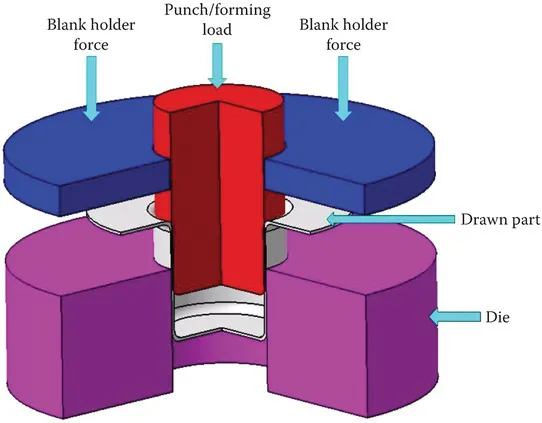
There has been tremendous development in the automotive and aerospace industry in the last decade, especially in India. The major manufacturing strategy for constructing bodies of automotive and aerospace structures is sheet metal forming. It involves a cluster of significant manufacturing processes from simple bending to deep drawing. A wide range of products from body panels, fenders, and wing parts to consumer products like kitchen sinks, cans, and boxes are made with precision through different operations on a plane blank. One of the most significant operations is the forming process, which is also termed drawing/stamping, and in some cases deep drawing, when the depth of the drawn part exceeds its diameter. This process includes a wide spectrum of operations and flow conditions. Simultaneous compression–tension can be observed in the radial and circumferential direction. The forming process involves rigid tooling, draw punches, a blank holder, and a female die. The blank is generally kept over the die and pushed by the draw punch into the die radially; pressure is applied on the blank holder to control the flow of material. Accurate control of material can avoid dominance of compression, resulting in wrinkling. With developments in the automotive and aerospace industry, the formability of metals is gaining more and more attention. This is due to the continuous demand on the industry to produce lightweight components. Materials with higher strength to weight ratios are being used in forming parts of missiles, aircraft, and, more recently, even in automobile industries. There is also significant ongoing research on materials and composites for these applications.
On the other hand, design in sheet metal forming is considered an art rather than a science in small-scale industries as it depends on the operator’s knowledge, experience, and intuition. Computer-aided design and computer-aided engineering have not yet percolated to that level. This is due to the involvement of many parameters and their interdependence in the forming process. These include properties of material, punch and die geometry, work piece profile, and working conditions. The other reason is that research and development in sheet metal forming requires extensive and costly prototype testing and experimentation to arrive at a competitive product. An example is the traditional method of designing die geometry for the sheet metal stamping process. A working design is arrived at, based on the competency of the designer and by trial and error. The goals of the sheet metal forming process are to minimize the time and cost of manufacturing while optimizing the quality of the product. It is very difficult to satisfy these goals because the success of the deep drawing part depends upon the experience acquired by the tool design engineer over the years.
Thus, a large amount of time and money is utilized in an industry in finding appropriate tool geometries and manufacturing parameters by trial and error, after which they are modified by performing repeated experiments till a feasible solution is obtained. This leads to the sheet metal forming process simulation, which has emerged as the need of the hour. As sheet metals are transformed from their initial to final shape, the process involves large displacements and induced strains. Finite element methods play a very important role in reducing cost as well as time to obtain a complex physical phenomenon, and also help to better understand the process and to control the quality of the product. Thus, numerical simulation of the sheet metal forming process is a very useful tool for analysis.

1.2Drawing/Deep Drawing Process

Drawing/forming/stamping is a process in which the form of a flat blank is changed into the desired component. Drawing is mostly applied in metal-working industries to produce cup-shaped components with high manufacturing efficiency on mechanical or hydraulic press. Cup drawing is a basic procedure to test for the sheet metal formability prior to forming other shape components. Typically in drawing, the blank is usually constrained over the draw punch inside the die to give the required shape of the cavity. Large plastic deformation combined with a complex flow of material is required for a successful process (Figure 1.1).
image
FIGURE 1.1
Deep drawing process—schematic representation.
The physics of the...

Table of contents

  1. Cover
  2. Halftitle Page
  3. Title Page
  4. Copyright Page
  5. Contents
  6. Preface
  7. Authors
  8. 1. Introduction to Metal Forming
  9. 2. Process Parameters in Drawing
  10. 3. Failures in Drawing
  11. 4. Engineering Optimization
  12. 5. Thinning Optimization: Cohort Intelligence
  13. 6. Springback Optimization: Flower Pollination
  14. 7. Fracture Optimization: Genetic Algorithm Approach
  15. 8. Thinning Optimization of Punch Plate: Gray Wolf Optimizer
  16. 9. Wrinkling Optimization: Firefly Algorithm
  17. 10. Thickness Gradient Optimization: Ant Lion
  18. 11. Springback Optimization: Cuckoo Search
  19. Appendix A
  20. Index