- 232 pages
- English
- ePUB (mobile friendly)
- Available on iOS & Android
eBook - ePub
About this book
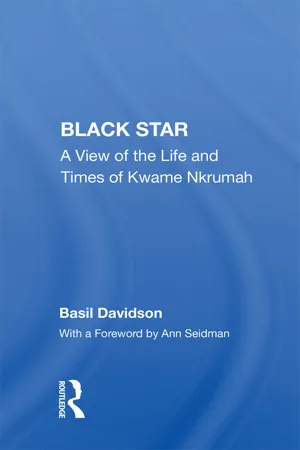
This book provides a balanced view about a charismatic leader, Kwame Nkrumah during an exciting period of history in Ghana. It discusses the failure of Nkrumah's means and abilities to meet the challenge of his aims from the standpoint of Ghana's welfare.
Information
1. Dreams and Visions
I was made aware that here was no ordinary teacher.
The Rev. Wynne Jones, Gold Coast Schools Inspector, writing of 1932
How he Began
Nkrumah was born to the senior wife of a goldsmith of the Nzima language-group who live in the south-western corner of Ghana: probably, he himself thought, on a Saturday in mid-September of the year 1909.
His mother used to say that the true date was 1912, but a Roman Catholic priest who baptized the young Nkrumah wrote 1909 in his records, and that seems to be the right date. He was a village boy close to the customs of his people, the child of a large and easy-going family. This family was part of a people who have lived since time immemorial in sound of the sea, who knew in their time the first small ships from Europe, and who have played a vivid role in the commercial life of their coastland: an out-going, self-confident, hard-working sort of people, accustomed more than most peoples to the chances and changes of life.
He will have listened when a boy to many tales of distant venturing and travel by sea or land. That was to be important for him, and all the more, perhaps, because he was a shy child who preferred to stand and listen to his elders rather than merely run with the crowd. He sucked in knowledge of the challenges of life, and dreamed dreams about the power a man can have to meet and overcome them. It was a habit of mind that stayed with him, a counterpart to his horror of violence and his later admiration for Gandhi and the pacifism which Gandhi preached.
His mother meant much to him. A strong-minded woman, she made sure that he went to school, and remained a central figure to him throughout his life. It was characteristic of the grown man that she should be the first person whom he sought when returning from his years abroad. Perhaps it was also for this reason, this importance to him of his mother, that he never found it easy to make a close and lasting relationship with any other woman. He used to say that women frightened him, explaining in 1957, when he was nearly fifty, that 'it is not fear today, but something deeper. Perhaps it is a dread of being trapped, of being in some way overpowered.'
There would be several women in his life to whom he gave his confidence. But the evidence suggests that he preferred to keep the relationship informal, although his one marriage, embarked on late in life, seems to have brought him happiness as well as a good wife and children. He had a large need for love and affection, and was capable of showing both. But it is also true that he showed these feelings with reserve, and this reserve was to be an obstacle to the confidence that others might wish to give him in return.
How soon he really felt himself to be somehow 'set apart', and bound to the fulfilment of a mission, is another matter. In any political sense, that came much later. Yet the fact remains that he was set apart as early as the age of nine from the great majority of boys and girls in the Gold Coast of his youth. The elementary school of Half Assini was no great academy, yet only a few children crossed its portals then. And of those few, fewer still stayed beyond the first year, the so-called 'infant year'. Gold Coast records for 1911 show that 10,874 children were enrolled in the 'infant year' at the colony's schools, but only 2,057 were in Standard 1, and no more than 387 in Standard 7, the final year of elementary schooling. The situation was still about the same when Nkrumah began his own 'infant year'.
He completed all seven standards, in itself something special in those times. And then, setting him apart once again, he went on to become a pupil-teacher. He had not only done well at his books and games; he had also showed a rare determination and self-discipline. No 'colonial child' could hope to stay the full elementary course, and then raise himself into teacher's rank, without powerful qualities of brain and character. Even in the Gold Coast, an 'advanced colony' as things went in those days, a child of humble parents had to be an outstanding child if he or she were going to win any of the prizes offered by education.
This was not because of any lack of bright children, or because these children did not want to go to school. On the contrary, those were years of tremendous educational demand. The schools were besieged for places. 'Never in the course of my experience of the tropics,' a British governor of the Gold Coast said in 1919, 'have I found a place where the people were so avid for education. It is the only country, I fancy, where the schoolboy, without being a prig, is more anxious to go to school than his parents are to send him.'
Yet there were few schools, few places in the schools, and few parents able and willing to meet the cost of keeping their children at their books. Nkrumah had brains and grit. But he had the chance, too, of going to school and staying there. He was also born at a lucky time for go-ahead young men in the Gold Coast; and it is useful to see why. For the answer explains a great deal about the later life and development of this earnest young teacher in the elementary school at Half Assini.
Early Enterprises
His first big chance came in 1926. It was to open the door to all that followed, and he seized it with joy, though also with an understandable fear that he might not be able to meet its difficult challenge.
In 1926 he had begun to teach in the small town of Half Assini, and might have so continued for the rest of his working life. There were only a handful of secondary schools in the country, and Nkrumah lacked in any case the necessary education for teaching in them. And in those days there were no worth while jobs for a teacher save in teaching.
But in 1919 there had come to the Gold Coast, as Britain's governor, a man who already knew the country and respected its people. This governor, Gordon Guggisberg, was one who greatly believed in the 'imperial mother's' mission to help the Africans. It is possible to judge him simply as a clever paternalist who wanted to improve the colonial system so as to make it stronger; but that would be to judge him outside the context of his times. Guggisberg thought the colonial system the only possible system there could be; but he also thought that in the end the Africans would take it over and work it for themselves.
That was an old British tradition in West Africa. As long before as 1853 a British minister, Lord Grey, had put it into words. 'The true policy I believe to be,' he said, 'the formation of a regular government on the European model, so that the interference of the British authorities may be less and less required.' Nowadays this policy might be called 'neo-colonialism'. In Guggisberg's day, more than half a century ago, it was thought enlightened; in a colonial sense, it was enlightened. Guggisberg set out to follow it.
This kind of colonial governor was less rare in British West Africa than elsewhere in the dispossessed continent. One reason why was that there were no white settlers in the British West African colonies. Even the big trading companies owned very little land, or none at all. Several of them had tried to get hold of land, but they had met with strong African opposition, and, because there were no white farming settlers, they had failed. Besides this, Britain had occupied these colonies partly by alliance with local peoples, and these local peoples had struggled for their rights. So it was accepted, at least in principle, that 'in the end' the Africans would recover their independence. Guggisberg thought it his duty to make 'the end' somewhat less remote in time.
He became Governor with two ideas in mind. He wanted more economic enterprise and tried to promote it, rightly seeing that Ghana's 'one crop economy'—its reliance on cocoa exports—was bad for the country. Secondly, he wanted more education for Africans, and in this he had some success. He spurred on the opening of new schools, gave teachers some improvement in their very low wages, and set about raising the standard of teaching. Much came out of this. In 1924 there was established at Achimota, not far from the capital of Accra, the colony's first high-quality training college for teachers.
The principal of this new college, the Rev. A. G. Fraser, was allowed to select his own staff; and Fraser chose for his vice-principal a man whose name is still honoured in Ghana, and likely long to remain so. This was Kwegyir Aggrey, a Gold Coaster from the seaboard country who had spent twenty-two years in the United States, teaching and studying, and who now returned with the aim of providing, at Achimota, an education that would be fully worthy of world citizenship. Though Aggrey died in 1927, his vigour and ideals achieved great things at Achimota. The 'winds of all the world' began to blow through its classrooms. The lessons of black America as well of white America became a stimulus and challenge.
Fraser and Aggrey set out to look for promising students, encouraged by Guggisberg who shared their belief that stores of talent lay hidden in the schools. One day in 1926 Fraser went down to Half Assini. He listened to the lessons given by Half Assini's teachers, and put in a recommendation that Kwame Nkrumah, then aged seventeen, should be admitted to Achimota.
Nkrumah stayed at Achimota for four years. After that he taught as a head or senior teacher in schools more advanced than Half Assini's. How well he taught was still vividly remembered forty years later by a former schools inspector, the Rev. Wynne Jones. He recalled in a letter to the Sunday Telegraph of 6 August, 1972, going to inspect a Roman Catholic junior school where Nkrumah was teaching 'in the local Fanti dialect'.
'I have never forgotten our meeting,' he wrote from his retirement in Wales, 'since I was suddenly made aware that here was no ordinary teacher. Despite a frieze of noisy spectators at the open windows, the pupils reacted to his calm, dignified and 'magnetic' manner whole-heartedly. It was an unforgettable inspectorial experience.'
Achimota had opened windows on the world for Nkrumah. Working at his own development, he eventually decided to visit the United States. That was when the major chapters of his life began for him. The years that he spent in the United States became his formative period. As they shaped him, so later did he think and behave in the years of his political leadership.
What ideas did he take with him there? How did he then see the future: his own, but also his country's and Africa's?
Now that most of Africa is politically independent, and other obstacles stand in the way of progress, it is not easy to picture the colonial system as it really was. Yet Nkrumah was born into its very heart.
In 1909, when Kwame's father poured libations to his ancestors and said prayers in thanks for the child's safe arrival in this world, the system was still pushing itself powerfully out across the continent. If its frontiers were already marked on maps, the colonial powers had still to make these colonies safe for their system, and it took them a long time to do this. In many colonies there were African wars of resistance as late as Nkrumah's time at Achimota, and sometimes even later still. The last great anti-colonial resistance in the Gold Coast, leading to the final overthrow of the Ashanti Empire, had ended only a few years before his birth.
The whole system was fastened upon Africa during his early lifetime. Its impact varied from place to place, being harshest for Africans wherever there were white settlers who saw themselves as a 'local master race'. There were no such settlers in the Gold Coast. But there were plenty of whites there who saw themselves in the same way: businessmen, police officers, officials, and others of their kind. These might give lip-service to the principle that Africans should have self-rule 'in the end'; few of them believed that this would ever happen. Those were the days when white men in Africa were contemptuous of 'natives', above all when these were educated men. They insisted on their own superiority, and thought that Africans had no history, culture, or civilization of their own.
The resultant atmosphere of cultural suffocation has been well described by a British historian of Africa, Christopher Fyfe, in his biography of the West African scientist and patriot, J. Africanus Horton (1853-83):
In these European possessions whites ruled and non-whites obeyed. All the European empires in Africa were empires of race, where there was little place for an educated African . . . Those [Africans] with professional qualifications were squeezed out of government service and humiliated socially. [Horton's] wife's relative Dr J. F. Easmon was ruthlessly hounded out of his post as Chief Medical Officer, Gold Coast, by a vindictive governor and replaced by a European. Regulations were made in 1902 to constitute a unified West African Medical Service. Africans were specifically excluded from it [only seven years before Nkrumah's birth] and relegated to a separate service, with lower salary scales, so that even the most senior African doctor could not give an order to the most junior white doctor.
Things were better, twenty-five years later, when Nkrumah entered Achimota. It was then a long time since a leading British official had declared that 'the educated native' was 'the curse of the West Coast'. But there were still quite a few local whites who agreed with that opinion. Only two years before Nkrumah's arrival at Achimota, the Gold Coast nationalist J. E. Casely Hayford complained of discrimination in the medical service. 'Until we knocked and knocked and knocked again,' he said, 'the West African Medical Service was a closed door; they did not want us to get in. It was a question whether we were ever going to get in at all.'
Nkrumah had no wish to be a doctor, but the words meant something to every African who cherished a belief in his right to equal treatment with other men; and one of the keys to Nkrumah's later thought and action can be found here. To the nationalists of those days it became the supreme need to assert and secure this right. They had to demonstrate that Africans could bear the same responsibilities as Europeans. They had to throw off the colonial heritage of 'inferiority'. Before they could hope to be able to do anything else, they had to 'get out from under' the mountain of colonial power.
This became the driving idea of the Ghana of Nkrumah's youth. The great and primary task was to achieve equality of respect and treatment, no matter what might happen next. Only this could restore to Africans the power to control their own history and development. Outstanding men in West Africa had long stated this absolute need. Horton and Blyden and others had done it before 1900. Mensah Sarbah, Casely Hayford and others in Ghana or elsewhere continued the work. Some were brilliant men who would have made their mark anywhere. They became the spokesmen and pioneers of West African nationhood; and Nkrumah was among the younger generation of half a century ago who ardently followed their lead.
What kind of lead was it?
These men were also the product of their times, and their times supposed, as ours do not, that worthwhile civilization had to come from Europe, So they were driven to compete with Europeans on European terms. They had to excel in all the subjects which Europeans thought necessary, not least in Greek and Latin, In the measure they succeeded, they had to accept a special status in their own African countries. They had to become a privileged group or élite, even if this divided them from the lives of the majority of their fellow-countrymen. There was no other way for them to develop their skills and exercise their talents.
They were therefore caught in an awkward contradiction. They wished to assert and show the value of Africa's peoples, cultures, civilizations of the past; and that was one thing. But they also looked to Europe for guides and good examples; and that was quite another.
Attoh Ahuma was one of them. His ideas demonstrate this contradiction very well. A distinguished Gold Coast newspaper editor, Attoh Ahuma exhorted his readers to do better than just copy the Europeans, and to love their own country for itself. But this same Attoh Ahuma also wrote: 'Let us help one another to find a way out of Darkest Africa. The impenetrable jungle around us is not darker than the dark primeval forest of the human mind uncultured. We must emerge from the savage backwoods and come into the open where nations are made.' Yet how were his readers to be proud of their country and its heritage, if this was 'a dark primeval forest' of 'savage backwoods'?
The contradiction stayed with the educated group, the élite, in all the years that followed. The men of the élite sincerely wished to 'make the nation', but they thought that only people who were able and willing to take their examples from Europe would be able to do that, Europe had become their 'spiritual home'. So it was to be, in due course, that one of the soldiers who overthrew Nkrumah's rule in 1966, Colonel (then Major) Afrifa, could write of the British military academy of Sandhurst with a boundless admiration not only as a training school but also as a guide to political behaviour. An Englishman might reply that whatever Afrifa may have learned at Sandhurst, he had not learned its sovereign rule about politics: that serving soldiers stay rigorously out of them.
But so it would be, again in due course, that Dr Kofi Busia, leader of the brief regime which followed military rule in 1969, withdrew to live in Oxford when he in turn was overthrown in 1972. There Dr Busia lived in the shadow of England's oldest and perhaps most conservative university, the one that was, in many ways, spiritual father to the British Empire. 'Oxford,' he had once said, long before, 'has made me what I am today.'
Such men desired Ghana's independence, but only if it could be independence 'in the British way', shaped on British models, enjoying British approval, and therefore, by the logic of this attitude, fulfilling Britain's interests. But could British interests be the same as Africa's? It was a question that the educated élite preferred not to consider, much less to answer, whether in colonial times or later.
Nkrumah was trained as a member of this privileged élite; the important point is that he rejected his training. Once through Achimota, climbing the scholarly ladder, he might well have followed the same kind of career as Busia, gaining eve...
Table of contents
- Cover
- Title
- Copyright
- Contents
- Foreword to the 1989 Edition
- Acknowledgements
- Introduction to the 1989 Edition
- Prologue THE MAN ON THE STEAMER DECK
- 1. DREAMS AND VISIONS
- 2. GRAPPLING WITH REALITY
- 3. TOWARDS INDEPENDENCE
- 4. VICTOR AND VICTIM
- Epilogue A VIEW FOR TOMORROW
- Index
Trusted by 375,005 students
Access to over 1.5 million titles for a fair monthly price.
Study more efficiently using our study tools.
Frequently asked questions
Yes, you can cancel anytime from the Subscription tab in your account settings on the Perlego website. Your subscription will stay active until the end of your current billing period. Learn how to cancel your subscription
No, books cannot be downloaded as external files, such as PDFs, for use outside of Perlego. However, you can download books within the Perlego app for offline reading on mobile or tablet. Learn how to download books offline
Perlego offers two plans: Essential and Complete
- Essential is ideal for learners and professionals who enjoy exploring a wide range of subjects. Access the Essential Library with 800,000+ trusted titles and best-sellers across business, personal growth, and the humanities. Includes unlimited reading time and Standard Read Aloud voice.
- Complete: Perfect for advanced learners and researchers needing full, unrestricted access. Unlock 1.5M+ books across hundreds of subjects, including academic and specialized titles. The Complete Plan also includes advanced features like Premium Read Aloud and Research Assistant.
We are an online textbook subscription service, where you can get access to an entire online library for less than the price of a single book per month. With over 1.5 million books across 990+ topics, we’ve got you covered! Learn about our mission
Look out for the read-aloud symbol on your next book to see if you can listen to it. The read-aloud tool reads text aloud for you, highlighting the text as it is being read. You can pause it, speed it up and slow it down. Learn more about Read Aloud
Yes! You can use the Perlego app on both iOS and Android devices to read anytime, anywhere — even offline. Perfect for commutes or when you’re on the go.
Please note we cannot support devices running on iOS 13 and Android 7 or earlier. Learn more about using the app
Please note we cannot support devices running on iOS 13 and Android 7 or earlier. Learn more about using the app
Yes, you can access Black Star by Basil Davidson in PDF and/or ePUB format, as well as other popular books in Politics & International Relations & African History. We have over 1.5 million books available in our catalogue for you to explore.