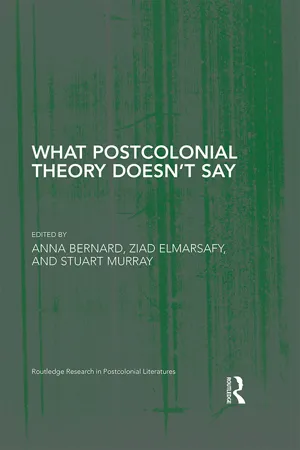
This book reclaims postcolonial theory, addressing persistent limitations in the geographical, disciplinary, and methodological assumptions of its dominant formations. It emerges, however, from an investment in the future of postcolonial studies and a commitment to its basic premise: namely, that literature and culture are fundamental to the response to structures of colonial and imperial domination. To a certain extent, postcolonial theory is a victim of its own success, not least because of the institutionalization of the insights that it has enabled. Now that these insights no longer seem new, it is hard to know what the field should address beyond its general commitments. Yet the renewal of popular anti-imperial energies across the globe provides an important opportunity to reassert the political and theoretical value of the postcolonial as a comparative, interdisciplinary, and oppositional paradigm. This collection makes a claim for what postcolonial theory can say through the work of scholars articulating what it still cannot or will not say. It explores ideas that a more aesthetically sophisticated postcolonial theory might be able to address, focusing on questions of visibility, performance, and literariness. Contributors highlight some of the shortcomings of current postcolonial theory in relation to contemporary political developments such as Zimbabwean land reform, postcommunism, and the economic rise of Asia. Finally, they address the disciplinary, geographical, and methodological exclusions from postcolonial studies through a detailed focus on new disciplinary directions (management studies, international relations, disaster studies), overlooked locations and perspectives (Palestine, Weimar Germany, the commons), and the necessity of materialist analysis for understanding both the contemporary world and world literary systems.
- 272 pages
- English
- ePUB (mobile friendly)
- Available on iOS & Android
eBook - ePub
What Postcolonial Theory Doesn't Say
About this book
Information
Part I
Disciplinary Constellations
New Forms of Knowledge
INTRODUCTION
This section of our volume deals with postcolonial theory’s self-understanding via multiple institutional topographies. The section is prompted in part by the “How did we get here?” question: What are the genealogies and epistemologies that went into the making of the current status quo and how might they be transcended? Far from repeating the standard rhetorical move of anaphoric criticisms as a way of opening the debate, the essays in this section constitute a four-way exchange across the sites and boundaries wherein postcolonial theory is invoked, thereby helping to re-map the institutional places and languages through which postcolonial theory knows and speaks. As such they also constitute points of return as well as departure, since the essays in subsequent sections will respond to the arguments presented here.
This section opens with Claire Westall’s incisive argument about the class basis of intellectual activity in general and the academic study of English Literature and postcolonial studies in particular. Given the Anglo-American beginnings of postcolonial theory, Westall’s essay zooms in on the blind spots of the field’s institutional framework and calls for more honesty (or what she calls “probity”) in debates about methodologies as they inform and shape the scholarship, teaching and management of postcolonial theory and literary studies. The late capitalist nexus linking English Literature and postcolonial theory in particular, she argues, requires exposure and exploration.
The next two papers take postcolonial theory beyond its humanities base and towards fields with which it has entertained an occasionally difficult, if not hostile and indifferent, rapport. Simon Obendorf interrogates what might happen if, instead of exchanging uneasy glances, postcolonial theory and International Relations (IR) took seriously their common interest in political understanding and change. By tracing the history of recent attempts at opening up the two fields to one other, Obendorf uncovers not only a history of Eurocentric contempt at the heart of IR, but also the very real difficulties that beset attempts to create a dialogue with a version of postcolonial studies that seems to have forgotten its activist dimension. A closer look at postcolonial theory’s aims promises a reinvigorated interdisciplinarity better able to fulfil the ever-elusive task of speaking truth to power.
Mrinalini Greedharry and Pasi Ahonen confront another complex interdisciplinary problem, namely, the relationship between postcolonial theory, with all of its intricacies, and the field of Management and Organization Studies (MOS), which is itself described as a heady mixture of economics, engineering, ethnography, psychology and sociology. Both fields have undergone multiple shifts and metamorphoses over the past three decades. Can – or even should – they have anything to say to each other? The answer is very much in the affirmative, not only because of the inscription of management knowledge as an integral part of the colonial system’s administration of slaves and plantations, but also because of the reconfigurations needed in both postcolonial theory and MOS if they are to effect, rather than merely observe, ruptures within Western epistemologies. In view of the steady advance of putatively objective ideologies and administrative techniques that claim to draw on management science in the operation of universities across the world today, the urgency of the questions raised here cannot be overstated.
The section closes with an intervention on the most basic, and arguably the most difficult, question in this volume: How should postcolonial theory address literature in the contemporary moment? John C. Hawley tackles this through an examination of postcolonial theory’s over-reliance on Western aesthetic norms in dealing with texts usually classified under such rubrics as orature, Indian bhasha literature or testimonio. The tension between the demand for newness, derived from the synthesis of colonial and indigenous forms, and the commitment to representing historical struggle and emancipation, has left postcolonial theory unable to address the demands made by such forms. Hawley asserts that if the vocabulary of postcolonial critical aesthetics is to go beyond the terms set out by Adorno, Lukács, Sartre and Jameson, greater attention will have to be paid to the subtle defigurations of established forms in our reading of postcolonial writers.
1 Capitalizing on English Literature
Disciplinarity, Academic Labor and Postcolonial Studies
This chapter takes up a challenge I set myself on achieving a permanent academic post, namely, to write about the institutionalization of postcolonial studies in relation to the discipline of English Literature, accelerating efforts in the UK, US and elsewhere to globalize English Literature programs, and, the laboring lives of academic staff, especially the “early career” crowd. This means drawing on Marxist critiques of postcolonial studies and reassessments of English Literature; writing on neoliberalization and academic labor; and the everyday efforts of colleagues and friends wanting to resist systemized exploitation (of themselves and others), “enough to be able to look in the mirror and say, ‘I’m trying’”, as one of them recently put it. It also means using my own experiences as points of reference whilst appreciating that they are notably limited and come via a particular intellectual training. These influences prompted this incursion into debates about academia’s postcolonial predicament, including the argument that, for all of its concerns with difference, inequality, representation and the role of the intellectual, mainstream (or institutionally endorsed) postcolonial studies – especially its theoretical and literary wings – has not got to grips with the disciplinary logic of English Literature that shapes, masks and fuels its defining errors and limitations as an academic field. Nor has it sufficiently grappled with the systemic connections between its intellectual history and priorities, and the workaday aspects of academic labor.
On writing I am mindful of numerous warnings about self and field reflexivity as entrapping us in pre-existing modes of inward-looking paralysis (Dean 2010 and 2013), which inhibit transformative thinking and action, as some critiques of postcolonial theory insist (Stam and Shohat 2012). I am also highly conscious of the dangers of personalization being read only as “complaint”, as lacking critical or political substance (Gill 2010, 230), and how “complainants” or “killjoys” are managed and silenced by institutionalized demands for “happy talk” (Ahmed 2012, 10). Nevertheless, this is an attempt to think about disciplinary formation and academic labor in the context of the literary-cultural move from the postcolonial to the global. It is also a sign of solidarity with those peers and mentors whose vision, integrity, warmth and humor survive in the face of exploitation, ill health and exhaustion.
Importantly, this discussion is not intended to dismiss all work within or informing postcolonial studies, much of which has been rigorous and significant. However, taking up convincing Marxist explanations of the field’s emergence and “misprisions” (Parry 2012a, 117; Parry 2013, 123), I argue that postcolonial studies has been widely endorsed, primarily within core, prestige-bound institutions because it enables and obscures capitalism’s organizing principles and ramifications. And it does so, in large part, by proffering a reconciliatory extension of English Literature’s imperial and market-oriented version of cultural capital based on precedence as saleable prestige. This argument relies on established readings of English Literature’s imperial dimensions and the discipline’s ongoing international dissemination and defense of undefined but class-bound “values” (Baldick 1983; Gardiner 2013). As an imperial discipline, English Literature must be reconnected to the development of the capitalist world system and explained as helping mold postcolonial theory and literary studies into a shape that accepts and aids global market creation. For most English Literature departments and universities caught within the anti-educational impetus of neoliberalization, postcolonial studies is supported as a saleable “good” (i.e. a positively valued and seemingly moral commodity) and as a tool facilitating global or international awareness and opportunity for the most advantaged people, groups and countries. Indeed, the field stands against Marxian efforts to call out and dismantle structural inequalities, and its widespread acceptance has exacerbated its authority to do so (see Chibber 2013). It is only when rethought in terms of capitalist modernity that the kinds of critical imperatives postcolonial studies has attributed to itself can be reoriented towards a resistant worldliness within which the reorganization of labor, education and literary studies may be possible.
ENGLISH LITERATURE AND POSTCOLONIAL STUDIES
“[D]isciplinary explanations” (Lazarus and Varma 2008, 321) of the influence English Literature exerts on postcolonial theory and literary studies are significant in ways not typically recognized in critiques of postcolonial studies. This includes how, as the “home” discipline, English Literature imbued postcolonial theory and literary studies with a mode of “perpetual auto-critique” (Stam and Shohat 2012, 372) that functions to stave off first principle, materialist challenges, challenges that are necessarily axiomatic for a radical, and overdue, reorganization of the world we share.
In the wake of postwar mass decolonization, Third World nationalist campaigns, and the rising force of social protest movements and identity-based claims to equality, postcolonial theory and literary studies emerged within and were then propagated by English departments at the most elite universities in the UK and US, making postcolonial studies a top-down academic creation that gained momentum as it penetrated other subject areas, institutions and locations (Lazarus and Varma 2008, 313). According to Arif Dirlik, postcolonialism really began “[w]hen Third World Intellectuals […] arrived in [the] First World academe” (1994, 329) and became postcolonialists within 1970s “high theory”, standing as part of the post-1968 settlement’s anti-systemic outlook. As regularly noted, the imprint of post-structuralism and postmodernism, evidenced in the field-defining works of Said, Bhabha and Spivak, helped establish a theoretical idiom (a vocabulary or jargon) that often makes little sense to those outside the English Literature nexus and even some within it. It also set in motion many of the field’s prevailing analytical trends and the responses they provoked. Robert Stam and Ella Shohat identify such critiques as including opposition to the seemingly loose approach to historicization; the rereading of political and economic/class/anti-capitalist struggles as “intra-psychic”; intertextual and inter-discursive tensions and ambiguities; and the corresponding celebration of ambivalence, difference hybridity, diaspora and cosmopolitanism (2012, 371–372). Infamously, the “post” of postcolonial studies was both akin to and distinct from other theoretical “posts” (Appiah 1991; McClintock 1992; Quayson 2000). It indicated but did not pin down an approach to “after” and “against” colonialism. Further, it has been repeatedly questioned for impeding accounts of the variance between peoples, places, languages and historic moments; buckling under the weight of exploitative economic continuities; and being unable to respond to the disintegration of the Soviet bloc or the subsequent dominance of the US. A self-declared anti-binarist, anti-universalist and anti-essentialist postcolonialism arose that could be seen as reneging on or contradicting its own moral and intellectual claims, with some works denouncing while also producing forms of binarism, universalism and essentialism (as explained by Dirlik 1994; During 1998; During 2012; San Juan 1998). According to Dirlik, and in line with Benita Parry’s ongoing interrogation of the field (2004 and 2012b), postcolonial studies was quick to mobilize its Marxist inheritance, but the field’s early poststructuralist anti-universalism led to a decentering and deconstructing of Marxism that ushered in a new, largely silent totality – that of global difference without a structure of relations. Crucially, this allows “postcolonial critics [to remain] silent on the relationship between the idea of postcolonialism to its context in contemporary capitalism” (Dirlik 1994, 331).
Historically situating the emergence of postcolonial studies within the collapse of the postwar economic boom, the related inability of Third World liberationism to hold out against capitalism and the widespread defeat of anti-capitalist ideologies during the restructuring of capital or neoliberalization, Lazarus and Varma describe the field as “janus faced”, “having two aspects […] as an academic enterprise, one accommodationist, the other subversive” (2008, 312), otherwise labeled the “anti-liberationist” and the “anti-anti-liberationist” (Lazarus 2011, 5). Parry links this distinction to Simon During’s earlier warning of the “reconciliatory” dimension of academic postcolonialism (2012b, 342), which During defines as an approach that figures “colonialism as a kind of tragedy with a happy ending” – that of global connectivity – and opposed to a “critical postcolonialism” that attempts to “recover or construct differences and marginalized pasts” (1998, 37). We may also relate During’s distinction to Graham Huggan’s hopeful view of academic postcolonialism as a resistant mode of critique working against imperialism and its consequences, which he sets against the globalized, saleable version of postcoloniality manifest in the publishing, profiling and circulation of “postcolonial”, “international” and “cosmopolitan” authors (2001, 4–6). The gap presented by Huggan can be described, to academia’s benefit, as the difference between intellectuals working within scholarly debates set towards political resistance and graduates and other workers capitalizing on their exposure to such debates in order to market and sell their “products”. However, postcoloniality is already dominant within academia, which is itself the chief arena for the marketing and selling of postcolonialism. Huggan’s more recent explanation of the postcolonial field as “torn […] between competing revolutionary and revisionist impulses” marks an ongoing tension, but he resists conceding that institutional support for revisionist (and largely continuant) causes has won out when this appears to be the day-to-day reality (2013, 4). For, although postcolonial studies emerged as “of and against its time” (Lazarus 2011, 4), the field’s accommodationist and reconciliatory aspects have been the most influential, gaining institutional and (where possible) financial backing, especially via endorsements of English Literature’s view of itself as a post-imperial discipline working towards a global appreciation of literary culture. We might say that the internationalization and marketization of higher education, particularly of the arts and humanities, relies upon a vision of reconciliation and connection that a globalizing postcolonial studies enables and offers back to English Literature, specifically to its debt-bound student consumers and others looking to purchase English Literature’s heritage and use it to join the international creative class of neoliberal laborers (see Brouillette 2014).
Where During and Huggan defend the potential of postcolonial studies, Lazarus and Varma challenge the grounds of such optimism, implicating both aspects of postcolonial endeavor they identify as bound to a failure to recognize imperialism’s place within capitalist modernity. Indeed, even when contemporary defenses of postcolonial theory, or studies, oppose imperialism’s twenty-first-century manifestations, they still typically start from and stop at imperialism. Weighing up these defense-of-the-field narratives, and seemingly with no scholarly pun intended, Stam and Shohat point to a “Lazarus-like resurrection of the cadaver of postcolonialism” (2012, 371). However, Lazarus’ own efforts towards the “plausible reconstruction” needed for a worlded comparative literary practice have pierced the imperial bubble of postcolonial studies. He reprimands scholars for paying “insufficient attention to the fact that colonialism is part and parcel of a large, enfolding historical dynamic, which is that of capitalism in its global trajectory” and for effecting a “category error” that uses “the West” as an ahistorical “euphemism for capitalism” (2011, 7 and 14). As Lazarus puts it, “the field didn’t take a wrong turn, it is a wrong turn” (Lazarus in Gunne 2012, 9). Such thinking explodes postcolonial studies, including its efforts at self-transformation, and calls for a badly needed new model of comparative literary analysis that contends with the capitalist world system. This call is echoed in Vivek Chibber’s response to Subaltern Studies in Postcolonial Theory and the Spectre of Capital (2013). The same type of reconsideration, though, also needs to be wielded against English Literature, against its familial nurturing of postcolonial studies and the manner in which, together, these domains inhibit the creation of alternative models of literary studies that are materially critical in a systemic fashion.
For Simon Gikandi, the positive dimension of postcolonial theory’s emergence was as a “reaction against the institutionalization of the discipline of empire”, that is, English Literature, with its “imperial imperative” and narrow set of canonically “great men” – most notably Shakespeare, Wordsworth and Dickens (Agnani et al. 2007, 635). The predominant view of postcolonial literary studies follows this line of argument, supporting the idea that, from the 1960s onwards, English Literature and it...
Table of contents
- Cover Page
- Half Title page
- Series Page
- Title Page
- Copyright Page
- Contents
- List of Figures
- Acknowledgments
- Introduction What Postcolonial Theory Doesn't Say
- Part I Disciplinary Constellations: New Forms of Knowledge
- Part II Case Studies: Geocultures, Topographies, Occlusions
- Part III Horizons: Environment, Materialism, World
- List of Contributors
- Index
Trusted by 375,005 students
Access to over 1.5 million titles for a fair monthly price.
Study more efficiently using our study tools.
Frequently asked questions
Yes, you can cancel anytime from the Subscription tab in your account settings on the Perlego website. Your subscription will stay active until the end of your current billing period. Learn how to cancel your subscription
No, books cannot be downloaded as external files, such as PDFs, for use outside of Perlego. However, you can download books within the Perlego app for offline reading on mobile or tablet. Learn how to download books offline
Perlego offers two plans: Essential and Complete
- Essential is ideal for learners and professionals who enjoy exploring a wide range of subjects. Access the Essential Library with 800,000+ trusted titles and best-sellers across business, personal growth, and the humanities. Includes unlimited reading time and Standard Read Aloud voice.
- Complete: Perfect for advanced learners and researchers needing full, unrestricted access. Unlock 1.5M+ books across hundreds of subjects, including academic and specialized titles. The Complete Plan also includes advanced features like Premium Read Aloud and Research Assistant.
We are an online textbook subscription service, where you can get access to an entire online library for less than the price of a single book per month. With over 1.5 million books across 990+ topics, we’ve got you covered! Learn about our mission
Look out for the read-aloud symbol on your next book to see if you can listen to it. The read-aloud tool reads text aloud for you, highlighting the text as it is being read. You can pause it, speed it up and slow it down. Learn more about Read Aloud
Yes! You can use the Perlego app on both iOS and Android devices to read anytime, anywhere — even offline. Perfect for commutes or when you’re on the go.
Please note we cannot support devices running on iOS 13 and Android 7 or earlier. Learn more about using the app
Please note we cannot support devices running on iOS 13 and Android 7 or earlier. Learn more about using the app
Yes, you can access What Postcolonial Theory Doesn't Say by Anna Bernard,Ziad Elmarsafy,Stuart Murray in PDF and/or ePUB format, as well as other popular books in Literatura & Crítica literaria. We have over 1.5 million books available in our catalogue for you to explore.