- 208 pages
- English
- ePUB (mobile friendly)
- Available on iOS & Android
eBook - ePub
About this book
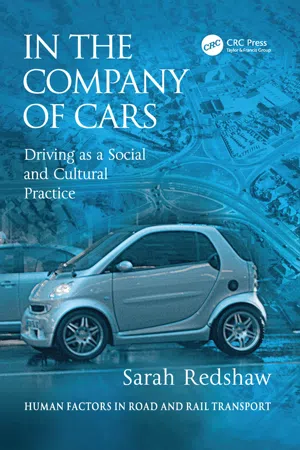
It has long been accepted that the social and cultural meanings of the car far exceed the practical need for mobility. This book marks the first attempt to contribute to road safety, considering, in depth, these meanings and the cultures of driving that are shaped by them. In the Company of Cars examines the perspectives that young people have on cars, and explores the broader social and cultural meanings of the car, the potential it is supposed to fulfil, and the anticipated benefits it offers to young drivers. From focus-group research conducted in Australia, the book takes up the views of young people on a range of topics, from media to car use to gender performance. The author looks at the ways in which driving has been defined by articulations of the car that emphasize valued features of the car-driver, such as gender, youthfulness, status, age, power, raciness, sexiness, ruggedness and competitiveness. The book takes a global perspective on mobility, considering the impact of cars and road safety policy on quality of life, and the value and significance of other modes of travel, in a range of countries.
Chapter 1
Enticing Cars and Driving Styles
The first dimension of driving as a cultural practice that will be explored in this book is the car. Particular cars have reputations for ‘demanding’ to be driven in particular ways. This is not just popular myth however. There is some substance to the idea that ‘hot cars’ demand to be driven in ways that could be described as ‘hot’. At the very least, the type of car suggests a style of driving whether that style is expressed or not. Powerful cars ‘suggest’ take-off power though this may not always be used. Young people’s comments on their driving styles in relation to different types of cars and examples of car advertising inform and illustrate this theme showing for example, that a large car with sports pack such as a Ford Falcon XR6 produces a driving style that may otherwise be alien to the person driving:
My dad has an XR6, right, and learning to drive on an XR6 was quite difficult because as soon as you hit the accelerator you’re doing 50 K’s already ... I get the worst road rage in that but I think it’s because I know that I can beat that guy who’s driving a little slow car, so why not? (Female 3, Lawson)
How cars are articulated in advertising and on the roads informs people’s relation to different car types. The Ford Falcon XR6 is built and promoted as a mean, aggressive car that has to be driven accordingly. Aggressive power and speed have been ‘baked into’ it.
The first dimension of driving as a cultural practice then is the car itself and its variations, and how articulations of particular cars contribute to the driving cultures related to them. While improvement in technologies can be achieved by focusing on the car in isolation from the driver and the road environment, there are other aspects of cars that are equally important, in particular the meanings that are ‘baked into’ cars, from the factory floor to the public roads and the owner’s garage via the framing of the car through the media. The expressions given to cars on the road are informed by these framings. The ways in which cars will be driven and by whom then, are influenced by the social framing of the particular car, and this is built into the car. Further, it will be argued in this chapter that cars embody particular cultural attitudes and thus that attitudes extend beyond individuals.
Cars and drivers are implicitly connected in important ways that will be highlighted in this chapter. The car can become something different according to who it is being driven by, even though car and driver have their own separate and particular meanings. The driver themselves can likewise become someone different depending on the car they are driving. Some will need to drive differently in order to maintain their identities, such as men in small cars who might drive more aggressively rather than according to the expectations of how one drives a small car. Women similarly might find themselves driving more aggressively in a larger, more powerful car.

Figure 1.1 Ford Falcon is a popular model in Australia and this XR6 with sports pack is attractive to young men
The conduct of cars
The relationship between cars and drivers has been theorised in a variety of ways as we saw in the previous chapter. Although in legal terms drivers have been held accountable, in the early days this was not necessarily so (Jain 2004) and drivers themselves have variously placed the blame with cars and roads. Cars are sometimes ‘blamed’ for the failings of drivers such as when speed is attributed to the car ‘just wanting to go’ and when cars just ‘run off the road’ because of their power. Sometimes control is vested with the car but ultimately it is vested in the driver. A Ferrari might be promoted as a car that demands ‘high driving skill’ (Pollard 1974, annotated illustration opposite page 25 by John Carnemolla) but it is also the type of car that offers the greatest potential for losing control as if it might be capable of overpowering the driver despite their superior driving skill. This ambiguity is a theme that runs throughout the history of the car and is perhaps one of the reasons that the future of cars is seen to rest primarily with improvements in technology such that the car more or less drives itself in order to overcome driver error and remove the temptation to take risks. The contest between driver and car highlights the ambiguity of the relationship and the ways in which cars are articulated. Exploring the articulations of cars then will involve some elucidation of the relationships between cars and drivers, which are of course many and varied.
Cars are the ultimate symbol of freedom, independence and individualism. They offer the freedom to ‘go anywhere’, whenever it suits and with whom one chooses in the privacy and comfort of a vehicle that can exploit the public roads. We are however by the same token, car dependent and addicted to what it is able to offer despite its real costs, restrictions and inconveniences. Cars are appropriated as a ‘magical object’ (Barthes 1957), fetishised and offer both visual and visceral pleasures combining ‘mechanical impersonality with everyday intimacy’ (Pickett 1998, 23). They are a form of adornment that attributes status and their ‘sculpted appearances’ are seen as objectifying sensation and desire. The ‘elemental experience of speed puts cars into a different category from other commodities’ (Pickett 1998, 23). Our relationship to cars and the sculpting of cars to suit desires also sets them apart from other objects of consumption. While they meet a fundamental need – that of mobility – cars are purported to offer much more:
Australians and New Zealanders eat, sleep, fish, hunt, cosh and make love in motorcars. They have babies in them, carry everything from live crocodiles to budgerigars in them. They have fought wars from some fairly rickety models, held concerts in them, committed murder in them, driven around seven million acre properties in them, and explored and developed both countries in them. They race each other up hills in them, around racetracks, down stairs and through places like Lake Mirrapongapongunna. And, of course, they sometimes round up sheep in cars. (Pollard, 1974, ix)
We ostensibly owe our lives, our present and the development of our countries to cars, and we are wedded to them. The range of activities they have accommodated have exceeded anything intended or dreamed of by the manufacturers and yet they are also limited and limiting. We have a very intimate relationship with cars that nevertheless allows us to overlook the shortcomings and inconveniences.
Cars are generally considered in quite separate terms from drivers in research relating to road safety. The focus is either on the psychology of individual drivers or the technology of the car and features that can increase safety. There is very little overlap between the two, and the symbolism of the car and how it is framed and articulated is given no significance in the sciences. In sociology there has been questioning of the neutrality of the car (Urry 2000) and some theorisation of the relationship between drivers and cars (Michael 1998). This relationship has seen the car considered as an extension of the human body (McLuhan 1964) or a more or less private space that is inhabited, but also as an intertwining of human and non-human, a ‘hybridisation’ (Urry 2000, Michael 2001, Hagman 2006).
The possible effects of vehicle characteristics on driver behaviour has been investigated in studies such as Horswill and Coster (2002) who found evidence for a relationship between vehicle characteristics and driver risk-taking using an observation based survey and questionnaire study. Despite more safety features in newer cars, crash rates have remained steady due to the riskier behaviour of drivers possibly compensating for the extra safety margins provided by the car (Fosser and Christiansen 1998). It has been noted also that there are different crash rates associated with different types of vehicle (Horswill and Coster 2002, 86). Horswill and Coster’s (2002) first study showed an association between higher vehicle performance and higher choice of speed that was not simply due to the capabilities of the vehicles observed. Rather, ‘drivers of higher performance vehicles chose to drive faster, even on a residential road with a low speed limit’ (89).
In order to distinguish the causal direction of the relationship, that is, whether individuals with a propensity for higher risk-taking are more likely to choose a higher performance car or whether the design of the car influences the risk-taking propensity of drivers, another study was carried out. Horswill and Coster suggested that this was important because it determined who was obliged to take responsibility for risk-taking behaviour – manufacturers would have to take into account design aspects that could be shown to influence risk-taking behaviour. Drivers were asked about their risk-taking intentions in different kinds of cars. If a higher performance vehicle resulted in drivers being more inclined to take risks than other kinds of vehicles then it would show that the vehicle type was a factor influencing risk-taking behaviour.
The results showed a bidirectional relationship, that is, those who drove faster tended to buy higher performance cars and also that higher performance vehicles caused drivers to travel faster. A further study reinforced the relationship between vehicle performance and risk-taking propensities. It showed that increased performance and safety features correlated with increased speed choice, reduced car following distances and length of gap in traffic people were prepared to pull into (Horswill and Coster 2002, 101–102).
A study of car and pickup truck drivers found that pickup truck drivers, who were primarily males aged 30–39 years and married, had a lower reported restraint use and reported more risky driving behaviour and also had more traffic citations (Anderson, Winn and Agran 1999). The authors maintained that better safety messages needed to be targeted for pickup truck drivers.
Another study of vehicle types and driver risk-taking found that the ‘higher aggressivity’ of truck based Sports Utility Vehicles 1 (SUVs) and pickups makes their combined risk higher than that of almost all other cars with the exception of sports cars (Wenzel and Ross 2005). The study was focused on vehicle design characteristics and how the technology of cars could be improved. It also took into account the possibility of driver characteristics playing a part. Wenzel and Ross analysed fatality data in order to determine the risk-to-drivers and the risk-to-others of different types of vehicles. Next to sports cars, truck based (as opposed to unibody) SUVs and pickups had a much worse combined risk than other vehicles, which the authors largely attributed to vehicle design. The crash data was cross referenced with three particular driver characteristics with strong risk associations; driver age/sex, an illegal driving measure (‘bad driver rating’) and urban/rural driving (Wenzel and Ross 2005, 490). With some vehicles it was evident that age and sex could only explain part of the differences in risk-to-drivers but when combined with illegal driving, correlations between young male drivers and vehicle types were evident. Sports cars had the highest risk factor, the highest number of young male fatalities and highest bad driver rating. Pickup drivers appeared only slightly worse than the average car driver in this analysis – much worse than minivan and large car drivers and much better than sports car drivers (Wenzel and Ross 2005, 491).
Wenzel and Ross (2005) considered factors such as the likelihood that minivans were driven as family vehicles carrying children and would therefore be driven with more care, and that safety related marketing of European cars, attracted safer drivers. SUVs on the other hand, it was noted, had not been sold as requiring the special care in driving required for trucks. The authors considered these important factors to take into account in considering the influence of driver behaviour on car risk rating based on crash data. The higher risk rating of pickup trucks was subsequently related primarily to design and being driven in rural areas and less to driver behaviour (491–492).
One other study that is of interest here because of the way the car/driver relationship was approached, is the Benfield, Szlemko and Bell (2007) study of driver and vehicle personality attributions. The study considered whether a predictive relationship could be established between characteristics attributed to the car and aggressive driving tendencies. They were surprised to find that of the 200 undergraduates who filled out the personality inventories for both themselves and their vehicles, none questioned the attribution of personality characteristics to a car.
The analysis showed that driver and vehicle personalities were distinct and not just the projection of the driver’s own personality into the vehicle. In the correlations of driver and vehicle personality with indexes of aggressive driving tendencies, some were predicted better by vehicle personality than driver personality. High extraversion, low agreeableness, low conscientiousness and lower openness were associated with more aggressive driving, and vehicle agreeableness was negatively correlated with driver anger (254).
These studies all represent attempts to consider and separate the car/driver relationship and yet none of them take into account the symbolic dimensions of the car or the connection between car and driver in any substantial way. The last study (Benfield, Szlemko and Bell 2007) allowed for a relationship between car and driver more seriously but this could only be considered as anthropormorphism, that is, attributing human qualities to an inanimate object. Cars are more than inanimate objects just as they are much more than a means of transport, and the importance of the study is that it shows that the qualities attributed to cars exceeded the driver’s own personality. The relationship between cars and drivers is more complex than that between an inanimate object and a person and cars have a ‘being’ in an important sense.
The car is of significance independent of individual users and provides a real physical presence but there is also an important interconnection between cars and drivers. Tim Dant explored the assemblage of driver-car as a form of social being that produces a range of social actions through the idea of ‘affordance’ recognising that the car shapes and is shaped by human action (2004, 61). Dant flags the difficulty of theorising the relationship between human and machine in his discussion of the notion of affordance and alternatives that draw on notions of hybridity and cyborgs. As an affordance a car gives mobility (movement) and motility (spontaneity and independence) but it also ‘enables a range of humanly embodied actions available only to the driver-car’ (74) Dant’s analysis draws on Merleau-Ponty’s phenomenology to allow a more effective encapsulation of the car-driver assemblage as an embodied experience whereby humans have adapted to the form of perceiving brought about through the car. The car is a shaping force though lacking in intentionality but it is the driver-car that as an ‘assembled social being’ with properties of both person and thing that is meaningless without both (74). This social being will be explored further through the idea of articulation to be outlined in the following however it is not so much specific perceptions brought about through the car that will be of interest here but the meanings applied to cars through its assemblage with particular humans. First I will give a brief history of the social significance of the car and then I will outline the importance of social framing through the media and gendered relations to technology.

Figure 1.2 Fear No1: a customised car type popular with young men affords an identity
A short social history of the car
The changes in culture that were wrought by and with the car are significant in establishing the enormous impact of the car and its connection to changes in the way lives were lived. While the car developed with other technologies of the home, industry and consumption – radio and television reaching into people’s homes, separation of work and home, and the growth of shopping centres – it did not merely permit or facilitate those developments but was in part responsible for them (Urry 2000, 59). In the social patterns of life that developed automobility was a key feature. ‘The car’s significance is that it reconfigures civil society involving distinct ways of dwelling, travelling and socialising in, and through, an automobilised time-space.’ (59)
Cars were originally a toy of the wealthy who enjoyed the speed and status it offered. A...
Table of contents
- Cover
- Half Title
- Title Page
- Copyright Page
- Contents
- List of Figures
- Foreword – Tim Dant
- Preface
- Acknowledgments
- Introduction Cars and their Associations
- Chapter 1 Enticing Cars and Driving Styles
- Chapter 2 Inscribing Driving: Boredom and Pleasure on the Roads
- Chapter 3 Cultured Drivers
- Chapter 4 Driven by Desire
- Chapter 5 Dilemmas of the Car
- Chapter 6 An Ethical Future of Mobility
- Bibliography
- Index
Trusted by 375,005 students
Access to over 1.5 million titles for a fair monthly price.
Study more efficiently using our study tools.
Frequently asked questions
Yes, you can cancel anytime from the Subscription tab in your account settings on the Perlego website. Your subscription will stay active until the end of your current billing period. Learn how to cancel your subscription
No, books cannot be downloaded as external files, such as PDFs, for use outside of Perlego. However, you can download books within the Perlego app for offline reading on mobile or tablet. Learn how to download books offline
Perlego offers two plans: Essential and Complete
- Essential is ideal for learners and professionals who enjoy exploring a wide range of subjects. Access the Essential Library with 800,000+ trusted titles and best-sellers across business, personal growth, and the humanities. Includes unlimited reading time and Standard Read Aloud voice.
- Complete: Perfect for advanced learners and researchers needing full, unrestricted access. Unlock 1.5M+ books across hundreds of subjects, including academic and specialized titles. The Complete Plan also includes advanced features like Premium Read Aloud and Research Assistant.
We are an online textbook subscription service, where you can get access to an entire online library for less than the price of a single book per month. With over 1.5 million books across 990+ topics, we’ve got you covered! Learn about our mission
Look out for the read-aloud symbol on your next book to see if you can listen to it. The read-aloud tool reads text aloud for you, highlighting the text as it is being read. You can pause it, speed it up and slow it down. Learn more about Read Aloud
Yes! You can use the Perlego app on both iOS and Android devices to read anytime, anywhere — even offline. Perfect for commutes or when you’re on the go.
Please note we cannot support devices running on iOS 13 and Android 7 or earlier. Learn more about using the app
Please note we cannot support devices running on iOS 13 and Android 7 or earlier. Learn more about using the app
Yes, you can access In the Company of Cars by Sarah Redshaw in PDF and/or ePUB format, as well as other popular books in Business & Transportation Industry. We have over 1.5 million books available in our catalogue for you to explore.